
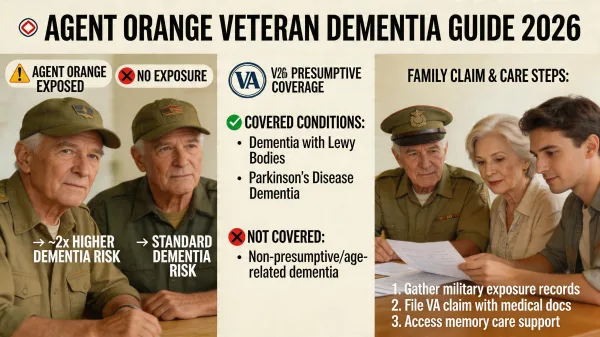
Could Agent Orange exposure half a century ago be contributing to your father's dementia? It's a question thousands of Vietnam veteran families are asking, and the honest answer is more nuanced than the VA's presumptive list suggests on a first read. Agent Orange dementia is real as a research finding, and it's partially recognized by the VA through the Parkinsonism presumption expanded in 2021. Pure Alzheimer's disease, on the other hand, isn't on the presumptive list as a standalone condition in 2026.
Here's the short version, and then we'll work through the details. If your father served in Vietnam, Thailand, Laos, Cambodia, Guam, American Samoa, Johnston Atoll, or the Korean DMZ during the qualifying windows, the VA presumes he was exposed to Agent Orange. If he later developed Parkinson's disease or Parkinsonism, which under current VA policy includes dementia with Lewy bodies and Parkinson's disease dementia, his cognitive symptoms may already qualify for presumptive service-connection. If his diagnosis is Alzheimer's or vascular dementia without a Parkinsonian component, he can still file a claim, but it will need medical nexus evidence rather than presumptive status.
I'm not from a Vietnam veteran family, and I want to be upfront about that. I spent weeks reading the VA's current presumptive rules, peer-reviewed dioxin research, and advocacy reporting to make sure this article gets the specifics right. Vietnam families have waited decades for the science and the benefits system to catch up to what they've been living with. They deserve accuracy, not hedging.
Is Dementia a Presumptive Agent Orange Condition?
Partially. Dementia itself is not listed as a standalone presumptive condition on the VA's Agent Orange list. However, some dementias are already covered under existing presumptions, and others may qualify for service-connection through secondary or direct-evidence claims. This is the most important distinction for families to understand before filing anything.
Specifically, the VA added Parkinsonism to the Agent Orange presumptive list in 2021, and that change expanded benefits to veterans with Parkinson's disease dementia, dementia with Lewy bodies, and multiple system atrophy. If your father's diagnosis falls into the Parkinsonian dementia category, he likely qualifies for presumptive service-connection without having to prove a direct link to his service. If his diagnosis is Alzheimer's disease or vascular dementia, the presumptive route doesn't apply, but that doesn't end the conversation. Research published in JAMA Neurology in 2021 found that Vietnam-era veterans with presumed Agent Orange exposure were nearly twice as likely to be diagnosed with dementia as unexposed veterans, which gives direct-evidence claims more weight than they had a decade ago.
What the VA Recognizes in 2026: Presumptive Conditions and Cognitive Decline
The VA's Agent Orange presumptive framework rests on two pieces: presumed exposure based on where and when your father served, and presumed service-connection for a defined list of conditions. If both apply, he doesn't have to prove Agent Orange caused the illness. The VA assumes it.
For exposure, the PACT Act of 2022 expanded the qualifying locations significantly. In addition to Vietnam (January 9, 1962 through May 7, 1975) and the Korean DMZ (September 1, 1967 through August 31, 1971), presumed exposure now covers any U.S. or Royal Thai military base in Thailand from January 9, 1962 through June 30, 1976, Laos from December 1, 1965 through September 30, 1969, Cambodia at Mimot or Krek from April 16 through April 30, 1969, Guam or American Samoa from January 9, 1962 through July 31, 1980, and Johnston Atoll from January 1, 1972 through September 30, 1977. Air Force personnel who regularly worked on C-123 aircraft between 1969 and 1986 also qualify. Blue Water Navy veterans who served within 12 nautical miles of Vietnam's coast are covered under the 2019 Blue Water Navy Act. These expansions matter because many veterans and their families assumed for decades that only in-country Vietnam service qualified, and that assumption kept thousands of eligible veterans from ever filing.
On the condition side, the VA now recognizes more than 50 Agent Orange presumptive diseases. The ones most relevant to dementia families are Parkinson's disease and Parkinsonism. The Parkinsonism addition in 2021 was quietly consequential for memory care because under current VA guidance, Parkinsonism covers Parkinson's disease dementia, dementia with Lewy bodies, multiple system atrophy, and related atypical Parkinsonian syndromes. A veteran whose cognitive decline is part of a Lewy body picture, or who developed dementia as part of his Parkinson's progression, may qualify presumptively even if the primary diagnosis on paper reads "dementia." That's why getting the dementia subtype clearly specified in the medical record matters so much for claims purposes, and why a generic "dementia, unspecified" diagnosis can be worth asking your father's neurologist to refine.
Pure Alzheimer's disease remains off the presumptive list, and so does vascular dementia. That doesn't mean your father can't receive service-connected benefits for those diagnoses, but the path is harder. He'd need to file a direct-evidence claim supported by a medical nexus letter from a qualified provider linking his dementia to his Agent Orange exposure. Some neurologists and VA-accredited physicians are willing to write these letters when the medical picture supports it, especially given the growing research base. Families need to document up front: the DD-214 showing service dates and locations, a current clinical dementia diagnosis with subtype specified, neurology notes or cognitive testing results, and any records of related presumptive conditions already service-connected. If your father already has a service-connected Parkinson's diagnosis, establishing dementia as secondary to that condition is often the cleanest path forward.
How Agent Orange-Related Dementia May Present
The dementia pattern in Agent Orange-exposed veterans doesn't always look like classic Alzheimer's. The overlap with Parkinsonian disease and vascular contributions shapes how symptoms appear and how care needs to be structured.
In Parkinson's disease dementia and dementia with Lewy bodies, cognitive symptoms often arrive alongside or after motor symptoms: tremor, stiffness, slowed movement, balance problems, and changes in handwriting or gait. Visual hallucinations and significant fluctuations in attention and alertness are common in Lewy body dementia specifically, sometimes more prominent than memory loss in the early stages. REM sleep behavior disorder, where the person physically acts out dreams, often predates the dementia diagnosis by years. Executive function and visual-spatial skills tend to decline earlier than short-term memory, which reverses the typical Alzheimer's pattern. Many families describe the progression as looking less like their mother's Alzheimer's and more like a parallel condition that moves differently.
Vascular contributions complicate the picture further. Many Vietnam veterans also carry service-connected or secondary diagnoses like hypertension, ischemic heart disease, and type 2 diabetes, all of which drive small-vessel disease in the brain over time. The result is often a mixed dementia with some Alzheimer's pathology, some Lewy body features, and some vascular burden layered on top. Brain imaging may show frontal and temporal lobe atrophy, a pattern documented in long-term imaging studies of Korean Vietnam veterans exposed to defoliants. That atrophy pattern differs from the hippocampal-first atrophy seen in typical Alzheimer's, and it often correlates with earlier executive function decline and personality changes rather than early memory loss.
Practical implications for families: some memory care communities are significantly better equipped to manage Parkinsonian dementia than others. Medication sensitivity is a major issue because people with Lewy body dementia can have severe, sometimes permanent reactions to certain antipsychotics routinely used in memory care settings. Fall risk is higher because of the motor component. Staff trained in dementia care without Parkinsonian experience may misread symptoms as behavioral when they're actually neurological. When you tour facilities, ask directly about their experience with Lewy body dementia and Parkinson's disease dementia specifically, not just "dementia" broadly.
What the Research Actually Says
The evidence base splits into two categories: what's solid enough to drive VA policy, and what's suggestive but still developing. Families deserve to know the difference because it shapes what's likely to happen with a claim and what ground a nexus letter can stand on.
On the solid side, Parkinson's disease and Parkinsonism are now well-established as associated with Agent Orange exposure, backed by years of National Academies of Sciences, Engineering, and Medicine reviews and codified in VA regulation. The 2021 Martinez et al. study published in JAMA Neurology, which followed 316,351 Vietnam-era veterans for up to 14 years, found that those with presumed Agent Orange exposure were nearly twice as likely to receive a dementia diagnosis (adjusted hazard ratio 1.68) and developed symptoms about 1.25 years earlier than unexposed veterans. That's a large, well-designed study drawn from VA data, and it's the most frequently cited evidence supporting direct-evidence dementia claims for conditions that aren't presumptive.
On the developing side, the mechanism by which dioxin (TCDD) contributes to Alzheimer-type pathology is still being worked out. Research suggests TCDD exposure may increase amyloid-beta accumulation, drive oxidative stress, and disrupt the blood-brain barrier. Brain imaging studies in Korean Vietnam veterans have shown accelerated atrophy in frontal and temporal regions over time. The biology is plausible and the epidemiology points in a consistent direction, but the regulatory bar for adding Alzheimer's disease to the Agent Orange presumptive list hasn't been met yet. Families should know both things are true at once: the research has strengthened considerably over the past five years, and the presumptive list hasn't caught up to it.
A Family Scenario: Working Through the Claims Path
Consider a situation where your 74-year-old father served in Vietnam in 1969 and 1970, came home, built a career, and started showing cognitive changes in his late sixties. By 72, the family noticed he was losing his balance more often, his handwriting had shrunk, and he was having vivid, disturbing dreams where he'd physically act things out. A neurologist diagnosed him with dementia with Lewy bodies at 73. He's now 74 and the family is trying to figure out how to pay for memory care that runs $9,500 per month in their area.
Under current VA rules, his Lewy body dementia likely falls under the Parkinsonism presumptive, meaning his service in Vietnam establishes presumed Agent Orange exposure, and Parkinsonism (which the VA has interpreted to include dementia with Lewy bodies) is a presumptive condition. If his claim is approved with a significant disability rating, he may qualify for monthly disability compensation, VA healthcare, and potentially Aid and Attendance through the VA pension program if the family meets the income and asset thresholds. Those benefits can materially change what the family can afford. The difference between filing a presumptive claim and trying to prove direct service-connection can be the difference between a claim that resolves in four months and one that drags on for years.
Cost Implications When Service-Connection Is Established
Memory care in 2025 runs roughly $6,500 to $11,000 per month depending on location and care level, according to the CareScout Cost of Care Survey. That's $78,000 to $132,000 per year. Most families walking into this don't have that kind of ongoing cash flow, and home equity or long-term care insurance only goes so far. For a veteran with service-connected Parkinsonism rated at 100 percent, 2026 monthly disability compensation for a single veteran is around $4,098, and it's higher with dependents. If the veteran and spouse also qualify for Aid and Attendance through the VA pension program, that can add another $1,500 to $2,700 per month depending on household structure. None of that fully covers memory care, but it can be the difference between depleting retirement assets quickly and stretching them across several years, which often determines whether the family ends up in a Medicaid spend-down situation later.
Service-connected veterans may also qualify for VA-paid care in a State Veterans Home, a VA Community Living Center, or through the Veteran-Directed Care program. Eligibility rules vary by disability rating and care setting, and wait lists in popular State Veterans Homes can stretch months or longer. This is worth a direct conversation with a Veterans Service Officer who can model what your father would actually receive given his specific service record and current diagnoses.
Why Facility Experience With Agent Orange Dementia Matters
Not all memory care communities have deep experience with Vietnam-veteran dementia specifically. Some do, particularly those near VA medical centers or in regions with large veteran populations. In my mobile X-ray work years ago, I saw real differences between facilities that understood Parkinsonian care and those that didn't. The ones that got it right had staff who knew how to time medications with meals, how to distinguish sundowning from Lewy body fluctuations, and which antipsychotics to avoid at all costs. The ones that didn't sometimes made residents worse.
When you tour, ask specifically: how many residents do you currently have with Parkinson's disease dementia or Lewy body dementia? What's your approach to medication management for Parkinsonism? Do you coordinate with neurology or movement disorder specialists? Have your staff received training on Lewy body medication sensitivities? The answers will tell you a lot about whether the facility is the right fit for a veteran with Agent Orange-related cognitive decline.
Common Questions Families Ask
Does my father need to prove Agent Orange exposure? No, not if he served in a qualifying location during a qualifying window. The VA presumes exposure based on service records alone, and his DD-214 typically does the work.
What if a previous claim was denied? If it was denied before Parkinsonism was added in 2021 or before the PACT Act expansions, it's worth filing a supplemental claim. VA policy requires review of older claims under current law, and many veterans denied years ago now qualify under the expanded rules.
Can my mother file after my father has passed? Yes. Surviving spouses may qualify for Dependency and Indemnity Compensation (DIC) if the veteran's death was related to a service-connected condition, including a presumptive one. Spouses may also qualify for survivor benefits through state veterans programs.
How long does a claim take? Presumptive claims often move faster than standard ones, sometimes 90 to 150 days, but timing varies with VA workload and the completeness of the initial filing.
Is there a cost to filing? No. Veterans Service Officers and VA-accredited representatives assist with claims at no charge. Be cautious of private firms that charge fees for what a VSO will do for free.
The Bottom Line for Vietnam Families
If your father served in Vietnam or one of the other qualifying locations and he has dementia, the VA presumptive framework may already work in his favor, especially if his diagnosis involves Parkinsonian features. The Parkinsonism expansion in 2021 and the PACT Act in 2022 meaningfully widened a door that was closed to many veterans for decades. It didn't open fully for Alzheimer's and vascular dementia, but the research is moving in that direction, and direct-evidence claims are more viable than they used to be.
What matters right now is getting your father's diagnosis clearly documented with a specific subtype, pulling together his service records, and sitting down with a Veterans Service Officer who can assess his situation against current rules. That one conversation is free, and it usually clarifies within an hour whether his case is a strong presumptive claim, a secondary claim, or a direct-evidence claim. You don't have to figure out the whole system yourself. Vietnam veterans and their families have been advocating for acknowledgment of these health consequences for fifty years, and the system is finally catching up. If you're the adult child reading this at 11 p.m. after another difficult day with your dad, you're not behind. You're exactly where most families are when they start asking these questions. Take the next step, not all of them.