
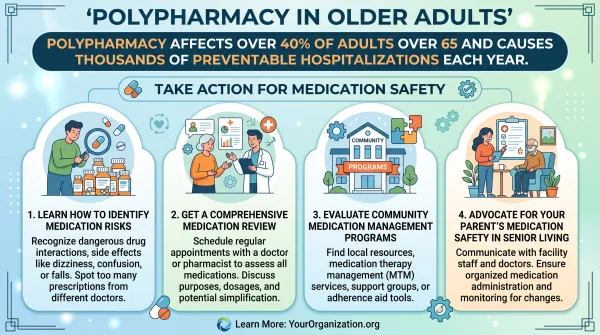
Every year, roughly 100,000 older Americans end up in the emergency room because of adverse drug events, and researchers estimate that up to half of those hospitalizations could have been prevented. That's not a number driven by exotic diseases or rare conditions. It's driven by everyday medications, taken as prescribed, piling up until the combination itself becomes dangerous. The clinical term is polypharmacy, defined as taking five or more medications at the same time, and it affects more than 40% of adults over 65 in the United States, according to data published in the journal BMC Medicine (as of 2023). For seniors in assisted living or memory care, the numbers are even higher.
I've worked in hospital settings for nearly two decades, and some of the most alarming cases I've seen involve elderly patients who arrive in the ER with symptoms everyone assumes are a new medical crisis. Dizziness, confusion, a fall that seemed to come out of nowhere. Then someone finally looks at the full medication list, and it turns out the "new problem" was the medications all along. That pattern repeats far more often than most families realize.
This article walks you through how polypharmacy threatens your parent's safety, what good medication management actually looks like in a senior living community, and the specific steps your family can take to make sure your parent's medications are working for them rather than against them. Whether you're evaluating communities for the first time, your parent is already placed, or you're managing medications at home and feeling overwhelmed by the complexity, the medication question deserves more attention than it usually gets. The good news is that polypharmacy is one of the few senior care problems where the fix is often subtracting rather than adding.
What Polypharmacy Looks Like in Real Life
Polypharmacy doesn't happen overnight. It builds gradually as your parent sees different specialists for different conditions, each one prescribing medications based on their specific area of expertise. A cardiologist adds a blood pressure pill and a blood thinner. A neurologist prescribes something for nerve pain. A primary care doctor starts a statin and a sleep aid. A urologist adds a bladder control medication. An orthopedist recommends an anti-inflammatory. Before long, your parent is taking 12, 15, or even 20 medications, and nobody has reviewed the full list as a whole.
Consider a situation where your father takes 17 medications prescribed by five different doctors. He's been increasingly confused, tired, and unsteady on his feet. The family assumes this is just aging, maybe early dementia. But a geriatric pharmacist reviews the full medication list and discovers four drugs that should have been discontinued long ago and two dangerous interactions between active prescriptions. Once those medications are adjusted, his confusion clears noticeably, his energy improves, and the "dementia" symptoms largely disappear.
That's not an unusual scenario. It's one of the most common and most solvable problems in senior care. The challenge is that nobody in the system is automatically responsible for looking at the whole picture. Each specialist manages their piece. The gaps between them are where polypharmacy grows.
A 2024 meta-analysis published in Pharmacoepidemiology and Drug Safety, covering 122 studies and over 57 million individuals, found that roughly 39% of the global elderly population is exposed to polypharmacy, and about 13% take ten or more medications simultaneously. In North America, the prevalence is even higher, estimated around 52%. These aren't patients with unusual medical histories. They're your parent's neighbors, friends, and fellow residents at the assisted living community down the street.
The financial cost adds up quickly, too. Fifteen prescriptions filled monthly means fifteen copays, fifteen potential prior authorization battles, and annual out-of-pocket costs that can reach thousands of dollars for medications your parent may not even need anymore. Families rarely question the cost of individual prescriptions, but the total burden of an unreviewed medication list can drain resources that would be better spent on care, comfort, or quality of life.
The Hidden Harm: How Too Many Medications Create Their Own Disease
The most dangerous thing about polypharmacy isn't any single medication. It's what happens when multiple drugs interact inside an aging body that processes chemicals differently than it did at 40 or 50. Kidney function slows down, the liver clears drugs less efficiently, and body composition shifts in ways that affect how long medications stay active in the system. A dose that was safe and appropriate ten years ago can become too strong without any change to the prescription, simply because the body handling it has changed. Older adults are four to seven times more likely than younger adults to experience adverse drug events that result in hospitalization, according to research published in Drug Safety.
The specific symptoms polypharmacy produces often look exactly like the conditions families are already worried about: fatigue that mimics depression, confusion that looks like dementia, appetite loss that resembles failure to thrive, and behavioral changes that get attributed to sundowning or disease progression. Falls get blamed on muscle weakness or poor balance rather than the three medications each contributing a small amount of dizziness that adds up to an unsteady gait. I've seen families accept these changes as inevitable when the real cause was reversible with a careful medication adjustment.
Anticholinergic medications, a category that includes common drugs for bladder control, allergies, sleep, and certain antidepressants, are among the worst offenders in this pattern. These drugs block acetylcholine, a brain chemical critical for memory and learning. In older adults, they can cause confusion, dry mouth, constipation, blurred vision, and increased fall risk. The 2023 American Geriatrics Society Beers Criteria, the standard reference for potentially inappropriate medications in older adults, specifically warns against the cumulative anticholinergic burden that builds when a patient takes several of these drugs at once. What's particularly troubling is how common these medications are. Diphenhydramine, the active ingredient in many over-the-counter sleep aids like Benadryl and Tylenol PM, is strongly anticholinergic. Many families don't realize their parent is taking an anticholinergic drug at all because it's sold without a prescription.
Benzodiazepines like lorazepam and diazepam, often prescribed for anxiety or sleep, carry well-documented risks of cognitive impairment, unsteady gait, and increased fall rates in seniors. Certain blood pressure medications can cause dizziness and fainting when a person stands up, leading to falls that get blamed on frailty rather than the drug itself.
Then there's the prescribing cascade, and this is where the problem compounds. Your parent takes a medication that causes a side effect. That side effect gets interpreted as a new medical condition, and a second medication is prescribed to treat it. The second medication causes its own side effect, which triggers a third prescription. A blood pressure pill causes ankle swelling, so a diuretic is added for the swelling. The diuretic then causes dizziness, and now your parent is labeled a fall risk while the original blood pressure pill is never questioned. Research published in the Canadian Medical Association Journal describes these cascades as a significant and underrecognized driver of unnecessary polypharmacy in older adults, with some cascades extending four or five medications deep before anyone traces the chain back to its starting point.
In my years working in the ER, I've seen this cascade play out dozens of times. A patient comes in after a fall, and the workup focuses on broken bones, head injuries, and whether they're safe to go home. What rarely gets the same level of scrutiny is the medication list. I've watched doctors order imaging and labs and consultations, all while the answer was right there on the intake form: fourteen medications, three of which cause dizziness, two that shouldn't be taken together, and one that should have been stopped years ago. It taught me that the most important medical intervention for many seniors isn't adding something new. It's taking a hard look at what's already there. That's why a comprehensive medication review by a geriatric pharmacist or geriatrician should be the first step before any placement decision, before any new treatment plan, and certainly before assuming that new symptoms mean a new diagnosis.
Warning Signs That Medications May Be the Problem
Families aren't expected to diagnose drug interactions. But you can learn to notice patterns that suggest medications deserve a closer look. If your parent has become noticeably more confused, drowsy, or unsteady in the weeks or months after a medication change, that timing matters. New incontinence issues, increased agitation, personality changes, unexplained weight loss, loss of appetite, and a pattern of recurring falls should all prompt the question: could this be a medication side effect?
The symptoms of polypharmacy often mimic the symptoms of aging, dementia, depression, and frailty. That overlap is exactly what makes it so easy to miss. Many adult children spend months or years attributing medication side effects to their parent's condition worsening, when the medication itself was making things worse the entire time. I've seen it in my own family, too. The tendency is to trust that every pill has a purpose because a doctor prescribed it. But prescriptions accumulate across providers and over time, and what was appropriate two years ago may not be appropriate today.
Watch for changes that coincide with medication adjustments. Keep a simple log of new symptoms and when they appeared. Note what was added, changed, or increased in the weeks before the symptom started. That information gives a pharmacist or geriatrician something concrete to work with, and it's far more useful than a general statement like "Mom hasn't been herself lately." Specifics drive better reviews, and better reviews lead to safer medication regimens.
How to Get a Comprehensive Medication Review
A medication review isn't your parent's doctor glancing at the prescription list during a 15-minute appointment. It's a structured, thorough evaluation of every medication, supplement, and over-the-counter product your parent takes, assessed against their current diagnoses, lab results, and functional status. Here's how to make it happen:
Step 1: Compile the Complete Medication List
Gather every prescription, over-the-counter medication, vitamin, and supplement your parent takes. Include the prescribing doctor for each one, the dose, and how long they've been taking it. Don't forget eye drops, inhalers, topical creams, and anything bought without a prescription. Bring the actual bottles if possible.
Step 2: Request a Geriatric Pharmacist or Geriatrician Review
Ask your parent's primary care doctor for a referral to a geriatric pharmacist or geriatrician who specializes in medication appropriateness for older adults. These specialists are trained to evaluate the full picture, not just individual prescriptions. A geriatric pharmacist will assess each medication against your parent's current conditions, cross-check for dangerous interactions, identify drugs on the Beers Criteria list that should be reconsidered, and evaluate whether doses are still appropriate given your parent's current kidney and liver function. If a referral isn't readily available, some consultant pharmacists offer private medication review services that families can arrange independently. The cost of a private review typically runs $200 to $400, which is a fraction of what a single preventable hospitalization costs.
Step 3: Ask About Every Medication's Current Purpose
For each drug on the list, ask: What is this treating? Is it still necessary? Could a lower dose work? Is there a safer alternative? Are there interactions with other medications on this list? These questions force a conversation that often doesn't happen when prescriptions are managed across multiple providers who don't communicate with each other.
Step 4: Discuss Deprescribing Options
Deprescribing is the planned, supervised process of tapering or discontinuing medications that are no longer needed, no longer appropriate, or causing more harm than benefit. It isn't about taking away your parent's treatment. It's about making sure every medication on the list is earning its place. A good geriatric pharmacist will identify candidates for deprescribing and create a plan that makes changes gradually, monitoring for any problems along the way.
Step 5: Establish Ongoing Review
One review isn't enough. Medication needs change as conditions progress, new drugs are added, and your parent's body continues to age. Ask how often reviews will happen and who is responsible for initiating them. For seniors in care communities, ask whether the facility has a system for regular pharmacist-led reviews or whether it falls entirely on the family to arrange them.
Starting the Deprescribing Conversation
Many families hesitate to bring up deprescribing because it feels like questioning the doctor's judgment. It isn't. It's asking the same question any good clinician would ask during a thorough review: is every medication on this list still necessary and still safe?
Start with your parent's primary care provider and frame the conversation around your observations. "Dad has been more confused and unsteady since his last medication change. Can we review whether any of his current medications might be contributing to these symptoms?" That approach is specific, non-confrontational, and gives the doctor a clear reason to take a fresh look. If your parent is already in a senior living community, ask whether the community's consulting pharmacist has done a recent review, and request a copy of the findings and recommendations.
Not every medication can or should be discontinued. Some are genuinely necessary and life-sustaining. Blood thinners for someone with atrial fibrillation, insulin for a diabetic, seizure medications for someone with epilepsy. The goal isn't zero prescriptions. It's the right prescriptions at the right doses for your parent's current situation, reviewed by someone who can see the full list in context.
Deprescribing works best when it happens gradually. A geriatric pharmacist or geriatrician typically identifies one or two medications to taper first, monitors for any changes over a few weeks, and then reassesses. Rushing to cut multiple medications at once can cause its own problems, including withdrawal effects and the return of symptoms that were being managed. Patience matters here. The medication list didn't grow overnight, and it shouldn't be cut overnight either.
What Good Medication Management Looks Like in Senior Living
There is an enormous difference between a senior living community that distributes medications and one that actively manages them. Both will pass out pills on schedule. Only one will regularly question whether those pills should still be on the list. Understanding this difference is one of the most important things you can do when evaluating a community for your parent.
In a community that treats medication management as a distribution task, the process looks like this: a medication cart rolls through the hallways on schedule, a staff member hands each resident their medications, the resident takes them, and it gets documented. The medications themselves are prescribed by outside physicians, filled by an outside pharmacy, and administered exactly as ordered. If a resident develops a new symptom, the community reports it to the doctor, who may order a new medication to address it. Nobody steps back to evaluate the full list. The system is designed for compliance, not optimization.
A community with a genuine clinical medication management program operates very differently. It employs or contracts with a consulting pharmacist who reviews each resident's medication regimen on a scheduled basis, not just when a problem surfaces. That pharmacist reviews the full medication list alongside current diagnoses, recent lab work, and nursing observations about the resident's functional status and behavior. They flag potentially inappropriate medications using established tools like the AGS Beers Criteria and the STOPP/START screening criteria. They communicate findings and recommendations directly to prescribers. And they follow up to see whether recommended changes were implemented.
Federal law requires monthly drug regimen reviews by a consultant pharmacist for every nursing home resident. Assisted living communities don't face the same federal mandate, and state regulations vary widely. Some states require periodic medication reviews by a licensed pharmacist. Others have minimal or no requirements at all. That means the quality of medication oversight in assisted living depends heavily on the individual community's commitment to doing it well, not on regulatory pressure forcing compliance.
The question no one thinks to ask during a community tour is this: does your community actively review whether every medication is still necessary, or do you just administer whatever the doctors prescribe? The answer reveals whether they're managing medications or just distributing them. A community that pauses before answering, or responds with a vague statement about following doctor's orders, is telling you everything you need to know about their approach.
Here are specific questions that reveal the depth of a community's medication management program. How often does your consulting pharmacist review each resident's full medication list? What happens when the pharmacist identifies a potentially inappropriate medication or a dangerous interaction? Can you give me an example of a time a pharmacist's recommendation led to a medication change for a resident? Do you track medication-related incidents like falls, confusion episodes, or ER visits, and connect them back to the drug regimen? How do you handle communication between the pharmacist, the prescribing physicians, and the family? Is deprescribing part of your medication management philosophy, or is it only initiated when a family or doctor specifically requests it?
Communities that treat medication management as a clinical program will answer these questions with specifics. They'll describe their review schedule, their communication process, their pharmacist's qualifications, and how recommendations flow to prescribers. Communities that treat it as a distribution task will talk about compliance, passing audits, and following orders. The difference matters more than almost any other factor in your parent's daily safety.
Polypharmacy and Memory Care: Why the Risk Is Higher
Residents in memory care face a compounded polypharmacy risk. They're taking medications for the dementia itself, medications for behavioral symptoms, medications for the chronic conditions that predate the dementia diagnosis, and often medications prescribed during hospital stays that were never discontinued afterward. Many memory care residents can't report side effects, can't tell staff they feel dizzy or nauseous, and can't advocate for themselves when a medication isn't working. Their behavior may change in ways that get attributed to the disease rather than to a drug reaction, and that misattribution leads to yet another prescription instead of a review of the existing ones.
When I was going through a family member's dementia journey, I was stunned by how quickly the medication list grew and how little any single provider seemed to be looking at the whole picture. Every specialist visit added something. Nobody was subtracting. The financial cost of all those prescriptions was its own shock, but the greater concern was whether every medication was truly helping or whether some were actively making things worse. That experience showed me how easy it is for families to trust the system without realizing that the system doesn't have a built-in checkpoint for the full medication picture.
If your parent is in memory care or heading there, insist on a comprehensive medication review before placement and at regular intervals afterward. Their inability to speak up for themselves makes your advocacy even more critical.
Building a Medication Safety Plan for Your Family
You don't need a medical degree to be your parent's medication advocate. You need a system. Keep a current, complete medication list that includes every prescription, over-the-counter product, and supplement. Update it after every doctor visit, hospitalization, or pharmacy change. Bring it to every appointment. Share it with every provider involved in your parent's care. A written list prevents the dangerous gaps that occur when providers assume someone else is tracking the full regimen.
Designate one family member as the medication coordinator. This person tracks changes, asks questions, and makes sure no medication gets added without someone reviewing how it fits with everything else on the list. If your parent is in a care community, this person is also the contact who follows up on pharmacist recommendations and asks for copies of review findings. Families who split this responsibility across multiple siblings often end up with no one truly owning it. Pick one person, make it official, and make sure every provider knows who to call.
If your parent sees multiple specialists, consider whether all of them need to remain involved. Sometimes a geriatrician can consolidate management of several conditions, reducing the number of prescribers and making it far easier to maintain an accurate, comprehensive medication list. Fewer prescribers means fewer opportunities for conflicting prescriptions and overlooked interactions.
Ask about every new prescription before it starts: what is it for, what are the common side effects, does it interact with anything already on the list, how long will your parent need to take it, and what would happen if it wasn't added? Those questions aren't confrontational. They're the same questions a geriatric pharmacist would ask on your parent's behalf. Having worked inside hospitals for nearly 20 years, I can tell you that the families who ask these questions get better answers and better care. Providers respond to engaged families because engagement signals that someone is paying attention.
Finally, after any hospitalization, request a full medication reconciliation before discharge. Hospital stays are one of the most common points where new medications get added and old ones get changed, sometimes without clear communication back to the primary care team. The transition from hospital to home or hospital to care community is a high-risk moment for medication errors, and your vigilance during that window can prevent problems before they start.
The Medication Conversation Your Family Needs to Have
Polypharmacy is one of the most dangerous and most solvable problems in senior care. It doesn't require a new diagnosis or an expensive intervention. It requires someone looking at the full medication list with fresh, qualified eyes and asking whether every drug is still earning its place. The answer, more often than families expect, is no.
If your parent takes more than five medications, a comprehensive review isn't optional. It's urgent. If they take more than ten, it's overdue. And if they're entering or already living in a senior community, the quality of that community's medication management program directly affects your parent's safety every single day.
You didn't cause this problem, and you can't fix it alone. But you can start the conversation, request the review, and hold the right people accountable for looking at the full picture. Start with the medication list. Ask the hard questions. Your parent's comfort, clarity, and daily quality of life may depend on the medications that get removed just as much as the ones that stay. That's a conversation worth having today, not next month.