
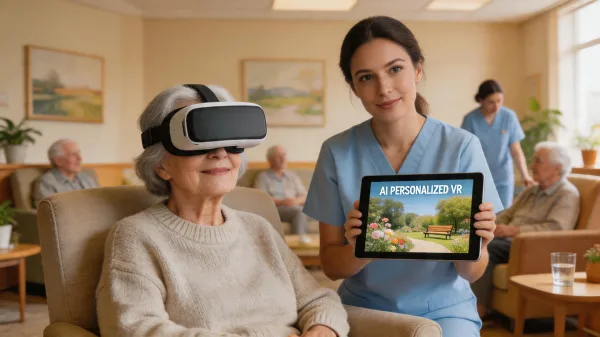
Picture this. Your 85-year-old mother has been in memory care for fourteen months with moderate Alzheimer's. She used to recognize you most days. Now she's withdrawn during the morning, restless in the late afternoon, and almost unreachable by dinnertime. The activities director mentioned at the last care conference that the community is bringing in a virtual reality program. Your sister read something online about VR helping dementia patients. You don't know what to make of it. Is it real therapy or another tour-feature dressed up as care?
As of April 2026, virtual reality combined with AI-personalized content is one of the few new therapeutic tools the dementia research community has taken seriously. Some senior living facilities have integrated it into memory care programming, family-facing versions are now sold direct to home users, and the marketing around it is louder than the evidence. But the evidence is real for specific uses.
Here's the answer in plain terms. Research suggests VR combined with AI-personalized content produces measurable improvements in agitation, mood, and engagement in specific dementia populations, particularly when used for reminiscence therapy and for pain management. Benefits are partial and patient-dependent rather than universal.
From years as a caregiver and watching a family member's dementia journey, I know how much families wish for something that actually engages a parent in later-stage dementia. VR is one of the few new tools where the research suggests that wish might be partially met.
What VR for Dementia Actually Is
VR therapy for dementia uses a head-mounted display to immerse the person with dementia in a 360-degree environment. The headset is typically a simplified version of consumer hardware, configured for short sessions and patient safety. Sessions usually run five to fifteen minutes. Trained staff or family members guide the experience and watch for adverse reactions.
The content libraries fall into a few categories. Reminiscence content takes the person back to familiar settings from their earlier life: a childhood neighborhood, a wedding venue, the place they vacationed every summer. Nature content offers calm forest walks, beaches, and mountain vistas. Creative engagement options include virtual travel, music, or guided activities. Pain and anxiety modules use guided breathing and immersive distraction during procedures or during periods of distress.
The AI layer is what's new. Older VR programs played a generic library of videos. Current platforms personalize content based on the person's history and response, learning which scenes produce calm, which produce agitation, and adjusting what they offer next. Some platforms now include AI conversational companions that ask the person about their memories, store the answers, and use them to seed future sessions.
Two companies dominate the senior care market. Rendever focuses on group VR in senior living communities and has partnered with high-profile operators, hospital systems, and research institutions. The platform's newer Nova companion captures and preserves resident memories during reminiscence sessions and feeds them back into future content. Mynd Immersive, formerly known as MyndVR, focuses on individual therapeutic VR and was selected by the Department of Veterans Affairs to roll out prescriptive VR therapies nationally. Pain-management VR programs in hospitals and hospices, often using nature scenes, are deployed through palliative care teams.
Adoption has grown faster than the average family realizes. According to a 2024 industry report from Rendever, assisted living and memory care are now the most common acuity settings for senior care VR deployment, with memory care representing roughly a quarter of installations. From mobile X-ray rounds I used to do inside care facilities, the gap between facilities investing in real therapeutic technology and those buying tour-features has always been wide. VR makes that gap easier to spot if you know what to ask.
What the VR Dementia Research Actually Shows
The most cited finding comes from a randomized controlled trial published in 2024 in the Journal of Medical Internet Research. Sixty-nine hospitalized dementia patients aged 65 and older were assigned to VR therapy or standard care. Patients in the VR arm watched 360-degree nature scenes for up to twenty minutes every one to three days. The trial found a significant reduction in aggressive or violent behavior and loud vocalizations in the VR group. It did not find significant changes in other behavioral and psychological symptoms, falls, length of stay, or quality of life.
That's a representative pattern. A 2025 systematic review and meta-analysis published in Age and Ageing pooled ten trials of VR for behavioral and psychological symptoms of dementia. The review found a meaningful reduction in depressive symptoms across studies. It found no significant reduction in agitation when results were pooled, even though several individual studies did report reduced agitation and aggression. Mixed findings appeared for anxiety. Four of the ten studies found no significant change in overall behavioral symptom scores.
The reminiscence research has produced clearer signals in specific applications. A randomized study comparing VR-panorama reminiscence therapy with conventional photo-based reminiscence in older adults with mild cognitive impairment found that both groups showed cognitive function improvement. The VR group showed higher subjective well-being and the largest gains in temporal orientation. Pain-management VR in palliative care has produced moderate to large reductions in pain intensity in pooled analyses, with longer interactive sessions producing the strongest effect.
What the research does not show is what the marketing sometimes implies. VR doesn't reverse cognitive decline, doesn't slow the progression of Alzheimer's or any other form of dementia, and doesn't treat the underlying disease. The benefits, where they appear, are short-term effects on mood, engagement, agitation, and pain perception during and shortly after sessions.
The populations where benefits appear strongest are people with moderate dementia who have retained visual processing, can tolerate a headset comfortably, and have family or staff support during sessions. The populations where caution is warranted include people in advanced dementia, where disorientation may worsen rather than ease. Lewy body dementia patients with significant visual hallucinations, people with significant motion sensitivity, and people with psychiatric comorbidities that VR could amplify also fall in the caution category.
Walking through a family member's dementia journey changed how I read studies like this. The decline came faster than any of us expected, and we spent months looking for something that gave her real engagement instead of just passive television hours. We tried music. We tried photo albums. We tried bringing the dog. Some of it landed for a few minutes, most of it didn't, and the inconsistency was its own kind of grief. None of us had heard of VR reminiscence then. If we had, I don't think it would have changed the outcome. What it might have changed is the texture of certain afternoons, when she was lucid enough to be aware of being bored and not quite present enough to do much about it. That's the honest claim the research supports, and it's the one I'd offer any family asking the same question now. Fifteen minutes of something better, on the days when fifteen minutes matters.
What a Facility's VR Program Actually Looks Like
Two facilities can both put a Rendever or Mynd Immersive sticker on their brochure and run completely different programs. The difference between a real clinical integration and a tour-feature is visible if you know what to ask. A real program has trained staff administering sessions, not a marketing coordinator pulling a headset out of a closet for visitors. Content is selected for the specific resident based on their history, preferences, and current presentation. Staff watch for adverse reactions like nausea, increased agitation, or post-session confusion, and document what they see. The community has documented therapeutic goals for VR use and tracks outcomes against those goals. A tour-feature program has none of that. The headset gets demoed during marketing tours and used for occasional group sessions where everyone watches the same video. There's no individualization, no outcome measurement, and no record of which residents respond well, which residents become disoriented, and which residents shouldn't use it at all.
The questions to ask when evaluating a memory care facility's VR program are specific and practical. How often is the program used per resident? Who administers each session? How is content selected for a specific resident? How do you measure whether VR is helping a particular resident, and what do you do if it's making things worse? Can a family member sit in on a session?
If the answers are vague, the program is probably more brochure than therapy. From the years I spent doing mobile imaging inside care facilities, the gap between what families are told during a tour and what's actually happening on a Tuesday afternoon at 3 p.m. is often enormous. VR doesn't change that pattern. It just gives you another concrete thing to verify, alongside other warning signs that a community's marketing has outpaced its actual care. A facility that takes the program seriously will be able to talk about specific residents, specific outcomes, and specific adjustments.
Home VR Use for Families
Several paths exist for families who want to try VR with a parent at home. The simplest is a consumer headset like a Meta Quest 3S, which currently retails in the $300 to $500 range, paired with free or low-cost 360-degree video apps. This setup works for some families and not others. Consumer hardware isn't designed for cognitive accessibility and the interface can confuse a person with dementia.
The senior-focused alternatives include Mynd Immersive's home subscription, which bundles a senior-configured headset with a caregiver companion tablet and a curated content library. Rendever offers family-focused experiences that integrate with the platform their parent's community might already use. Costs for senior-focused services typically combine an upfront equipment investment in the $200 to $1,500 range with a monthly subscription that varies by provider and content level. Veterans may qualify for prescriptive VR through the Department of Veterans Affairs as part of Mynd Immersive's national rollout.
Practical guidance applies regardless of which path you choose. Keep sessions short, around five to fifteen minutes. Start with familiar content, like a beach scene if your parent loved the beach, or a virtual visit to a place from their early life. Sit with them during the session and watch for confusion, fear, or agitation. Don't use VR as a substitute for family presence. Use it alongside.
The situations where home use most often helps are afternoon agitation in the period before sundowning, evening restlessness when sleep onset is delayed, and engagement during long visits to a parent in memory care when conversation has run out. From the years my husband was sick and I spent most days as his caregiver, I learned that a fifteen-minute change in someone's experience isn't trivial when their world has gotten very small. The same logic applies here. The goal isn't transformation. It's a better fifteen minutes inside a hard day.
The Honest Caveats Marketing Doesn't Mention
Not every person with dementia tolerates VR. A scoping review of palliative care VR research found that some patients with dementia experienced worsened behavioral and psychological symptoms and increased pain scores after VR sessions. Headsets can feel disorienting, and the immersive sensation that calms one person can frighten another. People with significant visual processing deficits, people prone to motion sickness, and people in advanced dementia stages are the most likely to react poorly.
The benefits that do appear are usually short-term. The reduction in agitation, the lift in mood, the moment of engagement during a reminiscence scene: those effects typically don't persist long beyond the session. VR doesn't bank cognitive function for later use. Each session is its own brief intervention.
VR also doesn't slow disease progression. It isn't a treatment for the underlying dementia. Marketing that frames VR as memory therapy in any sense that implies cognitive recovery is overstating what the evidence supports. The Alzheimer's Foundation of America explicitly does not recommend its own dementia simulation experience for individuals living with dementia, which gives a sense of how careful matching content to a specific person needs to be.
For advanced dementia, VR may not be appropriate at all. The research populations where benefits are strongest are people in mild to moderate stages who can verbally engage with content and have family or staff support. Late-stage dementia patients who can't follow what's happening in a virtual scene are unlikely to benefit and may experience increased confusion. The honest claim about VR for dementia is narrower than the marketing usually allows. Real benefits, in specific populations, for specific purposes, lasting for the duration of the session and shortly after. Not nothing. Not everything either.
Where This Leaves a Family
VR isn't the breakthrough some marketing implies, and it isn't the gimmick some skeptics dismiss. It's a real therapeutic tool with a real, narrow evidence base for specific applications in specific dementia populations. For a parent in moderate-stage Alzheimer's who has retained enough visual processing to engage with a screen and enough verbal ability to talk about what they're seeing, VR reminiscence and nature content can produce calmer afternoons, lifted moods, and shared moments with family that wouldn't have happened otherwise. For a parent in advanced dementia, it may not be appropriate at all.
If your parent is in memory care, ask the community how they use VR and whether they track outcomes for individual residents. If you're considering home use, start with short sessions, familiar content, and your full attention during the experience. The point isn't to bring back what dementia has taken. It's to make a specific window of a specific day better. That's a smaller claim than the marketing makes. It's also the claim the research supports.