
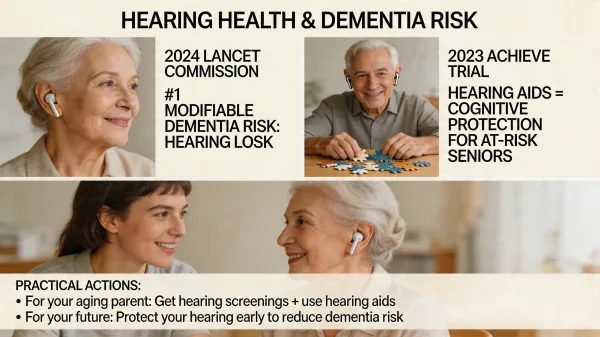
As of April 2026, the strongest evidence-based answer to "what can my family actually do to reduce dementia risk" doesn't involve a supplement, a brain game, or a fancy diet. It involves a hearing test. The 2024 Lancet Commission on dementia prevention, the most cited synthesis of dementia risk research in the world, identifies hearing loss as the single largest modifiable risk factor for dementia, accounting for roughly 7% of cases globally. That's larger than smoking. Larger than physical inactivity. Larger than depression. And it's the one most families have never been told to take seriously.
If you've been worried that your aging parent is "slowing down," pulling back from family conversations, or seeming distant at gatherings, hearing loss may be a bigger part of the picture than you realize. Untreated hearing loss can both mask cognitive decline and accelerate it, and the two get tangled together in ways that even primary care visits routinely miss. In ER settings especially, I've watched elderly patients be treated as confused when they were actually just not hearing what staff said. The same thing happens at home, in families, over years.
This piece walks through what the Lancet Commission actually found, what the 2023 ACHIEVE trial showed about hearing aids and cognitive protection, why most families miss the connection until late, and what to do about it for both your parent and yourself. The evidence is unusually strong for a prevention claim, and the action is unusually accessible.
What the Lancet 2024 Commission Actually Found
The Lancet Commission on dementia prevention, intervention, and care has been the gold-standard synthesis of modifiable dementia risk since its first report in 2017. The 2024 update identifies 14 modifiable risk factors that, taken together, account for roughly 45% of dementia cases worldwide. Hearing loss sits at the top of that list. Mid-life hearing loss alone is estimated to account for about 7% of dementia cases globally, more than any other single modifiable factor in the analysis.
The mechanism isn't mysterious, and it's well-supported by independent research, particularly the work of Frank Lin and colleagues at Johns Hopkins. Three pathways appear to contribute. First, cognitive load: when the brain has to work harder to interpret degraded sound, it pulls resources away from memory and other cognitive processes. Second, social withdrawal: people who can't follow conversations stop showing up for them, and isolation is itself an independent dementia risk factor. Third, reduced auditory input: long-term loss of sound stimulation appears to shrink the brain regions that process it, with knock-on effects on neighboring cognitive areas.
What makes the hearing loss finding stand out among the 14 risk factors is that it's both highly prevalent and highly correctable. Roughly two-thirds of adults over 70 have measurable hearing loss. Most don't know it, or do know it and haven't acted on it. That combination of scale and treatability is what gives hearing loss its outsized population impact in the modeling. It's not that hearing loss is uniquely toxic to the brain. It's that it's the most common dementia risk factor that families can actually fix.
Independent confirmatory research has reinforced this picture. Long-running cohort studies including the Atherosclerosis Risk in Communities (ARIC) study and the Health, Aging and Body Composition study have documented faster cognitive decline and higher dementia rates in adults with untreated hearing loss, even after controlling for age, education, cardiovascular risk, and other confounders. The signal is consistent. That doesn't make causation airtight, and we'll come back to that nuance, but the pattern is consistent enough that the Commission ranked it where it did.
The ACHIEVE Trial and What It Showed About Hearing Aids
The most important randomized trial on this question is ACHIEVE, the Aging and Cognitive Health Evaluation in Elders study, published in The Lancet in July 2023. ACHIEVE enrolled roughly 3,000 adults aged 70 to 84 with untreated hearing loss and randomized them to either a comprehensive hearing intervention (audiologist-fit hearing aids plus counseling) or a healthy aging control. The participants were followed for three years, and the primary outcome was rate of cognitive decline.
The headline finding was nuanced in a way that matters. In the overall trial population, the hearing intervention didn't significantly slow cognitive decline. But the trial had two cohorts: participants drawn from the long-running ARIC study, who were older and had more cardiovascular risk factors, and a de novo cohort of healthier community volunteers. In the higher-risk ARIC cohort, the hearing intervention slowed cognitive decline by approximately 48% over three years compared to the control group. In the healthier de novo cohort, the effect was neutral.
The practical interpretation is important. Hearing aids appear to provide significant cognitive protection for the seniors most at risk for cognitive decline, the people with cardiovascular comorbidities, family history of dementia, or already-emerging early symptoms. For healthy elderly adults at low baseline risk, the cognitive benefit may be smaller or longer to materialize. This isn't a finding that argues against hearing aids generally. Better hearing has its own quality-of-life value regardless of cognitive impact. It's a finding about where the brain protection signal is strongest.
I'll be direct about why this section matters to me. When my own family member's dementia accelerated, the speed of the decline caught us all off guard, and like most families we spent the early months looking for explanations and interventions. Hearing wasn't on the radar at all, and no one in the medical chain raised it. Looking back at twenty years of hospital work, I can count the number of times I saw an elderly patient's hearing seriously addressed during a cognitive workup on one hand. The system isn't built to catch this. ER physicians are looking for stroke, infection, medication interaction. Primary care visits are rushed. Audiology is a separate referral most patients never get. ACHIEVE is the strongest evidence we have that intervening early in the right population genuinely changes the cognitive trajectory, and it isn't reaching the families who would benefit most from knowing.
One more practical point about ACHIEVE: adherence in the intervention arm was high, around 80% device wear, supported by structured audiologist follow-up. That matters because real-world hearing aid abandonment rates are notoriously high. The cognitive benefit observed in the trial is the benefit of hearing aids that actually get worn, not hearing aids that sit in a nightstand drawer.
Why Most Families Miss the Hearing Loss Connection
Hearing loss is one of the slowest-onset chronic conditions in medicine. The decline typically happens over years or decades, and the brain compensates so smoothly that the person experiencing the loss often doesn't notice. They turn the TV up a notch. They start asking people to repeat themselves once or twice per conversation. They sit closer to the head of the table at family dinners. None of these feel like medical events. They feel like normal aging.
Families almost universally interpret the early signs wrong. When a parent stops engaging at gatherings, the family reads it as withdrawal, depression, or early cognitive decline. When the parent mishears a question and answers something slightly off-topic, the family reads it as confusion. When the parent prefers staying home over going out, the family reads it as personality change. The hearing piece is invisible because the parent themselves doesn't flag it, and because no one else in the family is in a position to test it.
The stigma around hearing aids compounds the problem. Hearing aids still carry an "old person" association that glasses shed decades ago, and many seniors actively resist them even after a clear diagnosis. Cost was a substantial barrier until the FDA's 2022 ruling on over-the-counter hearing aids, when prescription devices routinely ran $4,000 to $7,000 per pair, often uncovered by Medicare. That barrier has dropped significantly, but the stigma hasn't, and many families still encounter strong parental resistance.
Primary care isn't catching this either. Standard Medicare wellness visits don't include audiometric screening. Most primary care physicians don't have audiometers in their offices, and even when they suspect hearing loss they refer to audiology rather than testing in-house. The referral often doesn't happen, or doesn't get followed up on, or hits an out-of-pocket cost barrier. In years of mobile X-ray work inside care facilities, I rarely saw a resident's hearing being actively managed, even when the chart noted significant loss. Years of untreated loss accumulate while the family wonders why Mom or Dad seems slower than they used to. The chain of inaction is long, and every link in it is plausible.
What a Family Should Actually Do
For an aging parent, the path is concrete. Start with a comprehensive audiology evaluation, which typically runs $75 to $200 and may be covered by some Medicare Advantage plans or Veterans Affairs benefits. The evaluation produces an audiogram showing the degree and pattern of loss across frequencies, and an audiologist's recommendation about whether prescription or OTC devices are appropriate. For moderate-to-severe loss, professional fitting of prescription hearing aids remains the standard of care, with prices typically running $2,000 to $7,000 per pair depending on technology level, with significant variation. For mild-to-moderate loss, the FDA's October 2022 ruling opened the OTC market, and competent OTC devices now run roughly $200 to $1,500. Some are surprisingly good; some aren't. An audiologist can help screen options.
Adherence matters more than technology. A $300 OTC hearing aid that gets worn ten hours a day is delivering more cognitive and social benefit than a $5,000 prescription pair that sits in a drawer because it whistles or feels uncomfortable. I've seen the drawer outcome more often than I can count, both with patients in the hospital and with relatives in my own life. If your parent gets fit and then stops wearing them, the answer isn't "they don't work for me." The answer is going back to the audiologist for adjustments. Real fitting is iterative, and the first month is the hardest.
A practical conversation framing helps with parental resistance. Most seniors who resist hearing aids are responding to outdated mental images and to the discomfort of acknowledging an aging-related decline. Leading with the cognitive evidence, "the research now shows hearing affects brain health long-term," lands very differently than "Mom, you can't hear, you need hearing aids." The dementia angle is what moves the needle for many families. It reframes hearing aids from a vanity concession to a brain health intervention.
For yourself as the reader, the implications are also concrete. Baseline hearing testing starting around age 55 is reasonable, especially if you have a family history of dementia, cardiovascular risk factors, or significant noise exposure history. Protect your hearing now: occupational noise, concerts, power tools, headphones at high volume all accumulate damage that doesn't show up for decades. If you're already noticing difficulty in restaurants or with TV volume, get tested. The prevention value of catching loss early appears to be substantial, and the intervention is among the lowest-risk in medicine. For more on cognitive change patterns and what to watch for in aging parents, see our pieces on early signs of dementia and distinguishing dementia from normal aging.
The Honest Caveats
The hearing-dementia connection isn't a closed case, and intellectual honesty matters here. The strongest evidence is observational, and observational studies can't fully rule out reverse causation (early cognitive decline making hearing seem worse) or selection effects (healthier, more engaged seniors are more likely to seek hearing care, and would have aged better anyway). The Lancet Commission's population attributable fractions are model-based estimates, not direct measurements, and they assume causation that observational data can't fully confirm.
ACHIEVE provides the strongest causal evidence we have, but the cognitive benefit was specific to the higher-risk ARIC cohort. We don't yet have randomized evidence that hearing aids meaningfully protect cognition in healthy elderly adults. That gap doesn't mean the intervention is worthless for that group. It means the cognitive case is strongest for at-risk seniors and weaker for everyone else. Hearing aids alone won't prevent all dementia, and they won't reverse existing dementia.
That said, the intervention has an unusually favorable risk-benefit profile. Hearing aids carry almost no medical risk. They improve quality of life and social connection regardless of any cognitive effect. The downside of getting hearing addressed is small, and the potential upside, both quality-of-life and cognitive, is large enough that the calculus is clearly favorable for most older adults with measurable loss.
At the Intersection of Hearing Loss and Early Cognitive Concerns
When a parent shows both hearing loss and early cognitive symptoms, addressing the hearing first is almost always the right sequencing. I've watched families spend months chasing memory clinic referrals when an audiology visit would have answered half the question on its own. Hearing correction can clarify what's actually happening cognitively in a way that no other intervention can. Some of what looked like memory problems was actually missed information that never got encoded properly. Some of what looked like confusion was inability to follow conversations in noisy environments. Some of what looked like withdrawal was effortful listening fatigue. None of that is the same thing as dementia, and treating hearing first separates the signals.
What's left after hearing is corrected becomes much easier to evaluate. If real cognitive decline is present, it's now visible without the hearing-loss noise overlaid on top. A neurology or memory clinic referral can do its job. If decline isn't present, the family has its parent back in the conversation. Either way, the path forward is clearer than it was. Start here.
Where This Leaves Your Family
Of all the dementia prevention conversations a family can have, this is the one with the strongest evidence behind it and the lowest cost of acting on it. Hearing loss is the single largest modifiable dementia risk factor in the published evidence, the ACHIEVE trial showed real cognitive protection in at-risk seniors, and the 2022 FDA OTC ruling has dropped the cost barrier substantially. Most families haven't been told any of this, and most primary care visits won't surface it.
If your parent hasn't had a hearing test in five or more years, that's the first call to make. If you're over 55 and have noticed your own hearing slipping, that's the second. The decision isn't complicated. The evidence is clearer here than in almost any other prevention conversation, and the action is among the most accessible in senior health. For families already working through uncertainty about a parent's cognitive trajectory, this is the place to start.