
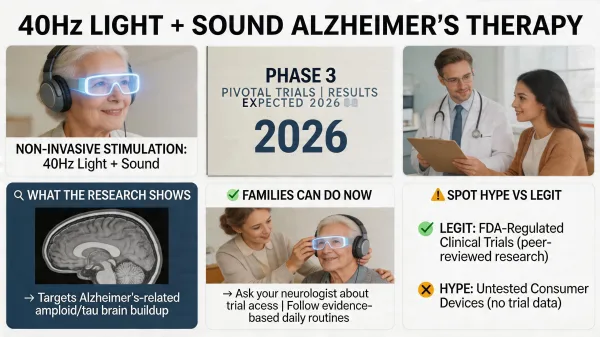
40Hz light and sound therapy is an experimental Alzheimer's treatment that uses synchronized light flashes and audio clicks at 40 hertz to stimulate gamma brain wave activity. The approach started in MIT mouse studies and is now being tested in a pivotal Phase 3 trial called HOPE through Cognito Therapeutics, with results expected around August 2026. The device is non-invasive and used at home.
As a radiologic technologist, I've worked with medical devices my whole career. Most of them are boring in the best way: standard, FDA-cleared, predictable. Some of them are weird in a promising way. A headset that flashes light and plays sound at exactly 40 hertz to slow Alzheimer's disease is the second kind, and the research behind it is stronger than the description suggests.
As of April 2026, this treatment isn't FDA-cleared. It can't be prescribed. You can't buy a real version of it on Amazon, no matter what the listings say. But the science behind 40Hz light therapy for Alzheimer's has nearly a decade of MIT-led research behind it, multiple independent replications, and a pivotal trial that just finished enrolling 670 patients. Families researching options for a parent with mild Alzheimer's are starting to hear about it. Most don't know what to make of it.
Here's what the science actually shows, where it stands today, and what families can and can't do with this information right now.
What 40Hz Gamma Stimulation Actually Is and Where It Came From
The story starts in 2016 at MIT's Picower Institute for Learning and Memory, in the lab of Dr. Li-Huei Tsai. Tsai's team published a paper in Nature showing that mice with Alzheimer's-like brain pathology had less amyloid buildup in their visual cortex after exposure to flickering LED light at 40 hertz, one hour daily for one week. That was it. Just light, flashing 40 times per second.
The finding was strange enough that it took years for the broader research community to take it seriously. Tsai and her collaborators, including MIT colleagues Edward Boyden and Emery Brown, kept building. By 2019, they'd published two more papers showing that 40Hz sound stimulation worked similarly, that combined light and sound reached deeper brain regions like the hippocampus, and that long-term exposure protected against neurodegeneration in mice. By 2023, they'd shown that 40Hz vibrotactile stimulation also reduced Alzheimer's pathology. The technique got a name: GENUS, for Gamma Entrainment Using Sensory Stimulation.
Working in radiology, I've seen plenty of strange-looking technology turn out to be exactly the breakthrough it claimed to be, and plenty more turn out to be nothing. The pattern that separates them is usually the depth of basic-science work that came before the marketing.
The mouse studies are striking when you look at them in aggregate. 40Hz stimulation reduced amyloid-beta plaques and phosphorylated tau, the two proteins most closely linked to Alzheimer's pathology. It preserved synapses and prevented neuron death. Mice that received GENUS performed better on memory tests than untreated controls. The effect held across multiple Alzheimer's mouse models.
The mechanism question took longer to crack. In a 2024 Nature paper, Tsai's lab reported that 40Hz audio and visual stimulation prompted interneurons expressing vasoactive intestinal peptide (VIP) to release more of that peptide, which drove the brain's glymphatic clearance system to flush amyloid from brain tissue. That's a real proposed mechanism, with cellular and molecular detail behind it. That isn't "vibes." Other groups have since identified additional responses across microglia, astrocytes, and cerebral blood vessels.
Independent labs have replicated and extended the work. A Chinese research team corroborated amyloid-clearance findings in 2024. Researchers at Aarhus University Hospital in Denmark, Stanford, Harvard, and other institutions have run their own 40Hz trials. Not every replication has been clean. A 2025 review noted that some studies found limited propagation of 40Hz entrainment beyond primary sensory cortices, and a few teams have questioned whether real gamma oscillations are being entrained at all in human subjects. That's healthy science: a decade of work, mostly converging, with a few disputes still active.
The Human Trial Evidence Published So Far
Mouse data is interesting. Human data is what matters. So what does the human evidence look like?
The early MIT human work was a Phase 1 and Phase 2A program testing whether 40Hz GENUS was safe and whether it reliably entrained gamma oscillations in human brains (confirmed via EEG). Those studies, even with small samples and a trial cut short by COVID, showed that participants tolerated the daily one-hour stimulation well, and that early markers of brain volume preservation looked promising at three months.
The most clinically interesting human data was published in October 2025 in the journal Alzheimer's & Dementia. Five MIT volunteers from the original mild Alzheimer's trial continued using their 40Hz light and sound devices on an open-label basis for around two years. Researchers brought them back at the 30-month mark for a battery of tests. Among the three women with late-onset Alzheimer's, several cognitive measures were significantly higher than what comparable patients showed in national database comparators (the National Alzheimer's Coordinating Center being the primary benchmark). Two of those three donated plasma samples that showed declines in phosphorylated tau 217 of 47% and 19.4%, a biomarker the FDA recently approved as the first plasma-based diagnostic test for Alzheimer's. The two men with early-onset Alzheimer's didn't show those benefits.
As someone who has worked around hospital medical devices for nearly two decades, I've watched a lot of investigational technology find its way (or fail to find its way) to the clinical floor. Most of what looks promising in early-stage trials doesn't make it. The ones that do tend to share a few traits: a clean preclinical mechanism, reproducible results across independent groups, and researchers who publish the failures alongside the wins. When I read this MIT extension study and see three out of five participants benefit while two don't, with researchers reporting the split openly and offering hypotheses about why (sex, age of onset, disease subtype), that reads as real science to me, not as marketing. It doesn't mean Phase 3 will win. It does mean I'd take a neurologist seriously who suggested asking about trial participation while we wait for the readout.
The Phase 3 trial, called HOPE, is the one that matters for FDA clearance. Cognito Therapeutics, an MIT spinoff, fully enrolled 670 participants by July 2025 across 70 U.S. clinical sites. The trial is randomized, double-blind, and sham-controlled. The intervention is one hour of daily home-based 40Hz light and sound stimulation for 12 months, followed by a 12-month open-label extension. The primary endpoint is a composite of two well-established Alzheimer's measures: ADCS-ADL (activities of daily living) and MMSE (cognitive function). HOPE is the largest medical device pivotal trial in Alzheimer's disease history. The data readout is expected around August 2026.
Why Most Consumer 40Hz Products Aren't the Trial Device
This is where families get burned. There's a real device in Phase 3 trials with a decade of MIT research behind it. There's also a flood of "40Hz" consumer products on Amazon, social media, and direct-to-consumer websites: none are the Cognito device, none are clinically validated for Alzheimer's, and many are sold by companies that wouldn't survive a careful look at their substantiation.
From my mobile X-ray work, I've spent a lot of time inside care facilities where families were sold one thing and given another. The same pattern shows up in unvalidated supplement and device marketing aimed at desperate families.
The Cognito Therapeutics device, branded Spectris AD (and referred to as CogTx-001 in earlier studies), isn't available for purchase. It's an investigational device. Patients receive it through participation in the HOPE trial, where it was provided at no cost along with research participation compensation at most sites. The dosing matters: one hour daily, EEG-confirmed gamma entrainment, intensity calibrated for each individual at enrollment, sham-controlled comparison. None of those elements are matched by consumer 40Hz lamps or apps.
The FTC has spent years pursuing companies that market unsubstantiated cognitive-improvement and Alzheimer's products. Lumosity paid $2 million to settle charges over claims its games could prevent dementia. The agency has sent dozens of joint warning letters with the FDA over Alzheimer's-related health claims and pursued refund cases against supplement companies that promised to protect against memory loss. A consumer 40Hz light strip with no clinical study behind it falls squarely into the category the FTC is paid to prosecute.
If your parent's neurologist suggests trying a consumer 40Hz device on the theory that it can't hurt, that's a different conversation. As a possible Alzheimer's treatment though, the only validated work is happening through Cognito's clinical program.
What a Family Can and Can't Do With This Right Now
Here's the practical breakdown for a family considering 40Hz light therapy for a parent with mild Alzheimer's or mild cognitive impairment.
What you can do
Ask your parent's neurologist about the HOPE study or any open trials at academic medical centers using 40Hz GENUS. While HOPE stopped enrolling in mid-2025, related trials at MIT and elsewhere are still recruiting, including a study of gamma stimulation as a dementia preventative in cognitively normal at-risk adults. ClinicalTrials.gov lists active studies. Entering "40 Hz" or "gamma sensory stimulation" returns the current list.
If your parent is already on lecanemab (Leqembi) or donanemab (Kisunla), 40Hz stimulation isn't a competing treatment. It's mechanistically different and could plausibly be combined with disease-modifying drugs once cleared. That's a question for the neurologist, not something to decide in isolation.
What you shouldn't do
Don't buy a consumer 40Hz device on the expectation that it will deliver clinical benefit. Most aren't validated, none are FDA-cleared for Alzheimer's, and the dosing parameters likely don't match the clinical protocol. The risk isn't that the light or sound will hurt your parent. The risk is that you'll spend money on a placebo while feeling like you're doing something, and that you'll potentially delay other interventions that have actual evidence behind them.
In my own family's experience with a relative's dementia, I learned how hard it is not to grasp at any intervention that sounds promising. The instinct to do something is overwhelming, especially when the official options feel limited.
Don't expect 40Hz therapy to reverse existing damage. Even in the best clinical scenarios, the proposed effect is to slow progression, not to restore lost function.
What HOPE's Outcome Will Actually Mean for Families
The HOPE trial readout is the inflection point. There are three scenarios.
If HOPE hits its primary endpoint: Cognito will likely pursue FDA clearance, and Spectris would become the first non-invasive medical device approved as a disease-modifying Alzheimer's therapy. It would be home-based, drug-free, and compatible with existing treatments like lecanemab and donanemab. Insurance coverage would take time to sort out. Expect a multi-year ramp before it's broadly available, with academic medical centers and specialty memory clinics serving as early prescribing sites.
If HOPE misses but shows partial benefit: The most likely scenario based on the open-label data is that the therapy works for some Alzheimer's subtypes but not others. The 2025 extension study hinted at a possible split between late-onset and early-onset Alzheimer's, and possibly between female and male patients, though the sample is too small to draw firm conclusions. A partial result could lead to a follow-up trial in a more carefully selected population, or a narrower FDA indication.
If HOPE clearly fails: The therapy doesn't go away entirely. Mouse data and mechanistic findings are strong enough that academic research will continue. Cognito would likely pivot, and the field would have to absorb that at-home gamma stimulation, while interesting, isn't ready to be the disease-modifying breakthrough that was hoped for.
Either way, families won't have to wait long. The data is expected around August 2026.
What This Means If You're Watching a Parent Decline Right Now
Alzheimer's research moves slower than families need it to. The gap between "this is interesting in mice" and "your parent can use this at home" is usually fifteen to twenty years, and a lot of promising candidates die in that gap. From inside hospitals, I've watched the FDA-clearance process play out for plenty of devices. Even when a trial succeeds, there's still a multi-year stretch between readout and routine clinical availability.
What's encouraging is that this is one of the few non-pharmaceutical Alzheimer's interventions with a serious evidence base, an active pivotal trial, and a clear timeline to a regulatory decision. It doesn't replace the work families are already doing: neurologist visits, medication management, conversations about memory care, financial planning. It might, if it succeeds, become a useful piece of an integrated treatment approach that didn't exist three years ago.
For now, the right move is to keep your parent's neurologist informed about your interest, ignore the consumer device noise, and watch for the HOPE readout next summer. The science is real. The timing of when it'll matter is what we're waiting on.