
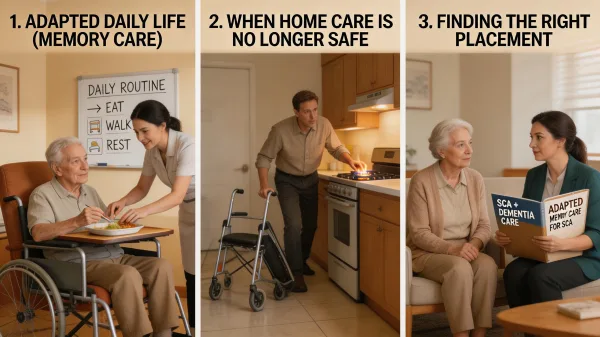
For years, your parent managed. They gripped the grab bar before standing. They placed each foot with care. They knew exactly which floorboards creaked, which doorway was narrow, which rug could slide. Spinocerebellar ataxia had taken their balance, their smooth gait, their steady hands, but they had learned to work around it. Then something shifted. One morning, your parent stood up from the couch without reaching for the grab bar at all. Not because they were feeling stronger, but because they forgot it was there. Two falls in a week became three falls in two weeks, and the pattern stopped looking like a coordination problem and started looking like something else entirely.
This is the moment that changes everything for SCA families. Cognitive decline doesn't just add another item to the list of symptoms. It strips away the very strategies your parent developed to stay safe despite their physical limitations. The walker they relied on sits untouched by the door. The careful routine they built over years starts breaking apart, and the falls that follow aren't from ataxia alone. They're from ataxia without a safety net.
Spinocerebellar ataxia memory care is still an unfamiliar concept to many families, and even to some care providers. Most memory care communities are designed around Alzheimer's, where residents can walk but can't remember. SCA families face the opposite problem, and often both at once. This article explains what happens when cognitive decline layers onto a progressive movement disorder, why the combination creates a level of risk that's difficult to manage at home, and how to find a care setting equipped for both.
Understanding Spinocerebellar Ataxia and Memory Care Needs
Spinocerebellar ataxia is a group of inherited, progressive neurological disorders that primarily affect the cerebellum, the part of the brain responsible for coordinating movement. People with SCA gradually lose control of balance, walking, hand coordination, and speech. More than 40 genetic subtypes have been identified, and the global prevalence is estimated at 1 to 5 per 100,000 people, with roughly 150,000 people diagnosed in the United States at any given time (StatPearls/NCBI, updated 2023).
What many families don't expect is the cognitive component. Research published in the journal Orphanet Journal of Rare Diseases has shown that cognitive decline is a distinct feature across several SCA subtypes, not just a side effect of aging. SCA types 2, 3, and 17 are most commonly associated with cognitive changes, including slowed processing speed, poor memory retrieval, reduced mental flexibility, and in some cases, progressing to dementia. The cognitive changes often correlate with the severity of physical symptoms, meaning that as coordination worsens, thinking and judgment may decline in parallel.
When Ataxia Meets Dementia: The Compounding Care Challenge
This is where SCA care becomes fundamentally different from caring for someone with ataxia alone or dementia alone. Each condition is manageable with the right support. Together, they create a compounding effect that families and even some care professionals underestimate until a crisis forces the issue.
A person living with SCA for years has typically built an entire architecture of compensation. They know to lock the wheelchair brakes before transferring. They use weighted utensils to manage hand tremors during meals. They pause at doorways, grip railings, and move slowly and deliberately. These aren't instincts. They're learned behaviors, practiced hundreds of times until they become automatic. Cognitive decline erases that learning. Your parent may reach for a glass with the same unsteady hand they've always had, but now they misjudge the distance, knock it over, and try to catch it with a lunge that sends them off balance. The physical limitation hasn't changed. What changed is the judgment that used to prevent the fall.
I watched this kind of unraveling during the years I spent as my husband's primary caregiver through his illness. Abilities don't disappear all at once. They leave in pieces, and each loss exposes the next vulnerability. One week it's forgetting a step in a routine they've done a thousand times. The next week it's something bigger. Families grieve these losses in installments, and the grief is complicated because the person is still right there in front of you, still themselves in so many ways, just less able to protect themselves from their own body. That experience taught me something I carry into every article I write about progressive disease: the hardest part isn't the diagnosis. It's the slow accumulation of moments where you realize your loved one can no longer do something they could do last month.
Adapted mobility support becomes critical in this stage. Standard fall prevention strategies assume the person will remember to use their assistive devices. With cognitive decline in the picture, staff need to provide hands-on guidance during every transfer, every walk to the dining room, every trip to the bathroom. Bed alarms and motion sensors help, but they're reactive tools. Proactive support means a care team that anticipates the gap between what the resident's body can do and what their brain remembers to do.
Mealtime modifications are another area where the combination of ataxia and dementia creates layered challenges. SCA often causes dysphagia (difficulty swallowing), and research published in PMC has documented that swallowing problems become moderate to severe in many patients after 10 to 15 years of disease progression. A person with ataxia alone might learn to eat slowly, use adaptive utensils, and avoid thin liquids. A person with ataxia and cognitive decline might forget to chew thoroughly, eat too quickly, or refuse thickened liquids because they don't understand why the texture has changed. They may try to eat foods they can no longer safely swallow, or pocket food in their cheeks without realizing it. Care staff trained in both movement disorders and dementia can recognize when a resident is struggling and intervene before choking or aspiration becomes a medical emergency. Mealtime supervision for SCA residents isn't optional. It's a safety requirement.
The risk equation is simple. Ataxia creates physical danger. Dementia removes the person's ability to manage that danger. Together, they produce a care scenario that requires constant, skilled, anticipatory support.
What Spinocerebellar Ataxia Memory Care Looks Like Day to Day
Daily life for a resident with SCA in memory care is built around structured routines, physical assistance, and cognitive engagement adapted to their abilities. Mornings typically involve staff helping with transfers from bed to wheelchair, assistance with bathing and dressing, and guided movement to the dining area. Meals are served with adaptive equipment: non-slip mats under plates, weighted cups, utensils with built-up handles for easier gripping. Staff monitor eating pace and swallowing closely.
Activities look different for SCA residents than for those with Alzheimer's or other forms of dementia alone. Music programs, visual art with adapted tools, and sensory activities work well because they don't rely on fine motor precision or steady hands. Physical therapy sessions focus on maintaining whatever mobility remains and preventing contractures. Speech therapy may also play a role, since SCA frequently causes dysarthria (slurred or slow speech), and cognitive decline can make communication even harder. The goal isn't recovery. It's preserving function for as long as possible and keeping the person comfortable, engaged, and safe.
Having spent nearly 20 years working in hospitals, I've seen how much of a difference it makes when a care team actually understands the condition they're treating versus when they're guessing. For SCA residents, that means staff who know the difference between a fall caused by poor balance and a fall caused by confusion, because the response and the prevention strategy are completely different.
Recognizing When Home Care Is No Longer Enough
Families often hold on longer than is safe because the ataxia symptoms developed gradually and they've adapted their home over the years. Grab bars, walkers, shower chairs, hospital beds: these modifications work when the person remembers to use them. The tipping point usually comes when cognitive decline reaches the stage where your parent's judgment can't keep up with their physical limitations.
Consider a situation where your parent has been managing at home with a walker and grab bars throughout the house. They've fallen before, but always recovered. Then the falls start happening because they forgot the walker, or tried to reach something on a high shelf they haven't been able to reach safely for two years, or got up in the middle of the night confused about where they were. Three falls in two weeks with increasing confusion is a pattern that most geriatricians would consider a clear signal that the home environment isn't safe anymore, no matter how well it's been adapted.
Other warning signs include refusing to eat or drink because swallowing has become difficult and they don't understand why their food texture has changed, wandering or becoming disoriented in a home they've lived in for decades, and needing more help than one or two family caregivers can realistically provide around the clock. If you're sleeping in shifts or quitting work to provide supervision, it's time to talk about placement. That's not failure. That's recognizing a care need that has outgrown what home can offer.
Finding the Right Spinocerebellar Ataxia Memory Care Community
Not every memory care community is equipped for a resident with a progressive movement disorder. Most are designed for Alzheimer's and related dementias where residents are physically mobile but cognitively impaired. SCA flips that profile, and finding the right fit requires asking specific questions during your visit.
Ask whether the facility has experience with residents who use wheelchairs full-time. Ask how they handle dysphagia and modified-texture diets. Ask about their staff-to-resident ratio during mealtimes and overnight, when fall risk is highest. Find out whether physical therapy and occupational therapy are available on-site or through contracted providers. Ask about their approach to progressive neurological conditions where the care plan will need to be updated frequently as your parent's abilities change. A good community will welcome these questions and have real answers, not generic reassurances. From my years doing mobile X-ray in care facilities, I can tell you that the difference between a facility that's prepared for complex residents and one that isn't becomes obvious fast once you walk through the door.
If you're in a rural area with limited options, look into whether nearby skilled nursing facilities have dedicated memory care wings. Some families also find that connecting with the National Ataxia Foundation or a local neurological society can produce referrals to communities with relevant experience.
The Cost of Specialized Memory Care for SCA
Memory care in the United States costs a median of roughly $7,000 to $8,000 per month as of 2025, with significant variation by state and community (Genworth/CareScout 2025 Cost of Care Survey). That's approximately $84,000 to $96,000 per year. For a resident with SCA who needs higher physical support on top of cognitive care, costs can run toward the upper end of that range or higher, particularly if the community charges tiered rates based on care level.
Medicare doesn't cover memory care. Medicaid may cover some costs in states that offer home and community-based waiver programs, but eligibility requirements and waiting lists vary widely. Long-term care insurance, VA Aid and Attendance benefits for eligible veterans and surviving spouses, and personal savings are the most common funding sources. Some families sell a parent's home to fund care, and a financial advisor with experience in elder care planning can help you map out a sustainable approach.
I've seen firsthand how the financial shock of memory care costs catches families off guard, and the earlier you start planning, the more options you'll have. That means having the money conversation now, even if placement feels far away. The families who do best financially aren't the wealthiest ones. They're the ones who started looking at numbers before a crisis forced the decision.
The Hereditary Factor: When SCA Runs in Your Family
Because spinocerebellar ataxia is an autosomal dominant genetic condition in most subtypes, each child of an affected parent has a 50% chance of inheriting the gene. This adds a layer of emotional weight that most other dementia caregiving situations don't carry. You may be watching your parent's decline while wondering whether the same future awaits you or your children.
Genetic counseling is available and can help family members decide whether to pursue testing. Some people want to know. Others don't. Neither choice is wrong, and a genetic counselor can walk you through the implications of testing for insurance, family planning, and your own peace of mind. The National Ataxia Foundation (ataxia.org) maintains resources for families dealing with hereditary ataxia, including support groups, research updates, and connections to clinical trials that may be relevant to your parent's specific subtype. Connecting with other SCA families through these networks can also reduce the isolation that comes with a rare diagnosis. Most people you talk to won't have heard of spinocerebellar ataxia. Finding others who understand the disease makes a real difference.
Moving Through This With Your Family
Caring for a parent with spinocerebellar ataxia and cognitive decline is one of the hardest versions of a hard thing. The disease takes abilities away on two fronts at once, and the person you're trying to protect may not fully understand why you're making the decisions you're making. That's a weight that no article can fully prepare you for.
What you can do is make informed choices. Understand the combination of risks. Visit memory care communities and ask the hard questions. Start the financial conversation before a crisis forces it. Talk to your siblings, your parent's neurologist, and a care coordinator who understands progressive neurological disease. You don't have to figure this out alone, and asking for help isn't giving up on your parent. It's making sure they get the level of support that keeps them safe, comfortable, and as engaged in life as possible for as long as possible.