
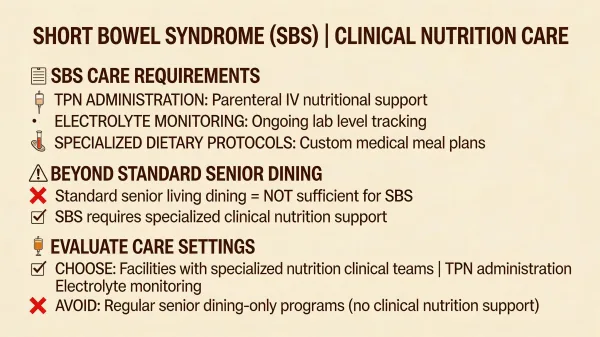
Can an assisted living community actually manage the nutritional complexity of short bowel syndrome? For most families asking this question, the honest answer is more complicated than a simple yes or no. Short bowel syndrome (SBS) requires a level of clinical nutrition management that goes well beyond what standard senior living dining programs are designed to handle, and understanding that gap is the first step toward making the right care decision for your parent.
SBS affects an estimated 10,000 to 30,000 people in the United States, according to data from the Crohn's & Colitis Foundation and recent claims-based studies. The condition develops after surgical removal of a large portion of the small intestine, leaving the body unable to absorb enough nutrients, fluids, and electrolytes from food alone. For older adults, the consequences of poor SBS management compound quickly: dehydration, dangerous electrolyte imbalances, malnutrition, and frequent hospitalizations.
If your parent had extensive bowel surgery years ago and now lives with chronic diarrhea, weight loss, and the need for supplemental IV nutrition, finding the right care setting isn't just about comfort. It's about clinical capability. This article walks through what SBS daily management demands, where standard senior living communities fall short, and what to look for when your parent's condition requires more than a modified meal plan.
What Is Short Bowel Syndrome and Why Does It Affect Senior Living Decisions?
Short bowel syndrome occurs when less than about 200 centimeters (roughly 6.5 feet) of functioning small intestine remains after surgical resection. The normal adult small bowel measures between 275 and 850 centimeters, and most nutrient absorption happens in the first 100 centimeters of the jejunum. When a significant portion is removed due to Crohn's disease, mesenteric ischemia, cancer, or surgical complications, the remaining bowel often can't absorb enough nutrition to sustain health without medical intervention.
For seniors, SBS creates a unique care challenge. The condition demands daily clinical oversight that combines strict dietary protocols, fluid and electrolyte monitoring, medication management, and often intravenous nutritional support. This isn't something that can be managed with a special diet card in the community dining room. The level of medical coordination required puts SBS in a different category from conditions like diabetes or food allergies, where dietary accommodations are more predictable and less clinically intensive.
What Does Daily SBS Management Actually Require?
Living with SBS means managing a body that can't reliably extract what it needs from food. Daily management typically includes multiple small meals spread throughout the day (often six or more), oral rehydration solutions to replace fluid and sodium losses, antisecretory and antimotility medications to slow transit and reduce diarrhea, regular monitoring of weight and stool output, and periodic blood draws to track electrolytes, vitamins, and mineral levels. Many SBS patients also require supplemental vitamins and minerals, including fat-soluble vitamins (A, D, E, K), B12, calcium, magnesium, iron, and zinc, because these aren't absorbed efficiently through the shortened bowel.
The daily routine is demanding. Missing a dose of medication or skipping an oral rehydration session can trigger a cascade of dehydration and electrolyte problems within hours, not days. That speed catches families off guard.
Medications are a central part of the management picture. Proton pump inhibitors or H2 blockers control gastric acid hypersecretion, which typically occurs for six to twelve months after major bowel resection but can persist in some patients. Antimotility agents like loperamide slow intestinal transit time, giving the remaining bowel more opportunity to absorb nutrients and fluids. Some patients also take octreotide to reduce gastrointestinal secretions, or cholestyramine to bind bile salts that cause diarrhea when the terminal ileum has been removed. Each of these medications needs to be dosed and timed carefully around meals, and some have interactions with the oral rehydration and vitamin regimens. In my hospital work, I've watched how quickly things go sideways when even one part of a complex medication schedule gets missed or timed incorrectly. For SBS patients, the margin for error is razor thin.
The Nutritional Tightrope: Managing Oral Intake and Parenteral Nutrition
This is where the distinction between "dietary accommodation" and "clinical nutrition management" becomes critical. In practice, this is where things break down for families trying to place a parent with SBS into a standard assisted living community.
Oral nutrition for SBS patients isn't a matter of preference or portion control. It's a calculated medical protocol. The specific approach depends on the anatomy of what remains: patients with a jejunocolic anastomosis (jejunum connected to the colon) follow different dietary rules than patients with a jejunostomy (where the small bowel ends at a stoma). For jejunum-colon patients, a higher-complex-carbohydrate, lower-fat diet is typically recommended because the preserved colon can ferment unabsorbed carbohydrates into absorbable short-chain fatty acids, partially compensating for the lost small bowel. Jejunostomy patients, by contrast, often need a higher-fat diet because they lack the colonic compensation mechanism. Getting this wrong doesn't just cause discomfort. It worsens malabsorption and increases fluid losses.
Meals need to be small, frequent, and carefully composed. Most SBS protocols call for six to eight eating occasions per day, with specific macronutrient ratios tailored to the individual. Oral rehydration solutions (ORS), distinct from water or sports drinks, are essential for many patients because plain water can actually worsen sodium losses in shortened bowels. The ORS must contain a precise balance of glucose and sodium to drive absorption through the remaining intestinal tissue. Standard community beverages don't come close to meeting this requirement.
Having worked in hospital settings for nearly 20 years, I've seen the difference between a dietary program and clinical-grade nutritional oversight. A dietary program adjusts what's on the plate. Clinical nutrition management tracks input and output, adjusts formulas based on lab results, and coordinates with gastroenterology specialists when absorption patterns shift. That distinction matters enormously for SBS patients, and it's the gap most families don't realize exists until their parent is already struggling in a community that promised to "accommodate special diets."
For patients whose remaining bowel can't maintain adequate nutrition through oral intake alone, total parenteral nutrition (TPN) or partial parenteral nutrition becomes necessary. TPN delivers a complete nutritional formula directly into the bloodstream through a central venous catheter, bypassing the digestive system entirely. It typically infuses over 10 to 12 hours, usually overnight. The formulation includes amino acids, glucose, lipids, electrolytes, vitamins, and trace minerals, all customized to the patient's specific metabolic needs. Managing TPN requires sterile technique for catheter care, proper storage and preparation of nutrition bags, monitoring for complications like catheter-related bloodstream infections and liver dysfunction, and regular lab work to adjust the formula. Home parenteral nutrition serves roughly 32,000 Americans annually, according to the National Home Infusion Association, and costs range from $150,000 to $250,000 per patient per year. That cost alone fundamentally changes the financial equation for families evaluating care settings.
Electrolyte monitoring ties the entire program together. Sodium, potassium, magnesium, and calcium levels can shift rapidly in SBS patients, and dehydration is the most common reason for hospital readmission. Regular blood work, sometimes weekly, is not optional. It's the early warning system that keeps the entire nutritional program calibrated.
Can Assisted Living Communities Handle SBS Care Needs?
Most can't. That's the direct answer families need to hear before they start touring communities.
Standard assisted living communities are licensed to provide assistance with activities of daily living: bathing, dressing, medication reminders, and meal service. They aren't typically staffed or equipped for clinical nutrition management, IV infusion administration, or the kind of ongoing medical monitoring SBS demands. Some communities offer "medication management" services, but there's a significant difference between reminding a resident to take a pill and administering TPN through a central line with proper sterile protocols. Licensing regulations vary by state, and in many states, assisted living staff aren't permitted to perform IV administration at all without specific clinical certifications.
Another challenge is the kitchen. Even communities with genuinely good dining programs are built around a set menu with limited dietary modifications. SBS dietary management requires individually composed meals prepared multiple times per day with precise macronutrient targets, and those targets may change when lab work comes back or when a gastroenterologist adjusts the care plan. That's a fundamentally different operating model than most assisted living kitchens run.
That said, a small number of assisted living communities with enhanced medical services or on-site nursing staff may be able to coordinate SBS care, particularly if a home infusion company handles the TPN preparation and delivery while the community staff manages the infusion schedule and catheter site monitoring. This arrangement requires a community that's willing to build a custom care plan with the resident's gastroenterologist and home infusion pharmacy, and that has nursing staff trained in central line management. These communities exist, but they're the exception.
What Should Families Ask When Evaluating Communities for SBS Care?
Imagine your parent had extensive bowel surgery several years ago and now deals with chronic diarrhea, electrolyte imbalances, and the need for supplemental IV nutrition multiple times per week. The family needs a care community that can manage both the TPN infusions and the complex oral dietary requirements. Before signing any agreement, you need specific answers to specific questions.
Ask whether the community has licensed nursing staff on site 24 hours a day, or only during business hours. Ask if their staff has experience managing central venous catheters and TPN administration. Find out whether the kitchen can prepare individualized meals six to eight times per day with specific macronutrient compositions, not just "low fat" or "diabetic" options from a pre-set menu. Ask how they coordinate with outside specialists and home infusion pharmacies. And ask what happens when something goes wrong at 2 a.m., because with SBS, problems rarely wait for convenient hours.
During my years doing mobile X-ray work in care facilities, I saw wide variation in how communities actually delivered on their promises versus what families were told during the sales tour. The gap between marketing and reality is something every family should verify before committing to a community for complex medical care.
What Does Short Bowel Syndrome Senior Living Actually Cost?
The financial picture for SBS care in a senior living setting is layered. You're not paying for one service. You're paying for several that overlap.
The base cost of assisted living in the United States reached a national median of $6,200 per month, or $74,400 annually, according to the 2025 CareScout Cost of Care Survey. But that figure reflects a standard resident. A parent with SBS will almost certainly incur additional charges for enhanced nursing services, custom meal preparation, and care coordination. Communities that offer this level of service often charge $8,000 to $12,000 per month or more, depending on location and the intensity of nursing support.
Then add the cost of home parenteral nutrition if your parent requires TPN. Published estimates place HPN costs between $150,000 and $250,000 per year in the United States. Medicare Part B covers some home infusion therapy costs, and some private insurance plans provide partial coverage, but out-of-pocket exposure can still be substantial. When our family first encountered the cost reality of specialized medical care for a loved one, the numbers were staggering. Families dealing with SBS face that same shock, often compounded by the ongoing nature of the expense. This isn't a temporary rehabilitation cost. It's a long-term financial commitment.
When Is Skilled Nursing the Better Option for SBS?
For some families, a skilled nursing facility is the more appropriate choice. Skilled nursing communities are staffed with registered nurses around the clock and are equipped to handle IV therapy, wound care, and complex medication regimens as part of their standard operations. If your parent requires TPN several times per week, has a history of catheter-related infections, or experiences frequent electrolyte crises that need rapid clinical response, skilled nursing may offer the medical infrastructure that assisted living simply doesn't have.
The trade-off is cost and environment. The national median cost for a semi-private room in a skilled nursing facility is $315 per day, or roughly $114,975 annually, based on the 2025 CareScout data. A private room runs about $355 per day, or $129,575 per year. The environment tends to feel more institutional than assisted living. But for a condition as medically demanding as SBS, the clinical capability of the setting has to come first. Quality of life matters, but it depends on keeping your parent medically stable.
If your parent's SBS is well-controlled on a stable TPN regimen with infrequent hospitalizations, an enhanced assisted living arrangement might work. If your parent has had repeated catheter infections, unpredictable electrolyte swings, or frequent ER visits for dehydration, skilled nursing provides the rapid-response clinical environment that can keep those episodes from becoming life-threatening. The decision comes down to stability. A parent who has been on a consistent HPN protocol for several years with good lab values is in a different position than one who was recently transitioned to parenteral nutrition and is still being stabilized.
How Can Families Build a Care Team That Works Across Settings?
SBS management doesn't happen in isolation, regardless of where your parent lives. The care team typically includes a gastroenterologist who oversees the overall treatment plan, a registered dietitian with expertise in intestinal failure, a home infusion pharmacy that compounds and delivers the TPN, infusion nurses who manage the central line and monitor for complications, and the day-to-day caregiving staff at whatever community your parent calls home.
The most important thing you can do as a family is make sure these providers are actually communicating with each other. I've seen what happens in hospital settings when care teams work in silos, and the consequences are worse for patients with conditions this complex. Ask for a care coordination meeting before your parent moves into any community. Get everyone in the same room, or at least on the same call, to establish protocols, escalation procedures, and lab monitoring schedules. That one meeting can prevent a lot of preventable crises down the road.
Finding the Right Fit for Your Parent's SBS Care
Short bowel syndrome demands a level of daily medical management that most senior living communities weren't built to provide. That doesn't mean your parent has no options, but it does mean you need to evaluate those options with clear eyes and specific clinical questions, not just a facilities brochure. The gap between what a community says it can do and what your parent actually needs is where the risk lives, and closing that gap takes homework.
Start with your parent's gastroenterologist. They understand the specific anatomy and nutritional requirements better than anyone and can help you define exactly what level of care your parent needs. From there, work outward: identify communities or skilled nursing facilities that can meet those requirements, verify their capabilities through detailed questions and reference checks, and build a care coordination plan that connects every provider involved in your parent's nutrition and medical management. Put the expectations in writing. A verbal assurance from a marketing director doesn't carry the same weight as a documented care plan signed by the nursing director.
The decisions you're making right now are hard, and they carry real weight. But asking the right questions early, and refusing to settle for vague assurances about "dietary accommodations," will put your parent in a much stronger position. You're doing the right thing by looking into this carefully.