
If your father lost his leg in Vietnam in 1968, he's spent more than 55 years learning how to live with limb loss. He adapted. He built a career. He may have raised a family while managing pain, prosthetic socket changes, and the quiet toll of compensating with his intact leg. Now he's in his mid-70s, and something has shifted. His shoulders ache from decades of crutch use on bad-weather days. His residual limb breaks down faster than it used to. The prosthesis that fit perfectly five years ago doesn't feel right anymore. His family is starting to ask a question they never expected: should he move to senior living, and which communities can actually meet the needs of an aging veteran amputee?
This article is written for adult children and spouses trying to figure out which communities can actually handle a veteran amputee's specific needs. The short version: most assisted living communities meet ADA minimums, but ADA minimums weren't designed with a lifelong amputee in mind. Veteran amputee senior living requires a different lens, one that accounts for altered gait over decades, changing prosthetic fit, and the accumulated wear on secondary joints that ADA codes don't address.
As a Radiologic Technologist in Orthopedics, I've imaged plenty of veteran amputees. The pattern you see in chart after chart, the secondary damage to the intact leg, the shoulder wear from crutch or cane use, the skin breakdown at the socket line, isn't random. It's what 40 or 50 years of living with a prosthesis actually looks like. This guide covers what to look for during tours, what the VA pays for, how aging changes the amputee experience, and how to tell communities that can support your veteran from those that only look the part.
What to Look For: Accessibility Features for Veteran Amputees
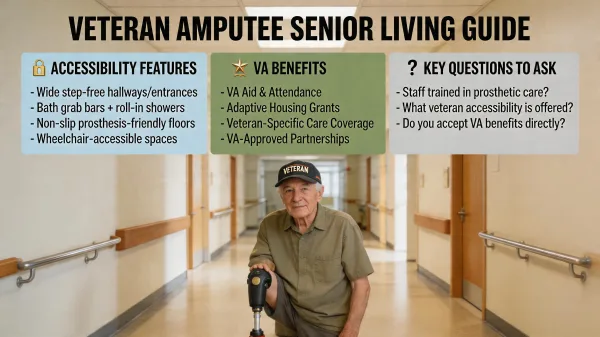
Before touring communities, families should have a checklist that goes beyond the brochure. Here are the accessibility features veteran amputees should look for:
- Roll-in showers with fold-down seats and grab bars on multiple walls. Transfer showers at 36 by 36 inches work for some users but are tight for a veteran who may need to sit, remove a prosthesis, and store it safely.
- Zero or near-zero threshold bathroom entries. ADA allows up to a half-inch beveled threshold. For an older amputee with balance issues, even that can be a fall risk.
- Continuous flooring transitions. Look at where carpet meets tile, especially in hallways and dining rooms. Uneven transitions are a leading cause of falls for prosthetic users.
- A seated dining setup. Armchairs and moveable seating make it easier to manage a prosthesis during long meals.
- Wider bathroom doors, a minimum of 32 inches clear, ideally 36. Wider is better, especially if the resident uses a wheelchair for part of the day.
- Proximity to a VA medical center or VA-approved prosthetist. This matters more than most families realize.
- Staff trained on prosthetic skin care and wound monitoring. Residual limb breakdown is common, and early intervention prevents hospitalization.
- A private, clean space to don, doff, and store the prosthesis. Ideally near the bed and the shower, not in a hallway closet.
Accessibility Beyond ADA Minimums: What Amputee Residents Actually Need
The Americans with Disabilities Act sets the floor, not the ceiling. When a senior living community says it's ADA-compliant, what they're saying is that the building meets federal accessibility minimums. Those minimums were written for a general disability population, not for a 75-year-old veteran who's been walking on a prosthesis since 1968.
Bathroom and Bathing Configurations
ADA transfer showers are 36 by 36 inches. Standard roll-in showers are 60 by 30 inches with a threshold no higher than half an inch. Both meet code. Neither is ideal for a veteran amputee who needs to sit, remove the prosthesis, inspect the residual limb for pressure sores, and manage bathing without assistance. What amputee residents actually need is a roll-in shower larger than the minimum, a fold-down seat rated for substantial weight, grab bars on all three walls rather than just the code-required back and side walls, and a handheld shower head on a 59-inch minimum hose. Horizontal grab bars should be mounted 33 to 36 inches above the finished floor and installed into structural blocking, not just drywall anchors. Ask to see the blocking documentation or talk to the maintenance staff directly. One more piece that's easy to overlook is lighting. Older veterans with peripheral neuropathy check residual limb skin by sight, and dim bathrooms make that harder than it needs to be.
Flooring Transitions
ADA permits a quarter-inch vertical change and a half-inch beveled change between flooring types. That threshold is the enemy of a prosthesis user. Uneven transitions between carpet and tile are the most overlooked fall hazard in senior living buildings. Ask during the tour where the major transitions are. Walk them yourself.
Prosthesis Storage and Care Space
Most rooms have a closet, a bathroom, and a bed. Almost none are designed with a dedicated, clean space for a veteran to don, doff, and store a prosthesis near both the bed and the bathroom. This isn't a rare need. It's an every-day-twice-a-day need. A stable chair or bench near the bed and clean storage for liners, socks, and the prosthesis itself should be planned, not improvised.
On-Site Prosthetist Access
Almost no assisted living communities have a prosthetist on staff. What you should ask is whether the community has a working relationship with a VA-approved prosthetist who can make facility visits, and how quickly they can respond when a socket no longer fits or a liner tears. During my mobile X-ray years I visited facilities where a resident's prosthesis issue had gone unaddressed for weeks. That can't happen for a veteran who walks every day.
Flooring Elsewhere in the Community
Dining rooms, activity rooms, and hallways should be flat, firm, and continuous. Plush carpet drags prosthetic feet. Uneven tile catches them. The real accessibility test isn't the front entrance. It's the path between the entrance and every room the resident actually uses.
The Aging Amputee Reality
What most families don't realize is that limb loss isn't a one-time event. It's a lifelong clinical condition that changes with age, and for a veteran who's been living with an amputation for 40 or 50 years, the aging changes are well underway by the time senior living becomes a conversation.
The body compensates. A below-knee amputee overloads the intact leg for decades. Research consistently shows increased osteoarthritis in the knee and hip of the intact limb, osteoporosis in the residual limb from reduced loading, and back pain tied to altered gait and leg-length discrepancy. One clinical study found scoliosis in 64% of lower-limb amputees. Upper-limb amputees and long-term crutch users deal with shoulder and cervical spine issues from decades of compensatory movement. Residual limbs change too. Skin tolerance decreases with age, peripheral sensory neuropathy reduces the resident's ability to feel a pressure sore forming, and fluctuating limb volume means a socket that fit six months ago may not fit now. These aren't hypothetical issues.
I've X-rayed residual limbs in Orthopedics and in the ER. What happens to those limbs and prostheses over 30 years is part of why this article needed to exist. I've seen the chronic shoulder injuries in lifelong crutch users. I've seen the skin breakdown at the socket line that nobody caught until the veteran came in for something else. I've watched how differently hospital staff treat an amputee patient when they've seen that patient's pattern before versus when everything is new to them. That familiarity matters in senior living too.
VA Benefits for Aging Veteran Amputees
The VA doesn't stop providing prosthetic care when a veteran enters senior living. The VA Amputation System of Care operates at more than 140 sites nationwide, with 18 Polytrauma and Amputation Network Sites offering full rehabilitation services. Your veteran keeps that benefit regardless of where they live, as long as they stay enrolled in VA health care. Prosthetic services are covered whether the amputation was service-connected or not, and the VA can provide the prosthesis through its own accredited labs or through a VA-approved community prosthetist.
Veterans with service-connected amputations also qualify for the annual VA clothing allowance and, in many cases, the Home Improvement and Structural Alterations grant. For long-term care costs, the Aid and Attendance benefit adds to a qualifying veteran's basic pension. The 2026 maximum annual pension rate for a single veteran with Aid and Attendance is $29,093, or about $2,424 per month. The net worth limit is $163,699. A&A won't cover the full cost of assisted living at the national median of $6,200 per month, but it can close a meaningful portion of the gap. Over a year, that's $74,400 in assisted living costs versus roughly $29,000 in A&A benefits. Every dollar matters.
What Most People Miss on a Community Tour
The front entrance of almost every senior living community is beautiful. Wide automatic doors, a gentle ramp, warm lighting. It's the most accessible part of the building. It's also the part that tells you the least about what life will actually be like for an amputee resident.
The real accessibility test is the shower, the dining room, and the fitness area. Walk to the resident's bathroom and open the shower curtain. Is it a roll-in shower or a tight transfer shower? Where are the grab bars actually mounted? Can you see reinforced blocking or are the bars screwed into drywall? Sit on the shower seat if one exists and check whether the controls are within reach. Then walk to the dining room. How is the seating arranged? Are tables close enough that a resident with altered gait has to squeeze through? Is the flooring plush carpet or something flatter?
Finally, check the fitness area. A veteran amputee's secondary joint issues respond to consistent low-impact movement. If the community's fitness room is stocked with standing machines only, that's a signal. Look for seated equipment, a recumbent bike, and staff who can work with prosthesis users. When I did mobile X-ray in rest homes, the gap between the marketing and what I saw inside was wide. That gap widens further for residents with specialized needs.
Clinical Depth: Why It Matters More for Veteran Amputees
Most assisted living communities are licensed to provide help with activities of daily living: bathing, dressing, medication management, and some mobility support. What they're generally not licensed to do is treat wounds, manage complex pain, or intervene clinically when a prosthetic issue becomes a medical one.
For a veteran amputee, this gap can matter fast. A small pressure sore at the socket interface becomes an open wound in days. An open wound becomes a cellulitis case in a week. That trajectory pushes a resident from assisted living into a hospital or skilled nursing stay. Ask pointed questions during your tour. Does the community have a full-time nurse on-site, or only during business hours? How do they handle wound care between physician visits? What's their relationship with the nearest VA medical center? Do they have experience coordinating with VA prosthetic services? Some communities partner with outside wound care specialists or have a visiting podiatrist. Those partnerships fill a real gap.
A community that shrugs when you ask these questions probably isn't the right one for a lifelong amputee. A community that has answers has thought about residents like yours before.
A Framework for Your Family's Decision
No single community will check every box. The goal is to figure out which tradeoffs your veteran can live with and which ones create real risk. Walk through these questions with your family:
- What is the current state of the prosthesis and the residual limb? If fit is already an issue, proximity to a VA-approved prosthetist is the top priority.
- What secondary conditions are you managing? Chronic shoulder pain, knee osteoarthritis of the intact limb, and back pain all shape how accessible a building actually is.
- What level of care does the veteran need today, and what do they likely need in two years? Some communities offer multiple levels of care on a single campus, which matters for a veteran whose needs may progress.
- How will you pay? Aid and Attendance covers part, not all, of assisted living. Service-connected disability compensation can add substantial monthly income for eligible veterans. Long-term care insurance, savings, and family contributions often fill the gap.
Take your veteran with you on the tour when possible. The veteran amputees I've worked with in the ER don't sugarcoat what's wrong, and yours probably won't either. They'll tell you quickly whether a building works for them.
Questions Families Often Ask
Will Medicare pay for assisted living?
No. Medicare covers short-term post-hospital care and hospice, not long-term custodial care in an assisted living community. VA Aid and Attendance, long-term care insurance, Medicaid in some states, and personal savings are the main funding sources.
What about State Veterans Homes?
The VA partners with states to operate State Veterans Homes, which typically offer skilled nursing, domiciliary, and some assisted living services at lower cost than private communities. Eligibility and waitlists vary by state. The VA pays a per diem for eligible residents, which offsets cost but usually doesn't cover it fully.
Can my veteran keep using their VA prosthetist after moving?
Yes. Prosthetic care follows the veteran, not the facility. If the move takes your veteran outside the service area of their current VA medical center, the Amputation System of Care can transfer records to a closer location. The VA can also authorize care through a community prosthetist when appropriate.
What if my veteran occasionally uses a wheelchair?
Many older amputees use a prosthesis during the day and a wheelchair at night or during recovery from skin breakdown. A community needs to accommodate both. Ask whether the room, bathroom, and common areas work with wheelchair-width clearances.
Choosing Well for a Veteran Who's Earned It
Choosing a senior living community for a veteran amputee isn't the same as choosing one for a typical senior. The challenges are real, specific, and often invisible to someone who's never lived with limb loss. But they're also manageable with the right information and the right questions.
The veteran who's spent 50 years walking on a prosthesis has earned the right to age in a place that understands what that means. Look past the brochures. Ask about the shower, the flooring, the prosthetist partnership, and the clinical response time. Bring your veteran on the tour and let them tell you what they notice that you miss. Use the VA benefits they've earned. Aid and Attendance, prosthetic services, and in some cases the Home Improvement and Structural Alterations grant can make a real difference in both access and affordability. Lean on the VA's Amputation System of Care for coordination between your veteran's primary providers and the community's staff.
This isn't a decision your family has to get exactly right on the first try. But it's one worth slowing down for. Your veteran is worth it, and so is your peace of mind.