
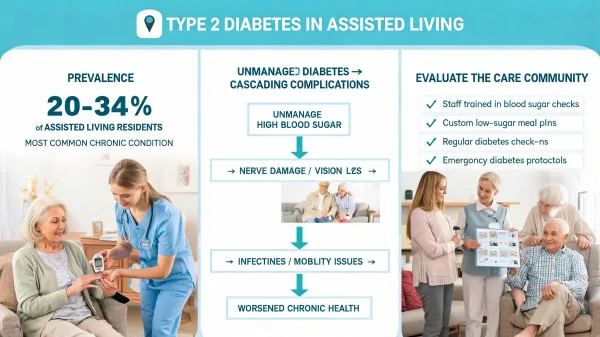
Between 20% and 34% of residents in U.S. long-term care facilities have diabetes, and that figure rises when you include people who haven't been formally diagnosed yet. If your parent is moving into an assisted living community, there's a strong chance diabetes will be either a primary reason for the move or a major factor in which community you choose. This isn't a niche concern. It's the most common chronic condition families encounter when evaluating senior living options.
What most people don't realize until they're in it: diabetes in a senior living setting isn't just about blood sugar numbers. Unmanaged glucose creates a cascade of complications that each individually could force your parent into a higher, more expensive level of care. Eyes, kidneys, nerves, heart, and skin are all on the same deterioration clock. A community that checks the "diabetes management" box without actually running a coordinated program can quietly let all of those systems degrade at once.
I've seen this pattern play out from the hospital side for close to 20 years. Elderly patients cycling through the ER for blood sugar emergencies is one of the most preventable patterns in healthcare. Every readmission represents a failure of daily management somewhere, and too often that somewhere is a care community that wasn't equipped to handle insulin-dependent diabetes properly. The families I talk to in the ER waiting room are exhausted and confused, and most of them had no idea their parent's community was falling short until the ambulance showed up.
This guide breaks down what good diabetes management actually looks like inside an assisted living community, the complications that develop when management falls short, how to evaluate whether a community can handle your parent's specific needs, and what the real costs look like when diabetes is part of the equation. Whether your parent takes oral medications, uses insulin, or is dealing with complications that have already started, the goal is to help you ask the right questions before you sign a contract.
Why Diabetes Management Changes When Your Parent Can't Do It Alone
Consider a situation where your parent's diabetes was well-controlled for years because they managed it themselves: checking blood sugar, timing meals, taking medications on schedule. Then a mild stroke affects their cognition slightly, and within a few months, they're missing insulin doses and eating erratically. Their A1C has spiked from 7 to 11, and the endocrinologist says the management gap is dangerous. That's the scenario that sends many families searching for assisted living with strong diabetes care.
The transition from self-managed to facility-managed diabetes is one of the most critical medical handoffs a family can face. Your parent might have managed their condition successfully for decades, but cognitive decline, mobility limitations, vision loss, or even depression can erode their ability to stay on top of a complex daily routine. Diabetes management requires consistency, and consistency is often the first casualty when health starts to shift.
This isn't just about forgetting a pill. Insulin timing, carbohydrate counting, blood sugar monitoring, foot inspections, and recognizing the signs of hypoglycemia all require a level of attention that gets harder to maintain as other health conditions pile up. The families I see in the ER are often surprised to learn that their parent's blood sugar has been wildly out of range for weeks or months before the crisis that brought them in.
What Good Diabetes Management Looks Like in a Care Community
Not every assisted living community that claims to manage diabetes actually does it well. There's a wide gap between a community that will remind your parent to take a pill and one that runs a coordinated, medically informed diabetes management program. Understanding what good looks like will help you tell the difference during tours and interviews.
Blood Glucose Monitoring Frequency and Protocols
A well-run community monitors blood glucose on a schedule that matches your parent's specific needs, not on a one-size-fits-all timetable. For insulin-dependent residents, that typically means testing before meals and at bedtime at minimum, with additional checks when symptoms suggest a blood sugar swing. The 2026 ADA Standards of Care for older adults recommend individualized glycemic goals, with healthy older adults targeting an A1C under 7.0% to 7.5%, those with complex health conditions targeting under 8.0%, and frail residents with limited life expectancy focusing primarily on avoiding hypoglycemia rather than hitting a specific number. The community should know your parent's target range and have clear instructions from their endocrinologist about when a reading triggers a call to the doctor versus when it triggers an on-site intervention.
Ask whether the community uses continuous glucose monitors (CGMs) for residents who need them. The ADA now recommends CGM use for older adults alongside traditional A1C monitoring, partly because A1C can be less accurate in elderly patients. A community that supports CGM technology and trains staff to read and respond to the data is ahead of the curve. If a community tells you they only check blood sugar once a day for all diabetic residents, that's a red flag. One morning fasting glucose reading doesn't capture the post-meal spikes and overnight lows that cause the real damage over time.
Insulin Administration and Staff Competency
Insulin management is where many assisted living communities fall short, because it requires trained staff who understand the difference between basal and bolus insulin, know how to adjust for meal timing and sick days, and can recognize when a dose needs to be held. In most states, insulin injections must be administered by licensed nurses or certified medication aides with specific training. Ask the community directly: who gives insulin injections, what credentials do they hold, and is a nurse on duty during all insulin administration times, including evenings and weekends?
Timing matters enormously with insulin. Rapid-acting insulin given 30 minutes too early or too late relative to a meal can cause dangerous blood sugar swings. A community with good protocols will have medication administration records that track not just whether insulin was given, but when it was given relative to the meal, the pre-meal blood sugar reading, the dose administered, and any adjustments made. If the community can't describe this level of tracking when you ask, their insulin management program probably isn't as structured as it needs to be.
Dietary Program Quality
Diet is half the equation in diabetes management, and this is where a lot of communities quietly fail. A strong diabetes dietary program isn't about slapping a "diabetic-friendly" label on a standard cafeteria tray. It means carbohydrate-controlled meal planning with consistent carb counts that your parent's insulin doses are calibrated to, meals served at predictable times to align with medication schedules, and kitchen staff who actually understand why a resident can't just have extra bread because they're still hungry.
During your tour, ask to see a sample weekly menu with nutritional information. Ask if the community employs or contracts with a registered dietitian. Ask what happens when your parent doesn't eat a full meal but has already received their pre-meal insulin. That last question reveals a lot, because the answer should involve blood sugar monitoring and possibly a supplemental snack to prevent hypoglycemia, not a shrug.
Emergency Protocols for Highs and Lows
Every community should have written protocols for both hypoglycemia (blood sugar below 70 mg/dL) and hyperglycemia (blood sugar above 250 mg/dL or whatever threshold the endocrinologist has set). The hypoglycemia protocol is especially critical for older adults. In patients over 80, severe hypoglycemia accounts for up to one in six hospital admissions. Staff should know the symptoms, have glucose tablets or juice immediately accessible, and understand when a low blood sugar episode requires calling 911 versus when it can be managed on-site. Ask: does every direct care staff member know what to do if a resident is found confused and sweating? Can they describe the protocol without looking it up?
A1C Tracking and Endocrinologist Communication
Your parent's A1C should be checked every three to six months, and the results should be shared with both you and the endocrinologist. A strong community doesn't just draw the lab work. They track A1C trends over time, adjust care plans when numbers move in the wrong direction, and communicate proactively with the diabetes care team rather than waiting for a quarterly appointment. I've talked to families who discovered their parent's A1C had climbed by two full points over six months and the community never flagged it. That kind of drift can mean the difference between stable diabetes and complications that permanently reduce quality of life.
Questions That Reveal Program Quality
The following questions will help you separate communities that manage diabetes well from those that are just checking boxes. How many residents currently have diabetes, and what's the staffing ratio for those residents? What happens if a resident's blood sugar is out of range at 2 AM? Does the community have a relationship with an endocrinologist, or does it rely entirely on the resident's primary care physician for diabetes management? What's the community's hospitalization rate for blood sugar emergencies? Can they show you their diabetes care protocol in writing? A community that can answer these questions confidently, with specifics rather than generalities, is one that takes diabetes seriously.
The Complication Cascade: Why Unmanaged Diabetes Destroys Everything Else
Families tend to focus on blood sugar numbers as the primary measure of diabetes management. That's understandable, because blood sugar is what gets checked and reported. But glucose control is really a proxy for something much bigger: whether your parent's organs and tissues are slowly being damaged by sustained high blood sugar. The complications of unmanaged diabetes don't show up as a single crisis. They accumulate gradually, often silently, until a tipping point forces a sudden escalation in care needs and costs.
Neuropathy: The Foundation of the Cascade
Peripheral neuropathy, the loss of sensation in the feet and lower legs, affects up to 50% of people with long-standing diabetes. In a senior living context, neuropathy creates a dangerous chain reaction. Your parent can't feel a blister forming from poorly fitting shoes. The blister becomes an ulcer. The ulcer doesn't heal well because diabetes also impairs circulation and immune response. Approximately 18.6 million people worldwide develop diabetic foot ulcers each year, and about 50% to 60% of those ulcers become infected. Among moderate to severe infections, roughly 20% lead to lower extremity amputations. The five-year mortality rate after a major amputation exceeds 70%. That's a progression from numbness to death that starts with something a healthy person would barely notice.
In an assisted living community, neuropathy management means regular foot inspections by trained staff, properly fitting footwear, immediate attention to any skin breakdown, and podiatry visits on a scheduled basis. If your parent has neuropathy, ask the community how often staff check residents' feet and what training they've received on diabetic foot care. This single question can tell you more about a community's diabetes program than almost anything else.
Retinopathy: Vision Loss That Compounds Every Other Problem
Diabetic retinopathy affects roughly 26% of elderly patients with Type 2 diabetes, and in one study of nursing home and assisted living residents, nearly 33% had a diabetes diagnosis while a concerning percentage showed signs of undiagnosed retinal damage. Vision loss from retinopathy doesn't just affect quality of life. It makes every other aspect of diabetes management harder. A resident who can't see well can't read a glucose meter, can't inspect their own feet, can't identify what's on their plate, and is at much higher risk of falls. Falls in seniors with diabetes heal slower and carry a higher risk of complications. The community should coordinate regular ophthalmology appointments and should recognize that vision changes in a diabetic resident require urgent evaluation, not a routine scheduling approach.
Kidney Disease: The Quiet Escalator
Diabetic kidney disease (nephropathy) is the leading cause of end-stage renal disease in the United States, and it develops gradually over years of poor glucose control. For families evaluating assisted living, kidney disease matters because it can quietly push your parent out of the assisted living level of care entirely. When kidney function declines past a certain threshold, your parent may need dialysis, which most assisted living communities can't accommodate. That means a transfer to a skilled nursing facility, at a much higher cost. The national median annual cost for a private nursing home room is $127,750 as of 2024, compared to $74,400 for assisted living as of 2025. Kidney disease is one of the most common reasons families face an unexpected and expensive care level transition.
A community managing diabetes well will track kidney function markers in routine lab work and will flag declining numbers to the care team before the situation becomes a crisis. Ask whether the community monitors creatinine and estimated glomerular filtration rate (eGFR) as part of their standard diabetes care protocol.
Cardiovascular Disease: The Leading Killer
Heart disease is the number one cause of death in people with diabetes, and unmanaged blood sugar accelerates cardiovascular damage significantly. High glucose damages blood vessel walls, promotes plaque buildup, and increases the risk of heart attack and stroke. For your parent, this means the quality of their diabetes management in assisted living directly affects their cardiovascular risk. A community that lets A1C drift upward for months without intervention isn't just failing at diabetes care. It's allowing accelerated damage to the heart and blood vessels that may not become visible until a cardiac event.
When Complications Force a Care Level Change
Each of these complications can individually push a resident from assisted living into skilled nursing or memory care. When multiple complications develop simultaneously, which is common because they share the same root cause, the care level transition happens faster and costs more. Research shows that patients with two concurrent microvascular complications have a roughly three-fold increase in mortality risk, and those with three concurrent complications face a nearly eight-fold increase. That's not an abstract statistic. It translates directly into the likelihood that your parent will need to move to a higher level of care sooner than expected, at significantly greater expense. The financial impact of diabetes complications on a family's long-term care budget is often the difference between a plan that works and one that falls apart.
Evaluating a Community's Diabetes Program During Your Search
You can learn a lot about a community's diabetes management capability before you ever sign a contract. The key is knowing which questions to ask and which answers should concern you. During tours, pay attention not just to what the marketing team tells you, but to what the nursing staff and direct care workers say when you ask specific clinical questions.
Start with staffing. A community that manages insulin-dependent diabetes safely needs licensed nursing staff available during all medication administration times, including early mornings, evenings, and weekends. If the community relies on medication aides for insulin, ask about their specific training and supervision. Ask about the nurse-to-resident ratio on each shift, because a single nurse covering 60 residents can't provide the kind of individualized monitoring that complex diabetes requires.
Look at the care assessment process. Before your parent moves in, the community should conduct a thorough health assessment that includes their full diabetes history: current medications, insulin regimen, A1C trends, existing complications, dietary needs, and endocrinologist contact information. That assessment should inform a written, individualized diabetes care plan. If the community seems to treat all diabetic residents the same way, that's a sign their program isn't sophisticated enough for complex management needs.
Ask about their track record. How many current residents have diabetes? What percentage are insulin-dependent? How often do diabetic residents get hospitalized for blood sugar emergencies? A community that tracks this data and shares it openly is one that takes accountability seriously. A community that can't answer these questions probably isn't tracking them, and that tells you something important about their priorities.
The Cost Reality: What Diabetes Adds to Senior Living Expenses
The national median monthly cost for assisted living is $6,200 as of 2025, or $74,400 annually, according to the CareScout Cost of Care Survey. But that base rate rarely tells the full story for a resident with complex diabetes. Most communities use tiered pricing based on the level of care a resident needs, and diabetes management, especially insulin administration, typically pushes a resident into a higher care tier.
Expect additional monthly charges for insulin administration (some communities charge per injection), blood glucose monitoring beyond a basic daily check, specialized dietary accommodations, and coordination with outside specialists like endocrinologists and podiatrists. These add-ons can increase the monthly cost by $500 to $1,500 or more depending on the community and the complexity of your parent's regimen. Over a year, that's an additional $6,000 to $18,000 on top of the base rate.
One common source of confusion is what Medicare and insurance actually cover inside an assisted living community. Medicare doesn't pay for assisted living itself, but it does cover diabetes supplies like test strips, glucose meters, and insulin when prescribed. Medicare Part B covers some durable medical equipment, and Part D covers insulin and oral diabetes medications. However, the community's fees for administering those medications and performing the monitoring are typically out of pocket. Families often assume that because the supplies are covered, the care is too. It's not. The labor and expertise required to manage diabetes daily are baked into the community's care fees, not covered by Medicare.
The bigger financial risk, though, is what happens if diabetes is managed poorly and complications develop. A transfer to skilled nursing care jumps the annual cost to over $127,000 for a private room. Hospitalizations for blood sugar emergencies add more. The diabetes-attributable nursing home costs for residents aged 65 and older have been estimated at $10 to $11 billion across the U.S. system. For your family, the math is simple but painful: paying more upfront for a community with a genuinely strong diabetes program can save tens of thousands of dollars in avoided complications, hospitalizations, and care level escalations down the road.
When Assisted Living Isn't Enough: Recognizing the Transition Point
Assisted living communities are designed for residents who need help with daily activities but don't require round-the-clock medical care. For many people with Type 2 diabetes, assisted living provides the right balance. But there are situations where diabetes and its complications push care needs beyond what assisted living can safely provide.
If your parent needs dialysis, most assisted living communities aren't equipped to coordinate that level of medical care. If they've developed wounds that require daily skilled nursing care, or if their blood sugar is so unstable that they need continuous medical monitoring, skilled nursing may become necessary. Cognitive decline that makes a resident unable to cooperate with blood sugar testing or insulin administration can also trigger a care level change, especially if the behavior creates safety risks for the resident or staff.
Having a conversation with the community early about what would trigger a transfer is important. Get specifics in writing: what clinical thresholds or scenarios would prompt the community to recommend a higher level of care? Knowing this upfront helps your family plan financially and emotionally, rather than being caught off guard by a sudden transition.
I've watched families go through this transition in the hospital when a parent arrives from assisted living with a diabetes complication that has spiraled. The shock isn't just medical. It's the realization that the living arrangement they spent months finding and paying for is no longer viable, and they have to start the search over under pressure, often while their parent is still in a hospital bed. Knowing the clinical markers that trigger a transfer, and monitoring those markers yourself, gives you time to plan instead of react.
Building a Diabetes Care Team Around Your Parent
The best outcomes for seniors with diabetes in assisted living happen when the community's care team, the endocrinologist, the primary care physician, and the family are all communicating regularly. Your parent's diabetes doesn't exist in isolation. It interacts with every other health condition they have, every medication they take, and every change in their physical or cognitive status.
Make sure the community has current contact information for your parent's endocrinologist and that they actually use it. Ask how often the community communicates with outside specialists and what triggers a call versus waiting for a scheduled appointment. Establish yourself as a point of contact for diabetes-related updates, and request regular reports on blood sugar trends, A1C results, and any changes to the care plan.
Medication coordination deserves special attention. Older adults with diabetes are often taking multiple medications for blood pressure, cholesterol, heart conditions, and other chronic issues alongside their diabetes drugs. Some of these medications interact with each other or affect blood sugar levels in ways that require careful monitoring. The community's nursing staff should be reviewing the full medication list regularly and flagging potential interactions to the prescribing physicians. If your parent sees multiple specialists, make sure one physician is serving as the coordinator for the overall medication picture.
From my years working in hospitals, I can tell you that the families who stay involved in their parent's diabetes management get better outcomes. Not because they're doing the medical work, but because their engagement signals to the care team that someone is paying attention. That accountability factor, more than almost anything else, is what keeps care consistent and catches problems early.
A Personal Perspective on Why This Matters
I've spent close to 20 years working in hospital settings where I see the consequences of diabetes management failures firsthand. The elderly patients who come through the ER with blood sugar crises, foot infections that have gone too far, or cardiac events accelerated by years of poor glucose control are some of the most heartbreaking cases I encounter. What makes them heartbreaking isn't just the medical severity. It's that so many of these emergencies were preventable. They happened because somewhere along the chain, daily management broke down: a missed insulin dose became a pattern, a small foot wound went unnoticed for weeks, an A1C that crept upward got ignored until something gave way. When I talk to the families in those moments, the most common thing I hear is, "We didn't know it had gotten this bad." That's the gap this article exists to close. Asking the hard questions now, while you're still choosing a community, is the single most effective thing you can do to protect your parent from becoming one of those preventable ER visits.
Making Your Decision With Confidence
Choosing an assisted living community for a parent with Type 2 diabetes means evaluating more than room quality and activity calendars. It means understanding whether the community can actually manage a complex, daily medical condition that touches every system in your parent's body. The questions you ask during your search, about insulin protocols, monitoring frequency, dietary programs, emergency procedures, and complication tracking, will tell you more about the quality of care than any glossy brochure.
The prevalence of diabetes in senior living means that communities deal with it constantly. But dealing with it and managing it well are two very different things. A community that invests in trained nursing staff, individualized care plans, coordinated specialist communication, and proactive complication monitoring is one that can keep your parent stable, comfortable, and out of the hospital.
Your parent spent years managing their diabetes. Now it's your turn to make sure the people taking over that responsibility are up to the task. Trust your instincts, ask the hard questions, and don't settle for vague reassurances. The right community is out there, and finding it is one of the most important things you can do for your parent's health and your family's peace of mind.