
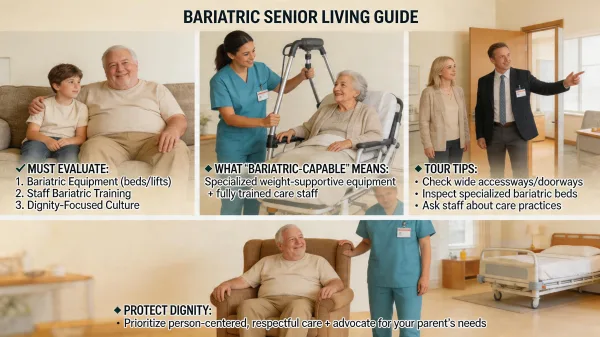
Morbid obesity senior living placement is one of the hardest searches a family can go through, and that's the honest starting point. It isn't about personal preference or location or price point. It's about whether a community physically has the beds, lifts, wheelchairs, doorways, and trained staff to safely care for your parent, and whether they're truthful about what they can and can't do. Most communities aren't equipped, and the ones that are fill up fast.
This matters now because obesity among older adults keeps climbing. According to the CDC, about 38.9% of adults age 60 and older have obesity, and roughly 6.6% have severe obesity, defined as a BMI of 40 or higher. That translates to millions of aging parents who will eventually need care in settings that weren't designed for them. The senior living industry has been slow to catch up, and the gap between what families need and what's available is real.
If you're reading this, you've probably already been told "no" by a community, or gotten the sense that a sales conversation changed the moment weight came up. That's the hard truth up front: you're going to have to work harder to find the right place, you may have to travel farther than you'd like, and the options that exist come with specific equipment and staffing questions you need to ask before you sign anything. This guide walks through what bariatric-capable actually means, how to evaluate communities, what to expect on cost, and how to protect your parent's dignity through a process that can feel dehumanizing.
Why Morbid Obesity Senior Living Placement Is So Difficult
Most assisted living communities are built around a standard set of equipment: beds rated for 350 to 450 pounds, wheelchairs that top out around 300 pounds, and standard doorways and bathroom fixtures. When a resident's weight exceeds those limits, the community often isn't legally or operationally able to accept them, because the equipment failure risk, staff injury risk, and care quality risk all escalate at once.
The Occupational Safety and Health Administration limits how much weight a single healthcare worker can safely lift, which directly shapes how facilities staff rooms. For a bariatric resident, routine tasks that one caregiver handles in 20 minutes can require two caregivers and 40 minutes. That math changes a community's entire staffing model, and most communities haven't built for it. I've seen the same dynamic in hospitals, where safely transferring a bariatric patient often means pulling three or four staff from other tasks, and the facilities that handle it well are the ones that built the staffing pattern around it from the start.
Add state licensing limits on what assisted living can legally provide, and you get a narrow window of communities that have actually invested in bariatric care as a specialty. They exist, but they're the exception, and they typically have waitlists.
A Scenario You Might Recognize
Imagine your mother weighs around 350 pounds and has reached a point where she needs help bathing, dressing, and getting in and out of bed safely. You start calling communities. The first three say they can't accommodate her without explaining why. The fourth schedules a tour, then calls back the day before to cancel after "reviewing her assessment." The fifth admits their beds are rated for 400 pounds but can't confirm whether their lifts or wheelchairs go higher. You're left trying to decode what's a polite refusal and what's an actual capacity limit.
Families often find that the communities willing to take bariatric residents are an hour or more from home, that the wait is six to nine months, or that both are true. That geographic and time pressure can push families toward poor fits because something is available now, which is how a placement goes wrong before the resident even moves in.
The Equipment Equation: What Bariatric-Capable Actually Means
This is where you have to get specific, and this is where many communities will try to keep things vague. A facility saying "we accept bariatric residents" means very little without knowing what their equipment actually supports. Before your parent moves in, you need real numbers on every major piece of equipment they'll interact with daily.
Beds. A standard hospital or long-term care bed is 36 inches wide and supports 350 to 450 pounds. A true bariatric bed ranges from 42 to 60 inches wide and supports 600 to 1,000 pounds depending on the model. Width matters as much as weight rating, because research published in peer-reviewed nursing literature has shown that residents with a BMI over 35 who can't reposition themselves need a wider bed to turn safely from supine to side-lying. A narrow bed, even if it technically holds the weight, creates pressure injury risk because the resident can't be rotated properly.
Lifts. Standard sit-to-stand and floor-based patient lifts handle about 400 pounds. Bariatric lifts run from 500 to 1,000 pounds, and ceiling-mounted bariatric lifts are often the safest option because they don't require floor clearance under the bed. Ask whether the lifts are ceiling-mounted or portable, what the rated capacity is in pounds, and whether staff are trained on that specific lift model. A facility that owns bariatric equipment but doesn't train staff to use it correctly isn't bariatric-capable in any meaningful sense.
Wheelchairs and commodes. Standard wheelchairs support about 300 pounds with a 16 to 18 inch seat. Bariatric wheelchairs range from 350 to 1,000 pounds with seat widths from 20 to 30 inches. Commodes follow the same pattern, with bariatric models rated to 650 pounds or more. If your parent needs a chair for daily use, confirm the facility either provides one at the right capacity or can accommodate one you bring.
Doorways, bathrooms, and furniture. A bariatric wheelchair that's 30 inches wide won't fit through a standard 32-inch interior doorway with any margin to spare, and bathroom doors are often narrower than main doorways. The bathroom itself needs reinforced grab bars anchored into studs or concrete, a roll-in shower large enough for a bariatric shower chair or bench, and a toilet anchored to support the resident's weight without shifting during transfers. Dining room chairs, lobby seating, recliners in common areas, and the furniture in the resident's room all need load ratings that match, and those ratings should be printed on spec sheets the facility can show you. Don't take assurances, and ask to see documentation on any equipment your parent will use every day. The facilities that have made a real bariatric investment keep this paperwork ready. The ones that haven't will get vague fast.
My hospital years taught me what bariatric-capable infrastructure looks like when it's actually there. In the ER and Main Radiology, we had bariatric stretchers with 800-pound capacities, ceiling lifts rated well above the beds, imaging tables sized for patients over 500 pounds, and staff who were drilled on safe transfer techniques because getting it wrong hurts everyone involved. I've watched four-person transfers done well and I've watched them done badly, and the difference comes down to training, communication, and whether the right equipment was available in the first place. That same infrastructure, scaled for daily living rather than acute care, is what a bariatric-capable community is supposed to provide. Most senior living communities don't have it. The ones that do have made a deliberate investment in bariatric equipment, staff training, and facility design, and you can usually tell within ten minutes of walking in whether that investment has been made.
In practice, this is where things break down. A community will tell you they accept bariatric residents, but when you ask for specific equipment ratings, they hedge. The bed turns out to be rated for 500 pounds when your parent weighs 400, which sounds adequate until you factor in the 1.5x safety margin experts recommend for dynamic forces during repositioning. The lift is a standard 400-pound model. No one's been trained on advanced bariatric transfers. They're willing to take the admission, but they're not equipped to deliver safe care, and the first bad transfer is when everyone finds out.
Dignity and Care Quality: Beyond the Equipment
Equipment alone doesn't make a community bariatric-capable. The staff culture matters just as much, and in many ways it matters more, because a resident can sense the difference between a team that's trained and comfortable and a team that's improvising.
Safe bariatric transfers require more than strong caregivers. They require training in body mechanics, lift operation, skin inspection during transfers, and communication during the move itself so the resident isn't being handled silently or roughly. Ask the community whether direct care staff complete specific bariatric handling training, and how often that training is refreshed. "We're experienced with larger residents" isn't an answer. "Our CNAs complete an eight-hour bariatric handling course during orientation with annual refreshers" is.
Skin care is a specific clinical concern for bariatric residents, and one many communities underappreciate. Pressure injuries form in skin folds, under abdominal panniculus, between thighs, and on the sacrum and heels, and they progress quickly once they start. Research on nursing home residents with obesity shows that pressure injury rates are higher in facilities with lower certified nursing assistant staffing and in larger for-profit facilities. The Wound, Ostomy and Continence Nurses Society recommends specialized support surfaces, structured skin fold assessments, and repositioning protocols that account for bariatric-specific pressure points. If a community can't describe their skin care protocol in detail, that's a red flag.
The psychological piece is harder to measure but just as important. A parent who has been turned away from three communities, asked invasive questions about how many staff it takes to turn them over, or made to feel like a logistical problem walks into any new facility with a guardedness that affects their whole experience. The community's job is to undo some of that, and the way staff greet, speak to, and physically handle bariatric residents tells you whether they will. I can tell almost immediately in a hospital setting whether staff are comfortable with bariatric patients or not, and families can learn to read the same signals during a tour. Watch how the people working there actually move through space with residents, not just how the admissions director talks during a tour.
Ask to meet the nursing director and the CNAs on the unit where your parent would live. Ask whether bariatric residents are integrated into community activities or tend to stay in their rooms. Isolation is a real risk when mobility is limited, and a community that has thought about this will have answers about wider dining room spacing, accessible activity areas, and transportation options for outings. A community that hasn't thought about it will give you vague reassurance.
Levels of Care for Morbid Obesity Senior Living
Bariatric care isn't limited to one level of senior living. The right setting depends on your parent's medical complexity and daily support needs.
Assisted living can work for bariatric residents who need help with two or three activities of daily living, can participate in transfers with equipment assistance, and don't have wounds or medical conditions requiring skilled nursing. Bariatric-capable assisted living is the hardest to find, because most communities operate on a lower acuity model.
Skilled nursing facilities are often the more realistic option for residents with higher acuity, existing pressure injuries, or a weight that exceeds 500 pounds. SNFs are more likely to have bariatric equipment and trained nursing staff, and they can bill Medicare or Medicaid for covered stays. The trade-off is a more clinical environment and less personal freedom.
Memory care for bariatric residents with dementia is an especially narrow slice. Most memory care units aren't equipped for bariatric residents, and most bariatric-capable communities aren't secured for memory care. Finding a community that does both well usually means broader geographic search or specialty placement.
Home care with equipment is an option families sometimes overlook. With a bariatric hospital bed, a ceiling lift, and a home care agency experienced with bariatric transfers, your parent can sometimes stay home longer than a facility search would suggest. It isn't cheap, but neither is bariatric-capable facility care.
Questions to Ask When Touring a Bariatric-Capable Community
Bring a written list to every tour. Sales staff are polished, and it's easy to leave without the answers you need. Direct, specific questions force concrete answers and flush out the communities that aren't really equipped.
Ask what the rated weight capacity is for beds, lifts, wheelchairs, and bathroom fixtures, and get numbers in writing. Ask how many bariatric residents currently live there, because a community that handles it regularly will answer easily. Ask what specific training CNAs and nurses complete for bariatric care, and how often it's refreshed.
Ask whether the community has refused or discharged bariatric residents in the past year, and why. The answer to that question tells you more than the brochure ever will. Ask about transportation, because standard senior transport vans usually can't accommodate bariatric wheelchairs safely, and medical appointments still have to happen.
The Cost of Bariatric Care in Senior Living
Bariatric care costs more. That's the honest reality, and families rarely see accurate numbers until they're deep into the process. As of 2025, the national median for a private one-bedroom in assisted living runs around $5,900 per month, but bariatric-capable communities frequently charge more because of equipment investment, staffing ratios, and care complexity. Expect to pay $6,500 to $9,000 per month, with some specialty communities charging more.
Skilled nursing runs higher still, with national medians around $10,000 to $12,000 per month for a private room. Medicare may cover a limited post-hospital SNF stay if your parent qualifies, but custodial long-term care isn't covered. Medicaid covers skilled nursing for residents who meet financial and clinical eligibility, but not all facilities accept Medicaid, and bariatric-capable Medicaid beds are especially scarce.
Most communities charge care level surcharges on top of base rent, and bariatric care often triggers the highest tier. A base rate of $6,000 can become $8,500 once two-person assist, bariatric equipment rental, and enhanced skin care are added. Get every charge in writing before admission. That adds up fast.
Using a Placement Specialist or Hospital Discharge Planner
A local placement specialist with bariatric experience can save weeks of cold-calling. They know which communities in your area have actually admitted bariatric residents, not just which ones claim to be capable. Some charge families directly, others are paid by facilities, and the payment structure can affect which options they surface, so ask how they're compensated.
Hospital discharge planners and social workers are another strong resource, particularly if your parent is being discharged after a hospital stay. Discharge planners work with facilities constantly and often know which ones have current bariatric capacity. In my hospital years I've watched good discharge planners move bariatric patients to the right facilities quickly, and I've watched rushed discharges land in facilities that weren't equipped. A physician referral to a specific facility sometimes opens doors that a family cold call can't.
A Decision Framework for Your Family
Before you tour a single community, sit down and answer a few concrete questions about your parent's situation. What does your parent weigh today, and is the trend going up, stable, or down? What specific ADLs do they need help with, and how many people does it take to safely transfer them right now? What's their current skin integrity, and have they ever had a pressure injury? Do they have related conditions like diabetes, heart failure, lymphedema, or sleep apnea that factor into care?
How far from family can your parent reasonably be placed? A community 90 minutes away that's truly bariatric-capable is usually a better placement than one 15 minutes away that isn't. Family visit frequency matters, but so does care quality, and the two sometimes trade off.
What's the financial picture? Private pay runway, long-term care insurance, VA benefits eligibility, and Medicaid planning timelines all change which options are realistic. Have that conversation with a financial planner or elder law attorney before narrowing your list.
Common Questions Families Ask
Do assisted living communities have legal weight limits? Not federally, but state licensing regulations and individual facility policies can effectively function as weight limits. A community can legally decline admission if they determine they can't meet a prospective resident's care needs safely, which for many facilities includes weight thresholds tied to equipment ratings.
What's considered bariatric in care settings? The threshold varies by facility, but a patient is typically classified as bariatric at 300 pounds or a BMI of 40 or higher. Some facilities activate bariatric protocols at 250 pounds or a BMI of 35, and the VA's patient handling guidebook recommends bariatric protocols at weights above 350 pounds.
Will Medicare pay for bariatric care in senior living? Medicare doesn't pay for long-term custodial care in assisted living or nursing homes. It can cover a short post-hospital stay in a skilled nursing facility if clinical criteria are met, and it covers durable medical equipment like bariatric hospital beds for home use when prescribed. Long-term placement is almost always private pay or Medicaid.
Where to Go From Here
Finding a bariatric-capable community takes more effort than a standard senior living search, and the emotional weight is heavier too. You're advocating for a parent who has probably already been told no in ways that hurt, and you're trying to hold a care standard most facilities aren't built to meet. The good news is that communities doing this work well exist, and once you find one, the difference in care quality is clear. Focus on specific equipment ratings, trained staff, and culture. Don't accept vague reassurance, and don't let urgency push you into a placement that isn't actually equipped.
This process is solvable, even when it feels overwhelming. Start with honest questions, get answers in writing, and trust what you see with your own eyes during a tour. Your parent deserves care that treats them as a whole person, not a logistical challenge, and you're the one who makes sure that happens.