
What happens when someone who has managed their own insulin for 40 years can no longer do it safely? For families of aging parents with Type 1 diabetes, this question carries a weight that most people don't fully understand. Your parent hasn't just been "taking medicine." They've been performing a complex daily calculation that involves counting carbohydrates, adjusting insulin doses based on activity and stress, reading their body's signals, and making corrections multiple times a day. They've done this thousands of times. They've kept themselves alive doing it.
And now, something is changing.
Maybe you've noticed dosing errors with the insulin pump. Maybe there have been hypoglycemic episodes that required emergency intervention. Maybe your parent, who could once glance at a plate and estimate carbs within a few grams, is now guessing wrong by margins that matter. The math isn't working anymore, and the person who built their entire adult identity around managing this condition is losing the ability to do it safely.
This article covers what families of aging Type 1 diabetics need to know about senior living: why T1D management is so different from what most care communities handle, what goes wrong when cognitive or physical decline intersects with insulin dependence, and how to evaluate whether a community can actually keep your parent safe. As someone who spent years as a caregiver watching a loved one lose the ability to do something they'd always handled on their own, I know that this transition cuts deeper than logistics. It's personal.
When the Expert Can No Longer Self-Manage: The T1D Transition
Type 1 diabetes management isn't a single task. It's a continuous series of micro-decisions that requires intact cognition, fine motor skills, functional vision, and a deep understanding of how one's own body responds to insulin, food, activity, and stress. A person with T1D doesn't just take a set dose at a set time. They calculate a bolus dose based on the carbohydrate content of each meal, apply their personal insulin-to-carb ratio, factor in their current blood glucose reading, account for any insulin still active from the last dose, and adjust for variables like exercise, illness, or even weather changes that affect absorption. That's a multi-step math problem performed three to six times daily, every day, for decades.
Even mild cognitive decline can disrupt this chain at any point. A parent who always knew their insulin-to-carb ratio was 1 unit per 10 grams might start applying the wrong ratio, or forget to account for correction doses. Carbohydrate estimation, which relies on visual judgment and memory, deteriorates when executive function weakens. Research from the ADA's Standards of Care notes that older adults with T1D who experience cognitive dysfunction often lose the ability to recognize their own hypoglycemia, a condition called hypoglycemia unawareness, which removes the very safety signal that used to protect them. The NIDDK's analysis of the DCCT/EDIC study found that the combination of higher HbA1c, severe hypoglycemic episodes, and elevated blood pressure in older T1D patients was associated with cognitive decline equivalent to an additional nine years of aging.
For pump users, the risks multiply. Insulin pumps deliver precise micro-doses throughout the day, but they require the user to input meal data correctly, respond to alerts, change infusion sites, troubleshoot occlusions, and recognize when the system isn't working properly. When a parent's vision makes it hard to read the pump screen, or their dexterity makes site changes painful and inconsistent, or their cognition means they dismiss a critical alarm they would have caught five years ago, the pump becomes a liability instead of a lifeline. Automated insulin delivery systems (hybrid closed-loop pumps) reduce some of this burden by adjusting basal rates automatically based on CGM data, but they still require meal boluses, site changes, and alert responses that depend on the user's engagement.
Then there's the psychological dimension, and families often underestimate how deep it runs. When I was caring for my first husband through his illness, I watched him grieve each ability he lost, not because of the task itself, but because each one represented a piece of who he was. For a person with lifelong T1D, insulin management isn't just a medical routine. It's woven into their identity. They've built their competence around it. They've proven to every doctor, every skeptic, every worried family member that they could handle it. Losing that ability doesn't just feel like a medical setback. It feels like losing themselves. Families who understand this will approach the transition with the respect it requires, not as "taking over" a task, but as partnering in something that has defined their parent's daily life for as long as they can remember.
The transition from self-management to assisted management isn't a single event. It's a gradual process that families need to monitor closely, ideally in coordination with an endocrinologist who specializes in T1D and understands the specific cognitive demands involved.
What Communities Get Wrong About Type 1 vs. Type 2
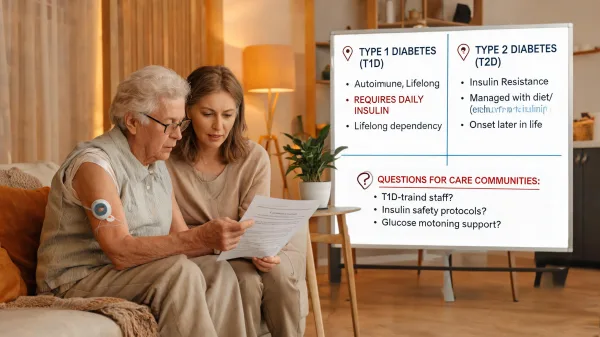
Where this gets confusing is that most assisted living and senior living communities manage Type 2 diabetes routinely and assume they're equipped for Type 1. They aren't. These are fundamentally different diseases with different risk profiles, different emergency scenarios, and different daily management demands. The gap between T2D competency and T1D competency can be dangerous, and families who don't understand that gap may not know the right questions to ask.
Type 2 diabetes, in most cases, involves insulin resistance. The body still produces some insulin, and treatment may include oral medications, lifestyle changes, or supplemental insulin injections at relatively predictable doses. A missed dose or a slightly off meal doesn't usually create an immediate emergency. Type 1 diabetes produces zero endogenous insulin. None. Every unit of insulin your parent receives is externally delivered, and every carbohydrate consumed must be matched with a precise dose. There's no buffer. Miss a bolus, and blood sugar spikes toward diabetic ketoacidosis (DKA), a life-threatening emergency that can develop in hours. Give too much, and blood sugar crashes into severe hypoglycemia, which can cause seizures, loss of consciousness, or death. Research from StatPearls (updated 2025) notes that DKA mortality exceeds 5% in older adults, and nursing home residence is independently associated with increased mortality during DKA episodes.
Carbohydrate counting is another area where the gap shows. Most T2D meal plans focus on consistent carb intake and portion control. T1D management requires precise gram-by-gram carb counting at every meal, because the insulin dose depends on it. A care community that serves meals without providing accurate carb counts is forcing a T1D resident (or their family, or their endocrinologist) to guess, and guessing at insulin doses is exactly how emergencies happen. I've seen how quickly things can go wrong when the people providing care don't fully grasp what they're dealing with, even with the best intentions.
Hypoglycemia risk profiles also differ sharply. A T2D patient on metformin alone has minimal hypoglycemia risk. A T1D patient on basal-bolus insulin or a pump can drop into dangerous territory within 30 minutes of a dosing error, a missed meal, or unexpected physical activity. Older adults with long-duration T1D are especially vulnerable because decades of insulin use can blunt their body's hypoglycemic warning signs. They may not feel shaky, sweaty, or confused until their blood sugar is already critically low. Night-time hypoglycemia is particularly dangerous and may go undetected without continuous glucose monitoring.
Communities that conflate T1D and T2D management expose your parent to real, preventable harm. The distinction matters more than almost anything else you'll evaluate during a facility tour.
What Are the Warning Signs That T1D Self-Management Is Failing?
The signs can be subtle at first, especially because your parent has been managing their diabetes so competently for so long. Watch for insulin dosing errors that your parent didn't catch or couldn't explain. Recurring hypoglycemic or hyperglycemic episodes that didn't happen six months ago are a red flag. Missed bolus doses before meals, confusion about when insulin was last administered, and pump alerts that go unacknowledged all point to declining self-management capacity. From my years working in hospital settings, I can tell you that the patients who struggle most with this transition are the ones who were the most competent before, because the gap between what they expect of themselves and what they can still do is the widest.
Physical signs matter too. If your parent is struggling to read the pump display, having trouble with the fine motor skills needed for site changes, or forgetting to rotate injection sites (leading to lipodystrophy that affects insulin absorption), these are functional red flags that the daily mechanics of T1D care are becoming too difficult.
Consider a parent who has managed Type 1 diabetes since childhood and now uses an insulin pump paired with a CGM. Their vision has declined enough that they can't read the pump screen without magnification, and their cognition has slipped to the point where they're entering wrong carb counts at meals. In the past month, they've had two hypoglycemic emergencies, one requiring paramedics. The family realizes that the person who knew their body better than any doctor can no longer be trusted with the math that keeps them alive. Two or more severe hypoglycemic events in a short period should be treated as an urgent signal. That pattern doesn't self-correct.
How Does Continuous Glucose Monitoring Change the Picture?
Continuous glucose monitors (CGMs) have transformed T1D management for older adults, and they're one of the strongest tools available during the transition to assisted care. A CGM measures interstitial glucose every one to five minutes and sends readings to a receiver, smartphone, or compatible insulin pump. The ADA's 2025 and 2026 Standards of Care recommend CGM for all individuals with T1D, and specifically for older adults at risk for hypoglycemia.
For families evaluating senior living communities, CGM capability matters because it shifts monitoring from a manual task to a continuous stream of data. A care community that can receive and respond to CGM alerts, especially high and low glucose alarms, can intervene before an emergency develops. Some newer automated insulin delivery (AID) systems pair CGMs with insulin pumps to adjust basal insulin automatically, reducing (though not eliminating) the burden on the patient. The 2026 ADA Standards of Care highlight that AID systems in adults over 65 with T1D resulted in less hypoglycemia compared to other insulin delivery methods, which makes them particularly valuable in care settings where staff response time may vary.
The key question is whether the community's staff is trained to interpret CGM data, respond to alerts promptly, and communicate with the resident's endocrinologist when patterns change. A CGM that sends alerts to a nursing station is only useful if someone at that station understands what a rapid downward trend means and how quickly they need to act. Technology only works if someone is watching it.
What Should Families Ask Senior Living Communities About T1D Care?
The evaluation process for a T1D parent is more specific than a standard assisted living tour. Families should ask how many current residents the community manages with Type 1 diabetes (not Type 2, specifically Type 1). Ask whether their nursing staff has experience with insulin pumps and can troubleshoot common issues like occlusions, site failures, and battery alerts. Ask if they provide carbohydrate counts for every meal and snack, or if they expect residents to estimate. Ask whether they can receive and respond to CGM alerts overnight.
Ask about their protocol for severe hypoglycemia: do staff have access to glucagon, and are they trained to administer it? Ask who manages insulin dose adjustments and how they coordinate with the resident's endocrinologist. If the community can't answer these questions specifically, or if their answers default to "we manage diabetes all the time," that's the answer. They manage Type 2. That isn't enough.
What Does T1D Senior Living Actually Cost?
The baseline cost of assisted living, as of the 2025 CareScout Cost of Care Survey, is a national median of $6,200 per month, or $74,400 per year. But a T1D resident typically requires a higher level of care than the median resident, which means higher costs. Communities that offer skilled nursing, medication management, and specialized chronic disease oversight often charge additional monthly fees for these services, sometimes adding $500 to $1,500 or more per month depending on the complexity of the resident's needs.
Insulin pump supplies, CGM sensors, and endocrinology visits add to the total. Medicare Part B covers CGM devices and supplies for beneficiaries with diabetes who use insulin, but coverage details and out-of-pocket costs vary by plan. Families should budget for the full picture: base rent, care level surcharges for T1D management, medical supplies not covered by the community's fee, and ongoing specialist visits. The annual cost for a T1D resident in assisted living can realistically reach $90,000 to $110,000 or higher when everything is factored in. That reality is worth planning for early.
Can Your Parent Stay Home with T1D Support Instead?
Some families explore home care as an alternative, and for some situations it's a workable option, at least temporarily. A home health aide can assist with meal preparation, medication reminders, and daily routines. But T1D insulin management requires clinical-level knowledge that most home health aides don't have. A standard aide can't calculate bolus doses, troubleshoot a pump, or interpret a CGM trend line. The gap between "medication reminder" and "insulin dose calculation" is enormous, and it's a gap that puts your parent at risk if the wrong person is managing the wrong task.
Private duty nursing, which the 2025 CareScout survey prices at a national median of $90 per hour, can fill that gap, but the cost adds up quickly for the level of coverage a T1D senior needs. If your parent requires insulin oversight at meals and overnight monitoring, you're looking at 12 to 16 hours of private nursing per day, which can exceed $1,000 daily. For families weighing this option, the question isn't just whether home care can work. It's whether it can work safely, consistently, and affordably over time.
How Do You Preserve Your Parent's Dignity During This Transition?
This might be the hardest part of the process. Your parent has been the expert on their own body for decades. They've corrected doctors, trained nurses, and managed a condition that most people can't begin to understand. Telling them that they can no longer handle their own insulin isn't like telling them they shouldn't drive anymore. It's closer to telling a surgeon their hands aren't steady enough to operate. It strikes at who they are.
Start the conversation by acknowledging their expertise. They aren't losing their knowledge. Their body is simply making the execution harder. Frame the transition as gaining support, not losing control. Involve them in choosing the community, in training the staff on their specific regimen, in setting the rules for how their care will be handled. When my husband was losing the ability to manage things he'd always done himself, the moments that hurt him most weren't the ones where he needed help. They were the ones where no one asked him how he wanted the help to work. That matters.
Whenever possible, let your parent remain involved in their own T1D decisions at whatever level they can safely participate. A care plan that includes their voice isn't just kinder. It's more effective, because nobody knows their diabetes better than they do.
Finding the Right Fit for a Lifetime of T1D Management
Moving a parent with lifelong Type 1 diabetes into senior living is one of the more complex care transitions a family can face. The stakes are higher because the margin for error is smaller, and the emotional weight is heavier because you're asking someone to hand off something that has been central to their daily existence for most of their life. This isn't a condition that care communities can learn on the fly. It requires specific training, specific technology, and a specific respect for what your parent has been doing on their own for decades.
The right community exists, but finding it takes specific, informed questions and a willingness to look beyond the standard "we manage diabetes" reassurance. Your parent deserves a care team that understands the difference between Type 1 and Type 2, that can handle pump technology and CGM data, and that respects the decades of self-management expertise your parent brings with them.
You're not just looking for a place that keeps your parent safe. You're looking for a place that understands who they are and what this transition means. Start with the endocrinologist. Ask for referrals. Tour with a list of T1D-specific questions. And give your parent a voice in the process, because they've earned it.