
Watching a parent waste away while they're still eating meals is one of the most frightening things a family can experience. You bring the protein shakes. You sit with them through dinner. You keep track of every bite. And the weight keeps falling off anyway. If this is happening, you may be dealing with cachexia, a wasting syndrome that behaves nothing like ordinary undernutrition and doesn't respond to the usual caregiving instinct of feeding more.
Cachexia in senior living situations tends to surface alongside advanced cancer, late-stage heart failure, severe COPD, chronic kidney disease, or advanced dementia. It's a metabolic condition, not a feeding problem. The body is breaking down muscle and fat faster than any reasonable amount of food can replace, driven by inflammation inside the body that no meal plan can switch off. Families who don't know this often blame themselves, blame the facility, or push harder on meals in a way that can actually make the person more miserable.
Understanding what cachexia is, how it differs from malnutrition, and what care actually looks like when wasting disease is in play changes everything. It shifts the goal from forcing calories to protecting quality of life. That shift is hard. It's also, when the condition is cachexia, the kindest and most honest path forward. I've watched a loved one lose weight I couldn't stop by cooking for him, and I've stood beside families in hospital settings who were desperate to understand why their parent kept shrinking. The information in this article is the information I wish more of them had received earlier.
What Cachexia Is, in Plain Terms
Cachexia is a complex metabolic syndrome tied to a serious underlying illness. It's defined by ongoing loss of skeletal muscle mass, with or without loss of body fat, that cannot be fully reversed by conventional nutritional support. The international consensus definition requires weight loss greater than 5% over six to twelve months, or weight loss greater than 2% in someone who is already underweight (BMI under 20) or already has reduced muscle mass.
The word itself comes from Greek roots meaning "bad condition." In practical terms, it means a body that has shifted into a catabolic state driven by inflammation, where muscle tissue is broken down regardless of how well the person is eating. It isn't laziness or stubbornness on the body's part. It's the underlying disease rewriting the rules of how the body handles food.
Why More Food Doesn't Work: Understanding the Metabolic Difference
This is the section most families need to read twice. The intuitive response to weight loss is to feed more, and it works when the problem is inadequate intake. Cachexia isn't an intake problem. It's a metabolism problem. Understanding the mechanism is what lets a family stop blaming themselves when the protein shakes don't stop the weight loss.
The Inflammatory Cytokine Engine
In cachexia, the body releases increased levels of pro-inflammatory cytokines, which are signaling proteins the immune system uses to respond to threats. The main drivers are tumor necrosis factor-alpha (TNF-?), interleukin-6 (IL-6), and interleukin-1. In a healthy person, these proteins surge briefly during an infection and then settle down. In someone with advanced cancer or another serious chronic illness, they stay high. That chronic signal tells the body to break down skeletal muscle for fuel, mobilize fat stores, and burn energy at a higher resting rate even when the person is lying still. The result is a negative protein and energy balance that persists no matter how many calories go in.
This is the critical distinction: in starvation, the body conserves muscle as long as it can. In cachexia, the body actively destroys it. You can't out-eat a process that turns protein into fuel faster than food can replace it.
Conditions That Cause Cachexia
Cachexia is common across several advanced illnesses, and the numbers are higher than most families realize. Estimates from medical literature place the prevalence at roughly 50% to 80% in advanced cancer, with the highest rates in pancreatic, gastric, and lung cancers where the tumors themselves seem especially efficient at driving inflammation. Chronic obstructive pulmonary disease (COPD) brings cachexia in 27% to 35% of cases, chronic heart failure in 10% to 39%, and chronic kidney disease in 30% to 60% of advanced cases. It also appears in advanced dementia, where unintentional weight loss, muscle wasting, and decreased appetite often signal that the body has moved into a similar metabolic state, even without cancer or heart disease in the picture. About one-third of cancer deaths are attributed directly or indirectly to cachexia rather than to the cancer itself, which is a sobering reminder that the wasting is not a side issue, it's often a primary cause of decline.
Why This Matters for Families
When a family understands the metabolic engine driving the weight loss, two things change. First, the self-blame eases. Families stop feeling like they failed to feed their parent well enough, because they didn't fail, the body is operating under different rules. Second, the focus can shift from caloric targets to what actually helps: comfort, dignity, managing symptoms that interfere with eating pleasure, and being present. The weight loss is a symptom of the illness, not evidence of poor caregiving.
Families often arrive at this understanding late. By the time someone has been losing weight for months despite three meals and supplements, there's usually exhaustion, guilt, and conflict in the mix. I've sat with families who were certain the facility was failing their parent when the real story was cachexia, and the relief on their faces when someone finally named it was hard to forget. Knowing the name for what's happening, and knowing that it doesn't respond to food the way hunger does, is a real relief for people who've been blaming themselves or the staff for something neither of them caused.
Cachexia vs. Malnutrition: Where This Gets Confusing
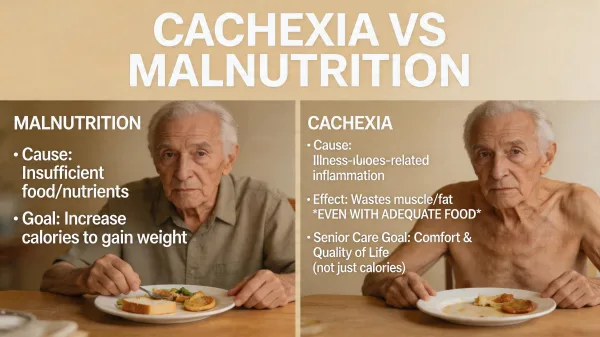
Where this gets confusing is that cachexia and malnutrition look almost identical from the outside. Both show up as weight loss, loss of muscle tone, fatigue, and a person who seems to be shrinking. The difference is what's driving it, and the difference changes what actually helps.
Malnutrition is a supply problem. The person isn't getting enough of the right nutrients, whether from poor appetite, difficulty chewing or swallowing, limited access to food, or a diet that's missing key components. Malnutrition responds to feeding. Increase calories and protein, address the barriers to eating, and the person usually stabilizes or improves.
Cachexia is a demand problem layered on top. Even when supply is adequate, the body's inflammatory state is burning through muscle and fat faster than food can replace. A malnourished senior who starts eating well regains weight. A senior with cachexia who starts eating well may slow the decline modestly, but will continue to lose muscle as long as the underlying disease drives the inflammation. Misidentifying cachexia as malnutrition leads to frustrated feeding attempts, conflict at mealtimes, and sometimes feeding tubes or IV nutrition that don't change the trajectory. That doesn't mean nutrition doesn't matter. It means the goal of nutrition changes.
Recognizing Cachexia in a Senior Living Setting
Senior living communities see weight loss frequently, and good communities track it closely. Monthly weight checks are standard in assisted living and memory care. A drop of more than 5% in six months, especially paired with loss of muscle tone in the face, shoulders, and thighs, is a signal worth raising with the medical provider.
Consider a situation where your father, who has been living in assisted living with a heart failure diagnosis, starts losing weight despite finishing most of his meals. Staff note he looks thinner in the face and his arms seem to have lost shape. His appetite is reasonable but he tires quickly during meals. This pattern, weight loss with preserved or near-preserved intake, is the fingerprint of cachexia rather than simple undereating.
Other signs to watch for include temporal wasting (hollowing at the temples), supraclavicular wasting (deep hollows above the collarbones), loss of grip strength, and persistent fatigue that isn't proportional to activity. In facility settings, the care team should be noting these alongside weights. In my years doing mobile X-ray work, I'd walk into a room and sometimes see cachexia written across someone's face before I saw the chart, and I could tell from the family's expressions that they had no idea what they were looking at.
Realistic Care Goals When Cachexia Is Present
When cachexia is driving the weight loss, the goal of nutritional care shifts from caloric targets to comfort and quality of life. Palliative care literature is clear on this point: in advanced illness, the aim is eating for pleasure rather than feeding to hit numbers. Small, favorite foods. No pressure at the table. Addressing symptoms that interfere with eating, including nausea, pain, constipation, or mouth discomfort. Accepting that what your parent can enjoy now may be far less than what they used to eat, and that's not a failure.
This shift was the hardest part for me personally. I spent five years caring for my first husband as he went through treatment for throat cancer, and I know the particular helplessness of watching someone you love lose weight while you stand in the kitchen trying to figure out what he might keep down. The instinct is to nourish. For a caregiver, that instinct is almost sacred, it's the most basic way we say we love someone. And cachexia is the condition that tells you the instinct alone won't save them. What I learned, too slowly, was that sitting with him while he ate two bites of something he actually wanted was worth more than any full plate I could plead into him. The goal had already changed, even before I was ready to accept it. Families deserve to be told directly that the goal has changed, because nobody arrives at that understanding on their own.
The medical team may also discuss appetite stimulants, anti-inflammatory approaches, or other pharmacologic options. These help some patients modestly. They don't reverse cachexia. Families deserve honest information about what these interventions can and cannot do.
What Structured Nutritional Support Actually Looks Like
Structured nutritional support in the context of cachexia is not about volume. It's about matching what the person can tolerate and enjoy with what their body can still use, and treating mealtimes as moments of comfort rather than clinical targets.
In practice, this usually includes small, frequent meals rather than three full plates, high-calorie and high-protein foods when tolerated, and foods the person actually likes. Familiarity matters more than nutrition theory at this stage. A favorite comfort food eaten in full is better than a balanced tray left half-finished. Texture modifications help if chewing or swallowing is an issue, and timing matters too, since many people eat better earlier in the day before fatigue sets in. Oral nutritional supplements like protein drinks can be offered, but should be treated as an option rather than a requirement. A registered dietitian experienced in palliative or geriatric settings can tailor a plan to the person's specific illness and preferences, and most good senior living communities can bring one in or refer to one.
Small practical changes sometimes do more than any supplement. Reducing strong cooking odors that trigger nausea, serving food on smaller plates so portions don't feel overwhelming, offering cold foods when hot foods feel heavy, and allowing the person to eat in a quiet space if noise and activity tire them. These adjustments don't reverse cachexia, but they can protect the pleasure of eating, which matters.
Artificial nutrition through feeding tubes or IV nutrition is a separate conversation and usually not appropriate in advanced cachexia. Research hasn't shown clear survival or quality-of-life benefit from these interventions in advanced cancer or dementia, and they carry real burdens including aspiration risk, discomfort, and restraint concerns. This is a decision for the family, the patient if able, and the medical team together, guided by what the person would want and what the goals of care actually are.
Working with Senior Living Staff on Cachexia Care
Good senior living staff can be real partners in cachexia care, but the family usually needs to drive the conversation. Ask the nursing director whether the community has worked with hospice or palliative care teams before. Ask how they handle residents who are losing weight despite eating. Ask what the communication rhythm looks like, whether they'll call you if your parent refuses multiple meals, and whether they'll push or respect that refusal based on your wishes and the medical plan.
I've spent nearly two decades working in hospital settings, and one pattern I see often is families assuming the facility or the medical team will raise the hard conversations first. They often won't, not because they don't care, but because they're waiting for the family's cue. You can ask directly: "Is this cachexia? What does that mean for what we should be doing?" The answer often opens up a better plan.
Questions Families Often Ask
Can cachexia be reversed?
Not usually, not once it's established. The underlying illness is the driver. If the illness can be treated and inflammation reduced (for example, successful cancer treatment), cachexia may improve. In advanced disease, the focus shifts to slowing progression where possible and maintaining comfort.
Should we try a feeding tube?
In most cases of advanced cachexia, feeding tubes don't extend life or improve quality of life, and they add their own burdens including aspiration risk, discomfort, and restraint concerns in people with dementia. There are specific situations where feeding tubes make sense, and this is a conversation for the medical team. Don't let fear of appearing to give up drive the decision.
How long does someone live after cachexia starts?
It depends on the underlying disease and stage. In advanced cancer, cachexia often signals the final months. In heart failure or COPD, the timeline can be longer. Your medical team can give you a better sense based on the specific diagnosis.
Is it cruel to stop pushing food?
No. Forcing food on someone whose body can't use it creates suffering without benefit. Offering food with love, accepting what they can take, and sitting with them is not neglect. It's appropriate care.
Can the assisted living community handle this?
Many can, especially with hospice or palliative care support brought in. Some situations may require a transition to a higher level of care or to hospice, either in the community or in a dedicated setting.
A Different Goal, Not a Lesser One
Cachexia asks families to trade one goal for another. The goal of keeping a parent nourished back to health gives way to the goal of protecting their comfort, dignity, and the quality of the time they have left. That trade feels like loss, because in a sense it is. But it's also the only goal that honors what's actually happening inside their body. A parent who dies peacefully, surrounded by people who understood the illness and stopped fighting the losing battle with the scale, has been cared for well.
If you're in the thick of this, you are not failing. The weight loss isn't a reflection of your effort. The confusion you feel is a reasonable response to a condition that doesn't respond to the most basic caregiving instinct. Ask the medical team whether cachexia is in play. If it is, let that knowledge guide the plan. Quality of life is a real and worthy goal, and in the context of wasting disease, it's the right one.