
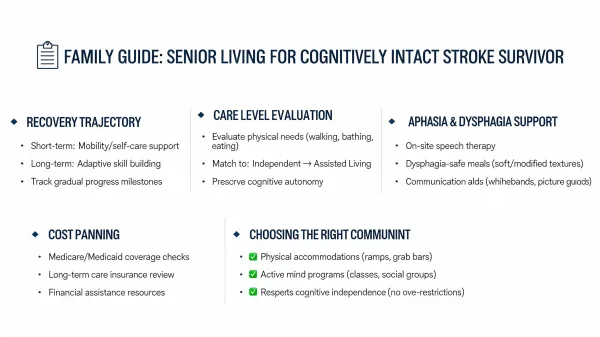
When a Stroke Changes Everything Except Your Parent's Mind
If your parent recently had a stroke, you're likely dealing with one of the most disorienting experiences a family can face. The person you know is still there, thinking clearly, understanding every word, following the conversation just like before, but their body won't cooperate the way it used to. Maybe they can't walk without help. Maybe they can't speak clearly, even though they know exactly what they want to say. And now someone at the hospital or rehab center is telling you it's time to start thinking about where your parent goes next.
That pressure is real, and it's unfair. You're being asked to make a major decision while you're still processing what happened. I've worked alongside stroke teams for years, and I've watched families sit in those discharge meetings trying to absorb information they weren't prepared for. The gap between what families hope recovery will look like and what the clinical team sees coming is one of the hardest things I've witnessed in nearly two decades of hospital work.
This guide is built for that exact moment. It covers what "plateau" actually means in stroke recovery, how to evaluate whether a care community will support your parent's physical needs without ignoring their intact mind, and what questions cut through the marketing to reveal how a place truly treats its residents. Your parent deserves a community that sees a whole person with a physical disability, not a diagnosis to be managed.
What Post-Stroke Disability Looks Like When Cognition Is Intact
Stroke affects the brain, but it doesn't always affect thinking. A large number of stroke survivors retain full cognitive function while living with significant physical disabilities. The disconnect between a sharp mind and a body that won't respond is something families struggle to wrap their heads around, and it's something many care communities handle poorly.
Consider a parent who had a left-hemisphere stroke two months ago. They understand everything you say, they follow conversations, they have opinions and preferences and humor. But they can't speak clearly because of expressive aphasia, and they have no functional use of their right arm and leg. Rehab has reached a point where the therapists are saying the current level of function is likely where things will stay. The family now needs a living situation that provides substantial physical assistance without treating their parent like someone who can't think for themselves.
The most common post-stroke physical disabilities that drive senior living placement include hemiparesis or hemiplegia (weakness or paralysis on one side of the body), expressive or receptive aphasia (difficulty producing or understanding speech), dysphagia (difficulty swallowing safely), balance and coordination problems that make falls a constant risk, and fatigue that limits endurance for daily activities. Any combination of these can make living alone unsafe, even when the person's judgment, awareness, and decision-making remain completely intact.
Recovery Trajectory: Understanding What "Plateau" Means and What Comes Next
The word "plateau" is one of the most misunderstood terms in stroke recovery, and families hear it at the worst possible time. When a therapist or physician says your parent has plateaued, most families interpret it as "recovery is over." That isn't what it means, but the distinction matters enormously when you're choosing a care setting.
Stroke recovery follows a well-documented pattern. The most rapid gains happen in the first three months, a period researchers call the early sub-acute phase. During this window, the brain is doing its most intensive self-repair work through a process called spontaneous recovery, where surviving neurons form new connections and recruit neighboring brain regions to compensate for damaged areas. This is when families see the biggest improvements, and it can create expectations that the pace will continue. The early gains can be dramatic, sometimes happening week to week, and they're fueled by biological processes that are unique to the injured brain, including neurogenesis, axonal sprouting, and the rebalancing of excitation and inhibition in cortical networks. Families who witness this rapid early progress often calibrate their expectations around it, which is part of why the slowdown that comes next hits so hard.
It usually doesn't. Between three and six months post-stroke (the late sub-acute phase), improvement slows considerably. After six months, the brain enters what neurologists call the chronic phase, and spontaneous neurological recovery largely reaches its limit. According to research published in Neurological Research and Practice, the most significant improvements occur in the first few weeks, often reaching a relative plateau after three months with less significant recovery subsequently, especially for motor symptoms.
Here's what families need to understand: neurological plateau and functional plateau aren't the same thing. Neurological recovery refers to the brain's biological healing, the regrowth and rewiring of neural pathways. That process does slow down and eventually stabilize. But functional recovery is different. Through ongoing therapy, adaptive strategies, and consistent practice, stroke survivors can continue making functional gains well beyond the six-month mark. Research from the American Physiological Society suggests that a critical period of enhanced neuroplasticity may extend beyond one year, and that patients who remain engaged in therapy continue improving in body function even at later chronic stages. The gains are slower and require more effort, but they're real.
The practical question for families choosing a care community is this: will the place continue working on functional improvement, or will they just maintain the current level of function? There's a meaningful difference between a community that provides ongoing outpatient therapy, encourages daily practice of adaptive strategies, and sets progressive goals versus one that simply helps your parent get through the day at their current ability level. Both are valid, but your parent's long-term trajectory depends on which approach the community takes.
When evaluating communities, ask specifically about their therapy partnerships and on-site rehabilitation services. Find out whether they coordinate with outpatient speech, physical, and occupational therapy providers. Ask what happens after the initial therapy authorization runs out. Does the community have staff who reinforce therapy exercises during daily routines, or does rehabilitation stop at the therapy room door? A community that understands the difference between neurological plateau and functional potential will talk about ongoing goals. A community that treats plateau as the finish line will talk about maintenance.
I've seen both approaches in practice. The families who asked these questions early made better long-term decisions, even when the initial answers weren't what they wanted to hear. Knowing where a community stands on continued therapy before you sign the agreement saves your parent from stagnating in a place that was never designed to push for more.
Finding a Community That Respects Intact Cognition With Physical Disability
This is the hardest part of post-stroke placement, and it's the issue families describe as the most painful. Your parent's body needs the level of help you'd find in an assisted living community or even a skilled nursing facility. But their mind needs the kind of engagement, autonomy, and respect that those settings don't always provide. The mismatch between physical dependence and cognitive awareness creates a specific kind of suffering that families underestimate until they see it happening.
Staff communication is the first and most revealing indicator of community culture. When you visit, watch how staff talk to residents who have physical limitations. Do they speak directly to the resident, or do they talk over them to a family member? Do they wait for a response from someone with aphasia, or do they finish sentences and move on? For a parent with expressive aphasia, this is critical. Your parent understands everything. They have thoughts, preferences, and the right to make decisions about their own day. If the staff defaults to talking past them because speech is slow or difficult, your parent will feel invisible in their own home.
Communication supports are non-negotiable for residents with aphasia. Ask whether the community has experience with communication boards, speech-generating devices, or picture-based choice systems. Find out if staff have received any training in supported communication techniques, things like giving extra time for responses, using yes/no questions when complex speech isn't possible, and offering visual options rather than open-ended verbal choices. Research from the American Speech-Language-Hearing Association shows that staff in long-term care settings often prioritize physical needs over interactional needs, unintentionally reducing communication to a functional minimum rather than supporting social connection and participation.
Activity programming reveals another layer of the problem. Many assisted living communities design their activities around cognitive stimulation for residents with dementia, things like simple crafts, sing-alongs, and reminiscence groups. For a cognitively intact stroke survivor, those programs can feel demeaning. Your parent likely wants to read, discuss current events, play strategic games, use a computer, or participate in conversations that match their intellectual capacity. Ask what the community offers for residents who think clearly but have physical limitations on participation. Can activities be adapted for one-handed use? Is there technology available that supports engagement when speech or mobility is limited?
Community culture is harder to measure but easy to feel when you visit. Walk through common areas and observe. Are residents with disabilities sitting alone in hallways, parked in front of televisions, or actually engaged with other people? Are wheelchairs clustered in a dining room corner, or are they integrated throughout the space? Look at how the physical environment is set up: is furniture arranged for easy wheelchair access, or do residents with mobility devices get pushed to the margins of every room? Talk to families of current residents if you can. Ask them whether their loved one feels respected and included, or whether they feel warehoused. During my years doing mobile X-ray work in care facilities, I saw both ends of this spectrum. Some places treated residents with physical disabilities as full participants in community life. Others treated them as bodies that needed to be moved, fed, and changed on schedule.
The single best question you can ask during a tour is: "How do your staff communicate with a resident who has aphasia?" If the answer is vague, if they don't know what aphasia is, or if they say "we treat everyone the same," keep looking. Communities that genuinely serve cognitively intact residents with physical disabilities will have specific, practiced answers to that question. The ones that don't will tell you everything you need to know by not having one.
What Families Often Underestimate: The Psychological Toll of Physical Dependence
Families tend to focus on the physical recovery after a stroke, and that makes sense. The physical changes are visible, measurable, and urgent. But what often goes unaddressed is how devastating it feels for a sharp-minded parent to suddenly need help with the most personal parts of daily life: toileting, bathing, dressing, eating. The loss of physical independence in a person who is fully aware of that loss creates a specific kind of grief that's different from what families with cognitively impaired loved ones experience. A parent with dementia may not fully register the indignity of needing help getting to the bathroom. A cognitively intact stroke survivor feels every moment of it. They remember what independence felt like. They can compare their current life to their former one in vivid, painful detail. And because they're aware, they often try to protect their family from seeing how much it hurts, which means the suffering goes underground where it's harder to address.
Your parent knows they need help. They can feel the indignity of it. They may stop asking for things they want because they don't want to be a burden. They may become withdrawn, irritable, or depressed, not because of cognitive decline, but because their sense of self has been fundamentally disrupted. Depression after stroke is extremely common, affecting roughly one-third of survivors, and it's often undertreated because the focus stays on physical rehabilitation.
When evaluating a community, ask about mental health support. Does the facility have access to counseling services, and specifically, do those counselors have experience with acquired disability in cognitively intact adults? A community that recognizes the emotional weight of physical dependence will talk about dignity in care delivery, resident choice, privacy during personal care, and emotional well-being as part of their standard approach.
Evaluating Care Levels: Assisted Living, Skilled Nursing, or a Hybrid Model
Post-stroke care needs don't fit neatly into standard care categories, and that's part of what makes placement so confusing. Assisted living communities provide help with activities of daily living like bathing, dressing, and medication management, but they vary widely in how much physical assistance they can safely deliver. If your parent needs two-person transfers, specialized positioning, or complex wound care, many assisted living communities won't be equipped to handle it.
Skilled nursing facilities offer higher levels of medical and physical support, including 24-hour nursing care, but they're often designed around populations with cognitive impairment. The environment, programming, and staffing ratios may not serve a cognitively intact stroke survivor well. Your parent could end up in a setting where they receive excellent physical care but have no real social interaction or intellectual engagement.
Some communities operate hybrid models or offer enhanced assisted living that bridges this gap. These settings provide higher levels of physical care, including some nursing support, while maintaining activity programming and community culture oriented toward engaged, aware residents. They cost more than standard assisted living, but for a cognitively intact stroke survivor with significant physical needs, they're often the best match. Ask communities directly where they fall on this spectrum and what physical care tasks their staff are trained and licensed to perform.
It's also worth understanding how communities handle the progression of needs over time. Your parent's physical abilities may change in either direction. Some stroke survivors gain function gradually with continued therapy, while others experience secondary complications or additional strokes that increase their care needs. Ask whether the community can adjust its care level up or down without requiring a full move to a different facility or wing. A community that offers tiered care within the same building gives your parent stability and continuity even as their situation evolves.
Matching Critical Physical Needs: Swallowing, Mobility, and Communication
Three post-stroke challenges require specific evaluation when choosing a community, because getting any of them wrong creates safety risks or quality-of-life problems that are hard to fix after move-in.
Swallowing and Dysphagia Management
Difficulty swallowing affects roughly half of stroke survivors initially, and while most recover safe swallowing within weeks, about 10 to 15 percent still have dysphagia six months later. If your parent is on a modified diet (thickened liquids, pureed foods, or specific textures), the community's dining program needs to accommodate that safely and consistently. Ask whether kitchen staff are trained on texture-modified diets, whether a speech-language pathologist reviews swallowing plans, and how the community monitors for aspiration risk during meals. Poor dysphagia management leads to aspiration pneumonia, which is a leading cause of post-stroke hospitalization. I've seen patients come back through the ER with aspiration pneumonia that could have been prevented with better mealtime supervision, and it's one of the most avoidable complications in post-stroke care.
Mobility and Fall Prevention
Hemiparesis changes everything about how a person moves through their day. The community needs to be physically accessible in ways that go beyond basic wheelchair ramps. Look for wide doorways, accessible bathrooms with grab bars positioned for one-sided weakness, and room layouts that accommodate wheelchair or walker use. Ask about fall prevention protocols and how staff assist with transfers. A community that understands hemiparesis will know that a person with right-side paralysis needs support set up on a specific side, and their staff will be trained accordingly.
Communication Support for Aphasia
If your parent has aphasia, every interaction with staff becomes a test of whether the community can actually serve them. Beyond the initial evaluation, ask for specifics. Will staff use communication boards during daily care? Is there a speech therapy referral process? Can the community facilitate video calls with family using adaptive technology? Aphasia doesn't diminish intelligence. It creates a barrier between the person and the world around them, and the right community actively works to lower that barrier every day.
What Post-Stroke Senior Living Costs and How to Plan
Post-stroke care typically costs more than standard senior living because of the additional physical support, therapy coordination, and specialized services involved. As of the 2025 CareScout Cost of Care Survey, the national median monthly cost for assisted living is $6,200, which works out to $74,400 annually. For a stroke survivor who needs enhanced care, add-on charges for extra assistance with transfers, medication management, and modified meals can push that figure significantly higher, sometimes by $1,000 to $2,000 per month or more depending on care tier.
If your parent's needs exceed what assisted living can provide, skilled nursing costs escalate sharply. The 2024 CareScout survey reported a national median of $111,325 per year for a semi-private room and $127,750 for a private room in a skilled nursing facility. That adds up fast, especially when the need for skilled nursing is driven by physical disability rather than a condition that's likely to be terminal in the near term.
Medicare covers short-term rehabilitation after a qualifying hospital stay (typically up to 100 days in a skilled nursing facility), but it doesn't cover long-term custodial care. Once rehab benefits run out, families are looking at private pay, long-term care insurance if the policy exists, Medicaid if the parent qualifies financially, or VA benefits for eligible veterans. Planning for the financial side early, even while your parent is still in rehab, gives you more options than waiting until discharge day.
I remember how quickly the financial reality hit when our family was going through a similar process. The numbers on paper and the numbers in practice were two different things, and the add-on costs were the part nobody warned us about until we were already committed.
Steps to Find the Right Post-Stroke Community Under Discharge Pressure
Hospital discharge timelines create real urgency, but rushing this decision leads to poor placement. Here's a structured approach that works within a tight window while protecting your parent's long-term well-being.
Step 1: Get a Detailed Functional Assessment From the Rehab Team
Before you tour a single community, ask your parent's physical therapist, occupational therapist, and speech-language pathologist for a written summary of current functional abilities, remaining deficits, and recommended ongoing therapy. This document becomes your matching tool. Every community you visit should be evaluated against what's on that list.
Step 2: Define Your Non-Negotiables
Based on the assessment, identify the care requirements that aren't flexible. If your parent aspirates on thin liquids, dysphagia management is non-negotiable. If they have right-side hemiplegia, two-person transfer capability might be required. If they have aphasia, communication support is essential. Write these down and bring them to every tour.
Step 3: Request Care Capability Specifics, Not Marketing Materials
Call communities before visiting and ask direct questions about their capacity to handle your parent's specific needs. Can they manage thickened liquids at every meal? Do they have staff trained in supported communication for aphasia? What's their protocol for residents who need two-person transfers? Communities that can't answer these questions clearly aren't equipped for your parent's care level.
Step 4: Tour With Your Parent When Possible
If your parent is physically able to visit, bring them. Watch how staff interact with them, especially if aphasia makes communication slower. Your parent's reaction to the environment tells you things a brochure never will. If they can't visit, bring a video of the community back to them and involve them in the decision to whatever degree is possible.
Step 5: Ask the Discharge Planner for a Short Extension If Needed
If you're being pressured to choose before you've had time to evaluate options properly, talk to the hospital or rehab facility's discharge planner about your concerns. In many cases, a few extra days can be negotiated, especially if you can demonstrate that you're actively working on placement. A poor placement that leads to rehospitalization costs the system more than a few additional days of transition planning.
Questions That Reveal a Community's True Culture
The questions you ask during tours matter more than anything you'll read in a facility brochure. These are the ones that separate communities built for people like your parent from those that aren't.
Ask: "Can you describe a typical day for a resident who uses a wheelchair and has difficulty speaking?" The answer should include specific activities, social opportunities, and communication strategies. Vague answers signal a lack of experience with this population.
Ask: "How do you handle care decisions for a resident who is cognitively intact but can't easily communicate verbally?" The right answer involves patience, adaptive tools, and a commitment to including the resident in their own care planning. The wrong answer involves defaulting to family members or staff making decisions on the resident's behalf.
Ask: "What happens when a resident's physical abilities change, either improving or declining?" You want to hear about reassessment processes, care plan updates, and therapy adjustments. You don't want to hear that residents get moved to a different unit or discharged.
Ask: "What training do your direct care staff receive on stroke-related disabilities?" If the answer is "general CNA training," that may not be enough. Communities that serve stroke survivors well train their staff specifically on hemiparesis care, aphasia communication, and dysphagia awareness.
Your Parent Is Still Your Parent
A stroke changes what your parent can do physically. It doesn't change who they are. The right community will see that distinction clearly, and it will show in how staff speak to your parent, how they include them in decisions, and how they structure each day around the assumption that this person has a full inner life that deserves engagement and respect.
Finding that place takes effort, especially when you're doing it under time pressure and emotional strain. But the work you put into this decision now determines your parent's daily experience for months or years to come. Use the assessment from the rehab team as your guide, ask the hard questions during tours, and trust your own observations about how a place feels when you walk through it.
You don't have to get this perfect on the first try. Many families make an initial placement and then transition to a better fit once the immediate crisis has passed. What matters most is that wherever your parent lands, the people caring for them understand that a body that needs help and a mind that works just fine can exist in the same person, and that person deserves to be treated accordingly. The right community is out there. It just takes the right questions to find it.