
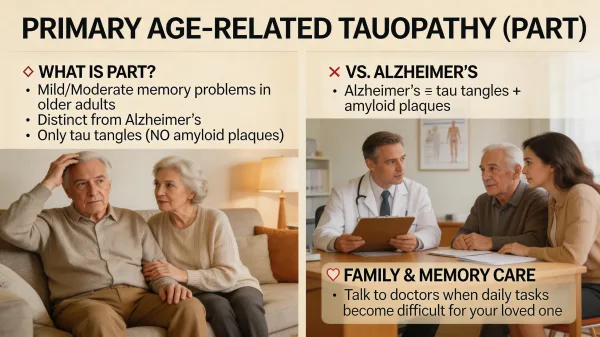
Primary age-related tauopathy (PART) is a brain condition in which tau protein tangles, similar to those found in Alzheimer's disease, develop in the brain without the amyloid plaques that define Alzheimer's. PART typically causes mild to moderate memory changes in older adults and follows a slower, less aggressive course than Alzheimer's.
Autopsy studies reveal that PART pathology is remarkably common. Research published in Acta Neuropathologica found that tau tangles without amyloid plaques are nearly universally detectable in elderly brains at autopsy. A 2024 study in Alzheimer's & Dementia examining over 1,500 autopsy cases identified PART in roughly 45% of all cases studied. And analysis of the National Alzheimer's Coordinating Center database found that about 14% of people clinically diagnosed with mild to moderate probable Alzheimer's disease actually had no significant amyloid plaques at autopsy, meaning their condition may have been PART or something similar all along.
Those numbers suggest that many families who believe they're dealing with Alzheimer's may actually be dealing with something different. From my own experience watching a family member's cognitive decline unfold, I know how much a diagnosis shapes the decisions you make and the timeline you prepare for. When the medical picture is unclear, families often feel paralyzed. This article is meant to help you understand PART, how it compares to Alzheimer's, and what it means for primary age-related tauopathy memory care planning, even when definitive answers are hard to come by.
What Is Primary Age-Related Tauopathy (PART)?
PART is a neuropathological condition first formally defined by researchers in 2014. The term describes brains that contain neurofibrillary tangles (twisted fibers of tau protein inside nerve cells) that look identical to those found in Alzheimer's disease, but without the amyloid-beta plaques that are the other hallmark of Alzheimer's. In PART, the tangles are mostly concentrated in the medial temporal lobe, the brain region involved in memory formation.
Symptoms in people with PART range widely. Some people show no cognitive changes at all. Others develop mild forgetfulness, particularly with recent events and names. A smaller number progress to more significant impairment, though profound dementia from PART alone is uncommon. The risk of greater impairment increases when PART coexists with other age-related brain conditions, which happens frequently in adults over 80. Researchers previously used terms like "tangle-only dementia" and "tangle-predominant senile dementia" for this condition, but those labels overstated the severity for most people affected. The PART designation better captures the full spectrum, from no symptoms to mild or moderate cognitive changes.
Because PART can't currently be confirmed with certainty during a person's lifetime (definitive diagnosis requires autopsy examination), families may receive a clinical description that points toward PART without a firm label. That ambiguity is one of the hardest parts.
PART vs. Alzheimer's: What the Differences Mean for Your Family
Understanding how PART differs from Alzheimer's disease isn't just an academic exercise. It directly affects care planning, medication decisions, expected timelines, and the emotional weight your family carries. The two conditions share visible similarities under a microscope, but they follow different biological paths and, in most cases, different clinical trajectories.
Different Protein Pathology
Alzheimer's disease involves two distinct types of abnormal protein deposits in the brain: amyloid-beta plaques that accumulate between nerve cells and tau tangles that form inside them. The prevailing theory holds that amyloid buildup triggers or accelerates the tau pathology, and together they drive the progressive neurodegeneration that defines Alzheimer's. PART involves only the tau tangles, without meaningful amyloid accumulation. This distinction matters because it changes the underlying biology. Without amyloid driving the process, the tau pathology in PART tends to remain more limited in its spread through the brain, staying concentrated in the medial temporal lobe rather than extending into the broader cortical regions the way Alzheimer's tau pathology typically does.
A Typically Milder Trajectory
Most people with PART experience either no cognitive symptoms or mild memory changes. When impairment does occur, it tends to progress more slowly than Alzheimer's. The average age of death for individuals with PART pathology is generally higher than for those with Alzheimer's, suggesting a less aggressive disease course overall. That said, "milder" doesn't mean "harmless." Higher levels of tau burden in PART (measured by Braak staging, a system that grades how far tangles have spread) are associated with more noticeable decline in memory, processing speed, and attention. Some individuals with advanced PART do develop significant cognitive impairment, particularly when other age-related brain changes are present alongside it. I've seen how quickly "mild" can shift in older adults. With my own family member, the early signs seemed manageable until they weren't. PART may move more slowly than Alzheimer's on average, but individual variation is real.
Why Alzheimer's Medications Aren't the Answer for PART
The newer Alzheimer's drugs approved in recent years target amyloid-beta plaques, the protein deposits that PART lacks by definition. Prescribing these medications for someone whose condition is driven by tau pathology alone would mean exposing them to serious potential side effects with no expected benefit. Older Alzheimer's drugs like cholinesterase inhibitors (donepezil, rivastigmine) work on neurotransmitter levels rather than disease pathology, and their effectiveness for PART specifically hasn't been studied. There is no approved treatment for PART as of 2025. Researchers are developing therapies that target tau pathology directly, including immunotherapies and antisense oligonucleotides, but these remain in clinical trials and haven't been validated for PART.
The Honest Reality: Diagnostic Certainty During Life Is Limited
Here's what makes this particularly difficult for families. PART can't be definitively confirmed while someone is alive. The gold standard is autopsy. During life, a neurologist may suspect PART based on a combination of factors: cognitive testing showing mild impairment, brain imaging showing temporal lobe changes without evidence of significant amyloid buildup (sometimes called a "SNAP" biomarker profile, for suspected non-amyloid pathology), and ruling out other causes. But these tools have limitations, and the line between PART and early Alzheimer's can be blurry. Families sometimes have to plan around ambiguity rather than waiting for clarity that may never come.
How Is PART Diagnosed?
In practice, families won't hear "your parent has PART" as a definitive clinical diagnosis the way they might hear "your parent has Alzheimer's." What they're more likely to hear is that testing shows signs of cognitive decline, possibly with tau-related changes on imaging, but without clear evidence of Alzheimer's-type amyloid pathology. The neurologist may mention PART as a possible explanation, or they may describe the findings without using the term at all.
Imagine your parent is in their late 80s with mild but steadily progressing memory problems. Testing rules out Alzheimer's, and the neurologist mentions PART, a condition your family can't find much about online. You're left trying to plan without a clear roadmap. That scenario is more common than most people realize, and it reflects the current state of PART diagnostics. Advanced PET imaging for tau and amyloid is available at some research centers, but it's expensive and not widely used in routine clinical care. CSF biomarkers (spinal fluid analysis) can also help differentiate, but again, these aren't standard tests for most patients. Working with a neurologist who is familiar with tauopathies beyond Alzheimer's is the best starting point. If your parent's neurologist isn't familiar with PART, asking for a referral to a memory disorders clinic at an academic medical center can help you get a more detailed evaluation.
Does a Milder Diagnosis Mean Memory Care Can Wait?
This is the question no one thinks to ask early enough. When a parent's condition is described as "milder than Alzheimer's" or "slower progressing," families often take that as permission to delay planning. That's understandable. It's also risky.
A slower trajectory gives you more time, but only if you use it. Memory care costs average $5,400 to $7,500 per month nationally as of 2025, depending on the source and region. That's $65,000 to $90,000 a year. If your parent's condition progresses over four to six years rather than two to three, you're not spending less. You may be spending more over a longer timeline. Financial planning needs to account for a potentially extended care period, not just a delayed one. Families who assume a milder diagnosis means lower total cost are often caught off guard when they add up the numbers across a longer span of years.
The practical needs don't always track neatly with the diagnosis, either. A person with PART may remain largely independent for years but still develop safety concerns: forgetting to turn off the stove, getting confused while driving, missing medications. Those functional gaps often drive the memory care decision more than the diagnosis itself. From working in hospitals nearly 20 years, I've seen families wait for a crisis to force the decision. Planning while things are stable gives you better options and more control.
How Should Families Plan for a PART Diagnosis?
Start with the legal and financial groundwork while your parent can still participate in decisions. That means power of attorney, healthcare directives, and an honest accounting of financial resources. These conversations are uncomfortable. They're also far harder to have after significant decline sets in.
On the care planning side, focus on functional ability rather than diagnostic labels. Ask practical questions: Can your parent manage medications safely? Are they eating regularly? Can they handle an emergency if one occurs? If the answers are shifting, it's time to evaluate support options, whether that's in-home help, adult day programs, or memory care communities. Don't benchmark your planning against an Alzheimer's timeline or a PART timeline. Benchmark it against what your parent can and can't do right now, and build in flexibility for what might change. Revisit the assessment every six months. Cognitive conditions don't follow a schedule.
If you're considering memory care communities, visit them before you need one. Ask about their experience with residents who have milder or atypical dementia presentations. Not every community is equipped to support someone whose needs are moderate rather than severe. From years of caring for others, both in my own family and professionally, I've learned that the families who feel most at peace with their decisions are the ones who started gathering information before the pressure was on.
What Does Current Research Say About PART?
PART research is still in relatively early stages. The term was only formalized in 2014, and there's active scientific debate about whether PART is truly a distinct disease process or simply a point on the spectrum of normal aging. Some researchers argue that the tau changes seen in PART are an inevitable part of getting older and only become clinically significant when they reach a certain threshold or combine with other age-related brain pathologies like Lewy body disease or TDP-43 protein deposits. Others maintain that PART represents a separate tauopathy with its own biological drivers.
What researchers do agree on is that PART is extremely common, that it can contribute to cognitive impairment in a subset of older adults, and that better diagnostic tools are needed to identify it during life. Tau-specific PET imaging is improving and may eventually allow clinicians to distinguish PART from Alzheimer's and other tauopathies with more confidence. Several tau-targeting therapies are in clinical trials for various tauopathies, though none are specifically designed for PART yet. For families, the practical takeaway is this: the science is catching up, but it isn't there yet. Decisions about care can't wait for research consensus.
Planning Through Uncertainty
Getting a diagnosis that raises more questions than it answers is disorienting. PART doesn't have the name recognition of Alzheimer's, the established care pathways, or the treatment options. What it does have is a generally slower course and a window for families to plan thoughtfully rather than reactively.
When my family member's cognitive decline accelerated, one of the hardest parts was realizing we'd spent months waiting for medical clarity instead of putting practical plans in place. The diagnosis never became perfectly clear, but the need for care did. We could have used that earlier time better. I think about that often now when I talk to families going through something similar, because the instinct to wait for answers before acting is so strong, and it can cost you the time you actually had to prepare. If your family is in that place right now, uncertain about the diagnosis but watching changes happen, the most productive thing you can do is plan for what you can see, stay in regular contact with your parent's neurologist, and build a care plan that adapts as needs change. You don't need a perfect diagnosis to make a good decision. You just need to be paying attention.