
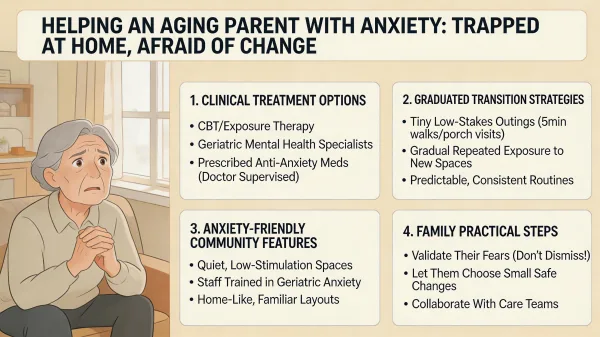
You call your mother for the second day in a row and she doesn't pick up. By the third call, you're in the car. When you finally reach her, she's sitting in her recliner. She hasn't eaten since yesterday morning. The kitchen is only twelve feet away, but she tells you she's too afraid to walk there. She's afraid she'll fall. She's afraid of what might happen if she passes out and nobody finds her. She's afraid of everything, and that fear has shrunk her world to a single chair in a single room.
If this sounds familiar, you're living with something millions of families face but rarely talk about: a parent whose severe anxiety has effectively made them a prisoner in their own home. This isn't occasional worry or normal aging caution. This is clinical anxiety so intense that it overrides your parent's ability to care for themselves, accept help, or consider any change at all.
The cruel paradox is that your parent needs to move to a safer environment, but the anxiety itself makes any transition feel impossible. Every conversation about senior living triggers panic. Every suggestion gets met with refusal. You can see the situation getting worse by the week, and you feel completely stuck. I've spent years working with people in fear and distress, both in the ER and during my years running a daycare where anxious children would cling to the door frame rather than let a parent leave. Anxiety looks different at 80 than it does at 4, but the core experience is the same: the fear is real, it's overwhelming, and it won't respond to logic.
This article will help you understand what's driving your parent's resistance, why traditional approaches often backfire, and what specific strategies can make a senior living transition possible even when anxiety seems like an immovable wall.
Why Severe Anxiety in Older Adults Looks Different Than You Expect
Anxiety disorders affect an estimated 10 to 20 percent of older adults, according to the National Council on Aging, yet the condition is frequently missed. A 2023 column in JAMA Psychiatry noted that only about one-third of older adults with generalized anxiety disorder receive any mental health treatment. Part of the problem is that anxiety in seniors often doesn't look like what families picture. Your parent probably isn't having visible panic attacks or talking about feeling anxious. Instead, the anxiety shows up as physical complaints, rigid routines, refusal to leave home, and escalating resistance to any change.
Fear of falling is one of the most common drivers. Research shows that 30 to 73 percent of older adults who have experienced a fall develop a lasting fear of falling again, and up to 70 percent begin restricting their activities because of it. Over time, this avoidance creates a devastating cycle: less movement leads to weaker muscles, which increases fall risk, which deepens the fear. Some seniors become functionally housebound not because they can't walk, but because they're terrified of what might happen if they try.
There's also a clinical condition called late-life agoraphobia, which the DSM-5 defines as intense fear or avoidance of situations where escape might be difficult or help might not be available. In older adults, this often centers on fear of falling, fear of a medical emergency away from home, or fear of being somewhere unfamiliar without support. Johns Hopkins reports that agoraphobia affects roughly 2 percent of U.S. adults, with higher rates among older adults and women. In severe cases, it can leave a person entirely dependent on others for basic needs.
What matters for your family is this: your parent's refusal to leave the house, accept help, or consider moving isn't stubbornness. It's a treatable medical condition.
The Anxiety-Resistance Cycle: Why Your Parent Fights Every Suggestion
Families often describe a frustrating pattern. You raise the topic of getting some help or visiting a community, and your parent immediately shuts down. They might get angry, cry, refuse to discuss it, or agree to something in the moment and then refuse when the time comes. Each failed attempt makes the next conversation harder.
This is the anxiety-resistance cycle, and understanding it changes everything. When a person with severe anxiety is confronted with the thing they fear (change, strangers, leaving home), their nervous system triggers a fight-or-flight response. The logical part of their brain goes offline. They can't process your careful reasoning about safety statistics or community amenities because their body is telling them they're in danger right now.
Pushing harder doesn't work. Reasoning doesn't work. Presenting brochures and tour schedules when your parent is already in a fear state actually reinforces the association between "senior living" and "threat." I've seen this same dynamic play out hundreds of times in clinical settings, where a terrified patient can't cooperate with a procedure no matter how clearly you explain why it's necessary. Fear doesn't respond to facts. It responds to safety, trust, and gradual exposure.
That's why the transition strategy has to start long before moving day.
Getting the Right Clinical Support First
Before you tour a single community or pack a single box, your parent needs a clinical evaluation from someone who specializes in geriatric mental health. A geriatric psychiatrist is the gold standard here. These are physicians with specialized training in how psychiatric conditions present in older adults, how aging affects medication metabolism, and how to manage anxiety alongside other medical conditions that are common in the elderly.
A geriatric psychiatrist can do several things a primary care physician typically can't. They can distinguish between generalized anxiety, late-life agoraphobia, depression-driven anxiety, and anxiety caused by medication side effects or interactions. This matters because the treatment approach differs for each one. They can also perform a thorough medication review, since older adults often take five or more prescriptions from different providers, and drug interactions can actually cause or worsen anxiety symptoms.
The treatment conversation usually starts with SSRIs (selective serotonin reuptake inhibitors), which are the first-line medications for anxiety in older adults. Families should know that these medications take longer to work in elderly patients, sometimes two to three months before the full benefit is clear, though modest improvement may start within four to eight weeks. Cognitive behavioral therapy, especially when it includes gradual exposure techniques, is also highly effective and can be delivered through telehealth if your parent won't leave home.
What about benzodiazepines like Xanax or Ativan? Geriatric specialists generally avoid these for ongoing use in older adults because they increase fall risk, cause confusion, and can worsen cognitive function. There may be rare, short-term exceptions during an acute crisis, but these should be carefully managed by a specialist.
Breaking Through Anxiety: Transition Strategies That Actually Work
Once your parent's anxiety is being actively treated, you can begin the transition process. The key word is "begin," because rushing this is the single biggest mistake families make. Forcing a move without adequate preparation often backfires in ways that are hard to recover from. A parent who is moved against their will during peak anxiety may refuse to eat, stop speaking to family members, or experience such severe distress that the community can't manage their care. I've watched families who meant well create trauma that took months to undo, simply because they didn't realize how much groundwork the transition required.
I learned this lesson early. During my ten years running an in-home daycare, I worked with children who had severe separation anxiety, kids who would scream, cling, and physically resist being left in a new place. The parents who pushed through with a quick goodbye and a firm hand often made the anxiety worse. The children who adjusted best were the ones whose parents came for short visits first, then stayed for gradually shorter periods, then left and came back predictably. Over those years, I watched dozens of anxious kids transform once they felt safe enough to trust their surroundings. It taught me that anxiety isn't defiance. It's a nervous system that doesn't feel safe yet, and the only way through it is to build that safety slowly and consistently. That same principle applies when you're helping an 80-year-old parent who hasn't left their apartment in three months. The ages are different. The fear is the same.
Graduated exposure is the most effective framework, and it's the same principle that therapists use to treat phobias. You start with the least threatening step and slowly work toward the goal, never pushing past what your parent can tolerate. For a housebound parent with severe anxiety, a graduated plan might look like this over the course of several weeks or months: first, a geriatric psychiatrist begins medication and telehealth therapy. Next, a home health aide visits just to sit and talk for 30 minutes, with no caregiving tasks. Then that aide begins helping with one small thing, maybe bringing lunch or organizing medications. Eventually, you take a short car ride together with no destination pressure. Then a drive past a senior living community. Then a brief visit to the lobby. Then a meal in the dining room. Each step builds on the last, and none should happen until your parent is reasonably comfortable with the previous one.
Respite stays can serve as a powerful bridge between home and a permanent move. Many assisted living communities offer short-term stays of one to four weeks, which give your parent a chance to experience the environment without the permanence of "moving." Frame it as a trial, not a decision. Some families find that the language matters enormously: "Let's try this for two weeks so I can get some rest" feels very different from "We've decided you're moving here."
Involving a consistent person throughout the transition is critical. Ideally, one family member or a hired companion should be present during every new step, from the first aide visit to the first night in the community. Anxious people anchor to familiar faces, and switching between multiple helpers during a high-stress period increases confusion and fear. If possible, arrange for this person to stay with or near your parent during the first one to two weeks after the move. That physical presence communicates safety in a way that phone calls can't.
Medication timing matters here, too. Work with the geriatric psychiatrist to optimize your parent's anxiety treatment before the move, not during it. If an SSRI was recently started, allow enough time for it to reach therapeutic effect. Some specialists will temporarily adjust dosing or add a short-term medication specifically to reduce acute anxiety around the transition period. This isn't sedation. It's giving your parent's nervous system enough support to tolerate the change.
After the move, expect an adjustment period. Research suggests that most seniors take three to six months to fully adjust to assisted living. For someone with severe anxiety, it may take longer. The first two weeks are usually the hardest. Your parent may call repeatedly asking to come home, refuse to participate in activities, or express anger and grief. This is normal and it doesn't mean the move was wrong. Stay steady, stay compassionate, and keep communicating with the community's care team about what's working and what isn't.
What an Anxiety-Friendly Community Looks Like
Not every senior living community is equipped to support a resident with severe anxiety, and choosing the wrong environment can set the entire transition back. When you're evaluating communities for an anxious parent, you're looking for specific characteristics that go beyond clean rooms and friendly staff.
Size matters. Smaller communities with 30 to 60 residents tend to be less overwhelming than large campuses with hundreds. The hallways are shorter, the dining room is quieter, and your parent is more likely to see the same faces every day. That consistency builds the sense of predictability that anxious people need. Staff consistency is equally important. Ask whether the community assigns the same caregivers to the same residents, or whether staffing rotates constantly. A parent with severe anxiety who has to adapt to a different aide every shift will struggle significantly more than one who sees the same three or four people throughout the week.
Ask about their approach to new resident integration. This is the question most families never think to ask, and it reveals more about a community's care philosophy than almost anything else. Many communities have a standard orientation that involves meeting the activities director on day one, attending a group lunch on day two, and being encouraged to join social programming by the end of the first week. For a resident with severe anxiety, that pace can be overwhelming enough to trigger a crisis. What you want to hear is that they can customize the integration timeline, letting your parent eat in their apartment for the first week if needed, introducing one staff member at a time, and allowing participation in activities to happen gradually rather than on a set schedule.
On-site mental health services are a major advantage. Some communities have a geriatric psychiatrist or psychiatric nurse practitioner who visits regularly, which means your parent won't need to leave the building for mental health appointments. Others have partnerships with telehealth providers. Either way, confirm that the community has a plan for ongoing anxiety management, not just a one-time assessment at move-in. Ask how they handle residents who become acutely anxious or panicked. The answer should involve trained staff, de-escalation techniques, and communication with the resident's mental health provider, not just "we call the family."
Finally, observe the overall environment during your visit. Is the common area calm or chaotic? Are there quiet spaces where your parent can retreat if they feel overwhelmed? Is the lighting gentle or harsh? These details might seem small, but for someone whose nervous system is already on high alert, they make a real difference.
The Cost Reality: Budgeting for Anxiety Care and Senior Living Together
Families dealing with a parent's severe anxiety face costs on two fronts: mental health treatment and senior living. Understanding both helps you plan realistically.
Geriatric psychiatry visits typically run $200 to $400 for an initial evaluation and $100 to $250 for follow-up appointments, though Medicare Part B covers most outpatient psychiatric services with standard copay requirements. Therapy sessions, whether in-person or telehealth, usually cost $100 to $200 per session, and Medicare covers many of these as well. Medications like SSRIs are generally affordable, with most available as generics for under $20 per month.
The larger expense is senior living itself. As of 2025, the national median cost of assisted living is roughly $6,200 per month, according to CareScout's Cost of Care Survey. That's approximately $74,400 per year. Communities with specialized mental health support or smaller, more personalized environments may charge somewhat more. Some communities charge additional fees for higher levels of care, so a resident who needs extra monitoring or support during the adjustment period might face a surcharge of $500 to $1,500 per month that could decrease as they stabilize.
Respite stays, which can be valuable for testing a community before committing, typically cost a daily rate that's higher than the equivalent monthly rate, often $200 to $350 per day depending on location and services. A two-week trial stay might cost $2,800 to $4,900.
When Your Parent Refuses Everything: The Hardest Decisions
Some parents with severe anxiety refuse all treatment, all help, and all discussion of change. You know the situation is unsafe. They're not eating well, they're isolated, they may have fallen and not told you. But they're an adult, and unless they've been declared legally incapacitated, they have the right to make their own decisions, even poor ones.
This is one of the most painful positions a family can be in. There's no easy answer.
If your parent has decision-making capacity, meaning they can understand their situation, appreciate the consequences, reason through options, and express a consistent choice, you generally can't force a move. What you can do is keep showing up, keep offering small forms of help, and keep the door to treatment open. Sometimes a crisis, like a fall or a hospitalization, creates a window where your parent is more willing to accept help. Having a plan ready for that moment can make all the difference.
If you believe your parent's anxiety has impaired their capacity to make safe decisions, a formal capacity evaluation by a geriatric psychiatrist or neuropsychologist is the appropriate step. This isn't something to pursue lightly, and it doesn't automatically give you authority to make decisions on their behalf. But it can open the door to guardianship or conservatorship proceedings if the situation is truly dangerous. Consulting with an elder law attorney early in this process is strongly recommended.
Consider also that your parent may accept help from someone who isn't you. Adult children sometimes carry an emotional charge that makes every interaction feel higher-stakes. A trusted friend, a clergy member, or a geriatric care manager (sometimes called an aging life care expert) may be able to reach your parent in ways you can't. I've learned over years of caregiving that sometimes the best thing you can do is step back and let someone else take the lead, not because you're doing it wrong, but because the relationship dynamic itself is part of the resistance.
Protecting Your Own Mental Health Through This Process
Watching a parent deteriorate while they refuse help is one of the most stressful experiences a person can go through. The guilt, the frustration, the fear that something terrible will happen while you're trying to respect their wishes: it accumulates.
You don't have to carry this alone. Caregiver support groups, both in-person and online, connect you with people who understand exactly what you're facing. A therapist who works with family caregivers can help you process the grief and make decisions from a grounded place rather than a panicked one. And setting boundaries around your own time and energy isn't selfish. It's necessary. You can't manage a months-long transition strategy if you're running on empty.
The situation your family is in right now won't last forever, even though it feels like it will. Anxiety is treatable. Transitions are possible. And the parent who refuses to leave their recliner today may, with the right support and enough time, be the one telling you about the friend they made at lunch. That outcome is worth working toward, even when the path there feels impossibly slow.