
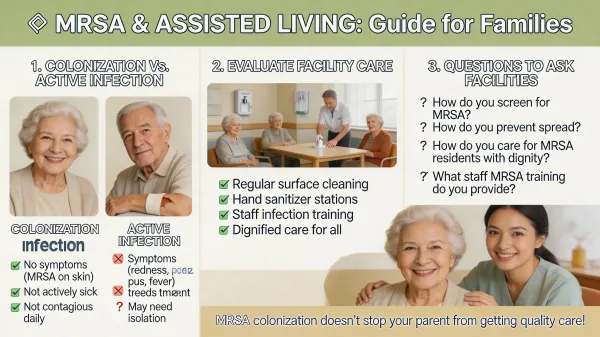
Will your parent's MRSA status prevent them from getting into assisted living? In most cases, no. MRSA colonization alone isn't a valid medical reason for a senior living community to deny admission, and many states explicitly prohibit facilities from turning away residents solely because they carry a communicable organism. The reality, though, is more complicated than a simple yes or no. Some communities refuse MRSA carriers out of fear or misunderstanding. Others accept them on paper but don't follow proper infection control protocols once your parent moves in. And a few handle MRSA exactly the way the evidence says they should: with consistent, facility-wide hygiene practices that protect everyone without isolating or stigmatizing the carrier.
If your parent has been colonized with MRSA after hospitalizations or recurrent infections, you're likely dealing with two problems at once. The first is medical: making sure the infection is properly managed and that your parent's care team has a plan. The second is social: finding a community that treats your parent as a person, not a biohazard. Both problems are solvable, but they require asking the right questions and knowing what good MRSA management actually looks like.
Consider a situation where your parent has been hospitalized three times in two years and tested positive for MRSA colonization during the most recent discharge. You start calling assisted living communities. Two refuse outright once they hear "MRSA." A third says they accept MRSA residents but can't explain their infection control protocol when you press for details. A fourth responds with specific questions about your parent's colonization sites, current treatment, and wound status. That fourth community is the one worth visiting. The difference between these responses tells you everything about how your parent will be treated once they move in.
I've seen infection control handled well and handled terribly in care facilities, and the difference almost always comes down to consistency. The facilities that do it right make hand hygiene and contact precautions part of the culture. The ones that don't treat it as a box to check when someone's watching. This article will help you tell the difference before your parent signs a lease.
What Is MRSA and Why Is It So Common in Senior Care?
MRSA (methicillin-resistant Staphylococcus aureus) is a strain of staph bacteria resistant to several common antibiotics. According to the CDC, about 2 in every 100 people in the general population carry MRSA, usually without symptoms. In senior care settings, those numbers climb sharply. Studies have found MRSA colonization rates ranging from 5% to 50% in nursing homes, often exceeding the rates seen in hospital intensive care units.
Older adults are more vulnerable for several connected reasons. Frequent hospitalizations expose them to the organism. Age-related immune decline makes clearance harder. Chronic wounds, urinary catheters, and feeding tubes create entry points. And communal living means close contact with staff and other residents throughout the day. Most seniors who carry MRSA acquired it during a hospital stay, not in their care community.
The important thing for families to understand is that MRSA colonization is extremely common in this population. Your parent isn't unusual. They aren't dangerous. And they aren't the only person in any given community carrying antibiotic-resistant bacteria, whether the community acknowledges it or not.
Colonization vs. Active Infection: What Senior Living Communities Need to Understand
This distinction is the single most important concept for families and communities to get right, because it determines everything: what precautions are necessary, whether isolation is warranted, and how your parent should be treated day to day.
Colonization means MRSA bacteria are living on your parent's body (typically in the nose, on the skin, or in a wound) without causing illness. There are no symptoms. No fever, no redness, no pus, no infection. Your parent carries the organism the way roughly one in three people carry regular staph bacteria in their nose without ever getting sick. Colonized individuals can potentially spread MRSA to others through direct contact, but the risk is manageable with standard hygiene practices that should already be part of any care community's routine: hand washing between residents, proper glove use, and regular cleaning of shared surfaces.
Active infection means MRSA has invaded tissue and is causing clinical symptoms. This might look like a skin wound that's red, swollen, warm, and draining pus. It could be a urinary tract infection, pneumonia, or, in serious cases, a bloodstream infection. Active MRSA infections require medical treatment, and they do call for additional precautions beyond standard hygiene. During an active wound infection, for example, the wound needs proper dressing and management to prevent transmission. A resident with MRSA pneumonia and an uncontrolled cough may need to wear a mask in common areas temporarily.
Here's where many communities get it wrong. They treat colonization and active infection as the same thing. A colonized resident with no active symptoms gets placed on unnecessary contact precautions, restricted from dining rooms and group activities, or isolated in their room for weeks. This isn't just wrong socially. It's wrong medically. The CDC's guidance for long-term care facilities is clear: standard precautions (hand hygiene, gloves when contact with body fluids is expected) are sufficient for residents who are colonized but not actively infected. Full contact precautions, including gowns, are appropriate during active infection or during a documented outbreak.
Decolonization protocols exist and can reduce MRSA carriage. The most evidence-backed approach involves chlorhexidine body washes combined with mupirocin nasal ointment, typically applied for five days on a twice-monthly cycle. A major randomized trial published in the New England Journal of Medicine found that this protocol reduced MRSA infections by 30% in carriers after hospital discharge. Some communities incorporate universal decolonization bathing for all residents, which a 2023 NEJM trial across 28 nursing homes showed reduced infection-related hospitalizations. Ask whether your parent's community uses any decolonization protocol, and if not, discuss it with their physician.
The question families should be asking isn't "Does this community accept MRSA patients?" It's "Does this community understand the difference between colonization and active infection, and does their policy reflect current evidence?" A community that isolates every MRSA-positive resident regardless of clinical status is telling you their infection control knowledge is outdated or fear-driven. A community that has tiered protocols, with standard precautions for colonized residents and enhanced precautions only during active infection, is working from the evidence.
The MRSA Stigma Problem in Senior Living
MRSA carries a stigma that far exceeds its actual risk in most senior living situations. Families report being told their parent "can't live here" or being quietly steered away during tours once MRSA status comes up. Some communities use language like "we aren't equipped" or "we don't have the staffing for that level of infection control," even when MRSA colonization requires nothing beyond the standard hygiene practices every community should already have in place.
This stigma affects residents directly. Colonized individuals who are unnecessarily isolated from activities, dining, and social spaces experience measurable declines in mental health, physical function, and quality of life. Research on infection control in long-term care has repeatedly emphasized that interventions to control MRSA transmission should be balanced against concerns for resident quality of life. Isolation should be reserved for genuine clinical need, not applied as a blanket policy out of convenience or fear.
From my years working inside healthcare settings, I can tell you that stigma often masks a deeper problem: the community doesn't have strong infection control practices and knows it. It's easier to keep MRSA carriers out than to train staff properly. That's a red flag about overall care quality, not just MRSA management.
Finding Communities That Handle MRSA in Senior Living Correctly
The infection control practices you want to see aren't exotic. They're the basics, done consistently. The challenge is that "consistently" is the hardest word in senior care. What you're evaluating isn't whether a community has a written infection control policy (they all do). You're evaluating whether that policy is actually followed on every shift, by every staff member, even when no one is supervising.
Start with hand hygiene. Every resident interaction should begin and end with hand washing or alcohol-based hand sanitizer. Hand sanitizer dispensers should be visible at room entrances, in dining areas, and at nursing stations. During your tour, watch whether staff actually use them. I saw infection control practices drop the moment supervisors left the floor in facility after facility during my years doing mobile X-ray work. I'd walk into a building where the front desk looked polished and the hallways smelled clean, but once I got to the back units and started working with residents, the gloves came off (literally) and the hand washing stopped. Staff would go from one resident's wound care to another resident's meal tray without pausing at the sink. The marketing tour and the Tuesday night shift are two different worlds, and the infection control you see during a scheduled visit may not reflect what happens at 10 p.m. on a Saturday. If you can visit at different times, including evenings or weekends, do it. That's when you'll see how embedded the protocols truly are.
Ask about their MRSA-specific protocols. A competent community will distinguish between colonization and active infection in their answer. They should describe standard precautions for colonized residents (hand hygiene, gloves for wound care or body fluid contact) and enhanced contact precautions only for active infections. If their answer is "we isolate all MRSA-positive residents," that's a policy built on fear, not evidence. Ask how they handle wound care for MRSA-positive wounds: you want to hear about proper dressing technique, dedicated wound care supplies, and staff trained in contact precautions during dressing changes.
The admission conversation matters. Disclose your parent's MRSA status upfront. You want transparency from the community, and that starts with transparency from you. A community that reacts to MRSA disclosure with alarm or confusion isn't equipped to manage it. A community that responds with specific follow-up questions about whether the colonization is active or resolved, what sites are involved, and what the current treatment plan looks like is demonstrating competence. If a community flatly refuses admission based on MRSA status alone, know that many states prohibit long-term care facilities from denying admission solely because of a communicable disease. Maryland's regulations state this explicitly, and similar protections exist in other states through health department guidelines and fair housing laws. Document the refusal and consult your state's long-term care ombudsman.
Staff training is another indicator. Ask when infection control training last occurred and how often it's required. Annual training is the minimum standard. Communities with strong programs train quarterly and include hands-on competency checks, not just slide presentations. Ask about staff turnover, too. High turnover means new staff who may not have received thorough training yet, and MRSA management requires everyone on the floor to follow the same protocol every time.
Questions That Reveal Whether a Community Is Competent
The question no one thinks to ask is the most revealing one: "How many current residents are MRSA-positive?" If the answer is zero, be skeptical. Given that MRSA colonization rates in senior care settings range from 5% to 50% depending on the population, a community claiming zero MRSA-positive residents is either not testing, not tracking, or not being honest. Any of those answers tells you something about how seriously they take infection surveillance.
Other questions worth asking during your evaluation:
Does the community screen new admissions for MRSA? Routine screening isn't universal, but communities that do it demonstrate proactive infection awareness. What happens when a resident develops an active MRSA infection? You want to hear about medical response protocols, not just isolation. How does the community handle shared equipment like blood pressure cuffs and wheelchairs? Proper cleaning between residents is a basic but often neglected step. Can colonized residents participate in all community activities? The answer should be yes for colonized residents without active symptoms. What's the community's policy on notifying roommates or nearby residents? This is a balancing act between transparency and privacy, and a good community will have thought it through.
I've learned that the way a community answers questions about infection control tells you as much about their overall care philosophy as anything on their brochure. Confidence and specificity are good signs. Vagueness or defensiveness are not.
Legal Protections for MRSA Carriers in Senior Living
The legal picture around MRSA admission varies by state, but several protections exist. Federal fair housing laws prohibit housing discrimination based on disability, and assisted living communities fall under these protections. While MRSA colonization itself may not qualify as a disability under the ADA, some states have regulations that specifically prohibit long-term care facilities from denying admission based solely on communicable disease status.
Nursing homes that receive Medicare or Medicaid funding face stricter requirements than private-pay assisted living communities. They generally can't refuse a resident they're equipped to care for based on infection status. Assisted living regulations are state-controlled, and the rules vary widely. In some states, a community can decline admission if they determine the resident's needs exceed their licensed level of care. But "has MRSA" alone typically doesn't meet that threshold, since managing MRSA colonization doesn't require skilled nursing.
If your parent is denied admission and you believe the decision was discriminatory, contact your state's long-term care ombudsman program and your state health department's licensing division. Document the denial in writing, including the reason given. These agencies can investigate and, in some cases, compel communities to reconsider.
What Proper MRSA Management Adds to Senior Living Costs
The honest answer: very little, if the community is already following basic infection control standards. MRSA management for a colonized resident shouldn't add anything to your monthly bill beyond what any resident requires. Standard hygiene supplies, gloves, and hand sanitizer are operational costs the community should already absorb.
If your parent has an active MRSA wound requiring ongoing care, some communities may charge for wound care supplies or nursing time as part of their tiered care pricing. With the national median assisted living cost at $6,200 per month as of the 2025 CareScout Cost of Care Survey, additional wound care charges might add $200 to $500 monthly depending on the severity and the community's fee structure. Ask for a written breakdown before signing the admission agreement.
Communities that charge a significant premium simply for MRSA-positive status, without any additional care needs, are profiting from stigma. That's a red flag worth walking away from.
Helping Your Parent Through the Process
Beyond the medical and logistical concerns, your parent is likely dealing with feelings about their MRSA status that they may not express directly. Nobody wants to feel like they're "contaminated" or that they'll be treated differently because of something they didn't choose. Reassure them that MRSA colonization is common, manageable, and doesn't define their quality of life. The right community will see them as a person first.
Help your parent prepare for the admission process by gathering their medical records, including recent culture results, any decolonization protocols they've completed, and notes from their infectious disease specialist if they have one. Having this documentation organized shows communities that the MRSA status is being actively managed and that your family takes the medical side seriously. It also gives the community's nursing staff what they need to build an appropriate care plan from day one.
When I think about what separates good care from adequate care, it comes down to dignity. A resident with MRSA deserves the same access to meals, activities, friendships, and daily life as everyone else. The precautions needed to keep them and others safe are modest. They just need to be done consistently. Finding a community that understands this, both in policy and in practice, is the goal.
Start your search early. Talk to multiple communities. Ask the hard questions. And trust what you observe during visits more than what you read in brochures. The community that handles MRSA correctly is almost certainly handling everything else correctly, too. Your parent's MRSA status isn't a barrier to a good life in senior living. It's a filter that helps you find the communities worth choosing.