
When Hearing Loss Becomes More Than an Inconvenience
Research consistently links untreated hearing loss to a significantly higher risk of dementia, making it one of the most important health concerns families can address. The 2024 Lancet Commission on dementia prevention identified hearing loss as the largest modifiable risk factor for dementia from midlife, estimating that eliminating hearing loss alone could prevent up to 7% of dementia cases worldwide. For families watching a parent withdraw into silence, that statistic reframes everything. This isn't about turning up the TV volume or repeating yourself at dinner. It's about safety, cognitive health, and the quality of your parent's remaining years.
Yet hearing loss remains one of the most minimized conditions in aging, despite affecting roughly one in three adults between 65 and 74 and nearly half of those over 75, according to the National Institute on Deafness and Other Communication Disorders. Families chalk it up to "just getting older" while their parent stops answering the phone, skips family gatherings, and sits alone for hours. The isolation builds so gradually that by the time anyone recognizes the pattern, the damage to social connections, mood, and cognitive function may already be significant. I've spent nearly 20 years working in hospitals, and I can tell you that hearing loss rarely gets the clinical attention it deserves. Patients come through the ER or orthopedic clinic, and their hearing difficulty gets noted in passing but almost never treated as the serious health risk it actually is.
This article covers when profound hearing loss crosses from manageable inconvenience into a genuine safety and health risk, how untreated hearing loss accelerates cognitive decline, and what to look for in a senior living community that can actually support someone whose hearing aids aren't enough anymore.
When Hearing Loss Becomes Dangerous: Beyond Missing Conversations
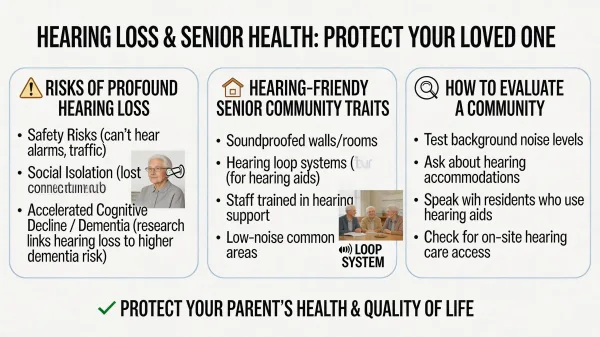
Most families think of hearing loss as a communication problem, something you manage by speaking louder or repeating yourself. But when hearing loss progresses to severe or profound levels, the risks extend far beyond missed words in conversation. Consider what your parent can't hear: smoke alarms, carbon monoxide detectors, the doorbell, a phone ringing, an approaching car in a parking lot, a kettle boiling over. Each one represents a real safety threat, and together they describe someone living in an environment that was never designed for a person who can't rely on sound. A parent who doesn't hear a smoke alarm at night is in genuine physical danger, not dealing with a minor inconvenience. From my years doing mobile X-ray work inside care facilities, I saw how quickly things could go wrong for residents who couldn't hear staff calling out warnings or instructions. A simple "watch your step" or "hold on, let me help you" means nothing if the person can't hear it, and the safety net that sound provides is invisible until it's gone.
Research has also established that hearing loss independently increases fall risk. A study using National Health and Nutrition Examination Survey data found that for every 10-decibel increase in hearing loss, the odds of reporting a fall increased by 1.4 times, even after adjusting for age, cardiovascular factors, and vestibular balance function. The inner ear houses both the cochlear system responsible for hearing and the vestibular system responsible for balance, and damage to one frequently accompanies damage to the other. Beyond that shared anatomy, hearing loss reduces access to the spatial audio cues that help your brain orient your body in space, removing an entire layer of environmental awareness that contributes to balance and safe movement.
What families often underestimate is the cognitive decline connection. A 2024 meta-analysis combining data from 50 studies and more than 1.5 million participants concluded that adult-onset hearing loss increases the risk for cognitive decline, dementia, mild cognitive impairment, and Alzheimer's disease. The relationship follows a dose-response pattern: every 10-decibel worsening of hearing was associated with a 16% increase in dementia risk. Three hypothesized mechanisms explain this link. First, the brain devotes more cognitive resources to processing degraded sound signals, leaving fewer resources for memory and reasoning. Second, hearing loss changes brain structure over time, with neuroimaging studies showing accelerated atrophy in auditory and cognitive processing areas. Third, hearing loss drives social withdrawal, and social isolation itself is an independent risk factor for dementia.
The ACHIEVE trial, a landmark randomized controlled study sponsored by the National Institute on Aging, found that treating hearing loss with hearing aids slowed cognitive decline by 48% over three years in older adults at elevated risk. That result drives home something families need to hear: hearing loss isn't just about missing conversations, it's one of the strongest modifiable risk factors for dementia, and the isolation it causes accelerates cognitive decline faster than most families realize.
The Isolation Spiral: How Hearing Loss Drives Depression
Running a daycare for 10 years taught me something about how communication barriers isolate people. A child who can't hear the group instruction gets left behind, not because anyone means to exclude them, but because the activity moves forward and they can't keep up. I watched it happen, and the look on that child's face, confusion turning to withdrawal, is something I never forgot. The same dynamic plays out in an elderly person's social life, just more slowly and with far greater consequences. Research suggests that hearing loss often goes unrecognized and untreated among older adults in both community and care settings, compounding the isolation. A National Council on Aging survey of 2,300 adults age 50 and older found that those with untreated hearing loss were more likely to report depression, anxiety, and paranoia, and were less likely to participate in organized social activities compared to those who used hearing aids. Separate research has shown that 42% of the association between hearing loss and depression symptoms was explained by loneliness alone.
Imagine your parent sitting at a family gathering, unable to follow the conversation, smiling and nodding but completely disconnected from everyone around them. They used to be the person who told stories and asked about the grandchildren's school projects. Now they sit quietly because jumping into a conversation they can't follow feels worse than staying silent. Eventually, the invitations feel like obligations rather than pleasures, and silence becomes easier than the exhausting effort of trying to hear. Less social contact means less cognitive stimulation, which means faster cognitive decline, which makes social interaction even harder. The cycle feeds itself, and breaking it requires changing the environment, not just amplifying the sound.
Signs Your Parent's Hearing Loss Has Crossed a Threshold
Families often adjust to a parent's hearing loss so gradually that they don't recognize when the situation has become serious. Patterns that signal the problem has moved beyond what hearing aids and family patience can manage include a parent who has stopped answering the phone, stopped attending family gatherings or makes excuses to leave early, and either keeps the television extremely loud or has turned it off entirely because even at maximum volume it isn't clear. They may have stopped participating in hobbies that require hearing, like attending religious services or playing cards with friends, and they may respond inappropriately in conversations because they're guessing at what was said. Any of these alone might seem minor, but together they describe someone whose world is shrinking rapidly and will continue to shrink unless the environment around them changes.
The speed of that withdrawal catches most families off guard. A parent who was socially active six months ago can be nearly housebound by the time the family realizes something has shifted.
Why Hearing Aids Alone Aren't Always Enough
Hearing aids are extraordinary technology, and for many people with mild to moderate hearing loss, they're life-changing. But hearing aids amplify sound rather than restoring normal hearing, and in noisy environments like restaurants, group activities, or common areas in a living facility, background noise gets amplified along with speech. For someone with profound hearing loss, even the best hearing aids may not provide enough clarity for reliable speech comprehension. The gap between "can hear sounds" and "can understand what's being said" widens as hearing loss progresses, and hearing aids also require consistent maintenance, proper battery management, and correct insertion, all of which become harder for someone with arthritis, cognitive decline, or limited dexterity.
A parent living alone may go days with malfunctioning hearing aids without realizing it, or without having the ability to troubleshoot the problem. Even when hearing aids are working properly, the effort of straining to hear all day creates what audiologists call "listening fatigue," a real cognitive and emotional drain that leaves people exhausted by afternoon. This doesn't mean hearing aids should be abandoned, but it does mean the environment has to do more of the work. That's where a hearing-friendly senior living community becomes part of the solution rather than just a place to live.
What a Hearing-Friendly Senior Living Community Looks Like
Not every assisted living community is prepared to support someone with severe or profound hearing loss. Given that hearing loss affects the majority of older adults, you'd expect every community to be well-equipped, but that's not the case. Knowing what to look for makes the difference between a parent who continues to withdraw and one who re-engages with life. The most critical feature is visual alert systems integrated throughout the building and in individual apartments. Flashing strobe lights connected to fire alarms and emergency systems are non-negotiable for residents who can't hear standard alarms, along with doorbell systems with flashing lights and bed-shaking devices for nighttime emergencies.
Staff communication training matters just as much as the physical infrastructure. Look for communities where staff face residents directly when speaking, reduce background noise before conversations, use visual cues and gestures, and confirm comprehension rather than simply speaking louder. Some communities employ staff fluent in American Sign Language, which can be invaluable for residents who are profoundly deaf. Watch how staff interact with hearing-impaired residents during your tour, because those small behaviors, approaching from the front rather than behind, using written communication when verbal attempts fail, making consistent eye contact, tell you whether the training translates into daily practice.
Hearing loop systems transmit audio signals directly to hearing aids equipped with telecoils, dramatically reducing background noise in dining rooms, activity spaces, and worship areas. Ask whether common areas are looped, whether portable loops are available for one-on-one conversations at reception desks or meeting rooms, and whether captioned televisions and amplified phones are provided in resident rooms. This technology isn't new, but it's still uncommon in many senior living communities, so its presence tells you something about how seriously a facility takes hearing accessibility.
Beyond technology, evaluate the programming and social design. Communities that genuinely support hearing-impaired residents offer captioned movie screenings, visual-based activities that don't rely heavily on spoken instruction (art classes, gardening programs, exercise sessions with visual demonstration), and small-group dining options where conversation is more manageable than in large, noisy halls. Ask about meal seating arrangements, because round tables of four to six people in quieter areas of the dining room are far more accessible for someone with hearing loss than long tables in a cavernous space. Pay attention to the acoustics of common areas during your visit, because spaces with carpeting, acoustic panels, and soft furnishings indicate a community that takes hearing accessibility seriously across the board.
Hearing Loss and Senior Living Costs
The national median cost of assisted living reached $6,200 per month, or $74,400 annually, as of the 2025 CareScout Cost of Care Survey. That figure has been climbing steadily, up from $64,200 in 2023, driven by inflation, rising labor costs, and increasing demand as the baby boomer generation ages. Communities with specialized hearing accessibility features may charge slightly more, though many hearing-friendly accommodations fall under ADA compliance and don't carry additional fees. The more significant financial concern is what happens when hearing loss goes unaddressed: the cognitive decline that untreated hearing loss accelerates can lead to a need for memory care, where monthly costs typically run 20% to 30% higher than standard assisted living. At the higher end, that's an additional $18,000 to $22,000 per year. Falls resulting from hearing-related balance issues generate emergency room visits, hospital stays, and rehabilitation costs that add up fast.
I remember the financial shock my family experienced during a family member's dementia journey. No one had planned for those costs, and they changed everything about how the family made decisions going forward. If addressing hearing loss through the right environment can delay or reduce cognitive decline, that's not just a quality-of-life calculation, it's a financial one. Medicare doesn't cover hearing aids, though some Medicare Advantage plans offer limited benefits, and Medicaid coverage varies by state. The VA provides hearing aids and audiological care to eligible veterans at no cost, making it one of the most comprehensive hearing benefit programs available.
How to Talk to Your Parent About a Move
Suggesting a move to someone who's already isolated is delicate, because your parent may not recognize how much their world has contracted. The contraction happened so slowly that what feels normal to them now would have been unthinkable two years ago. Frame the conversation around what they're missing rather than what's wrong with them: "I've noticed you don't seem to enjoy family dinners like you used to, and I wonder if the noise makes it hard to keep up" lands very differently than "You can't hear and you need to move."
Involve their audiologist if possible, because a professional recommendation carries different weight than a child's suggestion. Focus on what a hearing-friendly community adds rather than what living alone takes away: the ability to follow conversations in properly designed spaces, the safety of visual alarm systems, the social connection of activities designed for people with hearing challenges. If your parent will agree to a tour, choose a community where you've already confirmed hearing accommodations are in place, so they can see the technology and environment for themselves. Resistance is normal, and most adults don't want to leave their home, but the research linking untreated hearing loss to cognitive decline means that delay carries real consequences.
Questions to Ask When Evaluating Communities
When you tour a senior living community, bring a focused list of hearing-specific questions. Ask whether individual apartments can be equipped with visual alert systems for fire alarms, doorbells, and phone notifications, and what assistive listening technology is available in common spaces. Find out if staff receive training in communicating with hearing-impaired residents, how often that training is updated, and whether the community has relationships with audiologists who can provide on-site evaluations and hearing aid maintenance. Ask about captioned programming, small-group dining options, and activities designed to be accessible for residents with significant hearing loss. Find out how they handle communication during medical emergencies, because a resident who can't hear verbal instructions during an evacuation faces a different kind of risk than someone who simply prefers a quieter dining room.
Then spend time observing rather than just asking. Visit during a busy period, sit in the dining room, and watch how staff interact with residents who have hearing difficulty. Notice the noise level in common spaces and ask yourself whether your parent could function in that environment. Look at whether televisions in common areas have captions turned on by default, whether signage is clear and visual, and whether the general atmosphere feels calm or chaotic. A beautiful facility with terrible acoustics and no assistive technology won't solve the problem you're trying to address.
Taking the First Step
Profound hearing loss doesn't improve on its own, and the cognitive and social consequences of leaving it unaddressed in an isolating environment compound over time. Start with a comprehensive audiological evaluation if your parent hasn't had one recently, so you understand exactly where their hearing stands and what technology can and can't do for them. Ask the audiologist directly whether your parent's current living situation is safe and sustainable given their level of hearing loss, because that professional perspective can help the whole family get on the same page.
Then take an honest look at their current living situation. If they're sitting in silence most of the day, missing alarms, and withdrawing from the people and activities that used to give their life structure, the environment is failing them. The right senior living community won't restore your parent's hearing, but it can rebuild the safety, social connection, and daily engagement that hearing loss has taken away. You don't need to have all the answers before you start looking. You just need to recognize that the current situation isn't working and that better options exist. That recognition is the first step, and it's worth taking now rather than waiting for the consequences to become harder to reverse.