
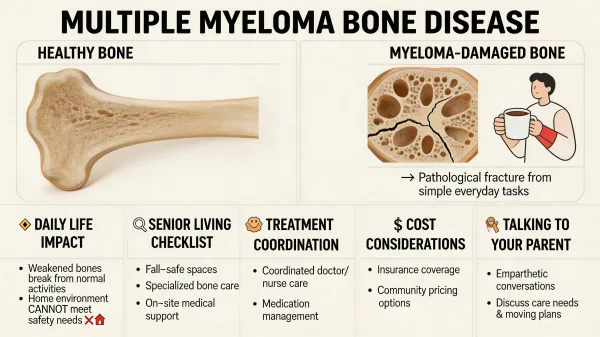
Your parent reaches for a coffee mug on the top shelf and winces. There's a soft pop, and suddenly they can't take a deep breath without sharp pain shooting across their ribs. An X-ray confirms what no one expected: a rib fracture from almost no effort at all.
And the imaging shows more than just one broken bone. There are holes scattered through the ribs and spine, round and well-defined, like something has been eating away at the bone from the inside. That's when the doctor says the words "multiple myeloma," and everything changes.
Multiple myeloma is a blood cancer that grows inside the bone marrow and destroys the surrounding bone structure. It affects roughly 36,000 people per year in the United States, and the average age at diagnosis is 69. That means families are often dealing with this diagnosis in a parent who already has other age-related health concerns. The bone damage is what makes daily life so difficult and so dangerous. Ordinary movements that were safe last month can cause fractures this month.
I've seen the characteristic "punched-out" bone lesions of multiple myeloma on X-rays during my years working in radiology. Those round, dark holes on the imaging tell a very specific story, and once you understand what they mean, you understand why these patients fracture from things as simple as a cough or a careful hug. This article will walk you through what myeloma bone disease looks like in daily life, how to recognize when your parent needs more support, and what to look for in a senior living community that can protect fragile bones while preserving quality of life.
What Multiple Myeloma Does to Bones
Healthy bone constantly rebuilds itself through a cycle of old bone being broken down and new bone taking its place. Multiple myeloma disrupts this cycle at both ends. The cancer cells activate the cells that destroy bone (osteoclasts) while simultaneously shutting down the cells that build new bone (osteoblasts). The result is bone that gets thinner and weaker over time, with no mechanism for repair. This is different from age-related osteoporosis, where the bone thins gradually and evenly. Myeloma creates specific areas of destruction, leaving some spots catastrophically weak while nearby bone may still have some strength left. That patchwork pattern is part of what makes the fracture risk so unpredictable.
About 85% of myeloma patients develop significant bone disease. The damage typically concentrates in the spine, ribs, pelvis, skull, and the upper portions of the arms and legs. On imaging, these weakened areas appear as lytic lesions, holes in the bone where cancerous destruction has outpaced the body's ability to keep up. Compression fractures in the spine are especially common and can happen without any injury at all. Your parent may lose height, develop a hunched posture, or experience sudden back pain that signals a vertebra has collapsed under its own weight. Research shows that myeloma patients face a nine-fold increase in fracture risk compared to the general population, and those fractures cluster around the time of diagnosis when the bone damage is often already extensive.
As bones break down, the calcium they release floods into the bloodstream. This condition, called hypercalcemia, causes confusion, fatigue, excessive thirst, and nausea. Families sometimes mistake these symptoms for dementia or medication side effects. If your parent with myeloma suddenly seems disoriented or unusually drowsy, ask the oncology team to check calcium levels before assuming the worst.
When Bones Become Fragile From the Inside: Living With Myeloma Bone Disease
The hardest thing for families to grasp about myeloma bone disease is that the danger isn't coming from outside. There's no fall to prevent, no icy sidewalk to avoid. The bones themselves are compromised from within, which means the rules about what's safe have fundamentally changed. A sneeze can crack a rib. Lifting a bag of groceries can fracture a wrist. Helping your parent out of a low chair by pulling on their arm can break the very bone you're gripping. Families need to recalibrate their entire sense of what's safe, and that recalibration is both urgent and emotionally exhausting.
The spine takes the worst of it for most patients. Vertebral compression fractures happen when weakened vertebrae simply collapse under the weight of the body, sometimes while the person is just sitting or bending forward slightly. These fractures cause intense pain, loss of height, and a progressive forward curvature of the spine called kyphosis. Over time, the changing spinal alignment affects breathing, balance, and the ability to walk comfortably. A parent who was moving around the house independently three months ago may now be unable to stand upright without severe pain.
Working in hospital radiology for nearly two decades, I've imaged patients with myeloma who came in after what seemed like nothing. A woman who fractured her humerus rolling over in bed. A man whose ribs broke while his wife helped him put on a jacket. These aren't exaggerations or worst-case scenarios. When bone has been hollowed out by myeloma, the structural integrity simply isn't there. The fractures happen during the activities that make up an ordinary day, and that's exactly what makes this disease so difficult to manage at home.
Pain management for myeloma bone disease requires a layered approach because the pain itself comes from multiple sources. There's the ache of the disease eating into bone, the sharp pain of fractures both new and healing, and the nerve pain that occurs when collapsed vertebrae press on the spinal cord. Oncologists typically combine medications, sometimes including opioids for severe bone pain, with targeted radiation therapy for particularly painful lesions. Bisphosphonates like zoledronic acid play a critical role here. These drugs slow bone destruction by inhibiting the cells that break down bone, and they've been shown to reduce fractures and alleviate pain in myeloma patients. A newer option, denosumab, works through a different mechanism but achieves similar results. Neither drug rebuilds bone that's already been destroyed, but both can slow the rate of further damage.
A care community designed for older adults can structure the physical environment and daily assistance around these specific risks in ways that a private home usually can't. That means raised beds and chairs to reduce the force needed to stand, grab bars positioned to minimize twisting, staff trained to assist with transfers using proper body mechanics rather than pulling on arms, and hallways kept clear of anything that could cause even a minor stumble. Bathing assistance becomes critical, since wet, slippery surfaces combined with fragile bones create an especially dangerous combination. Physical therapy programs adapted for myeloma patients focus on gentle strengthening and balance work that improves mobility without putting stress on compromised bones. The goal isn't to wrap your parent in bubble wrap. It's to build an environment where they can move through their day with appropriate support, reducing fracture risk while maintaining as much independence as their condition allows.
Signs Your Parent May Need More Support Than Home Can Provide
Myeloma bone disease can progress faster than families expect. The shift from "managing at home" to "this isn't safe anymore" often happens over weeks rather than months. Watch for pain that prevents your parent from completing basic tasks like bathing, dressing, or getting in and out of bed. Increasing reliance on furniture or walls for support while walking is another warning sign, as are new fractures from minimal activity. Pay attention if your parent starts mentioning new pain locations or if you notice them moving differently, guarding one side, or wincing during transfers.
If your parent has started avoiding movement because they're afraid of breaking something, that fear itself is a signal. Immobility causes its own cascade of problems, including muscle loss, blood clots, pressure sores, and worsening depression. When the choices narrow to moving with fracture risk or not moving with its own serious consequences, that's often the point where a supervised care environment becomes the safer option. Don't wait for the worst-case scenario to make this call.
The speed of this disease catches most families off guard. What looked like manageable back pain two months ago is now a situation where your parent can't safely shower alone.
What to Look for in Multiple Myeloma Senior Living Communities
Not every assisted living community is equipped to support a resident with active myeloma bone disease. When you're evaluating options, ask specific questions about how the community handles fall prevention for residents with bone fragility, and whether their staff has experience with pathological fracture risk. You want to know about the physical layout: are there raised toilet seats, walk-in showers with benches, adjustable beds, and wide doorways for mobility aids? Ask how staff assist residents who need help standing or transferring. Pulling on a weakened arm is exactly the kind of well-meaning help that causes fractures in myeloma patients, and the staff needs to know that.
Ask about transportation to oncology appointments, because your parent will need regular visits for chemotherapy, bisphosphonate infusions, and blood work. A community that can coordinate these schedules reduces the burden on you and ensures treatments don't get missed. Some communities also offer on-site physical therapy, which is a significant advantage for myeloma patients who benefit from consistent, supervised exercise programs. From visiting care facilities during my mobile X-ray work, I know there's a gap between what families are told and what actually happens inside. Ask to visit at different times of day, talk to current residents, and watch how staff interact with residents who have mobility challenges.
Treatment Schedules and How Senior Living Can Help
Multiple myeloma treatment for older adults typically involves chemotherapy combinations given in cycles, along with monthly or quarterly bisphosphonate infusions to protect bones. Some patients also receive radiation therapy targeted at particularly painful bone lesions. These treatments cause fatigue, nausea, and increased vulnerability to infections, all of which make daily self-care harder. Your parent may feel well enough to manage on their own during good weeks and completely unable to during treatment weeks. That unpredictability is one of the biggest practical challenges for families trying to support a parent at home.
Senior living communities provide consistent support that doesn't fluctuate with how your parent is feeling on a given day. Meals are prepared, medications are managed, and assistance is available around the clock for the days when treatment side effects make even simple tasks overwhelming. Staff can also monitor for signs of infection, which is critical for myeloma patients whose immune systems are suppressed by both the cancer and its treatment. Having trained eyes on your parent daily catches problems earlier. That consistency matters more than it sounds.
The Cost of Multiple Myeloma Senior Living Care
As of 2025, the national median cost of assisted living is approximately $6,200 per month, or about $74,400 per year, according to the CareScout Cost of Care Survey. Communities that offer higher levels of personal care or specialized support for residents with complex medical needs often charge more, and the additional services a myeloma patient requires, such as more frequent transfer assistance, pain monitoring, and coordination with oncology providers, can push monthly costs toward $7,500 or higher in some markets. Over two years, that's close to $180,000 for assisted living alone, not including cancer treatment costs.
When our family faced the financial reality of placing a loved one in a care facility, the sticker shock was immediate. The costs don't wait for you to be ready, and they add up on top of ongoing cancer treatment expenses that insurance may only partially cover. Look into whether your parent's long-term care insurance (if they have it) covers assisted living. Medicaid waiver programs in some states can offset costs for qualifying residents, and VA benefits may apply if your parent is a veteran or the surviving spouse of one. Start the financial planning conversation early, because waiting until a crisis forces the decision usually means fewer and more expensive options.
Talking to Your Parent About Senior Living After a Myeloma Diagnosis
A cancer diagnosis carries enormous emotional weight, and suggesting that your parent also needs to leave their home can feel like piling on. Timing matters. Don't have this conversation in the hospital or immediately after a new fracture when emotions are highest. Wait for a calm day, and frame the discussion around what you want for them: less pain, more support, and a safer environment that lets them focus on treatment rather than struggling through daily tasks alone.
Many families find that framing senior living as part of the treatment plan rather than a sign of decline makes the conversation easier. Your parent's oncologist can be a powerful ally here. When a doctor explains that reducing fracture risk is a medical priority, it reframes the move from "giving up" to "getting the right support." If possible, visit a couple of communities together before any decisions are made. Seeing the environment firsthand, meeting the staff, and watching how other residents live their days can shift the conversation from abstract fear to concrete reality. Your parent may still resist, and that's normal. Give them time, but don't let the conversation drop entirely.
The Emotional Toll of Watching a Parent's Body Become Fragile
Multiple myeloma doesn't just affect your parent's bones. It changes the way you interact with them physically. Hugging becomes something you think twice about. Helping them stand up requires a technique you never thought you'd need to learn. The constant awareness that something could break creates a low-level anxiety that sits with you through every visit, every phone call where they sound like they're in more pain than yesterday.
I've cared for people I love through serious illness, and I know that the emotional exhaustion of being the responsible one, the one who has to make the hard calls, is real and cumulative. Give yourself permission to ask for help. Talk to the social worker at your parent's oncology practice about caregiver support resources. If you're the one driving to every appointment, managing medications, and lying awake worrying about falls, you're already carrying too much. Recognizing that isn't weakness. It's clarity. Your parent needs you to stay strong for the long haul, and that means building a support system around both of you, not trying to do everything yourself.
Making the Decision That Protects Your Parent
Multiple myeloma changes the equation of daily life in ways that are hard to fully appreciate until you're in the middle of it. The bones your parent has relied on for decades are no longer dependable, and the activities they once did without thinking now carry real risk. That's a difficult reality for both of you. But understanding what the disease does, and knowing what kind of support exists, puts you in a stronger position to make good decisions.
Finding the right senior living community won't cure the disease, but it can create an environment where your parent is safer, more comfortable, and better supported through treatment. The right community reduces fracture risk, ensures treatment schedules stay on track, and gives your parent daily assistance without the isolation that often comes with managing a serious illness at home. You don't have to figure this out alone, and you don't have to wait until a serious fracture forces the decision. Start researching communities now, ask the specific questions that matter for myeloma patients, and trust that choosing safety and support for your parent is one of the most caring decisions you can make.