
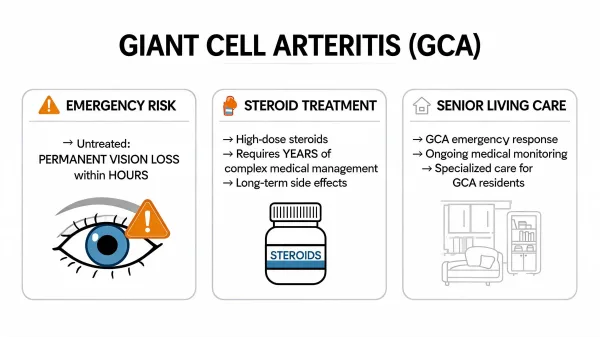
Up to 20% of people diagnosed with giant cell arteritis experience permanent vision loss, and once that damage occurs, it's almost always irreversible. For the roughly 200 out of every 100,000 adults over 50 living with this condition in the United States, the stakes of a missed diagnosis or delayed treatment are devastating. GCA inflames the arteries that supply blood to the eyes, brain, and scalp. When those arteries swell enough to restrict blood flow to the optic nerve, blindness can follow within hours.
What makes giant cell arteritis especially dangerous for older adults in senior living is the speed at which everything changes. A parent who seemed fine yesterday may wake up unable to see out of one eye tomorrow. If treatment doesn't begin immediately, the other eye can follow. And the treatment itself, high-dose steroids continued for months or years, creates a second layer of medical complexity that affects everything from bone density to blood sugar to infection risk.
I've worked in emergency medicine long enough to know that certain symptoms in older patients can't wait for a Monday appointment. A new, severe headache with jaw pain or sudden vision changes in someone over 50 is one of those situations. This article covers what families need to know about GCA: the warning signs, why it's treated as an emergency, what life looks like after diagnosis, and what to expect from a senior living community managing a resident with this condition.
What Is Giant Cell Arteritis?
Giant cell arteritis, also called temporal arteritis, is an inflammatory disease that targets medium and large arteries. It primarily affects the temporal arteries running along the sides of the head, but it can also involve arteries in the neck, upper body, and aorta. GCA is the most common form of vasculitis (blood vessel inflammation) in adults over 50, with an average onset age of around 70. It affects women roughly three times more often than men.
The inflammation causes the arterial walls to swell, narrowing the vessel and reducing blood flow. When this happens in the arteries supplying the optic nerve, the result can be sudden, severe, and permanent vision loss. GCA can also cause strokes and aortic aneurysms in rare cases, though the immediate threat to eyesight is the primary concern driving the urgency of treatment.
The condition tends to appear suddenly. Families often describe a parent who developed a persistent headache over a few days, then started complaining about jaw pain while eating. That combination of symptoms in someone over 50 should prompt an urgent medical evaluation, not a wait-and-see approach.
What Warning Signs Should Families Watch For?
The hallmark symptoms of GCA cluster around the head and face. A new, persistent headache, particularly focused on one or both temples, is present in 40% to 90% of patients at diagnosis. Scalp tenderness is common and often noticed when brushing hair or resting the head on a pillow. Jaw claudication, pain or fatigue in the jaw while chewing that eases when you stop, is one of the strongest predictors of a GCA diagnosis.
Visual symptoms require emergency attention. These include sudden loss of vision in one eye, episodes of temporary vision loss (called amaurosis fugax, where vision goes dark for seconds or minutes before returning), double vision, and blurred vision. Amaurosis fugax is particularly important for families to understand because it's easy to dismiss. Your parent might describe their vision "going gray" or "like a shade coming down" over one eye for a few seconds, then returning to normal. Research shows that about one-third of patients who eventually lose vision permanently experienced these brief warning episodes in the 7 to 10 days beforehand. That window between the first temporary episode and permanent loss is the critical opportunity to start treatment. If your parent mentions anything like this, treat it as an emergency, even if their vision seems fine by the time you talk to them.
Other symptoms can include unexplained fever, fatigue, unintended weight loss, and general body aches. Because roughly half of GCA patients also have polymyalgia rheumatica, widespread shoulder and hip stiffness may be present too. These systemic symptoms can make GCA look like the flu or general aging at first, which is part of what makes it dangerous.
The Emergency Phase: Why GCA Cannot Wait
Giant cell arteritis is one of the few conditions where treatment must begin on clinical suspicion alone, before diagnostic confirmation. The reason is simple and sobering: the window between treatable inflammation and irreversible blindness can be measured in hours, not days. Research shows that patients who begin steroid therapy within the first 24 hours of visual symptoms have a 22-fold greater chance of visual improvement compared to those who start later. After 48 hours, vision damage is typically permanent. There's no middle ground here, and there's no option to take a wait-and-see approach the way families can with many other conditions.
The mechanism behind the vision loss is arterial ischemia. When GCA inflames the posterior ciliary arteries that feed the optic nerve, blood flow drops below what the nerve tissue needs to survive. The result is anterior ischemic optic neuropathy, which accounts for more than 80% of permanent vision loss from GCA. The damage isn't gradual. It's a vascular event, similar in principle to a heart attack but happening in the blood supply to the eye. Once the optic nerve tissue dies from lack of blood flow, no amount of treatment can restore it.
What terrifies families most, and what I've seen catch people off guard in the ER, is how fast the second eye can follow. Studies show that if the first eye loses vision and treatment doesn't start promptly, 70% of untreated patients will lose vision in the other eye within 7 to 10 days. That's the critical number that turns GCA from a serious diagnosis into a true medical emergency.
Imagine your parent wakes up one morning unable to see out of their right eye. In the emergency room, blood tests show elevated inflammatory markers (ESR and CRP), and the clinical picture points strongly toward GCA. The ER team starts IV methylprednisolone immediately, typically 500 to 1,000 mg daily for three days, followed by high-dose oral prednisone at 60 mg per day. They don't wait for biopsy results. They can't afford to. A temporal artery biopsy will be scheduled within the next one to two weeks to confirm the diagnosis, but treatment has already begun because the other eye is at risk right now.
This is where the treatment saves vision even as it creates new challenges. The high-dose steroids that protect the second eye also launch a treatment journey that will last one to two years at minimum. Families often leave the hospital relieved that blindness was prevented in the remaining eye, only to realize weeks later that the steroid regimen their parent now depends on carries its own serious risks. That transition from emergency to long-term management is where many families feel the ground shift under them.
How Is GCA Diagnosed?
Diagnosis starts with blood work. Erythrocyte sedimentation rate (ESR) and C-reactive protein (CRP) are typically elevated in GCA, though a small percentage of patients present with normal inflammatory markers despite active disease. These blood tests help build the clinical picture but aren't definitive on their own.
The traditional gold-standard confirmation is a temporal artery biopsy, where a small section of the artery at the temple is removed and examined under a microscope for the characteristic "giant cells" and inflammatory changes. However, because GCA affects arteries in patches rather than uniformly, a negative biopsy doesn't rule it out. Ultrasound of the temporal arteries is increasingly used as a non-invasive first step, looking for a "halo sign" that indicates vessel wall inflammation. Some centers also use PET/CT scans to detect large-vessel involvement that a biopsy would miss entirely.
The critical point for families: diagnosis should never delay treatment. If the clinical signs point toward GCA, steroids start first, and the diagnostic workup follows.
How Does GCA Connect to Polymyalgia Rheumatica?
GCA and polymyalgia rheumatica (PMR) overlap frequently enough that understanding one means understanding both. About 50% of people diagnosed with GCA also have PMR symptoms, and 5% to 15% of PMR patients will eventually develop GCA. The two conditions share similar demographics (women over 50, Northern European descent) and similar inflammatory pathways, though PMR alone doesn't carry the same risk of vision loss.
For families managing a parent in senior living, this overlap matters practically. A parent initially diagnosed with PMR who develops a new headache, jaw pain, or any visual changes needs immediate re-evaluation for GCA. Staff at a care community should understand that PMR and GCA sit on the same spectrum and that new head or vision symptoms in a PMR patient aren't routine complaints to be noted at the next scheduled visit. From my years working in hospitals, I can tell you that the patients who do best are the ones whose care teams recognize when a known condition has escalated. That recognition has to happen fast with GCA.
Living With GCA Aftermath: Vision Loss Plus Long-Term Steroid Management
After the emergency phase, families face a dual challenge. If vision loss has occurred, the parent must adapt to permanent changes in how they see the world. At the same time, the steroid therapy that saved the remaining vision becomes its own long-term medical project, with side effects that compound the difficulties of aging.
Monocular vision, the loss of sight in one eye, affects far more than reading. Depth perception changes dramatically, making stairs, curbs, and uneven surfaces unreliable in ways they never were before. Research consistently identifies vision impairment as an independent risk factor for falls in older adults. A parent who lost vision in one eye from GCA now faces a significantly higher fall risk, which means their living environment needs to be reassessed completely. Grab bars, improved lighting, removal of tripping hazards, and careful attention to stair safety aren't optional improvements. They're medical necessities.
Driving is usually no longer possible with monocular vision, which has enormous implications for independence. A parent in senior living may adjust more easily than one living alone, since transportation is typically provided, but the psychological impact of losing both an eye and the ability to drive can be profound. I've watched patients in the hospital absorb news about permanent changes to their bodies, and the vision loss from GCA hits especially hard because of how suddenly it happens. One day your parent could see. The next, they can't.
The steroid taper adds a parallel layer of complexity. After the initial high-dose phase, prednisone is gradually reduced over one to two years, guided by symptoms and inflammatory markers checked every few weeks to months. Between 34% and 75% of patients experience at least one relapse during the taper, requiring the dose to increase again. Each relapse adds more cumulative steroid exposure.
Those side effects hit older adults especially hard. Long-term prednisone use can cause or worsen osteoporosis, with up to 10% to 20% of bone mass potentially lost within the first six months of treatment. For a senior already at elevated fracture risk, that acceleration can be the difference between a stumble and a broken hip. Prednisone raises blood sugar, pushing some patients into steroid-induced diabetes that requires its own monitoring and treatment plan. It suppresses the immune system, increasing susceptibility to infections that might be minor in a younger person but dangerous in someone over 70. Weight gain, mood changes including irritability and depression, sleep disruption, thinning skin, easy bruising, and cataracts round out a list that families find overwhelming when they see it all at once. For a senior living community managing a GCA resident, this means coordinating bone density monitoring, blood sugar checks, infection surveillance, and regular rheumatology appointments alongside vision rehabilitation.
Tocilizumab, a biologic medication approved in 2017 for GCA, offers a steroid-sparing option that may allow faster tapering with fewer side effects. Not every patient is a candidate, and the medication carries its own risks, including infection. But for parents struggling with severe steroid complications, it's a conversation worth having with the rheumatologist.
The Question No One Thinks to Ask
After the initial crisis passes, most families focus on adapting to the current reality: one eye lost, steroids managed, living situation adjusted. What they don't often think to ask is what happens if it comes back.
GCA can recur. More than half of patients relapse at least once during their steroid taper. A relapse that affects the previously unaffected eye would be catastrophic, potentially resulting in total blindness. This is the question that should be on every family's list when evaluating or communicating with a senior living community: what is the protocol when a resident with a GCA history reports new visual symptoms?
The answer needs to be specific. "We'll call the doctor" isn't good enough. The protocol should include immediate staff recognition that new vision changes in a GCA patient are an emergency, a clear escalation path that bypasses routine reporting channels, and the ability to get the resident to an emergency room within hours, not the next business day. From everything I've seen working in emergency settings, the facilities that handle time-sensitive conditions well are the ones that have thought through the scenario before it happens. Ask the community whether they have experience with residents on long-term steroid therapy and whether their staff training covers the warning signs of GCA recurrence. If the answer is vague, that's information you need.
What Should Families Ask a Senior Living Community About GCA Care?
When evaluating whether a senior living community can support a parent with GCA, the questions need to go beyond standard amenities. Families should ask how the community handles medical emergencies during overnight hours and weekends. They should ask about medication management protocols for residents on tapering steroid regimens that require dose adjustments based on lab results. They should ask whether staff are trained to recognize sudden vision changes as emergencies rather than routine complaints.
Practical considerations matter too. Can the community accommodate regular rheumatology appointments and blood work schedules? Is the physical environment designed to reduce fall risk for residents with impaired vision? Are meals flexible enough to support the dietary needs of someone managing steroid-induced blood sugar issues? Having spent time inside care facilities during my mobile X-ray work, I know that the gap between what a facility says they can handle and what they actually provide day-to-day can be significant. Push for specifics. Ask about recent emergency transfers and how quickly they happened. The answers will tell you more than the brochure ever will.
Making the Best Decision for Your Family
Giant cell arteritis changes the calculus of senior living decisions because it combines two realities that are each difficult on their own: sudden vision loss and years of complex medication management. Neither challenge is one most families anticipate when they first start thinking about care options for an aging parent.
The best thing you can do is understand the condition well enough to ask the right questions. Know that GCA is a medical emergency that requires same-day treatment. Know that the steroids that save vision create their own long-term health risks. Know that recurrence is common and the other eye is always potentially at risk. And know that the right senior living community will have specific, practiced answers when you ask how they handle these situations.
If your parent has been diagnosed with GCA, you're already past the point of easing into this conversation. The good news is that with proper treatment and monitoring, many people with GCA live well for years. Your job is to make sure the care environment around them is ready for both the daily management and the possibility that speed will matter again.