
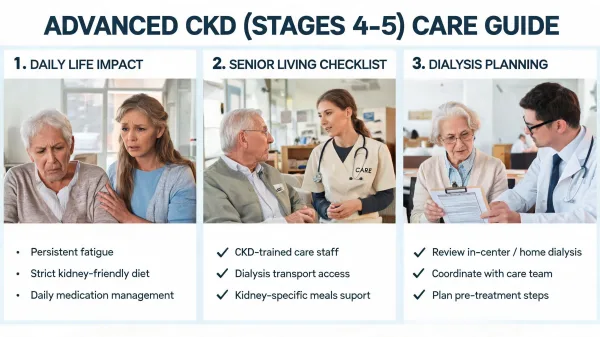
Most families don't see the crisis coming. Your parent has had chronic kidney disease for years, maybe even a decade. The numbers on their lab work have been creeping downward, their nephrologist has been adjusting medications, and everyone has been treating it as something manageable. Then one appointment changes everything. The doctor says dialysis is likely within the next six to twelve months, and suddenly you realize that the fatigue, the appetite loss, and the slow withdrawal from daily life weren't just aging. They were signs that your parent's kidneys were failing faster than anyone expected.
I watched something similar happen with my late husband's illness. For years, his condition felt like something we were managing. Then it crossed a threshold, and what had been a slow decline became an urgent daily reality almost overnight. Chronic diseases have a way of doing that, progressing gradually until they don't.
Chronic kidney disease follows this same pattern, and Stage 4 is usually where the shift hits families hardest. Your parent's eGFR (the number that measures how well their kidneys filter waste) has dropped below 30, and the body can't compensate anymore. Dietary restrictions tighten, medications multiply, and the fatigue becomes the kind that doesn't improve with rest. And the question families thought they had more time to answer, "Can Mom or Dad still live safely at home?", suddenly needs an answer now.
This article walks through what advanced CKD actually demands in daily care, how to evaluate whether a senior living community can handle those demands, and how to plan ahead for dialysis or the decision not to pursue it.
What Changes Between CKD Stage 3 and Stage 4
What families often underestimate is how the complexity of CKD management accelerates nonlinearly. Stage 3 can feel like a condition your parent's doctor monitors. Stage 4 feels like a condition that starts running your parent's life.
At Stage 3, kidney function sits between 30% and 59% of normal. Most people at this stage still feel relatively well, and the management is often limited to blood pressure medication, some dietary awareness, and regular lab work. The jump to Stage 4, where kidney function drops below 30%, brings a cascade of new challenges. The kidneys can't regulate fluid balance, electrolytes, or waste removal effectively, and the body starts showing the strain in ways that affect daily functioning. According to the National Kidney Foundation, Stage 4 means the kidneys are working at just 15% to 29% of what healthy kidneys can do.
The jump from Stage 4 to Stage 5 changes everything again. At that point, kidney function is below 15%, and the body is accumulating toxins that affect cognition, energy, appetite, and cardiovascular stability. Families who felt they had a handle on things at Stage 3 often find themselves overwhelmed by Stage 4, and completely unprepared for Stage 5.
Stage 4-5 CKD: The Care Needs That Escalate Before Dialysis Starts
The daily reality of advanced CKD is something most families don't fully understand until they're living it. It isn't one big problem. It's a dozen smaller ones that compound each other, and together they create a care burden that can exceed what a single family caregiver or even a home health aide can manage.
The dietary restrictions become a full-time job. At Stage 4, your parent's diet isn't just "eat healthy." It's a precise balancing act across four or five nutrients simultaneously. Protein intake needs to be restricted to slow the buildup of waste products, but not so much that muscle wasting occurs. Potassium has to stay within a tight range because the kidneys can't clear excess amounts, and high potassium levels can cause dangerous heart rhythm problems. Phosphorus must be limited because the kidneys no longer remove it efficiently, which triggers calcium loss from bones and can lead to painful bone disease. Sodium is capped to control fluid retention and blood pressure, typically below 2,000 milligrams per day. And fluid intake itself may need to be measured and restricted if swelling develops. The KDOQI Clinical Practice Guidelines recommend sodium intake below 2,300 milligrams daily for CKD Stages 3 through 5, and many nephrologists set tighter limits depending on the patient. Every meal becomes a calculation. The banana your parent used to eat for breakfast may now be off limits because of potassium. The glass of milk with dinner adds phosphorus they can't afford. Even "low sodium" packaged soups can contain potassium chloride as a salt substitute, creating a hidden risk.
Medication management grows more complex by the month. A typical Stage 4 CKD patient may take ten or more medications daily. Blood pressure medications (often ACE inhibitors or ARBs) need careful dose adjustments because they can raise potassium levels. Phosphate binders must be taken with every meal to prevent phosphorus absorption. Erythropoiesis-stimulating agents may be prescribed to treat the anemia that develops when failing kidneys stop producing enough erythropoietin. Sodium bicarbonate tablets may be added to correct metabolic acidosis. Diuretics help manage fluid overload. And if your parent also has diabetes or heart disease, which many CKD patients do, those medications need constant recalibration as kidney function changes. Timing matters for many of these drugs. Some must be taken with food, others on an empty stomach, and some can't be taken within hours of each other.
Fatigue and anemia reshape daily life. The fatigue of advanced CKD isn't ordinary tiredness. Anemia develops because the kidneys produce less erythropoietin, which means fewer red blood cells to carry oxygen. Your parent may sleep ten or twelve hours and still feel exhausted. Simple tasks like showering, getting dressed, or walking to the kitchen become genuinely difficult. I've seen this kind of exhaustion before, that bone-deep fatigue that sleep doesn't fix. It changes a person's ability to manage their own care in ways that catch families off guard.
Activities of daily living start to slip. The combination of fatigue, nausea, poor appetite, and cognitive fog (uremic toxins can affect mental clarity) means your parent may start struggling with tasks they handled fine a few months ago. They might forget medications, skip meals because nothing tastes right, or stop bathing regularly because standing in the shower feels unsafe. Many families notice weight loss, increased confusion, and a withdrawal from activities their parent used to enjoy.
The tipping point. There's a moment for many families when the cumulative burden of CKD management crosses what home care can provide. It isn't usually one dramatic event. It's the realization that meal preparation alone requires someone who understands renal dietary restrictions, that medication errors are becoming more frequent, and that the fatigue is making falls a real risk. When that moment arrives, the question shifts from "how do we manage this at home" to "where can our parent get the level of support this disease now requires."
When Home Care Isn't Enough: Recognizing the Tipping Point
Imagine your father has been living alone with Stage 4 CKD. His kidney function has been declining for years, but the family thought it was manageable. Then at his last nephrology appointment, the doctor says dialysis is likely six to twelve months away. You notice he's lost fifteen pounds over the past few months. He's eating less because food tastes metallic, and he admits he's been skipping his phosphate binders because he can't remember which pills go with meals.
That scenario plays out in families across the country. The signs that home care isn't enough often include: your parent is losing weight without trying, medications are being missed or doubled, there's visible swelling in the legs or ankles that wasn't there before, your parent is too tired to prepare meals that meet their dietary restrictions, or they're falling or nearly falling due to weakness and dizziness. Any two or three of these happening at the same time usually signals that the care demands have outpaced what the current living situation can safely provide.
Having a home health aide helps, but most home aides aren't trained in renal nutrition or the specific medication timing that CKD requires. The gap between general home care and CKD-specific care is significant.
What to Look for in Senior Living Communities That Support Chronic Kidney Disease
Not every assisted living community is equipped to handle the demands of advanced CKD. The level of dietary customization, medication management, and medical coordination that Stage 4 and 5 require goes beyond what many standard communities offer. When evaluating options, families should ask specifically about the kitchen's ability to prepare renal-friendly meals. This means more than "low sodium options." It means the dietary staff understands potassium limits, phosphorus restrictions, protein targets, and fluid caps, and can adjust meals to your parent's current lab values.
Ask whether the community has experience with residents on multiple medications that require specific timing and whether nursing staff can coordinate with a nephrologist's office for regular lab review. Some communities have relationships with mobile lab services that can draw blood on-site, which matters when your parent needs labs every two to four weeks. Transportation is another practical concern. If your parent is seeing a nephrologist regularly and may soon need dialysis three times per week, the community's ability to provide or arrange reliable medical transportation becomes a deciding factor.
Evaluating a Community's Medical Coordination
The best indicator of whether a senior living community can support advanced CKD isn't their marketing materials. It's how they answer specific clinical questions. From my years working inside the healthcare system, I've learned that the gap between what a facility says it can do and what it actually delivers can be wide. Ask to speak with the director of nursing, not just the admissions team.
Questions that reveal real capability include: How many current residents have CKD or are on dialysis? Does the community have a relationship with a nephrology practice? Can nursing staff administer erythropoietin injections or other injectables on-site? How does the dietary team adjust meal plans when a resident's lab values change? What happens if a resident returns from dialysis feeling weak or nauseated, which is common? Communities that give vague answers to these questions may not have the infrastructure your parent needs.
Planning for the Dialysis Decision: How Location Affects Options
If your parent's nephrologist has indicated that dialysis is on the horizon, where your parent lives will directly shape what dialysis looks like. This isn't just a medical decision. It's a logistics decision that affects every aspect of daily life.
Hemodialysis is the most common form for older adults. It typically requires three sessions per week at a dialysis center, each lasting three to four hours. But the real time commitment is larger than it sounds. Factor in transportation to and from the center, the pre-treatment check-in, and the post-treatment recovery period (many older patients feel drained, dizzy, or nauseated for hours after a session), and you're looking at most of the day, three days a week. According to research published in Kidney International, most frail and older patients default to in-center hemodialysis. The physical toll is real: intradialytic hypotension (drops in blood pressure during treatment), extended recovery time, and vascular access complications are common in elderly patients.
Peritoneal dialysis is a home-based alternative that uses the lining of the abdomen to filter blood. It can offer more flexibility because it's typically done daily, sometimes overnight while the patient sleeps. For seniors in assisted living, peritoneal dialysis requires trained staff who can assist with the exchanges (connecting and disconnecting the dialysis fluid bags) and maintain strict sterile technique to prevent peritonitis, a serious abdominal infection. Not all assisted living communities support peritoneal dialysis, so this needs to be confirmed before admission. Medicare covers both forms of dialysis, paying 80% of approved costs through Part B after the annual deductible. Your parent is responsible for the remaining 20%, though Medigap policies or Medicaid may cover that portion.
Proximity to a dialysis center matters more than families realize. If your parent is doing in-center hemodialysis, being within a reasonable drive of the center (ideally under 30 minutes) significantly reduces the exhaustion of treatment days. Some senior living communities are strategically located near dialysis centers and even provide dedicated transportation. Others are in areas where the nearest center is 45 minutes or more away, turning a four-hour treatment into an eight-hour ordeal. When touring communities, ask not just whether they offer medical transportation but how far the nearest dialysis center is and whether they've had residents on dialysis before.
The conservative care conversation. For some elderly patients with advanced CKD, particularly those over 80 or those with serious additional health conditions, dialysis may not extend life meaningfully and can reduce quality of life. Conservative kidney management is a medically supported approach that focuses on symptom control, quality of life, and comfort rather than dialysis. The KDIGO 2024 guidelines recognize conservative renal care as a reasonable option for patients who don't wish to pursue kidney replacement therapy. A 2025 study published in Kidney360 found that mortality outcomes were comparable between conservative management and dialysis in certain elderly populations, with the conservative group having lower hospitalization rates. This is a conversation that families should have with the nephrologist, ideally before the decision becomes urgent. It doesn't mean giving up. It means choosing a different set of priorities for the time your parent has.
The Financial Reality of CKD Care in Senior Living
Advanced CKD adds costs that families don't always anticipate. The base cost of assisted living in 2025 sits at a national median of $6,200 per month, or about $74,400 per year, according to the CareScout Cost of Care Survey. But that's the starting point. Communities that offer specialized dietary programs, enhanced medication management, or coordination with dialysis centers typically charge more, often through tiered care levels or add-on fees.
I remember the financial shock of researching care costs for my own family member. The monthly number you see on a website rarely reflects what you actually end up paying once you add the services your loved one needs. For CKD specifically, expect to ask about additional charges for: renal-specific meal preparation, medication management beyond a basic tier, transportation to dialysis or nephrology appointments, and any nursing services like injectable medication administration. Get the all-in monthly estimate in writing before signing anything.
Medicare, Medicaid, and Paying for Dialysis
One piece of good news in the CKD picture is that Medicare provides specific coverage for end-stage renal disease, regardless of age. People with permanent kidney failure qualify for Medicare even if they're under 65, and those already on Medicare get dialysis coverage through Part B. Medicare Part B pays 80% of approved dialysis costs, including in-center and home treatments, equipment, supplies, and certain medications like erythropoietin. The 2025 Part B monthly premium is $185, with an annual deductible of $257.
What Medicare doesn't cover is the assisted living community itself. That cost falls to private pay, long-term care insurance, or in some states, Medicaid waiver programs that may help with certain assisted living expenses. The disconnect between what Medicare covers (dialysis treatment) and what it doesn't (the housing and daily care that make dialysis sustainable) is something families need to plan for early. Some states have Medicaid programs that supplement assisted living costs for qualifying individuals, but eligibility rules and benefit levels vary significantly by state.
How to Start the Conversation with Your Parent
Talking to a parent about leaving their home is hard under any circumstances. When CKD is the reason, the conversation carries extra weight because your parent may not feel "sick enough" to move, especially if they've been managing the disease for years. The fatigue and appetite loss can feel like normal aging to them, even when the lab numbers tell a different story. After years of caregiving, I've learned that the people closest to a chronic illness are often the last to acknowledge how much it's changed their daily life.
Frame the conversation around safety and support, not loss. Instead of "you can't live alone anymore," try "I want to make sure you have the right support so you can focus on feeling as good as possible." Involve the nephrologist if you can. Many parents respond better to a doctor's recommendation than to a child's concern, and a nephrologist can speak specifically about the care demands ahead in a way that feels clinical rather than personal. Be honest about what's coming. If dialysis is likely within the next year, talk about what that will look like logistically, how many hours per week it will take, and how a community with transportation and post-treatment support could make those days easier rather than harder. Don't wait for a hospitalization to force the decision.
Questions to Ask Before Choosing a Community
Before committing to any senior living community for a parent with advanced CKD, get clear answers to practical questions. Can the kitchen prepare meals within the specific renal dietary restrictions the nephrologist has set? How does the community handle medication changes when labs come back and the doctor adjusts a dose? Is there nursing staff available who can give injections? What's the community's experience with dialysis patients, and how do they handle post-dialysis recovery days when a resident may need extra rest and monitoring?
Ask about their discharge policies too. Some communities have thresholds for the level of medical complexity they'll support, and if your parent's CKD progresses to the point of needing skilled nursing care, you'll want to know whether the community can accommodate that transition or whether another move will be necessary. Also ask whether the community has had residents transition from pre-dialysis to active dialysis while living there, and how they handled that shift in care needs. Getting these answers upfront saves families from a second disruptive move during an already difficult time.
Planning Ahead Changes Everything
Chronic kidney disease is one of those conditions that rewards early planning and punishes delay. The families who do best are the ones who start researching senior living options while their parent is still at Stage 3 or early Stage 4, well before the dialysis conversation, well before the crisis hospitalization that forces a rushed decision.
If your parent has been diagnosed with CKD, even at an earlier stage, start asking the questions now. Tour communities. Talk to the nephrologist about what the trajectory looks like. Understand the financial picture before the bills start arriving. The disease will set the timeline, but you can control how prepared your family is when it does.
You're doing the right thing by researching this now. The fact that you're reading this means you're already ahead of most families who find themselves scrambling when CKD reaches an advanced stage. Trust your instincts, ask hard questions, and know that finding the right level of support for your parent isn't giving up on them. It's making sure they get the care this disease demands.