
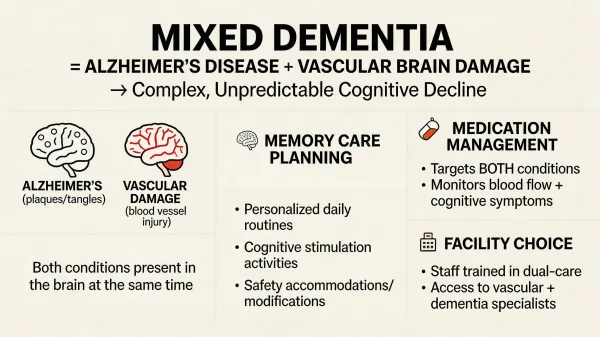
Mixed dementia is a condition where two or more types of dementia-related brain changes occur at the same time, most commonly Alzheimer's disease and vascular dementia. It affects how quickly symptoms progress, how a person responds to treatment, and what kind of memory care environment they need. Understanding the overlap is critical for families building a care plan that accounts for more than one diagnosis.
Imagine sitting in a neurologist's office after weeks of watching your parent's memory slip, expecting confirmation of what you've already suspected: Alzheimer's. But the doctor explains it isn't that simple. Brain imaging shows evidence of vascular damage alongside the Alzheimer's pathology. The care plan you spent weeks putting together, the facility you toured, the medication schedule you organized, all of it may need to be rethought.
That moment hits hard. I've watched a family member's cognitive decline follow a pattern that didn't match any single textbook description, and the confusion that created for everyone around them was almost as disorienting as the disease itself. Mixed dementia is more common than most families expect, and the sooner you understand what it means, the better prepared you'll be to make decisions that actually fit your parent's situation.
This article covers what mixed dementia is, why it behaves differently from a single diagnosis, how it changes care planning and medication management, and what to ask memory care facilities if your parent has overlapping conditions.
What Is Mixed Dementia, and How Is It Different from Alzheimer's Alone?
Mixed dementia refers to the presence of more than one type of dementia-related pathology in the brain at the same time. The most common combination is Alzheimer's disease (characterized by amyloid plaques and neurofibrillary tangles) alongside vascular dementia (caused by reduced blood flow from damaged or blocked blood vessels in the brain). Some individuals also have Lewy body changes in addition to Alzheimer's or vascular damage, though the Alzheimer's-vascular combination is the one families encounter most often.
The key difference from a single Alzheimer's diagnosis is how the two conditions interact. Alzheimer's typically follows a gradual, fairly predictable decline. Vascular dementia can produce sudden drops in function, often tied to small strokes or changes in blood flow. When both are present, the decline may look erratic: gradual worsening interrupted by sudden setbacks, followed by partial plateaus that don't quite match what the family was told to expect. That unpredictability is what makes mixed dementia so difficult to plan around.
How Common Is Mixed Dementia?
More common than most people realize. Autopsy studies consistently show that many people diagnosed during life with a single type of dementia actually had multiple types of brain pathology. Research from the Rush Alzheimer's Disease Center found that more than 50% of individuals whose brains met Alzheimer's criteria at autopsy also had evidence of at least one other type of dementia. Vascular damage was the most frequent co-occurring finding, with Lewy body pathology second.
A 2017 review published in Dementia & Neuropsychologia reported that neuropathological studies estimate mixed dementia prevalence at roughly 20% to 22% of all dementia cases. Other community-based studies put the figure higher, depending on how broadly "mixed pathology" is defined. The challenge is that mixed dementia is difficult to diagnose during a person's lifetime because current imaging can't always detect every type of brain change present. Many families don't learn their parent had mixed dementia until well into the care journey, when the pattern of decline doesn't match expectations for a single diagnosis.
Why Does Mixed Dementia Follow Such an Unpredictable Pattern?
Each type of dementia damages the brain differently. Alzheimer's gradually destroys neurons through protein buildup. Vascular dementia disrupts blood supply, and the damage depends on which blood vessels are affected and how severely. When both processes are happening at once, the resulting symptoms can shift depending on which type of damage is more active at any given time.
A person with mixed dementia might show weeks of slow, steady memory loss (typical of Alzheimer's), then suddenly lose the ability to follow a conversation or manage basic tasks after a small, undetected stroke. They might partially recover from that drop, then resume the slower Alzheimer's-pattern decline. The result is a trajectory that looks like a staircase with uneven steps, not the smooth downward slope families often expect. From the outside, it can feel like your parent is getting worse, then stabilizing, then getting worse again in a completely different way.
When my family member's decline started accelerating, none of us could make sense of the pattern. Some weeks the memory loss was the dominant issue. Other weeks it was sudden confusion or difficulty walking that seemed to come out of nowhere. We kept waiting for the progression to settle into something we could predict and prepare for, but it never did. It wasn't until later that we understood overlapping conditions were driving that unpredictability, and that the lack of a clean pattern was itself a pattern. That realization changed how we approached every care decision going forward, because we stopped trying to plan for a single disease trajectory and started planning for volatility instead.
How Is Mixed Dementia Diagnosed?
Diagnosing mixed dementia is difficult because no single test can definitively identify every type of brain pathology present in a living person. Neurologists typically use a combination of cognitive assessments, brain imaging (MRI or CT scans), medical history, and sometimes cerebrospinal fluid analysis or blood-based biomarkers to evaluate what's happening.
An MRI can reveal vascular damage such as white matter lesions, past strokes, or reduced blood flow patterns. But the Alzheimer's component is often diagnosed clinically, based on the pattern of memory loss and cognitive testing results, rather than confirmed by imaging alone. If your parent's cognitive decline doesn't follow the expected Alzheimer's pattern, or if brain imaging shows significant vascular changes, the neurologist may diagnose mixed dementia. A second opinion from a geriatrician or a dementia specialist can be valuable when the clinical picture is unclear. The diagnosis matters because it directly affects which medications are appropriate and what kind of care environment your parent needs.
How Does Mixed Dementia Change the Care Plan?
A mixed dementia diagnosis changes care planning in ways most families don't anticipate. The combination of Alzheimer's and vascular dementia doesn't just mean your parent has two problems. It means those problems interact, often accelerating decline faster than either condition would on its own. Research suggests that the presence of both Alzheimer's pathology and vascular damage increases the likelihood that a person will develop dementia symptoms at a lower overall level of brain pathology. In practical terms, your parent may reach the point of needing full-time memory care sooner than projected for Alzheimer's alone.
Medication management becomes considerably more complex. For the Alzheimer's component, doctors typically prescribe cholinesterase inhibitors (donepezil, rivastigmine, or galantamine) and, in moderate to severe stages, memantine. These medications are FDA-approved for Alzheimer's, and clinical guidelines from NICE also support their use in mixed Alzheimer's-vascular dementia. However, no medications are specifically FDA-approved for mixed dementia as a standalone diagnosis, so treatment decisions involve clinical judgment about which component of the disease is most active and responsive to medication.
The vascular component introduces an entirely separate medication layer. Your parent's care team will likely focus on managing cardiovascular risk factors to prevent further vascular damage: blood pressure medications, cholesterol management, blood thinners if there's a history of stroke or mini-strokes (TIAs), and blood sugar control for diabetic patients. I've seen in my years working in hospitals how many older patients are managing five, six, or more medications simultaneously, and each one has the potential to interact with the others. With mixed dementia, the medication list often grows quickly, and the risk of drug interactions or side effects increases with every addition.
Stroke prevention becomes a core part of the care plan alongside Alzheimer's treatment, and these two goals can sometimes create tension. Some medications that help one condition may complicate the other. Blood thinners reduce vascular risk but increase fall-related bleeding risk in someone with advancing Alzheimer's who is already unsteady on their feet. The care team needs to weigh these tradeoffs constantly, and those conversations should include you as the family decision-maker.
What you should discuss with your parent's care team: whether the current medication regimen addresses both the Alzheimer's and vascular components, how often medications will be reviewed and adjusted as the disease progresses, what signs to watch for that might indicate a new vascular event (sudden confusion, one-sided weakness, difficulty speaking), and how fall prevention is being factored into the overall plan. Ask the neurologist or geriatrician to explain which symptoms are likely Alzheimer's-driven and which may be vascular, because that distinction affects treatment priorities. Don't assume the same doctor is managing both sides of the condition. In some cases, a neurologist handles the Alzheimer's component while a cardiologist or internist manages the vascular risk factors, and communication between them isn't always automatic. You may need to be the person who connects those dots.
What Should You Ask Memory Care Facilities About Managing Mixed Dementia?
Not every memory care facility is equipped to handle mixed dementia well. Most facilities design their programs around Alzheimer's-type dementia, with routines and staff training built for a gradual, somewhat predictable pattern of decline. Mixed dementia doesn't follow that pattern, and a facility that isn't prepared for sudden functional drops, complex medication schedules, or the need to monitor for vascular events may not be the right fit.
Start by asking about staff training on dual-diagnosis dementia care. Find out whether the facility's caregivers and nursing staff understand the difference between Alzheimer's-driven symptoms and vascular-driven symptoms. This matters because the appropriate response to a sudden change in your parent's condition depends on what's causing it. A new vascular event may require urgent medical intervention, while an Alzheimer's-related behavioral change might call for a different approach entirely. Staff who aren't trained to distinguish between the two may miss warning signs or respond inappropriately. Ask how often staff receive continuing education on dementia subtypes, and whether that training covers vascular risk factors specifically, not just Alzheimer's progression. During my time doing mobile X-ray work in care facilities, I saw how much variation there was in staff knowledge from one building to the next. The difference between a facility where staff recognized a potential stroke and one where they attributed the sudden change to "just the dementia" was significant.
Ask specifically about medication review protocols. How often does a physician or pharmacist review the full medication list? For mixed dementia residents, quarterly reviews at minimum are reasonable, and some geriatricians prefer monthly reviews during periods of active change. You want to know that someone is looking at the complete picture, checking for drug interactions between Alzheimer's medications, cardiovascular drugs, and anything else your parent takes, not just refilling prescriptions on autopilot.
Ask about monitoring for vascular events. Does the facility have protocols for recognizing stroke symptoms in residents who already have cognitive impairment? This is harder than it sounds, because many stroke warning signs (confusion, difficulty speaking, sudden unsteadiness) overlap with symptoms the resident already exhibits daily due to their dementia. A facility that takes mixed dementia seriously will have a clear escalation process: what triggers a call to the physician, what triggers a call to 911, and how staff document and communicate changes in a resident's baseline function. Ask how they track your parent's baseline so they can recognize when something shifts beyond the expected range. If the facility can't articulate a clear answer to these questions, that's a red flag worth taking seriously.
What Do Families Often Underestimate About Mixed Dementia?
The biggest underestimation is thinking of mixed dementia as simply "Alzheimer's plus something else," as if you can just add a second diagnosis to the existing plan and continue forward. The reality is that the interaction between Alzheimer's and vascular dementia creates a trajectory that's more unpredictable and often faster than either condition alone. Families who plan based on an Alzheimer's timeline may find themselves behind, scrambling to adjust when the decline accelerates or shifts direction unexpectedly.
The financial impact catches families off guard too. I remember how quickly the costs added up when our family was sorting through memory care options, and we thought we had planned well. Memory care costs in the U.S. range from roughly $5,000 to over $8,000 per month as of 2025, depending on location and level of care. That's $60,000 to $96,000 a year. Mixed dementia often means a longer period in higher-acuity care and more frequent medication adjustments, both of which can push costs toward the upper end of that range. Planning financially for a two-to-three-year memory care stay is reasonable for some Alzheimer's cases, but mixed dementia may require a longer planning horizon. Factor that into your family's financial conversations early.
Does Insurance Help Cover Mixed Dementia Memory Care?
Medicare does not cover memory care facility costs. It covers some physician visits, diagnostic testing, and short-term skilled nursing after a qualifying hospital stay, but the ongoing room, board, and daily care in a memory care community come out of pocket for most families. Medicaid may cover some long-term care costs for eligible individuals, but eligibility requirements vary by state, and many states have waitlists for home and community-based waiver programs.
Long-term care insurance policies, if your parent purchased one before the diagnosis, may cover a portion of memory care costs. VA Aid and Attendance benefits are available for qualifying veterans and surviving spouses, providing a monthly supplement that can offset some expenses. The key is to explore every available option early, because the application process for Medicaid waivers and VA benefits can take months. Waiting until your parent is already in crisis limits your options and increases out-of-pocket exposure significantly.
Planning Ahead When the Path Isn't Clear
Mixed dementia asks families to plan for uncertainty, and that's one of the hardest things to do during an already emotional time. You can't predict exactly how your parent's two conditions will interact, and no one can give you a reliable timeline. What you can do is build flexibility into your care plan, choose a facility that understands overlapping conditions, and stay closely involved in medication decisions.
Talk to your parent's neurologist or geriatrician about what to watch for as the disease progresses. Make sure you understand the difference between changes driven by Alzheimer's and changes that might signal a new vascular event. Keep a written log of your parent's symptoms and share it at every medical appointment, because your observations from daily life often reveal patterns the clinical team can't see in a 20-minute office visit.
The fact that you're researching this tells me you're already doing more than most families do at this stage. Mixed dementia is confusing, and the lack of a single clear answer is frustrating. But being informed puts you in a better position to ask the right questions, push for better care, and make decisions you can feel confident about. Your parent needs someone advocating for them who understands the full picture, and right now, that person is you.