
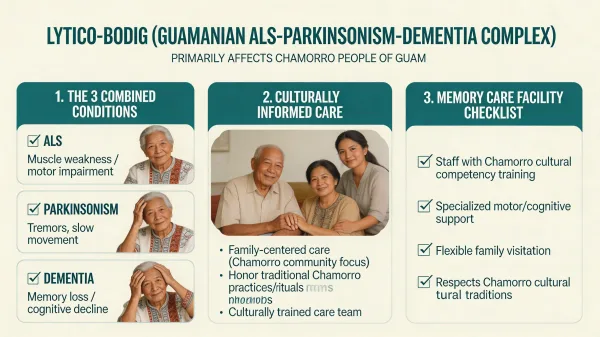
Guamanian ALS-parkinsonism-dementia complex (ALS-PDC), also known as lytico-bodig disease, is a rare and fatal neurodegenerative condition historically concentrated among the Chamorro people of Guam. It combines features of ALS, parkinsonism, and dementia into a single progressive illness that creates unique and overlapping care needs.
In the decades following World War II, this condition was 50 to 100 times more common on Guam than anywhere else in the world. At its peak, it was the leading cause of adult death among the Chamorro population between 1945 and 1956. While the incidence has declined significantly since then, and the ALS component has become rare, the parkinsonism and dementia features continue to appear in aging Chamorro individuals, particularly women. For families affected by this condition, whether living on Guam or part of the large Chamorro diaspora on the U.S. mainland, finding appropriate care remains a challenge with almost no published family guidance available.
If you're a family member trying to understand this diagnosis and figure out what comes next, this article covers what Guamanian ALS-PDC is, why its combination of symptoms creates specific care challenges, and what to consider when planning memory care for a loved one with this condition.
What Is Guamanian ALS-Parkinsonism-Dementia?
The Chamorro people of Guam have known this disease for over 180 years. They call it lytico-bodig: "lytico" refers to the ALS-like paralysis, and "bodig" describes the parkinsonism and cognitive decline. Western medicine named it ALS-parkinsonism-dementia complex, or ALS-PDC, in the early 1960s.
What makes this condition distinct from other forms of dementia is that it can present with any combination of three disease patterns. Some individuals develop progressive muscle weakness and paralysis similar to ALS. Others experience tremors, rigidity, and slowed movement resembling Parkinson's disease. Many develop cognitive decline that shares features with both Alzheimer's disease and frontotemporal dementia. The condition is a tauopathy, meaning it involves the abnormal buildup of tau proteins in the brain, but with a distribution pattern that differs from Alzheimer's.
The cause remains debated after decades of research. Genetics alone don't explain it. Chamorro individuals who grew up outside Guam didn't develop the disease, and some non-Chamorro residents of the island did. Environmental factors, including a neurotoxin called BMAA found in cycad seeds traditionally used in Chamorro cooking, have been investigated but not definitively confirmed. Recent research has also identified prion-like protein accumulation in brain tissue from ALS-PDC patients, suggesting possible links to the mechanisms behind other neurodegenerative diseases. Despite all this research, no treatment exists that slows or stops the progression. The disease remains terminal.
Where This Gets Confusing: Three Diseases, One Diagnosis
Here's where things get complicated for families trying to plan care. ALS, parkinsonism, and dementia each create very different care needs, and most facilities are set up to handle one category or another. Memory care communities specialize in cognitive decline. Skilled nursing facilities handle complex medical needs like those associated with ALS. Parkinsonism requires its own set of mobility supports and medication management. Few places are designed for all three at once.
Guamanian ALS-PDC doesn't fit neatly into any one of these categories. A person with this diagnosis might need help with swallowing and respiratory support (ALS features), assistance with movement and fall prevention (parkinsonism features), and a secure, structured environment for progressive cognitive decline (dementia features), all at the same time. The symptom profile can also shift as the disease progresses, with one component becoming more dominant than the others. I've seen in my years working in hospital settings how quickly a care plan can become outdated when a patient's condition changes across multiple systems at once.
This overlap means families often need a care environment that can adapt rather than one built around a single diagnosis.
Care Planning for Guamanian ALS-PDC: Bridging Culture and Medical Needs
Planning care for someone with Guamanian ALS-PDC requires thinking about two things simultaneously: the medical complexity of a multi-system neurodegenerative disease, and the cultural context that makes this condition unlike any other dementia diagnosis. Both matter, and neither should be treated as optional.
On the medical side, look for a facility that can handle progressive needs across cognitive, motor, and potentially respiratory domains. This means a memory care community with either on-site skilled nursing capabilities or a strong partnership with a nearby medical center experienced in ALS care. Key questions to ask include whether the facility has experience managing residents who need both dementia-level supervision and physical support for swallowing difficulties or fall risk, whether physical and occupational therapy are available on-site, and whether the care team can adjust the plan as symptoms shift between the motor and cognitive sides of the disease. Standard memory care alone won't be enough if the ALS or parkinsonism features become prominent. But a nursing home focused on medical management may lack the cognitive stimulation and secure environment that the dementia component requires.
On the cultural side, this disease carries a weight that goes beyond medical charts. For Chamorro families, lytico-bodig isn't just a diagnosis. It's often part of generational experience. A family may have watched grandparents or uncles go through the same decline on Guam decades ago. Imagine your father, living with your family in California, beginning to show the same tremors and confusion that took his own father years earlier, thousands of miles from the community that understands what this disease means and what it takes from a family.
Growing up in a household where we cared for children from every background taught me early that cultural humility in care isn't something you add on later. It's the foundation. When a family walks in carrying the weight of a disease tied to their homeland, their history, and their identity as a people, the care team has to meet them where they are. I watched my parents welcome families with patience and respect for what each one brought through the door, and that lesson has never left me. For Chamorro families dealing with lytico-bodig, this means finding providers willing to learn about the cultural significance of this condition, not just its clinical features. It means honoring family structures (Chamorro culture is matrilineal, with extended family playing central caregiving roles) and making space for traditional values alongside medical protocols.
Connecting with Chamorro community organizations on the mainland can help bridge the gap. Significant Chamorro populations live in California, Washington, Hawaii, and Texas, and local community groups may offer support networks that a standard care facility can't provide. Pairing a capable medical care environment with cultural community support is the best path for families facing this rare diagnosis far from Guam.
What to Look for in a Memory Care Facility
Not every memory care community will be the right fit for a resident with Guamanian ALS-PDC. The combination of motor symptoms and cognitive decline narrows the field, but the right facility does exist if you know what to ask.
Look for communities that offer tiered or adaptive care, where the level of support can increase without requiring a move to a completely different facility. Ask whether the staff has experience with residents who have movement disorders alongside dementia, not just Alzheimer's. Find out whether speech therapy and swallowing assessments are part of the available services, since dysphagia (difficulty swallowing) is common with both the ALS and parkinsonism components of this disease. I've done mobile X-ray work inside care facilities, and the difference between a place that adapts to complex residents and one that doesn't is visible the moment you walk through the door.
Fall prevention protocols are critical. Parkinsonism creates balance and gait problems that standard memory care safety measures may not fully address. Ask about grab bars, non-slip flooring, and whether staff are trained to assist with transfers for residents who have both cognitive confusion and physical instability. A facility that checks these boxes gives your family a realistic starting point.
The Cost Reality for Rare Dementia Care
Memory care in the United States costs a national average of roughly $7,000 to $8,000 per month as of 2025, which works out to $84,000 to $96,000 per year. For a condition like Guamanian ALS-PDC that may require additional medical services on top of standard memory care, costs can push toward the higher end of that range or beyond. If skilled nursing becomes necessary as ALS symptoms progress, monthly costs can exceed $10,000. Over a two to three year stay, a family could be looking at $200,000 to $300,000 or more in total care expenses.
That number can hit hard. When our family first faced the cost of memory care during a loved one's dementia journey, the financial shock was almost as overwhelming as the diagnosis itself. Families dealing with a rare condition face the added frustration that most cost-planning resources assume a more common dementia diagnosis. Medicare doesn't cover long-term residential memory care, though it may cover some medical services like physical therapy. Medicaid may help in some states through Home and Community-Based Services waivers, and VA benefits may apply if the individual or their spouse served in the military. Start these financial conversations early, before the care need becomes urgent.
Moving Through This Together
Guamanian ALS-parkinsonism-dementia is rare, and the families dealing with it often feel like they're the only ones trying to figure out a care plan with no roadmap. You're not alone in this. The Chamorro community, both on Guam and across the mainland United States, carries a shared understanding of this disease that most healthcare providers don't have. Lean on that knowledge. Bring it into the care planning conversation.
The right care environment for your loved one exists, even if it takes more searching than it would for a more common diagnosis. Ask hard questions, look for facilities that can adapt to a changing symptom profile, and don't settle for a place that only addresses one part of what this disease does. Talk to multiple facilities before deciding. Be upfront about the full scope of the condition so the care team can prepare rather than react. Your parent deserves care that respects both their medical needs and the cultural history they carry. That combination is worth fighting for.