
Is assisted living too risky for your parent with chronic lymphocytic leukemia, or is keeping them home alone actually the bigger danger? If you're wrestling with this question, you're not the first family to feel stuck between two imperfect choices. CLL compromises the immune system in ways that make every cold, every flu season, and every shared dining room feel like a potential threat. Your parent's oncologist may have warned about infection risk in group settings, and that warning is valid. But what rarely gets equal airtime is the other side of this equation: a parent living alone with a weakened immune system, no one to notice a low-grade fever at 2 a.m., and mounting isolation that quietly erodes both physical and mental health.
I've spent nearly two decades working inside hospitals, and I've seen how quickly respiratory illnesses move through care facilities. I've also seen what happens when older adults live alone too long without monitoring, showing up in the ER with infections that could have been caught days earlier. The risk isn't one-sided, and the decision shouldn't be either.
CLL senior living decisions sit at the intersection of oncology, geriatrics, and family dynamics, and no single medical professional sees the full picture. Your parent's oncologist focuses on cancer and immune status. The assisted living director focuses on what their community can accommodate. You're the one holding all the pieces together. This article breaks down the real infection risks on both sides, what to look for in a community that takes immunocompromise seriously, and how to make this decision with clarity rather than fear. Chronic leukemia and assisted living can work together, but only when families know what to demand.
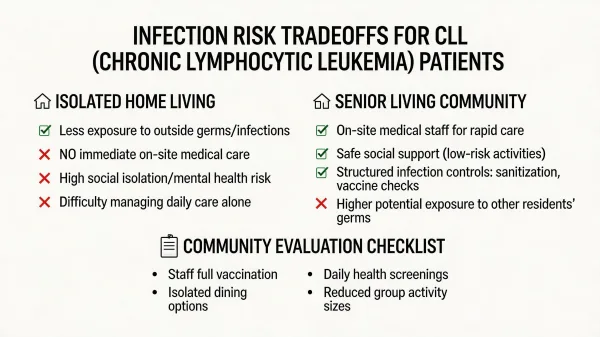
Communal Living vs. Home Isolation for CLL Patients: A Quick Comparison
| Factor | Assisted Living Community | Living Alone at Home |
|---|---|---|
| Infection exposure | Higher exposure to respiratory and GI pathogens from shared spaces, staff, and other residents | Lower baseline exposure, but infections still occur from visitors, errands, and medical appointments |
| Infection monitoring | Staff can detect fevers, changes in appetite, and early symptoms around the clock | No consistent monitoring unless family or home health visits daily |
| Emergency response | On-site staff can respond immediately to sudden illness or falls | Delayed response depends on phone access, alert devices, or someone checking in |
| Social connection | Built-in social opportunities reduce depression and cognitive decline risk | High isolation risk, linked to increased mortality comparable to smoking and obesity |
| Nutrition | Regular meals designed for dietary needs support immune function | Risk of poor nutrition if parent struggles with cooking or appetite |
| Infection prevention control | Varies widely by facility, from excellent to inconsistent | Family controls the environment but may lack medical-grade protocols |
| Medication management | Staff can monitor CLL medications, watch for side effects, coordinate with oncology team | Self-managed, with risk of missed doses or unnoticed side effects |
| Cost (as of 2025) | National median $6,200/month ($74,400/year), plus potential add-ons for enhanced care | Mortgage/rent plus home health aide if needed ($35/hour median for non-medical care) |
What CLL Does to Your Parent's Immune System
Chronic lymphocytic leukemia is the most common leukemia in adults, and it overwhelmingly affects older people. The median age at diagnosis is around 70, which means many families are facing CLL decisions at the same time they're considering senior living options. CLL isn't just a blood cancer. It's an immune system disease. The leukemia itself causes the body to produce defective B cells that crowd out healthy immune cells, leading to a condition called hypogammaglobulinemia, where antibody levels drop and the body loses its ability to fight off common bacteria and viruses effectively.
Here's what catches families off guard: every person diagnosed with CLL is considered immunocompromised, even in early stages before treatment begins. Treatment makes it worse. Targeted therapies like BTK inhibitors and venetoclax, while far better than older chemotherapy regimens, still carry infection risks of their own, including rare but serious fungal infections. The respiratory tract is the most common site of infection for CLL patients, which is exactly why shared indoor spaces raise red flags. Skin infections, urinary tract infections, and sinus infections are also common, particularly in patients whose IgA levels have dropped. But understanding the risk clearly is the first step toward managing it, not running from it.
The infection risk also changes over time. In the earlier stages, bacterial infections from organisms like Streptococcus pneumoniae are the primary concern. As CLL progresses or as treatment accumulates, the range of potential infections widens to include viral reactivations (like shingles) and opportunistic infections that healthy immune systems handle without trouble. This progression is important for families to understand because the infection prevention measures your parent needs today may be different from what they'll need two or three years from now.
The Infection Risk Calculus: CLL in Communal Living vs. Home Isolation
Where this gets confusing is that families hear "infection risk" and immediately picture the worst version of communal living, dozens of residents coughing in a crowded dining hall while your immunocompromised parent sits among them. That image is real in some facilities. But the alternative, your parent alone at home with a compromised immune system, carries risks that are just as serious and far less visible.
The Communal Living Side
Assisted living communities do present genuine infection risks for CLL patients. Respiratory illnesses like influenza, COVID-19, and RSV spread more easily in congregate settings where people share dining rooms, activity spaces, and common areas. Staff members interact with multiple residents throughout a shift, and if infection prevention protocols slip, a single sick employee can seed an outbreak across a floor. During my years doing mobile X-ray work in care facilities, I saw respiratory illness outbreaks sweep through buildings fast. What struck me wasn't just the speed of transmission but the inconsistency of infection prevention practices. Hand hygiene compliance would be solid when supervisors were present and visibly drop when they weren't. Gowns and gloves would be used correctly in one wing and skipped in another. That kind of inconsistency is what makes communal settings particularly dangerous for immunocompromised residents, not the mere fact of living near other people, but whether the facility enforces its protocols every shift, every day.
For a CLL patient, a routine respiratory infection that a healthy resident shakes off in a week can escalate quickly. Lower antibody levels mean vaccines may not provide full protection. Neutropenia from treatment can delay the body's initial response to bacterial infections, giving pathogens a head start before anyone notices symptoms.
The Home Isolation Side
Now consider the other scenario. Your parent lives alone, theoretically safer from communal exposure. But isolation introduces its own cascade of dangers. Without someone checking daily, a low-grade fever can progress to sepsis before anyone notices. Missed meals and dehydration weaken an already compromised immune system further. In the ER, I've seen older patients who live alone come in with infections that had been brewing for days before anyone realized something was wrong. Depression and loneliness, both well-documented consequences of social isolation in older adults, suppress immune function in ways that compound the damage CLL is already doing.
Research from the National Academies of Sciences found that social isolation is associated with an approximately 50 percent increased risk of developing dementia and carries mortality risks comparable to smoking and obesity. For a CLL patient already fighting immune dysfunction, adding the physiological toll of chronic loneliness is not a neutral choice. It's a compounding risk.
Imagine your parent with CLL is afraid to move into assisted living because their oncologist flagged infection risk in group settings. That fear makes sense. But staying home alone, they've already been hospitalized twice for infections they caught at home, once from a urinary tract infection that went undetected for days, once from pneumonia after skipping meals and becoming dehydrated. Nobody was there to notice the early signs, and the infection risk didn't disappear by staying home. It just shifted from a visible, manageable risk to an invisible, unmonitored one.
Making an Informed Decision, Not a Fear-Based One
The honest assessment is this: both options carry infection risk. The question isn't which one is perfectly safe. Neither is. The question is which set of risks your family can manage better, given your parent's stage of CLL, their current treatment, their ability to care for themselves, and your family's capacity to provide consistent oversight at home. A well-run assisted living community with strong infection prevention protocols, private room options, and staff trained to monitor immunocompromised residents may actually reduce overall risk compared to unmonitored home living. The key word is "well-run." Not every community meets that standard, which is why the next section matters.
What an Immunocompromised Resident Needs From a Community
If your family decides that assisted living is the better path for your parent with CLL, the next step is finding a community that takes immunocompromise seriously, not just on paper, but in daily practice. This requires asking specific questions and watching for specific behaviors during your visit. A community that gets defensive or vague when you ask about infection prevention is telling you everything you need to know.
Staff Health Screening and Sick Policies
Ask how the community handles staff illness. Do employees undergo daily symptom screening? What is the policy when a staff member calls in sick, is the shift covered by a float from another facility (who may be carrying different exposures), or do they have in-house backup staff? Communities that pressure sick employees to come in, even informally, are a red flag. For a CLL resident, a caregiver working through a "mild cold" is a serious exposure event.
Outbreak Response Plans
Every community should have a written outbreak response plan, and they should be willing to show it to you. Ask what happens when two or more residents on the same floor develop respiratory symptoms within a few days. You want to hear specifics: cohorting of symptomatic residents, increased PPE requirements for staff, notification to families, and communication with the local health department. If the answer is vague or amounts to "we follow CDC guidelines," push for details. Following guidelines is the minimum. Execution is what matters.
Vaccination Policies
Ask about vaccination requirements for both staff and residents. Some states require influenza vaccination for long-term care staff, but many assisted living communities aren't held to the same standard as nursing homes. A community that strongly encourages (or requires) staff vaccination for flu, COVID-19, and other respiratory viruses provides a meaningful layer of protection. For your parent with CLL, remember that their own vaccine response may be reduced. The vaccination status of the people around them matters more than usual.
Private Dining and Flexible Meal Options
During flu season or when respiratory illness is circulating in the community, your parent should have the option to eat meals in their room without extra charges or social pressure to join the dining hall. Some communities offer this routinely. Others treat in-room dining as an inconvenience. Ask directly, and pay attention to how the staff responds. A community that builds flexibility into its dining program is signaling that it understands residents have different risk profiles.
The Questions That Reveal the Most
Two questions cut through marketing language faster than anything else. First: "How many respiratory illness outbreaks has this community had in the past two years, and what did you do about them?" A community that answers directly and describes specific actions is more trustworthy than one that claims they've never had a problem. Outbreaks happen. The response is what separates good communities from dangerous ones. Second: "If my parent's oncologist needs to communicate special precautions to your nursing staff, what's that process?" A community with a clear care coordination pathway is equipped for medically complex residents. One that stumbles over this question likely isn't.
Daily Management of CLL in an Assisted Living Setting
Living with CLL in a senior community requires a few practical adjustments that most families can coordinate with the care team. Your parent's oncologist should provide the community's nursing staff with clear documentation of their current treatment regimen, any prophylactic medications (such as antivirals or antibiotics), and specific symptoms that warrant immediate medical attention rather than a wait-and-see approach. A written care plan that sits in the nursing station isn't enough. The aides who interact with your parent daily need to understand what they're watching for.
Medication timing matters with many CLL treatments. Some targeted therapies need to be taken at consistent intervals, and missed doses can affect both efficacy and side effect profiles. Confirm that the community's medication management system can accommodate these requirements. Blood work schedules should be coordinated so that transportation to and from oncology appointments doesn't become a barrier to consistent monitoring. Ask whether the community has relationships with mobile phlebotomy services, which can save your parent the fatigue and exposure of frequent trips to a lab.
The Cost Picture for CLL Patients Considering Senior Living
The financial reality of CLL and senior living runs on two tracks simultaneously. On one side is the cost of the community itself. As of the 2025 CareScout Cost of Care Survey, the national median for assisted living is $6,200 per month, or $74,400 annually. Communities that offer enhanced infection prevention measures, HEPA air filtration in individual rooms, or guaranteed private rooms may charge more, and these add-ons are worth investigating for a CLL patient. On the other side is the cost of CLL treatment, which can run thousands per month depending on the therapy, even with insurance. Between the community and the treatment, families can find themselves managing $100,000 or more in combined annual expenses.
Families sometimes assume that keeping a parent at home is automatically cheaper. That isn't always true. If your parent needs a home health aide for daily monitoring, the 2025 national median for non-medical in-home care is $35 per hour. At just six hours a day, five days a week, that's roughly $54,600 a year, and it still doesn't cover nights, weekends, or the kind of 24-hour oversight an assisted living community provides. Add in the cost of emergency hospitalizations from unmonitored infections, which CLL patients living alone are more likely to experience, and the math shifts quickly. A single hospitalization for pneumonia or sepsis can cost tens of thousands of dollars, even with insurance, and CLL patients face higher rates of complications that extend hospital stays. When I watched my own family face the financial shock of a loved one's care needs, the numbers that seemed affordable on paper became overwhelming once the real costs of doing it alone piled up. Start comparing total annual costs, not just monthly rates, before you commit to either path.
Working With Your Parent's Oncology Team on the Transition
Your parent's oncologist is a critical partner in this decision, not just for the initial green light, but for ongoing care coordination after the move. Before choosing a community, ask the oncology team for a written summary of your parent's infection risk level, current immunoglobulin levels, and any specific environmental recommendations. Some CLL patients with very low IgG levels receive immunoglobulin replacement therapy (IVIG), which requires regular infusions. Confirm that the community can accommodate transportation to infusion appointments or, in some cases, allow home infusion services on-site.
The oncologist can also help you calibrate expectations. Not every CLL patient faces the same level of risk. A parent in early-stage, untreated CLL has a different risk profile than one who's been through multiple lines of therapy with severe hypogammaglobulinemia. Working in hospitals, I've learned that the best outcomes happen when all the care providers are talking to each other, not just handing off paperwork. That distinction should shape both your community selection criteria and the precautions you negotiate with the facility. Ask for a letter you can share with the community's director of nursing that outlines your parent's specific vulnerabilities. This document becomes the foundation for a care plan that's tailored to your parent, not a generic immunocompromised protocol pulled from a binder.
Finding the Right Balance for Your Family
The decision to move a parent with CLL into assisted living isn't about eliminating risk. That's not possible. It's about choosing the environment where risk can be managed most effectively while still preserving quality of life. For some families, a well-vetted community with strong infection protocols and daily monitoring is genuinely safer than leaving an immunocompromised parent alone at home. For others, a hybrid approach with in-home care plus structured social activities through adult day programs may be the better fit.
What matters most is making this decision with open eyes. Ask the hard questions. Visit communities during off-hours, not just scheduled tours. Talk to your parent's oncologist about specifics, not generalities. Involve your parent in the conversation whenever possible, because their willingness to follow precautions, report symptoms early, and engage with their care team will shape outcomes more than any facility policy can.
Remember that protecting your parent from infection doesn't require protecting them from life. Connection, purpose, and daily engagement aren't luxuries for a CLL patient. They're part of the immune support system that no medication can replace. Start the conversation early, and give yourself permission to choose the option that's good enough rather than waiting for one that's perfect.