
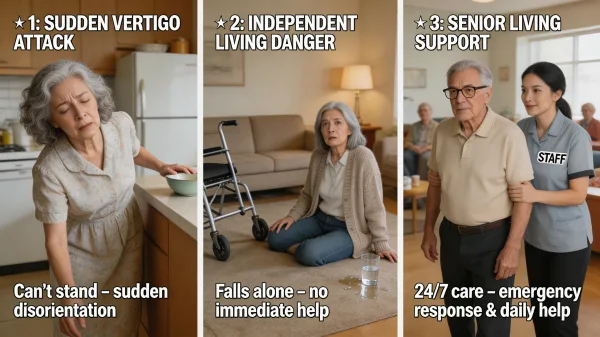
Your parent is standing in the kitchen, reaching for a coffee mug, when the room suddenly tilts. Not a subtle wobble or a brief head rush, but a violent, spinning rotation that makes the walls, the floor, and the ceiling blur into a single churning mass. They grab for the counter and miss. Their knees buckle. They're on the floor before they even understand what's happening, and the spinning won't stop.
This is what a Ménière's disease attack looks like. And if your parent has been diagnosed with this condition, or if they've been having episodes like this that no one can fully explain yet, you already know the fear that comes with it. Every time they're alone, every time you can't be there, you wonder: what if it happens again?
Ménière's disease is a chronic inner ear disorder that causes sudden, severe vertigo attacks along with hearing loss, tinnitus, and a feeling of pressure in the ear. For older adults living alone, these episodes create a fall risk that's hard to manage without consistent support. The attacks come without warning, last anywhere from 20 minutes to several hours, and leave your parent unable to stand, walk, or care for themselves until the episode passes. I've seen patients come into the ER during severe vertigo episodes, and the intensity shocks families who assumed "dizziness" meant something mild. It's not mild. It's completely disabling while it's happening.
This article covers what Ménière's attacks actually look and feel like, why they make independent living increasingly dangerous for seniors, and how a senior living community can provide the daily support and emergency response that this unpredictable condition demands.
What Is Ménière's Disease?
Ménière's disease is a disorder of the inner ear caused by abnormal fluid buildup in a structure called the labyrinth, which controls both hearing and balance. The excess fluid, called endolymph, disrupts the signals your inner ear sends to your brain. The result is sudden, intense vertigo, fluctuating hearing loss (usually in one ear), ringing or roaring sounds in the ear known as tinnitus, and a sensation of fullness or pressure in the affected ear.
The condition affects roughly 615,000 people in the United States. Onset typically occurs between ages 40 and 60, though about 15% of people with Ménière's are over 65. In older adults, the disease can appear for the first time or reactivate after years of remission, and the consequences of each attack become more dangerous as balance, bone density, and recovery capacity all decline with age. There's no cure. Treatment focuses on reducing the frequency and severity of attacks through dietary changes, medication, and vestibular rehabilitation.
What a Ménière's Attack Actually Looks Like, and Why It's Not Just Dizziness
Where this gets confusing for families is the word "dizziness." When most people hear that their parent has a condition that causes dizziness, they picture a brief moment of lightheadedness. Maybe the room shifts for a second, you grab a doorframe, and it passes. That's not what Ménière's does.
A full Ménière's attack is a violent, sustained assault on the vestibular system. The room doesn't just tilt or sway. It spins, aggressively and relentlessly, as if your parent were strapped to a carousel that won't stop. Opening their eyes makes it worse because every visual input confirms the false signal their brain is receiving, that the world is rotating around them. So they close their eyes, lie completely still on whatever surface they landed on, and try to ride it out.
The nausea hits almost immediately. Most people vomit during a Ménière's episode, and some vomit repeatedly for the duration of the attack. The body's autonomic nervous system reacts to the vestibular chaos with sweating, pallor, and sometimes a racing heart. I've worked in the ER long enough to see what this looks like from the clinical side: patients arrive pale and drenched in sweat, unable to open their eyes, vomiting into a basin, and terrified because they think they're having a stroke. The symptoms can genuinely look that severe. I remember one older patient whose daughter kept asking us to order a brain scan because she was convinced her mother was having a neurological event. What was actually happening was a Ménière's attack, but the violence of the symptoms made it impossible for the family to believe that "just an inner ear condition" could do this. Families standing in the doorway are often just as shaken as the patient because nothing they're witnessing matches what they expected from a condition described as "dizziness."
Episodes last anywhere from 20 minutes to several hours, with some stretching beyond half a day. During that entire window, your parent can't stand, can't walk, can't get to a phone, and can't care for themselves in any capacity. If they were standing when the attack started, they likely fell hard. If they were near stairs, a stove, or in a bathtub, the consequences become exponentially more dangerous.
Some people with Ménière's also experience what are called "drop attacks," clinically known as Tumarkin's otolithic crisis. These are sudden falls that happen without any warning at all. There's no preceding dizziness, no aura, no signal that something is coming. The person simply collapses as if their legs were swept out from under them, and they remain fully conscious the entire time, which makes the experience even more frightening. Research suggests that nearly half of people with Ménière's may experience drop attacks at some point during their illness. In older adults with already compromised bone density, a sudden unbraced fall like this can mean a hip fracture, a head injury, or worse.
After the spinning finally stops, recovery isn't instant. Most people feel profoundly exhausted for hours afterward, sometimes for the rest of the day. Hearing in the affected ear may be muffled or distorted, and balance often remains off well into the next day. Your parent may feel well enough to stand, but their vestibular system hasn't fully recalibrated, which means the post-attack hours carry their own fall risk.
The part that makes all of this especially hard to plan around is the unpredictability. Attacks don't follow a schedule. Some people go weeks or months between episodes. Others have clusters over several days. There's no reliable way to predict when the next one will hit, which means your parent is always one moment away from being on the floor, unable to move.
Why Ménière's Makes Independent Living Dangerous for Seniors
Fall risk is the central safety concern. Falls are the leading cause of injury-related death among adults 65 and older, and Ménière's disease adds a layer of risk that's fundamentally different from the gradual balance decline most seniors experience. This isn't about tripping over a rug or losing footing on a wet surface. A Ménière's-related fall happens because the brain suddenly loses its ability to orient the body in space. There's no chance to catch yourself.
For a senior living alone, a Ménière's attack means lying on the floor for hours with no one to help. If the fall caused an injury, if they hit their head or broke a bone, the delay in getting medical attention can be the difference between a recoverable injury and a life-altering one. Consider your parent having an attack at 10 in the morning and not being found until you stop by after work at 6 p.m. Eight hours on a hard floor with a possible fracture, dehydrated from vomiting, unable to reach a phone. That's not an unlikely scenario for someone living with Ménière's without daily support. The isolation between attacks is damaging in a different way. Many seniors with Ménière's stop going out, stop cooking, and stop doing the things that keep them physically active because they're afraid of what might happen if an attack strikes while they're standing. That fear-driven withdrawal accelerates physical decline and makes the next fall even more likely.
The Emotional Weight: Fear, Isolation, and Lost Confidence
Ménière's disease doesn't just affect the body. The psychological toll is real and often underestimated by families who are focused on the physical symptoms. Living with the constant threat of a disabling episode creates chronic anxiety that reshapes your parent's entire daily life. They may start avoiding activities they used to enjoy, not because they physically can't do them, but because they're terrified of being caught in public during an attack.
The hearing loss compounds this isolation. Conversations become harder to follow, especially in group settings with background noise. Tinnitus can make quiet moments anything but quiet, filling them with ringing or roaring that only your parent can hear. Over time, the combination of fear, hearing difficulty, and reduced activity can lead to depression. I've seen how quickly a person can pull away from the life they used to live when their body becomes unpredictable, and with Ménière's, the unpredictability is the defining feature of the disease. Watching your parent shrink their world down to the smallest, safest space they can find is one of the most painful parts of this for families.
How a Senior Living Community Supports Someone with Ménière's Disease
The most important thing a care community provides for someone with Ménière's is the guarantee that they won't be alone during an attack. Staff are present around the clock, which means if your parent collapses in the hallway or starts vomiting in their room, someone is there within minutes to help them get safe, stay still, and receive whatever support they need until the episode passes.
Beyond emergency response, assisted living communities offer daily structure that helps reduce attack triggers. Meals are prepared and served on a consistent schedule, which removes the risk of standing over a hot stove when an episode hits. Housekeeping reduces the clutter and obstacles that turn a sudden fall into a more dangerous one. Many communities also coordinate directly with residents' medical teams, helping manage medication schedules for diuretics, anti-nausea drugs, and vestibular suppressants that need to be taken consistently to be effective.
Communities with on-site or partnered rehabilitation services can provide vestibular rehabilitation therapy (VRT), a specialized form of physical therapy shown to improve balance and reduce fall risk in older adults with vestibular disorders. Having access to VRT in the same building where your parent lives eliminates the transportation barrier that prevents many seniors from attending appointments consistently.
Daily Management Strategies That Help Reduce Ménière's Attacks
While there's no cure for Ménière's disease, daily management can reduce the frequency and severity of episodes. The most widely recommended dietary change is sodium restriction, typically to 1,500 milligrams per day or less. Excess sodium increases fluid retention throughout the body, including in the inner ear, which can trigger or worsen attacks. Caffeine and alcohol are also common triggers worth limiting or eliminating.
Physicians often prescribe diuretics to help the body shed excess fluid, and medications like meclizine or diazepam may be prescribed to manage symptoms during an attack. Having these medications accessible and taken on schedule matters more than most families realize. In a senior living setting, staff can help ensure your parent takes their diuretic at the right time each day and has anti-nausea medication within reach when an episode begins. Stress is another known trigger. Regular routines, adequate sleep, and gentle physical activity can all contribute to fewer episodes over time, and those are things a structured care environment supports naturally.
What to Look for When Choosing a Senior Living Community
Not every assisted living community is equally prepared to support a resident with Ménière's disease. When you're evaluating options, ask specifically about fall response protocols. How quickly does staff respond to a resident's call? Is there an emergency call system in every room, including the bathroom? Are hallways and common areas equipped with handrails and non-slip flooring? During your tour, pay attention to lighting in hallways and bathrooms, since dim environments make balance problems worse for people with vestibular conditions.
Ask whether the community has experience with residents who have vestibular disorders or chronic balance conditions. A staff that has worked with these residents before will understand that a Ménière's attack isn't a medical emergency requiring an ambulance every time, but it does require someone to be present, calm, and trained in how to keep the person safe until the episode resolves. Ask about access to vestibular rehabilitation therapy, whether on-site or through a nearby provider with transportation support. And ask about dietary accommodations. Your parent's low-sodium diet should be something the kitchen team can handle as a matter of routine, not a special request that gets forgotten week to week.
Costs to Plan For
Assisted living costs vary significantly by location, but as of 2025, the national median is $6,200 per month, or about $74,400 per year, according to the CareScout Cost of Care Survey. That base rate typically covers housing, meals, housekeeping, and a standard level of personal care support. If your parent needs additional services like medication management, specialized fall monitoring equipment, or more frequent wellness checks, those extras may increase the monthly cost by several hundred dollars.
Vestibular rehabilitation therapy may be covered by Medicare Part B if prescribed by a physician and delivered by a licensed physical therapist, though coverage details vary. Private long-term care insurance, VA benefits for qualifying veterans, and Medicaid waiver programs in some states can also help offset costs. I remember the shock of seeing actual care costs for the first time when my family was looking at options for a loved one. The numbers hit differently when they're real and not hypothetical. The earlier your family starts researching financial options, the more flexibility you'll have to build a plan that works.
Helping Your Parent Take the Next Step
Ménière's disease is one of those conditions that sounds manageable until you see what an attack actually does to a person. The word "dizziness" doesn't begin to capture it. If your parent is having these episodes, especially if they're living alone, the risk isn't theoretical. Every attack that happens without someone nearby is a fall, a fracture, or a head injury waiting to happen.
A senior living community doesn't cure Ménière's. Nothing does, at least not yet. But it removes the most dangerous variable from the equation: being alone when an attack strikes. It provides the daily structure, medical coordination, and human presence that can make this unpredictable condition safer to live with. Your parent deserves to feel secure, and if their current home can't provide that security during a Ménière's episode, it may be time to consider one that can.
You're doing the right thing by researching this. That matters more than you realize right now.