
Picture this: you walk through the secured entrance of a memory care community, past a living room-style common area where a few residents are working on a puzzle with a staff member. Down a wide, well-lit hallway with handrails on both sides, you stop at a door. Next to it, there's a small shadow box on the wall filled with a family photo, a miniature American flag, and a carved wooden bird. These items aren't random decoration. They help the resident who lives here recognize their own door.
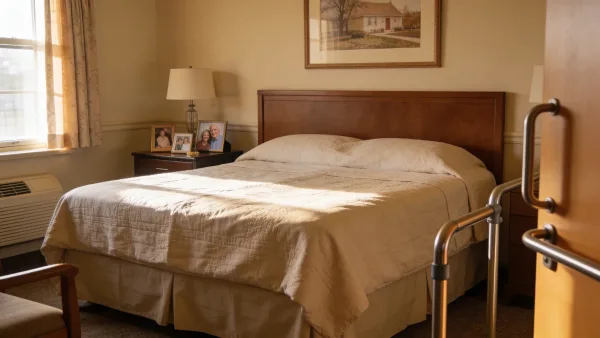
Inside, the apartment is compact. It's a private studio, roughly 300 to 400 square feet. There's a twin bed with a familiar quilt from home, a small recliner, and a dresser. The walls hold a few framed family photos. A large-face clock sits on the nightstand. The bathroom has a walk-in shower with a bench seat, grab bars on both sides, and a pull-cord emergency alert. There's no stove, no microwave, no sharp objects in sight. The lighting is warm and even, with no harsh shadows or dark corners.
It's smaller than you expected. It's also cleaner, calmer, and more intentional than you imagined. Every detail in this room serves a purpose: safety, orientation, or comfort.
If you're preparing to move a parent into memory care, knowing what the space actually looks like (and what it can and can't accommodate) will help you set realistic expectations and make the transition smoother for everyone.
What Does a Typical Memory Care Apartment Include?
Memory care rooms vary by community, but most share a similar foundation. The standard memory care apartment is a private or semi-private studio. Some communities offer one-bedroom units, though studios are far more common in memory care settings than in assisted living.
Most memory care apartments come furnished with the basics: a bed (usually twin or full-size), a nightstand, and often a small dresser or wardrobe. Some communities provide all furniture, while others expect families to bring their own. This is one of the first things to clarify during your tour.
Typical included features are a private or shared bathroom with walk-in shower, emergency call systems (pull cords or wall-mounted buttons), basic window coverings, overhead and wall lighting, climate control (often centrally managed with limited resident access), and flooring designed to be slip-resistant and easy to clean.
What you typically won't find in memory care rooms: a full kitchen or kitchenette, a washer and dryer, a separate living room or dining area, or a balcony or patio with independent access.
Meals are served in a communal dining room. Laundry is handled by staff. Activities take place in shared common areas. The apartment itself is designed for sleeping, resting, and spending quiet time, not for full independent living.
Safety Features and Adaptations: What You Won't See (but Should Know About)
This is where memory care apartments diverge most dramatically from any other type of senior housing. The safety infrastructure built into these spaces is extensive, and much of it is designed to be invisible so the environment feels like a home rather than an institution.
Wandering prevention
The Alzheimer's Association estimates that six in ten people with dementia will wander at some point. Memory care communities design their entire physical environment around managing this risk while still allowing residents freedom of movement within safe boundaries.
Exit doors throughout the community use electronic locks controlled by keypads, key cards, or staff credentials. Residents cannot open these doors independently. Many communities also use delayed-egress locks, which require a button to be held for several seconds before unlocking, giving staff time to respond. Alarm systems alert caregivers the moment a secured door is accessed.
Some communities use subtle design techniques that are remarkably effective. Doors leading to restricted areas may be painted the same color as the surrounding wall, so they don't visually register as exits. Dark-colored floor mats placed in front of certain doors can deter residents from approaching, because people with dementia sometimes perceive dark surfaces on the floor as holes or drop-offs. These psychological design elements work with the brain's changed perception rather than against it.
Wearable tracking devices, such as GPS-enabled wristbands, are increasingly common. These allow staff to monitor each resident's location in real time and receive instant alerts if someone approaches an exit zone or enters a restricted area. More advanced systems track movement patterns over time, helping care teams identify changes in behavior that may signal a shift in the resident's condition.
Fall prevention
Falls are a leading safety concern in memory care. The apartment design addresses this through multiple layers. Flooring is slip-resistant throughout, without transitions or thresholds that could catch a foot. There are no area rugs (a common tripping hazard, which is why they're on every community's "do not bring" list). Hallways feature handrails on both sides. Bathrooms include grab bars near the toilet and in the shower, walk-in showers with zero-step entry and built-in seating, and often raised toilet seats.
Lighting plays a critical role as well. Memory care apartments and hallways are designed with consistent, even illumination that minimizes shadows. Shadows and dark patches can be disorienting or frightening for someone with dementia, potentially causing them to stop, stumble, or become agitated. Nightlights or motion-activated lighting in bathrooms and along hallway paths reduce the risk of falls during nighttime trips.
Hazard removal
Memory care apartments are deliberately stripped of common household items that could pose a danger. There are no stoves, ovens, or toasters. Electrical outlets may be covered or limited. Cleaning supplies, medications, and sharp objects are stored and managed by staff in secured areas. Thermostats are typically controlled centrally or have limited ranges to prevent burns from excessively hot water. Even window operations are restricted to prevent accidental injury.
This hazard removal extends to items families bring from home. Every community maintains a restricted items list, and understanding this list before you start packing prevents frustration and disappointment on move-in day.
Emergency response
Every memory care room includes an emergency call system, most commonly a pull cord in the bathroom and a wall-mounted button near the bed. Staff respond to these calls quickly, and most communities also conduct regular wellness checks throughout the day and night, often every one to two hours. Security cameras in common areas (not in private rooms) provide additional monitoring. Staff are trained in dementia-specific emergency response, including de-escalation techniques for residents experiencing agitation or confusion.
What You Can Bring
Here's where families can make the biggest difference in their loved one's comfort and adjustment. Personalizing the space with familiar items is one of the most effective things you can do to ease the transition. Research consistently shows that familiar objects reduce anxiety and disorientation in people with dementia.
Furniture (if the community allows it): A favorite recliner or armchair, a familiar dresser, and a small side table can make the room feel like home. Check dimensions carefully. Memory care rooms are small, and overcrowding creates a fall risk. Stick to two or three key pieces at most. Choose furniture that's sturdy, easy to get in and out of, and doesn't have sharp edges.
Bedding and linens: Your parent's own comforter, quilt, or blanket from home can be powerfully comforting. Make sure bedding doesn't hang close to the floor where it could cause tripping.
Photos and wall hangings: Framed family photos are one of the most important items to bring. Label photos with names and relationships on the back or in visible captions. This helps staff with reminiscence activities and helps orient your parent when they're having a difficult day. Lightweight frames without glass are preferred by many communities.
A large-face clock and calendar: Orientation aids help residents stay connected to time and routine. Analog clocks with clear numbers work well. A simple day-of-the-week calendar (that someone updates daily) can reduce confusion.
Familiar sensory items: A favorite lotion with a scent your parent associates with home. A soft throw blanket. A music player loaded with songs they love. Scented items and music are particularly effective for people with advanced dementia, because sensory memory often persists long after other types of memory fade.
Activity items: Simple puzzles, photo albums, books with large photos of favorite subjects (gardening, cars, travel destinations), coloring books, and other engagement items. A memory box filled with meaningful keepsakes can be used by staff during reminiscence therapy.
A shadow box for the door: Many communities provide or allow a display case outside the apartment door. Fill it with items that help your parent recognize their room: a familiar photo, a small object tied to their identity (a flag for a veteran, a gardening tool for someone who loved their yard), or something that simply catches their eye.
What You Can't Bring (and Why)
In practice, this is where things break down for many families. The community brochure says "make it feel like home," but the restricted items list tells a different story. Understanding the reasoning behind these restrictions makes them easier to accept.
Sharp objects: Scissors, razors, nail clippers, knives, letter openers. Staff handle grooming and any tasks requiring these items.
Medications and supplements: All medications, including over-the-counter products, are managed by the care team. Even topical creams and cough drops must go through the community's medication management process.
Cleaning supplies: Household cleaners, wipes with chemicals, hand sanitizer in large quantities. These products can be ingested or cause skin reactions.
Small electrical appliances: Coffeemakers, toasters, fans, space heaters, irons, hair dryers (sometimes). Any appliance with a heating element or cord poses a risk.
Area rugs and throw rugs: Tripping hazard, period. Even non-slip rugs are typically prohibited because they can shift on the smooth flooring.
Candles and matches: Open flames are never permitted. Flameless LED candles are a good substitute if your parent finds candlelight comforting.
Financial items and valuables: Credit cards, checkbooks, Social Security cards, expensive jewelry. These items can be lost, misused, or cause anxiety. Keep originals secured at home.
Alcohol and tobacco products: These are managed or prohibited depending on the community's policies and the resident's care plan.
Items made of glass: Glass picture frames, vases, and decorative glass objects can break and create a sharp-edge hazard. Use acrylic, wood, or metal alternatives.
How to Make the Most of a Small Space
Memory care rooms are intentionally small. The compact size reduces disorientation (fewer places to get confused about), minimizes fall risks (shorter distances, fewer obstacles), and keeps the environment manageable for both the resident and staff.
But small doesn't have to mean sterile. A few strategies help:
Arrange furniture to mirror your parent's home layout as closely as possible. If their recliner was always to the right of their bed, place it on the right side here too. Visual consistency helps with orientation.
Use wall space wisely. Hang photos, a lightweight corkboard with rotating family pictures, or a simple wall shelf for a few meaningful objects. Vertical space is your friend when floor space is limited.
Label drawers and cabinets with words or pictures showing what's inside. This supports independence and reduces frustration. "Socks," "shirts," and "pajamas" labels can help your parent dress themselves longer.
Keep the space uncluttered. The instinct is to fill the room with beloved possessions, but too many objects create visual chaos that can increase anxiety for someone with dementia. A few well-chosen items are more effective than a room packed full of things.
Rotate items periodically. Swap out photos or bring new activity items during visits. This keeps the space engaging without adding permanent clutter.
Questions to Ask During Your Tour
When you visit memory care communities, ask these questions about the living spaces:
Can we bring our own furniture, or do you provide it? What are the room dimensions and floor plan options? What items are on your restricted list? How do you handle personal laundry and labeling? How often do staff conduct wellness checks? Can we set up the room before move-in day so it's ready when our parent arrives? Are there any fees for room customization or wall-mounted items?
That last question matters more than you'd think. Some communities charge for picture hanging or have restrictions on putting holes in walls. Knowing this upfront prevents frustration.
Conclusion
Memory care apartments are smaller and more regulated than most families expect. The restrictions on what you can bring feel rigid at first, especially when you're trying to make a small room feel like home for someone you love. But each restriction exists because someone with dementia was once harmed by the item it addresses. The safety features built into these spaces, from wandering prevention systems to fall-resistant flooring to emergency call systems, are designed to protect your parent while preserving as much dignity and normalcy as possible.
The most important thing you can bring isn't furniture or photos. It's your attention to what makes your parent feel safe and recognized. A familiar quilt, a labeled photo of the grandchildren, the scent of a lotion they've used for decades. These small, personal touches do more to make a memory care room feel like home than any piece of furniture ever could.
Ask the community what's allowed before you pack. Visit the room before move-in day. And if possible, set up the space before your parent arrives so they walk into something familiar rather than something empty. That first impression can set the tone for everything that follows.