
Understanding IBD in Senior Living Communities
Inflammatory bowel disease isn't something most people want to talk about openly, and that reluctance only deepens as your parent gets older. The bathroom urgency, the unpredictable flares, the dietary restrictions, the complex medications: these are daily realities for the roughly 2.4 million Americans living with Crohn's disease or ulcerative colitis, and a growing number of them are over 60. Research shows the proportion of IBD patients aged 60 and above rose from about 19% in 1999 to nearly 36% by 2018. If your parent is one of them, finding the right IBD senior living arrangement means addressing needs that most community brochures never mention.
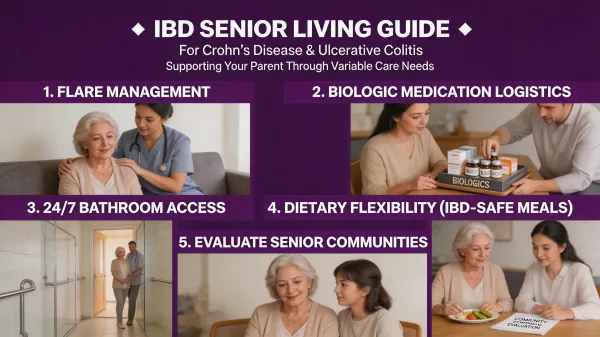
This article offers practical guidance for families evaluating senior living options for a parent with IBD. We'll cover what flare cycles mean for daily care needs, why bathroom access and room placement matter more than you'd expect, how biologic infusions and complex medication schedules fit into community life, and what dietary flexibility to look for. None of these topics show up in glossy brochures. The goal is to help you ask the right questions and recognize which communities can actually support your parent's condition rather than just accommodate it on paper.
Having spent years caring for people whose health swings between good days and difficult ones, I've learned that the best care plans are the ones built to flex. That principle applies directly to IBD, where your parent might need very little help one week and significant support the next.
What IBD Means for an Aging Parent
Inflammatory bowel disease is a group of chronic conditions that cause ongoing inflammation in the digestive tract. Crohn's disease can affect any part of the gastrointestinal system, from mouth to colon, while ulcerative colitis targets the large intestine and rectum. Both conditions cause recurring episodes called flares, which can include severe diarrhea, abdominal pain, rectal bleeding, fatigue, and unintentional weight loss. Between flares, many people experience periods of remission where symptoms settle down considerably. Some people go months or even years between episodes. Others cycle more frequently.
For older adults, IBD carries additional weight. Research published in PMC notes that IBD patients over 65 face higher risks of malnutrition, anemia, and dehydration during flares. The combination of age-related changes in immune function, multiple medications for other conditions, and the physical toll of chronic inflammation means that a flare in a 75-year-old can be far more destabilizing than the same flare in a 35-year-old. Recovery takes longer. Falls become more likely. That difference matters when you're evaluating whether a senior living community can truly meet your parent's needs.
Why IBD Gets More Complicated with Age
Older adults with IBD often manage several health conditions simultaneously. Blood pressure medication, cholesterol drugs, diabetes management, and bone density treatments may all overlap with IBD therapies, creating complex drug interactions that require close monitoring. A 2024 study in the Journal of Crohn's and Colitis highlighted that polypharmacy in older IBD patients is one of the biggest challenges clinicians face, because immunosuppressive IBD treatments can conflict with medications for other conditions. The risk of infections also rises when immune-suppressing drugs are combined with a naturally aging immune system.
There's also the diagnostic challenge. Symptoms that look like an IBD flare can actually be ischemic colitis, medication side effects, or infections like C. difficile, which older adults are more susceptible to. Getting the diagnosis right matters because the wrong treatment can make things worse. Working in hospitals for close to two decades, I've seen how quickly a misread set of symptoms can send treatment in the wrong direction, especially in older patients with multiple conditions. Any senior living community your parent moves into should have nursing staff who understand that not every GI symptom is the same and who know when to escalate to the gastroenterologist.
When Independent Living During a Flare Becomes Unsafe
Consider a parent with Crohn's disease who has managed flares independently for decades. They know their body, they know their triggers, and they've developed routines that work during remission. But a recent severe flare required hospitalization. The biologic infusions that followed left them fatigued. The dietary restrictions during recovery meant they weren't eating enough. The bathroom urgency made leaving the house feel risky. Suddenly, a person who has always handled things on their own is struggling to stay safe at home.
This is the pattern families often describe. The shift doesn't happen gradually. One bad flare can reveal that the gap between what your parent needs during a flare and what they can manage alone has grown too wide. Dehydration can set in quickly when severe diarrhea continues for days. Falls happen when someone who is weakened and dizzy rushes to the bathroom at 3 a.m. That realization is what brings many families to the senior living conversation for the first time.
There's an emotional layer here too. Many people with IBD have spent decades minimizing their symptoms around family and friends because the disease involves bodily functions no one wants to discuss. Your parent may resist the idea of moving somewhere that requires them to acknowledge, out loud, that they need help with something so private. Approaching the conversation with respect for what they've managed on their own, and framing the move as a way to protect their independence rather than give it up, can make a real difference.
Flare Days vs. Remission Days: Why IBD Needs Flexible Care
The defining challenge of IBD in a senior living setting is that your parent's care needs aren't constant. During remission, they may be active, independent, and socially engaged. They eat meals in the dining room, attend activities, and require only minimal assistance with medications. Then a flare hits, and within days, the picture changes completely.
A flare can mean 10 to 20 trips to the bathroom in a single day, often with painful urgency that allows almost no warning time. Severe diarrhea pulls fluid and electrolytes out of the body rapidly, and for an older adult who may already be at risk of dehydration, this can become dangerous fast. The Crohn's and Colitis Foundation notes that severe diarrhea depletes the body of sodium, potassium, magnesium, and zinc, all of which affect heart function, muscle strength, and cognitive clarity. In an older adult, even moderate dehydration can cause confusion, dizziness, and falls. The risk compounds quickly.
Malnutrition is the other major risk during flares. Your parent may lose their appetite entirely, or they may avoid eating because they know food will trigger more bathroom trips. Research on elderly IBD inpatients found that older adults are at significantly higher risk of inadequate nutritional intake during acute flares, and that the resulting malnutrition can extend recovery time and increase the likelihood of hospital readmission. Some older adults with IBD restrict their diet during flares in ways that reduce stool output in the short term but create calorie deficits that weaken them over the following weeks. Over the course of a weeklong flare, a senior who was doing well can lose several pounds and become noticeably weaker.
This is why IBD management in a community setting requires a fundamentally different approach than conditions with a stable baseline. The community needs to be willing and able to scale support up during flares and back down during remission without treating either state as the permanent reality. That means nursing staff who check in more frequently during flare periods, dietary staff who can prepare modified meals on short notice, and a care plan that explicitly accounts for the cyclical nature of the disease.
I spent years caring for people whose needs changed from one day to the next, and one thing became clear early: flexibility isn't a bonus in a care plan, it's the care plan. When you're responsible for someone who might need help getting to the bathroom six times in a morning and then be fine by the afternoon, you learn that rigid schedules don't work. A community that only offers one level of support, or that charges a permanent rate increase after one difficult week, isn't set up for IBD. What your parent needs is a team that treats a flare as a temporary escalation, responds quickly, and then steps back when remission returns. The specific features that make this possible include a room close to a private bathroom (not down a hallway), flexible meal scheduling that allows your parent to eat when their stomach cooperates rather than only at set times, and medication management capable of handling complex biologic regimens that may involve scheduled infusions, injectable medications with strict timing, and multiple oral drugs with different dosing windows.
The Question No One Thinks to Ask
When families tour senior living communities, they ask about meal quality, activities, staffing ratios, and costs. Almost no one asks about bathroom proximity, and for a parent with IBD, this can be the single most important factor in their daily quality of life.
For someone with active Crohn's or colitis, the distance between their bed and the nearest toilet isn't a convenience issue. It's a dignity issue. Urgency during a flare can mean seconds of warning, not minutes. If your parent's room is at the end of a long hallway with a shared bathroom, or if they need to call for assistance and wait for a staff member before they can access the toilet, the result is predictable and humiliating. Ask specifically: does the room have a private bathroom? How far is the bed from the toilet? Is there a call system in the bathroom itself? Are bathrooms accessible in common areas throughout the building? These questions may feel uncomfortable to raise, but they matter more than the quality of the landscaping.
IBD Medication Management in Senior Living
Many older adults with IBD take biologic medications, which are among the most expensive and logistically complex treatments in modern medicine. Infliximab, adalimumab, vedolizumab, and ustekinumab are commonly prescribed, and they require either IV infusions at a medical facility every several weeks or self-administered injections on a strict schedule. Direct healthcare costs for IBD patients average $9,000 to $12,000 per person annually in high-income countries, and those on biologic therapy often see costs two to three times higher, according to a 2025 report in Clinical Gastroenterology and Hepatology. Biosimilar options have brought some costs down, but the medications remain expensive.
When evaluating communities, ask how they handle infusion scheduling. Some communities coordinate transportation to infusion centers and track appointment dates. Others have nursing staff who can administer injectable biologics on-site. Find out whether the community's medication management system can handle the timing complexity of biologic dosing alongside your parent's other medications. This isn't optional. Missed or delayed biologic doses can trigger flares, and once a flare starts, it can take weeks to regain control.
Dietary Needs That Go Beyond Standard Menus
IBD dietary management isn't a simple list of foods to avoid. During remission, your parent may tolerate a fairly normal diet. During a flare, they may need low-residue or low-fiber meals, soft foods, smaller portions served more frequently, and careful avoidance of individual trigger foods that vary from person to person. Some people with Crohn's can't tolerate dairy. Others react to raw vegetables, high-fat foods, or certain spices. There's no single IBD diet that works for everyone.
The challenge in a community setting is that most kitchens operate on fixed menus with limited modification options. Ask whether the dining staff can prepare alternative meals during flares. Ask whether your parent can request food outside of standard meal times, because eating at 6 p.m. when their stomach is in revolt isn't realistic. Can they get broth, crackers, or a light meal brought to their room if they can't make it to the dining hall? A community that serves three rigid meals a day with no flexibility is a poor fit for IBD. Good communities will work with your parent's gastroenterologist or a registered dietitian to build a plan that adjusts with the disease cycle.
Comparing Senior Living Options for IBD Management
Independent living communities offer minimal medical support, which works fine during long periods of remission but leaves your parent without backup during flares. If flares are infrequent and mild, independent living with a home health aide on standby may be enough.
Assisted living provides a stronger safety net. Staff can monitor hydration, manage medications, prepare modified meals, and check in during flare episodes. The median cost of assisted living is $6,200 per month as of 2025 according to CareScout's Cost of Care Survey ($74,400 annually), and communities with stronger medical support or private bathrooms in every unit may charge above that median.
Continuing care retirement communities (CCRCs) offer the most flexibility because your parent can move between levels of care as their condition changes. During remission, they live independently. During a severe flare, they can access assisted living or skilled nursing support without relocating to a different facility. That built-in flexibility aligns well with the unpredictable nature of IBD. CCRCs typically require a larger upfront entrance fee, but for a condition that can swing between low and high care needs multiple times a year, the ability to move between levels without changing addresses is worth investigating.
What to Ask When Touring Communities
Beyond bathroom proximity and dietary flexibility, these specific questions will reveal whether a community truly understands IBD management or is simply saying they can handle it.
Does your nursing staff have experience with IBD patients? How do you adjust care plans when a resident's condition changes temporarily? Can you coordinate transportation to gastroenterology appointments and infusion centers? What happens if my parent needs increased support for a week during a flare, then returns to their normal level of independence? Is there an additional charge for temporary care level increases? How does your team monitor hydration and nutritional intake during a flare?
The answers will tell you a lot. Communities that respond with specific protocols and examples of how they've handled similar situations are better bets than those offering vague reassurances. Having visited care facilities during my years doing mobile X-ray work, I saw the gap between what a facility says it can do and what actually happens inside. Asking direct questions is the best way to close that gap before your parent moves in.
The Cost Picture: IBD Care Plus Senior Living
Managing IBD in a senior living community involves layered costs that families need to plan for carefully. The community's base rate covers housing, meals, and standard care. On top of that, your parent's IBD treatment adds medication costs that can run tens of thousands of dollars annually for biologic therapies, plus gastroenterology visits, lab work, and occasional colonoscopies or imaging. If your parent needs temporary skilled nursing during a severe flare, that may carry a separate daily rate depending on the community's pricing structure.
Medicare Part B covers many biologic infusions administered at infusion centers, though copays and deductibles still apply. Medicare Part D may cover self-injectable biologics, but coverage varies by plan and formulary. Some pharmaceutical companies offer patient assistance programs that can reduce copays for brand-name biologics, and the Crohn's and Colitis Foundation maintains a database of financial assistance resources that families can search. Families should verify which specific medications their parent's plan covers and what the out-of-pocket exposure looks like before committing to a community. When I saw firsthand what specialized care costs can do to a family's budget, it reinforced something I tell every family: get the financial specifics in writing before you commit, not after. The numbers add up fast.
Finding the Right Fit for Your Parent
Helping a parent with IBD find the right senior living community means looking past the surface. The nicest dining room and the best activity calendar won't matter if your parent can't get to the bathroom in time or can't get a modified meal when they need one. The right community understands that IBD is a condition that cycles, and it builds care around that reality rather than treating every flare as a crisis or every remission as evidence that your parent doesn't need support.
Start the conversation early, before a hospitalization forces a rushed decision. Tour communities with your parent's specific needs in mind, and bring a written list of the questions we've covered here. Ask the uncomfortable questions about bathrooms, meal flexibility, and medication logistics. Talk to the nursing staff directly, not just the admissions team. Your parent has managed this condition for years, likely with more grace and less complaint than anyone around them realized. The right community will respect that resilience while providing the backup they need when the disease demands it. You don't have to figure this out alone, and neither does your parent.