
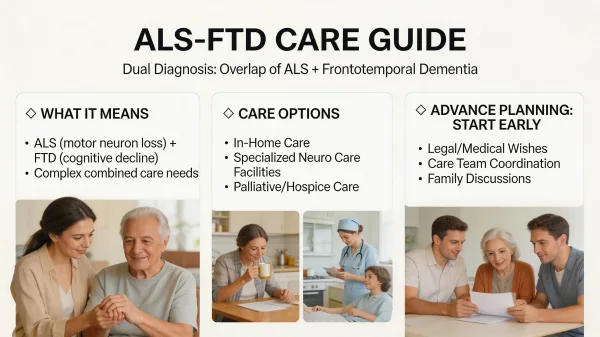
If your parent has been diagnosed with ALS-FTD, or if the medical team is starting to suspect frontotemporal dementia alongside an existing ALS diagnosis, you're facing one of the most difficult care situations any family can encounter. This isn't a typical dementia diagnosis, and it isn't a typical ALS diagnosis. It's both, happening at the same time, and the combination creates challenges that don't have tidy solutions.
ALS-FTD means your parent is losing physical function and cognitive or behavioral capacity simultaneously. The body is weakening while the brain's ability to reason, cooperate with care, and make decisions is deteriorating in parallel. Most care systems were built to handle one of these problems, not both together. That gap between what your family needs and what the care system can actually provide is real, and it's where most of the difficulty lives.
I've spent nearly 20 years working inside hospitals, and I've seen how even well-designed care systems struggle when a patient's needs don't fit into a single category. ALS-FTD is one of those situations where the standard playbook falls short. But there are options, there are steps you can take, and there are people who can help. This guide will walk you through what ALS-FTD actually means for care, what makes it different from ALS alone or FTD alone, and what realistic choices your family has for getting your parent the support they need.
What Is ALS-FTD?
ALS-FTD is a condition in which amyotrophic lateral sclerosis (a progressive motor neuron disease) and frontotemporal dementia (a type of dementia affecting behavior, personality, and language) occur together in the same person. Researchers now understand that ALS and FTD exist on a shared disease spectrum, connected by overlapping genetics and shared pathology in the brain. The most well-known genetic link is a mutation in the C9orf72 gene, which is the most common inherited cause of both ALS and FTD.
About 10 to 15 percent of people with ALS develop full frontotemporal dementia, though up to half may experience some degree of cognitive or behavioral changes during the course of the disease. The behavioral variant of FTD is the most common form seen alongside ALS, affecting personality, impulse control, and social behavior more than memory in the early stages. When the full dual diagnosis occurs, it creates a clinical picture that is substantially different from either condition on its own.
How ALS-FTD Differs from ALS Alone or FTD Alone
ALS by itself is a devastating disease, but most people with ALS retain their mental sharpness. They can participate in care decisions, communicate their wishes, cooperate with treatments like breathing support and feeding tubes, and direct their own care even as their body loses function. FTD on its own brings serious behavioral and cognitive changes, but the person can usually still walk, eat, breathe independently, and manage basic physical functions for years.
ALS-FTD removes both of those anchors. Your parent may refuse breathing treatments not because of a considered decision, but because the frontal lobe damage from FTD has caused apathy or poor judgment. They may resist feeding tube placement not out of an end-of-life preference, but because they can no longer understand why it matters. Communication devices that work well for ALS patients with intact cognition may be useless for someone who can't reliably process how to operate them. The timeline is also compressed. Research published in the journal Dementia and Geriatric Cognitive Disorders found that the average survival for people with ALS-FTD is approximately 2 to 3 years from symptom onset, substantially shorter than either condition alone.
Recognizing the Signs: When ALS and FTD Overlap
ALS-FTD doesn't always announce itself with a clear diagnosis. Sometimes the behavioral changes creep in gradually, and families attribute them to depression, frustration with the ALS diagnosis, or medication side effects. The FTD component is easy to miss early on. I've seen this kind of gradual shift in hospital settings too, where a patient's behavior changes so incrementally that the care team doesn't flag it until something dramatic happens.
Consider a situation where your parent was diagnosed with ALS a year ago, and lately they've started making impulsive financial decisions, buying things they don't need and giving away money without explanation. They've become apathetic about their own care, skipping physical therapy and refusing to use their BiPAP machine at night. When you try to talk to them about breathing treatments, they shrug it off or get irritated. The ALS team orders neuropsychological testing and suspects that frontotemporal dementia has entered the picture. Suddenly, your family isn't managing one progressive disease. You're managing two.
Watch for these behavioral shifts: new impulsivity or poor judgment around money, safety, or social situations. Loss of empathy or emotional blunting, where your parent seems indifferent to things they previously cared about. Apathy toward their own medical care. Repetitive behaviors or rigid routines. Inappropriate social behavior that's out of character. If your parent's ALS care team hasn't screened for cognitive and behavioral changes, ask them to. Early identification changes how you plan.
The Dual Burden: Why ALS-FTD Requires a Different Care Model
In practice, this is where things break down. The systems designed for ALS (physical support, respiratory care, mobility equipment, speech-generating devices) and the systems designed for FTD (behavioral management, cognitive support, structured environments, redirection techniques) rarely exist in the same facility. Families dealing with ALS-FTD are often forced to choose which set of needs to prioritize, and that's a choice no family should have to make.
Respiratory support is typically the most urgent medical concern in ALS. As the muscles that control breathing weaken, patients need noninvasive ventilation (usually a BiPAP machine) and eventually may face the decision about a tracheostomy and long-term mechanical ventilation. For someone with ALS alone, these decisions are made collaboratively with the patient, their neurologist, and the palliative care team. The patient can weigh the benefits and burdens, express preferences, and update their advance directives as things change. With ALS-FTD, that collaboration breaks down. The person may not understand what a ventilator is, may refuse to wear a BiPAP mask because it's uncomfortable without grasping the consequences, or may lack the judgment to participate in their own advance care planning. This puts the family and the healthcare proxy in the position of making life-sustaining treatment decisions on behalf of someone who didn't have the chance to fully express their wishes before cognitive decline set in.
Feeding tube decisions follow a similar pattern. Many people with ALS eventually need a gastrostomy tube (G-tube or PEG tube) as swallowing becomes unsafe. In ALS without cognitive impairment, the patient decides whether and when to pursue this intervention. In ALS-FTD, the person may not cooperate with the procedure, may pull at the tube afterward, or may not understand the purpose of enteral feeding. Families have to weigh whether tube placement will actually improve quality of life or create a new source of distress and conflict.
Communication presents yet another layer of difficulty. Speech-generating devices and eye-tracking technology have transformed the ability of ALS patients to communicate after they lose the ability to speak. These devices require cognitive cooperation: the person needs to understand the interface, form intentional thoughts about what they want to say, and execute the physical or eye-tracking commands consistently. FTD can compromise all of these abilities. A person who can't speak and can't reliably use assistive technology is profoundly isolated, and that isolation creates enormous challenges for caregivers trying to assess pain, comfort, and preferences.
I know something about what it's like to watch a progressive disease take away one function after another, because I was a primary caregiver for my first husband through five years of terminal cancer. What I learned during those years is that progressive loss doesn't announce each new stage. It just arrives, and you either adapt or you break. With ALS-FTD, the stages come faster, and the person you're caring for may not be able to tell you what they need or help you figure out the next step. That reality changes everything about how you plan care, and it makes early conversations about goals and preferences critically important, while the person can still participate in them.
The hospice timeline question is also complicated in ALS-FTD. Hospice eligibility generally requires a physician to certify a life expectancy of six months or less. With ALS-FTD's average survival of 2 to 3 years, families may wait too long to bring in palliative or hospice support, not realizing that palliative care can and should begin much earlier than the final months. The ALS Association and palliative care specialists recommend introducing palliative care at or near the time of diagnosis, not as a last resort. Given the cognitive decline in ALS-FTD, early palliative involvement is even more critical because the window for advance care planning closes faster than families expect.
Finding Care for ALS-FTD: Realistic Options
The honest reality is that very few facilities in the United States are specifically equipped for ALS-FTD. The needs are too specialized and too variable for most existing care models. ALS requires skilled nursing-level support (respiratory equipment management, feeding tube care, complex mobility needs), while FTD requires a secure, structured environment with staff trained in behavioral redirection, not physical restraint. From my years doing mobile X-ray work inside care facilities, I can tell you that the gap between what a facility says it can handle and what it actually provides day to day can be significant. Ask hard questions and trust what you observe during visits, not just what's in the brochure. Finding both ALS and FTD capabilities in one place is rare, but not impossible.
Specialized ALS residential programs do exist, though they are scarce. Skilled nursing facilities with ALS experience can manage the physical and respiratory components, and a few have developed expertise in patients with concurrent cognitive impairment. When evaluating a skilled nursing facility for an ALS-FTD patient, ask directly whether they've cared for patients on BiPAP or ventilators who also had dementia-related behavioral issues. The answer will tell you a lot. Memory care units represent another option, but most are designed for Alzheimer's-type dementia and don't have the medical infrastructure to manage respiratory equipment, G-tubes, or the rapid physical decline of ALS. If you're considering a memory care community, ask whether they can accommodate a hospital bed, suction equipment, and noninvasive ventilation. Ask about their nursing staff's experience with degenerative motor conditions. Many will be candid that they aren't equipped for this level of care, and that candor is valuable.
Home-based care with palliative support is the most common path for ALS-FTD families. This typically involves a combination of in-home caregiving (often requiring multiple shifts per day as the disease progresses), regular visits from the ALS clinic team, and palliative care coordination. The advantages of home care include a familiar environment that tends to reduce FTD-related agitation and the ability to customize the care approach to one person's specific needs. The disadvantage is that home care for ALS-FTD can become overwhelming for family caregivers, and the cost of round-the-clock home care often exceeds the cost of facility placement. As of 2025, memory care facilities nationally average $6,700 to $7,500 per month, but ALS-FTD home care with skilled nursing components can run significantly higher.
Hospice integration is the final piece. When the disease has progressed to the point where comfort is the primary goal, hospice brings in an interdisciplinary team that includes nursing, social work, chaplain services, and bereavement support. Hospice can be delivered at home, in a nursing facility, or in a dedicated hospice center. For ALS-FTD specifically, hospice providers with neurodegenerative disease experience are the best fit, because they understand the unique interplay between motor decline and cognitive impairment.
Advance Planning: The Window Is Shorter Than You Think
If your parent still has periods of clarity and can participate in conversations about their care goals, those conversations need to happen now. Not next month. Now.
Advance directives for ALS-FTD should cover decisions that most advance directive templates don't address specifically, including preferences around noninvasive ventilation and tracheostomy, whether and when to pursue feeding tube placement, goals for comfort versus life prolongation, and preferences around hospitalization for complications like pneumonia. A healthcare proxy (also called a durable power of attorney for healthcare) is essential. This is the person who will make medical decisions when your parent can no longer do so, and with ALS-FTD, that point may come sooner than anyone expects.
Consulting an elder law attorney early is worth the cost. They can help establish the healthcare proxy, review or create a living will, and address financial power of attorney, which is especially important given that FTD often impairs financial judgment before families realize it. If your parent has already made questionable financial decisions, getting legal protections in place quickly can prevent further damage. This is one of those situations where spending money on legal counsel now saves the family from much larger problems later.
Supporting Yourself While Supporting Your Parent
Caring for someone with ALS-FTD is a level of caregiving that most people have never imagined. The physical demands of ALS care combined with the emotional toll of watching your parent's personality and judgment change is a combination that exhausts even the most resilient families. From my own years as a caregiver, I know that the hardest part isn't any single task. It's the accumulation, the way each week brings a new loss that you didn't have time to prepare for because you were still adjusting to the last one.
The Association for Frontotemporal Degeneration (AFTD) and the ALS Association both offer caregiver support programs, including support groups specifically for families managing the overlap of motor neuron disease and dementia. These organizations can also help connect you with social workers who understand ALS-FTD and can advocate for appropriate services. If your parent is being followed by a multidisciplinary ALS clinic, the clinic social worker is often the best starting point for identifying local resources and coordinating between medical and community support systems.
Don't wait until you're depleted to ask for help. Respite care, whether through hospice programs, home health agencies, or family and friends, isn't a luxury. It's a requirement.
Finding Your Way Through This
ALS-FTD is one of the cruelest diagnoses a family can face, and there's no way around the fact that the road ahead is hard. But having clear information, a care team that understands both conditions, and advance plans in place before the window closes will give your family the strongest possible foundation.
You don't need to have everything figured out today. Start with the most urgent step: if advance directives aren't in place, make that the priority this week. If your parent's ALS team hasn't evaluated for cognitive changes, request a screening. If you're exploring facility options, call and ask the hard questions about what they can and can't handle. Each step you take now reduces the number of crisis decisions you'll face later.
The fact that you're here, reading this, researching this, tells me you're already doing right by your parent. That matters more than you might realize right now.