
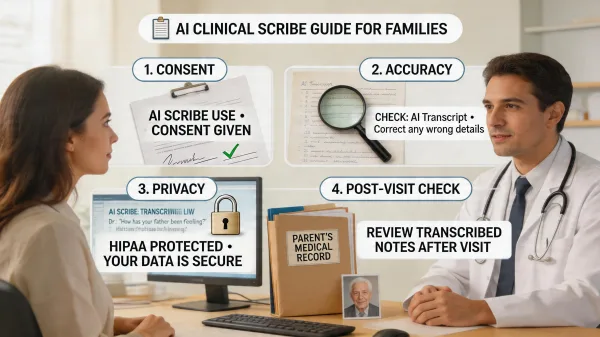
You're sitting in a neurology exam room with your 75-year-old father. He's been having memory lapses, repeating questions, getting confused about appointments. You took the morning off work to be here. The neurologist walks in, sets a small device on the desk, and says, "I'd like to use AI to help take notes today. Is that okay with you?" Your father looks at you. You realize you have about three seconds to decide what to say.
If this hasn't happened to you yet, it's going to. As of April 2026, AI scribing is deployed across most major US health systems, and an AI scribe doctor visit is now an ordinary primary care or specialist appointment. The technology has moved from pilot programs into the mainstream so quickly that many families haven't been told what's happening or what they're being asked to consent to.
Inside the healthcare system for nearly 20 years, I've watched physicians document patients during visits, after visits, and late into evenings at home. AI scribing is finally changing that, and for most visits it's a real improvement. For elderly parents specifically, there are a few things families should understand before they say yes.
This guide explains what an AI scribe doctor visit involves, why physicians have embraced it, what consent actually means, and what families should watch for. The short version: saying yes is usually fine. The nuance is in knowing what to check afterward.
What AI Scribes Actually Do and Why Doctors Love Them
An AI scribe in a doctor's appointment is ambient listening technology that records the conversation between physician and patient and uses artificial intelligence to generate the clinical note automatically. The device might be a phone on the desk, a tablet, or a dedicated unit. It listens to the visit, transcribes the conversation in real time, and produces a structured note covering the assessment, plan, medication changes, and follow-up. Most systems require the physician to review and edit the draft note before it enters the medical record.
The major vendors families will encounter include Abridge, Microsoft Dragon Copilot (formerly Nuance DAX Copilot), Suki, and Ambience Healthcare. Adoption at this point is enormous. Kaiser Permanente alone deployed Abridge across its 40 hospitals and more than 600 medical offices in 8 states and Washington, D.C., making it available to 24,000 physicians. Mayo Clinic, Yale New Haven Health, UChicago Medicine, Sutter Health, Emory Healthcare, UPMC, Johns Hopkins, and Duke Health have all rolled out ambient AI scribing systemwide. Smaller practices and specialty clinics use a wider range of vendors. By April 2026, an AI scribe doctor visit is closer to typical than novel, and families attending appointments with an aging parent are likely to encounter the technology at the visit they have next month.
The reason physicians have embraced this so quickly comes down to documentation burden. Before AI scribing, primary care doctors routinely spent more than half their workday in the electronic health record, with after-hours charting being one of the leading drivers of physician burnout. A 2026 JAMA study tracking AI scribe use across five US academic medical centers found that ambient scribing was associated with daily reductions of 13 minutes in EHR time and 16 minutes in documentation time, plus a small increase in patient visits. A separate JAMA Network Open study reported physician burnout dropped from 51.9% to 38.8% after just 30 days of AI scribe use.
For physicians, that's a real change. The documentation grind has been one of the loudest complaints I've heard from physicians inside hospitals for years, and the technology that finally addresses it has spread fast for a reason. For patients, the visible difference is that the doctor is looking at and talking to them instead of typing.
The Legitimate Benefits Families Should Know About
When a physician isn't tethered to a keyboard, the visit feels different. There's more eye contact. The doctor can actually watch your parent move, notice a tremor, see a wince when something hurts, follow up on a hesitation in an answer. For elderly parents specifically, who often need the physician to slow down, repeat things, or pick up on nonverbal cues, this matters.
Visit notes generated by AI scribes are also typically faster and often more complete than hand-documentation, which means the medical record your parent's other providers will read is clearer. Many health systems are now generating patient-friendly After Visit Summaries from the same AI transcript, written in plain language rather than clinical shorthand. For an adult child who attended the appointment and is now trying to remember what the doctor said about your mother's medication change, that's a real benefit.
This is the part of AI scribing that I think gets undersold. Inside hospitals for nearly two decades, I've watched physicians try to take a thorough history from an 82-year-old patient while typing into Epic, glancing at the screen every few seconds, asking the next question without looking up. The patient gives a partial answer, the physician misses the nonverbal hesitation that would have been the actual story, and the visit moves on. Elderly patients in particular need a doctor who's actually present in the room, not splitting attention between the patient and the keyboard. AI scribing gives physicians their attention back. For a parent who's nervous, hard of hearing, slow to answer, or working through cognitive changes, having the doctor's full focus often matters more than any single thing said during the visit. The technology isn't perfect, but the trade-off for most visits is genuinely in the patient's favor.
If your parent has had a recent appointment that felt rushed or impersonal, ask whether the practice uses AI scribing. The next visit may feel different.
The Consent Question and What It Actually Means
Most AI scribe deployments require patient consent at the start of the visit, usually a verbal "is it okay if I use AI to help with notes today?" Saying yes means the audio of the visit will be recorded, processed through the AI system, and used to generate the clinical note. Saying no typically means the physician will hand-document the visit instead, and the appointment proceeds normally.
What's less obvious is what varies by health system. Some retain the audio recording only briefly while the note is generated, then delete it. Others keep recordings for longer periods. Some vendor contracts allow the audio or transcript to be used to train the AI model further, and others don't. Some health systems allow patients to opt out without affecting their care. A few have made the technology so embedded in workflow that opting out feels socially awkward even if it's permitted. Most physicians can't answer detailed questions about their vendor's data practices, because that's a contract their health system signed, not something the doctor manages.
State law also matters. In two-party consent states like Florida, Pennsylvania, and California, all parties to a recorded conversation must consent to recording. In one-party consent states like Utah and Arizona, the physician's consent is technically enough, though most health systems still ask the patient. If you're attending the visit with your parent, you're a third party in the conversation, and your voice is being recorded too. Most consent scripts don't address this directly.
For most families, the practical question is simple. If your parent is comfortable saying yes and you trust the health system, saying yes is usually fine. If your parent is uncomfortable or you have specific concerns about a particular visit (a sensitive diagnosis, a family conversation that should stay private), saying no costs nothing.
What Families Should Watch For at an AI Scribe Doctor Visit
The most important habit to develop, when AI scribing was used at your parent's visit, is reviewing the After Visit Summary carefully. AI transcription accuracy is generally high but not perfect. Medication names and dosages, in particular, are where errors show up. A 2024 study from The Permanente Medical Group reviewed 35 AI-generated transcripts and found the technology scored highly on accuracy, with two notable instances of "hallucinations," meaning content the AI invented that wasn't said in the visit. The rate is low, but it's not zero. The peer-reviewed literature is clear that current systems can fabricate clinical information, misattribute statements between speakers, or miss things entirely.
For elderly parents, accuracy issues are more likely than for typical patients. Hearing loss and speech that's slower or softer can degrade transcription quality. A parent with cognitive concerns may give answers that contradict each other within the same visit, and the AI may capture only one. Strong regional accents or limited English proficiency reduce accuracy further. Published research has documented systematic disparities in speech recognition for some groups.
When three or more people are talking (your parent, you, the physician), speaker attribution can fail. Something you said about your mother's behavior at home might end up in the note as something your mother said about herself. I've sat in plenty of clinical encounters where the line between what the family reported and what the patient confirmed blurred even with a human writing it down. AI doesn't fix that problem. That's not a small error in a memory care evaluation.
The fix is simple: read the After Visit Summary the day of the appointment while the visit is fresh. If something is wrong, missing, or misstates what was said, contact the physician's office and ask for a correction. You have the right to request amendments to your parent's medical record under HIPAA.
The Privacy and Data Questions Nobody Discusses
Most patients have never asked, and most consent scripts don't volunteer the answers. Who actually owns the audio recording of your parent's visit? Where is it stored, and for how long? Is the data being used to train the AI vendor's model? What happens to your parent's recorded visits if the health system switches vendors next year, or the AI vendor is acquired by another company?
HIPAA does apply. AI scribe vendors operating in US health systems are business associates under HIPAA and must sign Business Associate Agreements with the health system. That sets a baseline of legal obligation around protected health information. What HIPAA doesn't do is mandate uniformity across vendors or health systems on retention, training data use, or breach notification specifics. Two health systems using the same AI scribe may have negotiated very different contracts.
If these questions matter to you, most major health systems publish patient privacy notices that address ambient AI documentation specifically. Kaiser Permanente, Mayo Clinic, and most large systems with public AI deployment policies will disclose retention windows, vendor relationships, and opt-out procedures somewhere on their website. Calling the health system's privacy office and asking directly is also reasonable. These are legitimate questions, and the staff answering shouldn't treat them as unusual.
Common Questions Families Ask
Can I refuse the AI scribe without hurting my parent's care? Yes. Saying no is a normal option, and the physician will hand-document the visit. Care quality shouldn't change.
Does the AI replace the physician's judgment? No. AI scribes generate draft documentation only. The physician reviews, edits, and signs every note that enters the medical record. The AI doesn't make clinical decisions.
What if the AI gets something wrong in my parent's chart? Contact the physician's office and request a correction. Under HIPAA, patients have the right to request amendments to their medical record. Document the request in writing.
Is my parent's recorded visit being used to train AI models? It depends on the vendor and the health system's contract. This is a fair question to ask the health system's privacy office directly.
The Practical Bottom Line
For most families, an AI scribe doctor visit means a more present, attentive physician and a faster, often clearer clinical note. Those are real benefits, especially for elderly parents who need a physician's full attention during the limited time of a visit. The technology isn't perfect, and accuracy issues are more likely with elderly patients than with typical patients, but the trade-off in most cases favors the patient.
Your job is to know what's happening, decide based on the specific visit and your comfort with the health system, and review the After Visit Summary afterward to catch anything the AI missed. You don't need to refuse on principle. You don't need to read the vendor's privacy policy line by line. You just need to be informed enough to make a real choice when the doctor asks. Most families end up grateful their physician finally has time to look up from the screen.