
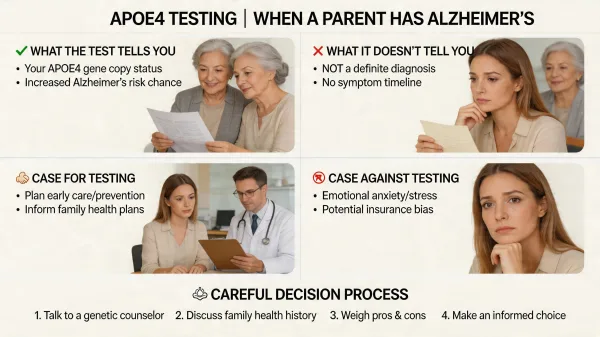
When a parent is diagnosed with Alzheimer's, one of the first questions many adult children ask themselves, often quietly, is what this means for their own future. APOE4 genetic testing is one of the few tools that can give a partial answer. As of April 2026, the test is widely available through 23andMe, through clinical labs ordered by a physician, and through dedicated direct-to-consumer services that bundle the test with genetic counseling. The information it provides is real and useful. The decision to know it is harder than most articles make it sound.
When a family member's dementia accelerated faster than any of us expected, it changed how I thought about my own future. I didn't want to know more, and I also very much wanted to know more. That contradiction is where the APOE4 decision lives for many people, and it deserves more honesty than the marketing around at-home testing usually offers.
This guide walks through what APOE4 testing actually tells you, what it doesn't, the genuine case for testing after a parent's Alzheimer's diagnosis, the genuine case against, the testing options available in 2026, and what a careful process looks like if you decide to move forward.
Should You Get APOE4 Tested If Your Parent Has Alzheimer's?
This is a personal decision with real benefits and real costs. Testing can support earlier preventive lifestyle action, eligibility for clinical trials, and earlier financial and legal planning. It also carries psychological weight, irreversibility, and insurance implications that federal law doesn't fully cover. Adults who tend to benefit are those with concrete plans for the result, who have already addressed long-term care and life insurance if they want it, and who go through pre-test and post-test counseling. Adults who tend not to benefit are those testing on impulse after a parent's diagnosis, without counseling, and without a clear plan for what they'd do differently.
What APOE4 Testing Actually Tells You (And What It Doesn't)
The APOE gene comes in three common variants: ?2, ?3, and ?4. Everyone inherits two copies, one from each parent, so any combination is possible. ?3 is the most common and considered neutral. ?2 is the rarest and appears to offer some protection against late-onset Alzheimer's. ?4 is the variant linked to higher risk.
According to the National Institute on Aging, about 25% of people carry one copy of APOE4 and 2 to 3% carry two copies. Risk estimates vary by ancestry and by study, but the ranges most commonly cited in current research line up roughly as follows. One copy of APOE4 raises lifetime risk of late-onset Alzheimer's by approximately two to three times compared with two copies of APOE3. Two copies of APOE4 raise lifetime risk by approximately eight to twelve times. A 2024 study published in Nature Medicine went further and argued that two copies of APOE4 should be considered a genetic form of Alzheimer's rather than a risk factor, with symptoms typically appearing seven to ten years earlier than in adults with other APOE combinations and amyloid changes detectable as early as age 55. The risk is also higher for women than men in roughly the 60-to-75 age window.
Those numbers sound definitive. They aren't. APOE4 is a risk factor, not a diagnosis, and the test can't tell you what you most want to know.
It can't tell you whether you'll develop Alzheimer's. Most people with one APOE4 copy never develop the disease, and a significant minority of people with no APOE4 copies do develop it. Your absolute risk depends on age, sex, ancestry, family history beyond a single parent, cardiovascular health, education, hearing, sleep, and a long list of factors that interact with each other in ways researchers are still mapping. Risk estimates are population averages, not personal predictions. The test also can't tell you when symptoms might begin, because two adults with the same APOE4 status can have very different timelines, and current biomarker testing, including amyloid PET scans and the new blood tests for Alzheimer's pathology, often gives more clinically useful information than APOE alone for adults already showing concerns.
It can't tell you whether the new amyloid-clearing drugs will work for you, either. Lecanemab and donanemab carry distinct safety considerations for APOE4 carriers, including higher rates of brain swelling and microbleeds. APOE testing has therefore become standard in some clinical settings before starting these drugs. Outside that specific context, however, knowing your APOE status doesn't change a treatment decision, because there's no APOE-specific prevention drug approved as of April 2026.
What APOE4 testing does tell you, in plain terms, is whether you carry zero, one, or two copies of a genetic risk variant that shifts your odds. That's real information. It's also incomplete information, and that gap is where many testing decisions go sideways.
The Case For APOE4 Testing After a Parent's Diagnosis
For some adults, knowing their APOE4 status genuinely changes what they do next. Earlier knowledge can support earlier and more aggressive attention to modifiable dementia risk factors. The 2024 update to the Lancet Commission on dementia prevention identified 14 factors that together account for about 45% of dementia cases worldwide, including hearing loss, untreated vision loss, hypertension, high LDL cholesterol, smoking, physical inactivity, social isolation, sleep, and several others. Some research suggests APOE4 carriers may benefit more than non-carriers from aggressive midlife management of these factors, though the evidence is still evolving.
Testing also opens the door to clinical trial participation. Several Alzheimer's prevention trials, including the API Generation Program and the APOLLOE4 study of ALZ-801 in APOE4 homozygotes, specifically enroll APOE4 carriers, and a known result is often required for eligibility. For adults who want to contribute to research and access investigational therapies before symptoms appear, APOE testing is the entry point.
Watching my own family member's dementia progress faster than anyone predicted changed how I thought about long-term care insurance, advance directives, and even what kind of work I wanted to be doing in my fifties. The speed of the decline caught the whole family off guard, and the financial and logistical scramble that followed was harder than the medical part in some ways. Knowing your APOE status earlier, while you're still in your forties or fifties, can let you apply for long-term care or life insurance before any result is on file, complete advance directives while capacity is unquestioned, and have honest conversations with a spouse and adult children about what you'd want if you started showing symptoms yourself. None of these things require an APOE result to do well. For some adults, though, the result is what finally makes the planning feel urgent enough to actually finish, and that nudge has real value.
For some adults, knowing is also simply better than not knowing. The REVEAL studies, which followed adult children of Alzheimer's patients who learned their APOE status, found that most participants reported the information had a positive impact on them and that disclosure didn't cause significant long-term anxiety or depression. Many people would rather live with clarity, even uncomfortable clarity, than ambient worry. If that describes you, the case for testing is stronger.
The Case Against APOE4 Testing (Or At Least Not Yet)
The case against testing is just as legitimate, and it gets less airtime in consumer marketing. The first reason is that the most evidence-based interventions for APOE4 carriers, things like treating hypertension, improving sleep, treating hearing loss, and increasing physical activity, are the same interventions everyone benefits from. Decades of additional anxiety in exchange for advice you would have received anyway is a real cost, and not a small one.
The second reason is insurance. The Genetic Information Nondiscrimination Act of 2008 protects against discrimination in health insurance and employment, but it doesn't cover life insurance, long-term care insurance, or disability insurance. Insurers in those categories can ask whether you've had genetic testing, can ask about results, and can use that information in coverage and pricing decisions. Some states, including California, Oregon, and Florida, have added partial protections, but coverage is patchy and changes regularly. A positive APOE4 result on file before you've secured the long-term care insurance you might want at age 70 is a decision that lasts the rest of your life.
The third reason is irreversibility. You can't un-know a result. Some adults who test APOE4 positive report regret in the months following disclosure, particularly when the test was done casually through a consumer service without counseling. Long-term studies suggest most regret resolves over time, but the months in between are real, and the result is permanent.
The fourth reason is family. Telling a sibling your result tells them something about their own genetics, whether they wanted to know or not. APOE4 inheritance is probabilistic, but a positive result in one sibling raises the probability for others, and many genetic counselors specifically discuss the family-disclosure question before testing. This is not a decision you make in isolation. Other people in your life inherit a piece of it.
The APOE4 Testing Options Available in 2026
As of April 2026, three pathways are widely accessible.
23andMe and similar direct-to-consumer services
23andMe's Health + Ancestry service, which continues to operate following its 2025 acquisition by the nonprofit TTAM Research Institute, includes a Late-Onset Alzheimer's Disease report based on APOE4 status. The result is delivered through a user-initiated reveal with moderate pre-test education built into the platform, but no live counseling. One technical limitation worth understanding: 23andMe tests only one of the two SNPs that determine full APOE genotype, which means a small subset of users with rare variant combinations may receive a result that doesn't reflect their full APOE picture. A clinical confirmation test is the way to resolve that.
Direct-to-consumer labs with genetic counseling included
Several specialty services bundle the APOE4 test with pre-test education and post-test counseling by a board-certified genetic counselor. These cost more than 23andMe but cover the parts of the process that matter most for a high-stakes test.
Clinical testing through a genetic counselor
This is the most comprehensive path. A genetic counselor takes a full family history, discusses testing alternatives and implications, orders the test through a clinical lab, and provides post-test support. When there's clinical indication, including a first-degree relative with Alzheimer's, insurance often covers part of the cost. The National Society of Genetic Counselors maintains a searchable directory of genetic counselors across the United States and Canada, including telehealth options. For a test with this much weight, the difference between clicking a button to reveal a result and sitting with a counselor is the difference between data and understanding.
What a Careful APOE4 Testing Process Looks Like
If you've read this far and you're still considering testing, here's a sequence that protects you.
Step one: understand what the result will and won't tell you. Read enough about APOE4 risk numbers, gene-by-environment interactions, and the limits of population statistics that the result, when it comes, doesn't surprise you with its ambiguity.
Step two: assess your insurance situation before you test. If you don't have long-term care insurance and you'd want it, talk with an independent insurance broker about applying first. If you don't have the life insurance or disability coverage you'd want, the same applies. GINA protects health insurance and employment, not these other categories. This step costs nothing to consider and can't be undone after a result is on file.
Step three: talk with a genetic counselor before you decide. The conversation is not an obligation to test. A good counselor will help you think through what you'd do differently with a positive result, what you'd do differently with a negative one, and whether there are family members the result might affect. Many counselors offer telehealth, which makes this accessible regardless of where you live.
Step four: give yourself permission to say no. The pressure adult children feel after a parent's diagnosis is real, and it makes "do everything you can" feel like the right answer. APOE4 testing isn't always the right answer. Some of the best decisions look like waiting, focusing on lifestyle changes, completing advance directives, and revisiting testing in five years. Memory care planning for your parent and dementia prevention work for yourself can move forward without an APOE result.
Step five: if you test, do it through a process that includes post-test support. The first few months after a positive result are the hardest. A counselor, a therapist familiar with genetic disclosure, and family members you've prepared in advance all matter more than the result itself.
Common Questions Adult Children Ask
Two questions come up almost every time families discuss APOE4 testing seriously, and they're worth addressing directly.
Will my health insurance go up if I test positive? Federal GINA protections specifically prevent health insurers from using genetic information for coverage or premium decisions, and those protections extend to private health plans, Medicare, and Medicaid. Health insurance is the area where the law is strongest. The exposure is in life, long-term care, and disability insurance, where GINA doesn't apply.
If my parent has Alzheimer's, am I going to get it? Not necessarily, even with two APOE4 copies, and not even certainly with one. A first-degree relative with Alzheimer's roughly doubles your baseline risk, and APOE4 layers on top of that, but most adults with both factors don't develop Alzheimer's. The 14 modifiable risk factors identified in the Lancet Commission report are where the most actionable information lies for most families. Dementia risk factor reduction isn't dependent on knowing your APOE status, and many memory specialists would argue it's the more important conversation regardless.
Why This Isn't a Decision Anyone Should Rush
The pressure you feel after a parent's Alzheimer's diagnosis to "do everything you can" is real and understandable. But APOE4 testing specifically isn't a decision that needs to happen this week, this month, or even this year. It's a decision for months, made carefully, with counseling and clear thinking about what the result would actually change. Many of the most important things you can do for your parent and for your own future, including aggressive attention to modifiable risk factors, advance planning, and securing the right insurance coverage, don't require knowing your APOE status. Some of them are actively easier to do before you know.
If you decide to test, do it through a process that respects how much weight the result carries. If you decide not to test, that's a legitimate answer too, and not a failure to act. The contradiction at the heart of this decision, wanting to know and not wanting to know, is honest. Honor it by giving yourself the time and the support to make a decision you can live with. Whatever you choose, you're already doing more for your family than most adult children realize they're doing simply by asking the question carefully.