
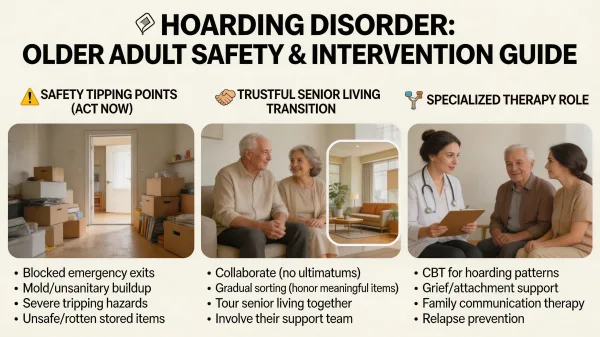
Hoarding disorder involves complex mental health considerations that require specialized therapeutic support alongside any living situation changes. While we explain common intervention approaches, your family's situation may benefit from guidance by a hoarding-specialized therapist and potentially legal consultation about capacity and intervention authority.
If your parent's home has become dangerous because of hoarding, you already know something has to change. Maybe you've noticed blocked doorways, stacks of newspapers reaching the ceiling, or a kitchen that hasn't been usable in months. You might have seen rodent droppings, smelled mold, or realized there isn't a single working smoke detector in the house. And your parent insists everything is fine.
This is one of the hardest situations a family can face. Hoarding disorder isn't a lifestyle choice or a messy habit. It's a recognized mental health condition in the DSM-5, and it tends to get worse with age, not better. Research suggests that hoarding symptoms are roughly three times more common in older adults compared to younger adults, and severity increases with each passing decade if left untreated. About 75% of people with hoarding disorder also have a co-occurring condition like depression, anxiety, or PTSD.
I've been inside homes during mobile X-ray work where the conditions were so bad I could barely get the equipment through the door. The person living there had completely adjusted to the clutter, the smells, the narrow paths between piles. But from the outside looking in, the danger was obvious. That disconnect between what the person sees and what the situation actually is sits at the heart of every hoarding intervention.
Waiting for a crisis to force the decision is the worst approach. Fires, falls, hospitalizations, or an Adult Protective Services investigation can all strip control from your family entirely. This article covers the specific safety tipping points that signal it's time to act, how to plan a transition to senior living without destroying your parent's trust, and what to expect from the therapeutic and legal side of hoarding interventions.
Understanding Hoarding Disorder in Older Adults
Hoarding disorder affects an estimated 2% to 6% of the general population, with significantly higher rates among adults over 60. The condition was classified as a standalone diagnosis in the DSM-5 in 2013, separate from obsessive-compulsive disorder. While hoarding behaviors often begin before age 40, the accumulation of objects over decades means the visible consequences usually become severe in a person's 50s, 60s, or later.
For older adults, the picture gets more complicated. Cognitive decline, executive function deficits, depression, physical limitations, and social isolation all feed the cycle. A person who once managed their collecting habit reasonably well may lose the organizational capacity to keep things in check. Grief and loss can trigger escalation. Retirement removes daily structure. Physical limitations make it harder to move or sort objects, so piles grow. The clutter becomes self-reinforcing because the person can't physically address it even if they wanted to.
One thing that catches most families off guard is the timeline. The shift from "a little cluttered" to "genuinely unsafe" can happen faster than anyone expects, especially when a health setback reduces your parent's mobility or cognitive sharpness. Don't assume you have years to address it.
When Hoarding Becomes Dangerous: The Safety Tipping Points
Every cluttered home isn't a hoarding crisis, and not every hoarding situation requires immediate intervention. The line families need to watch for is when the living conditions create genuine physical danger. Once a home crosses from disorganized into hazardous, the risk of a catastrophic event rises sharply. Knowing the specific hazards helps you document the situation and make the case for intervention, whether to your parent, to other family members, or potentially to legal authorities.
Fire Risk
Fire is the most lethal risk in a hoarding home, and older adults are already disproportionately vulnerable. According to the U.S. Fire Administration, adults 65 and older have a 2.5 times greater risk of dying in a home fire compared to the general population. Add floor-to-ceiling combustible materials, blocked exits, crowded cooking and heating equipment, and missing or non-functional smoke detectors, and that risk multiplies. Hoarded items rarely cause the ignition, but they serve as fuel that allows fires to spread faster than anyone can escape. Blocked windows and doors prevent evacuation and slow firefighters trying to enter. In many documented hoarding fire fatalities, the occupant couldn't reach an exit in time because pathways were impassable.
Falls and Mobility Hazards
Cluttered floors, narrow pathways between stacked objects, items piled on stairs, and unstable columns of boxes create constant fall risks. For an older adult with balance issues, reduced vision, or mobility limitations, a single fall in a hoarding home can result in a hip fracture, a head injury, or hours spent on the floor unable to reach a phone. Emergency responders may struggle to reach the person or maneuver a stretcher through the space.
Pest Infestation and Food Contamination
Accumulated food waste, hoarded groceries past expiration, and undisturbed piles of paper and fabric create ideal conditions for rodents, cockroaches, and other pests. Rodent droppings carry disease. Mold grows in damp, unventilated spaces buried under clutter. Spoiled food mixed into the general collection creates bacterial contamination that the person may not even notice because their sense of smell has adapted to the environment.
Structural Damage and Blocked Systems
The sheer weight of accumulated objects can stress floors, shelves, and walls beyond their capacity. Items piled against water heaters, furnaces, or electrical panels create fire and carbon monoxide risks. Plumbing leaks go undetected under piles. HVAC systems can't circulate air properly, worsening respiratory conditions. When home systems can't be inspected or maintained, everything degrades together.
Medication Loss and Health Neglect
In severely hoarded homes, prescription medications get buried, lost, or mixed with expired bottles. A parent who can't find their blood pressure medication, their insulin, or their blood thinner is facing a medical emergency hidden inside a behavioral one. Medical equipment like walkers, oxygen concentrators, or shower chairs may become inaccessible. I've seen situations in clinical settings where patients arrived at the ER with complications that traced directly back to missed medications, and for patients coming from hoarding environments, that pattern is far more common than most families realize.
Legal Thresholds: When APS Gets Involved
Adult Protective Services can investigate when hoarding conditions constitute self-neglect, but the legal threshold is high. Hoarding alone doesn't automatically trigger APS authority to intervene. A trained caseworker will assess whether the person's mental and physical condition, combined with the living environment, creates imminent risk of serious harm. APS can offer services, but they generally can't remove a person from their home or force them to accept help without a court order. Involuntary intervention typically requires evidence that the person lacks capacity to make safe decisions, and even then, a court must grant authority through guardianship or an emergency protective order. These standards vary by state, so families dealing with a hoarding crisis should consult an elder law attorney to understand what's possible in their jurisdiction.
Documenting the Conditions
If your family is considering legal intervention or needs to make a case for placement, documentation matters. Photograph every room, including blocked exits, pest evidence, food contamination, and non-functional safety equipment. Keep a written log of dates you observed specific conditions. Note any incidents, such as a fall, a fire department visit, or a missed medical appointment caused by the hoarding. This documentation can support an APS report, a guardianship petition, or a conversation with your parent's physician about capacity.
Why Hoarding Is Different from Other Senior Living Transitions
Most senior living transitions involve a parent who recognizes, at least partially, that they need more support. They may resist the change emotionally, but they can see the logic. Hoarding transitions are different because the parent often has limited or no insight into the danger. They don't see the clutter as a problem. They see it as their life, their security, their identity.
This lack of insight isn't stubbornness or denial in the usual sense. Research into hoarding disorder shows that the emotional attachment to objects activates the same brain regions involved in processing pain and loss. Asking a person with hoarding disorder to throw away a stack of old magazines can feel, neurologically, like asking them to abandon something they love. That's why logic alone rarely works, and why forced cleanouts almost always backfire.
Families who understand this distinction make better decisions. The goal isn't to win an argument about whether the home is safe. The goal is to build a path toward safety that respects the psychological reality your parent is living in.
The Transition Plan: Moving a Hoarding Parent Without Destroying Trust
In practice, this is where things break down. The mistake most families make is conducting a massive cleanout while the parent is away, whether they're in the hospital, visiting a relative, or at an appointment, and then expecting them to adjust. The family means well. They see the danger, they feel the urgency, and they want to fix it. But a forced cleanout without psychological preparation is traumatic. It triggers grief, rage, and a profound sense of betrayal that can fracture the parent-child relationship for years. Research consistently shows that people whose hoarded environments are cleared without their involvement often rebuild the hoard in a new location, sometimes within months. The compulsion doesn't live in the house. It lives in the person. If the underlying disorder isn't addressed before or during the transition, the objects will return. You haven't solved the problem. You've destroyed the trust you needed to solve it. The path that works is slower, harder, and less satisfying in the short term, but it's the only one with lasting results.
Start with a Hoarding-Specialized Therapist
Before any physical transition begins, your parent needs access to a therapist who specializes in hoarding disorder. General therapists or counselors, even good ones, often lack the specific training to address the cognitive and emotional patterns that drive hoarding. The gold-standard treatment is cognitive-behavioral therapy designed specifically for hoarding, developed by Drs. Randy Frost and Gail Steketee. Their protocol typically involves 26 sessions over six to nine months and includes motivational interviewing, practice in sorting and discarding, cognitive restructuring around beliefs about possessions, and ideally, in-home sessions. The International OCD Foundation maintains a directory of hoarding-specialized therapists at hoarding.iocdf.org.
For older adults, standard CBT for hoarding has shown more limited results compared to younger populations, partly because executive function deficits common in aging can interfere with treatment engagement. Newer approaches combining cognitive rehabilitation with behavioral therapy have shown more promise in geriatric populations. Regardless of the specific modality, the therapist's role is to help your parent develop some capacity to tolerate letting go, to process the emotions tied to their possessions, and to participate in decisions about what happens during a transition.
Use a Phased Approach
A successful hoarding transition rarely happens all at once. The phased approach works like this: start with safety-critical areas only. Clear pathways to exits, address fire hazards around heating and cooking equipment, remove spoiled food and biohazard materials, and ensure smoke detectors work. This isn't a full cleanout. It's harm reduction that buys time for the therapeutic work to take hold.
The next phase involves your parent making decisions about what they want to keep, with support from the therapist and possibly a professional organizer experienced in hoarding situations. Professional organizers who specialize in hoarding typically charge $50 to $100 per hour and bring both practical skills and emotional sensitivity that general cleaning crews lack. The IOCDF and the National Association of Productivity and Organizing Professionals (NAPO) can help families locate these specialists.
The final phase is the actual move. By this point, your parent should have had time in therapy to process what's happening, should have been involved in choosing which personal items to bring, and should have some understanding of why the move is happening. This doesn't mean they'll be happy about it. But there's a significant difference between a parent who feels informed and included versus one who feels ambushed.
What a Parent Should Be Allowed to Bring
Most assisted living communities have space limitations, and a parent with hoarding disorder will want to bring far more than the room can hold. Work with the care community in advance to establish clear, compassionate boundaries. Allow a meaningful number of personal items, particularly those with sentimental value: photo albums, a favorite blanket, specific keepsakes. Set a concrete limit (a specific number of boxes, for example) and help your parent choose what fills them. This gives them agency within boundaries, which is far less damaging than making all the choices for them.
Finding a Community That Understands Hoarding
Not every assisted living community is equipped to support a resident with hoarding disorder. During your search, ask directly whether the staff has experience with hoarding behaviors. Ask how they would handle a resident who begins accumulating items in their room. A community that responds with rigid "no clutter" policies and threats of discharge isn't a good fit. Look for communities that are willing to work with the resident's therapist, that understand hoarding as a mental health condition rather than a housekeeping issue, and that can set reasonable expectations about room conditions while still treating your parent with dignity. Some communities will do periodic room check-ins by agreement, which can help manage accumulation without confrontation.
The Cost Reality: Cleanup, Therapy, and Placement
Hoarding situations often come with layered costs that families don't anticipate. Professional hoarding cleanup ranges from $1,000 for mild situations to $25,000 or more for severe cases involving biohazard remediation, structural repairs, and pest control. A moderate cleanup of a standard-sized home typically runs $3,000 to $10,000. These costs cover assessment, sorting, hauling, deep cleaning, and disposal.
Therapy adds another layer. Individual CBT sessions for hoarding typically cost $150 to $250 per session, and the standard protocol calls for 26 sessions. Insurance may cover some of this, but hoarding-specialized therapists aren't always in-network. Assisted living placement itself runs a national median of about $6,200 per month as of 2025, or roughly $74,400 annually. That figure doesn't typically include the behavioral health support a hoarding resident may need on an ongoing basis.
When our family went through the financial shock of a sudden care placement, I remember feeling like we were making decisions with one hand tied behind our backs because nobody had ever laid out the real numbers. The costs around hoarding compound that experience, because you're paying for cleanup, therapy, and placement, often simultaneously. Start researching costs before you're in crisis mode.
Working with Your Family: When Siblings Disagree
Hoarding interventions almost always surface family conflict. One sibling sees the danger clearly and wants immediate action. Another feels guilty about overriding their parent's wishes. A third hasn't visited in years and doesn't believe the situation is as bad as you're describing. I've watched families in the hospital get stuck in exactly this pattern, where the sibling closest to the situation carries the burden while others second-guess from a distance. These disagreements can stall the process for months or years while the conditions worsen.
The most effective approach is to get all decision-makers into the same room (or on the same call) with documentation in hand. Photos, videos, and a written summary of specific safety hazards cut through disagreement faster than emotional arguments. If the family can't align, a geriatric care manager or elder mediator can facilitate the conversation. Their professional assessment carries weight that sibling opinions don't.
What Happens After Placement
Moving your parent into assisted living doesn't end the hoarding challenge. Without ongoing therapeutic support, the behaviors often resurface in the new environment. Your parent may begin accumulating items from community common areas, requesting excessive deliveries, or resisting housekeeping in their room. This is predictable, not a failure.
Continued therapy sessions, clear agreements with the care community about room expectations, and regular family involvement all help manage this transition. The first six months after placement are typically the hardest. Your parent is grieving the loss of their home, their possessions, and their independence, all while adapting to communal living. From years of caregiving, I can tell you that grief over lost independence shows up differently than other kinds of grief, and it doesn't follow a schedule. Patience matters here. Progress with hoarding is slow, measured in small shifts rather than dramatic transformations.
That's the honest truth about hoarding and senior living. There's no version of this process that's painless or quick.
Protecting Your Own Well-Being Through This Process
Families managing a hoarding intervention often underestimate the toll it takes on them. The emotional labor of watching a parent live in dangerous conditions, negotiating with siblings, managing legal and financial logistics, and absorbing your parent's anger or grief is enormous. You don't have to carry this alone.
Support groups for families affected by hoarding, including those run through the IOCDF and community hoarding task forces that operate in many cities, provide both practical guidance and emotional validation. A therapist for yourself, separate from your parent's treatment, is worth the investment. This work is heavy. Give yourself permission to ask for help.
Making the Decision: A Framework for Your Family
Every family's situation is different, but these questions can help you assess where things stand and what needs to happen next:
Can your parent safely exit the home in an emergency? If exits are blocked, the situation is urgent regardless of other factors. Has a fire inspector, code enforcement officer, or healthcare professional flagged the home as unsafe? External documentation strengthens your position and may trigger mandatory reporting. Is your parent missing medications, medical appointments, or meals because of the hoarding? These are health emergencies hiding inside a behavioral problem. Does your parent recognize any problem at all, or is their insight completely absent? The level of insight affects which intervention strategies will work. Have you consulted an elder law attorney about capacity, guardianship, and your legal options? Knowing your rights and limitations prevents costly missteps.
If you answered "no" to the first question or "yes" to several others, it's time to move from observation to action. The hardest part is starting.
Taking the Next Step with Compassion and Clarity
Helping a parent with hoarding disorder transition to senior living is one of the most emotionally complex things a family can do. There's no script that makes it easy, and there's no timeline that works for everyone. But waiting for a fire, a fall, or an APS investigation to force the issue is the worst possible path, because at that point, your family has lost the ability to control how the transition happens.
Start with professional support: a hoarding-specialized therapist, an elder law attorney if capacity is in question, and a care community that understands the condition. Involve your parent as much as their insight allows. Document everything. Take care of yourself along the way.
You're not betraying your parent by intervening. You're doing the difficult, loving work of keeping them safe when they can't fully see the danger for themselves. That's what family does, even when it doesn't feel like enough.