
You're sitting in a doctor's office when the neurologist says something you weren't expecting. Your father's confusion, the missed appointments, the bills piling up unopened on his kitchen counter, it isn't just aging. It's HIV-associated dementia. And in the same conversation, you learn something else: your father has been HIV-positive for over twenty years.
Suddenly you're processing two revelations at once. The diagnosis that explains the cognitive decline. And the long-kept secret that explains the diagnosis. If this sounds familiar, you're not alone, and you're not the first family to face this particular collision of medical reality and emotional weight.
More than half of all Americans currently living with diagnosed HIV are aged 50 or older, according to the CDC. Many have been managing the virus successfully for decades with antiretroviral therapy. But as this population ages, cognitive decline tied to long-term HIV infection is becoming a growing concern for families. HIV-associated dementia (HAD) is the most severe form of HIV-associated neurocognitive disorder (HAND), and while modern antiretroviral treatment has made it far less common than it was in the early years of the epidemic, it hasn't disappeared. For families, the path forward involves understanding the condition itself, finding a memory care facility willing and equipped to provide the right support, and managing the complex medication picture that comes with treating both HIV and cognitive decline at the same time.
Having spent nearly 20 years working in hospitals, I've seen how chronic infections can affect the brain over time in ways that catch families completely off guard. That clinical awareness is part of what drives the information in this article, because treating the cognitive symptoms without addressing the underlying HIV (or vice versa) simply isn't enough.
What Is HIV-Associated Dementia?
HIV-associated dementia occurs when the HIV virus crosses into the central nervous system and causes progressive damage to brain function. Unlike Alzheimer's disease, which primarily affects memory formation in the early stages, HAD tends to affect processing speed, concentration, and motor function first. Families often notice that their parent is thinking more slowly, struggling to follow conversations, losing coordination, or becoming withdrawn and apathetic before memory loss becomes the dominant symptom.
The condition is classified as the most severe stage within a broader spectrum called HIV-associated neurocognitive disorders (HAND). The milder forms, asymptomatic neurocognitive impairment and mild neurocognitive disorder, are more common in people on effective antiretroviral therapy. HAD itself is now relatively rare among people whose HIV is well-controlled, but it can still develop in those with a history of low CD4 counts, inconsistent medication use, or late diagnosis. The CDC reports that about 33% of people aged 55 and older who received an HIV diagnosis in 2022 already had late-stage infection at the time of diagnosis, meaning the virus had been causing damage for years before anyone caught it.
That delayed detection matters enormously for brain health.
Why HIV-Associated Dementia Looks Different from Other Dementias
If you've been reading about Alzheimer's or other common dementias, the symptoms of HAD may look somewhat familiar on the surface, but the underlying pattern is distinct. HAD primarily affects what neurologists call subcortical brain functions: the speed at which someone processes information, their ability to concentrate, their motor coordination, and their emotional regulation. Memory problems do develop, but they typically come later and look different from the forgetting patterns seen in Alzheimer's.
In practical terms, this means a parent with HAD might seem slow to respond rather than confused. They might have trouble with balance or fine motor tasks like buttoning a shirt before they start forgetting names. They may become unusually apathetic, losing interest in things they used to care about, or develop personality changes that feel sudden to the family. Depression is common and can be difficult to distinguish from the cognitive symptoms themselves. I've seen patients in the hospital whose families assumed they were just depressed or tired, when what was actually happening involved real neurological changes from their underlying condition.
This distinction matters because it affects the type of memory care programming that works best. Activities designed for Alzheimer's residents may not translate well for someone whose primary challenges are processing speed and motivation rather than memory retrieval.
Navigating Stigma and Facility Acceptance
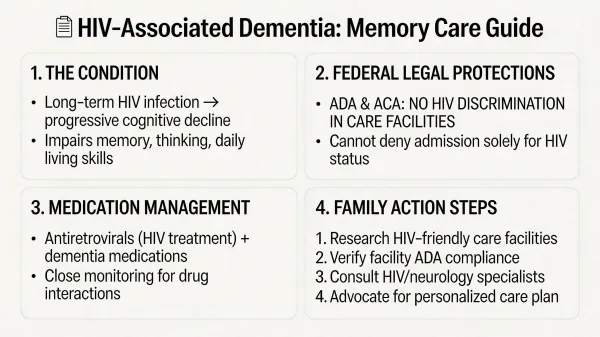
What most people don't realize until they're in it is that federal law clearly prohibits HIV discrimination in care facilities, but enforcement is uneven and stigma still creates real barriers. Families need to know their rights and be prepared to advocate.
Three major federal laws protect your parent's right to equal access in memory care and assisted living settings. The Americans with Disabilities Act (ADA) classifies HIV as a disability regardless of whether the person is symptomatic, and it covers private businesses that serve the public, including care facilities. The Fair Housing Act (FHA) specifically prohibits discrimination in housing, and the Department of Justice has confirmed that this applies to nursing homes, assisted living centers, and group homes. Section 504 of the Rehabilitation Act adds another layer of protection for any facility that receives federal funding, which includes most facilities that accept Medicare or Medicaid. A state-owned or publicly funded nursing home cannot refuse to accept patients with HIV under any of these laws.
Despite these protections, families still encounter resistance. Some facilities claim they aren't equipped to manage HIV, lack staff trained in infection control beyond standard precautions, or raise concerns about other residents. In a 2024 case in Arizona, the state Attorney General sued an assisted living facility for removing a resident after they were diagnosed with HIV and disclosing the resident's status to others at the facility, a clear violation of both the Fair Housing Act and basic medical privacy standards.
When you're evaluating facilities for a parent with HIV-associated dementia, ask direct questions. Does the facility have experience caring for residents with HIV? What infection-control training does the staff receive, and how often is it updated? Is there a pharmacist or pharmacy service that coordinates antiretroviral therapy? How does the facility handle confidential medical information? You aren't required to disclose your parent's HIV status before admission in most circumstances, but practical considerations around medication management often make disclosure necessary. The key is understanding that no facility can legally turn your parent away because of HIV alone.
If a facility does refuse admission based on HIV status, document the refusal in writing. You can file a complaint with the U.S. Department of Housing and Urban Development (HUD) at 800-669-9777, the Department of Justice's ADA Information Line, or your state's civil rights division. You have one year after the discrimination occurred to file a Fair Housing Act complaint with HUD. An elder law attorney can also advise you on state-specific protections, since many states have their own anti-discrimination statutes that may offer additional recourse.
The reality is that most well-run memory care communities follow universal infection-control precautions for all residents, which means the protocols for handling blood and bodily fluids are already in place. HIV doesn't change those protocols. A facility that claims otherwise is revealing a knowledge gap, not a legitimate clinical concern.
Medication Management: Antiretrovirals and Cognitive Care
The medication picture for someone with HIV-associated dementia is more complex than for most memory care residents, and getting it right is one of the most important things a family can do. Antiretroviral therapy (ART) remains the foundation, because maintaining viral suppression is the single most effective way to slow or stabilize cognitive decline caused by HIV. Research consistently shows that people with well-controlled viral loads have better cognitive outcomes, while uncontrolled viral replication in the central nervous system allows ongoing brain damage.
Working in hospital radiology for close to two decades, I've watched what happens when chronic infections go undertreated or when medication regimens fall apart. With HIV specifically, I saw how patients whose viral loads were well-controlled presented differently from those whose treatment had lapsed. The brain doesn't forgive gaps in suppression the way some other organs can. That experience is why I feel so strongly that families need to understand this piece of the puzzle: antiretroviral management isn't separate from dementia care. They're the same fight.
But ART doesn't exist in a vacuum. Many older adults with HIV are already managing multiple chronic conditions: cardiovascular disease, diabetes, kidney problems, osteoporosis. The CDC's Medical Monitoring Project found that one in four older adults who had been living with HIV for more than 25 years were prescribed an average of nine medications. Add cognitive support medications (antidepressants, antipsychotics, or stimulants sometimes used to manage HAD symptoms) and the risk of drug interactions climbs significantly. Antiretroviral regimens that include ritonavir or cobicistat are particularly prone to interacting with other medications because of how they affect liver enzymes responsible for drug metabolism.
This is where pharmacy services inside a memory care facility become critical. Ask whether the facility uses a specialized pharmacy service, and whether that pharmacy has experience coordinating antiretroviral regimens. The HIV specialist who manages your parent's viral suppression needs to remain involved even after the move to memory care, because adjustments to the ART regimen should only be made by someone with specific expertise. A gap in ART adherence, even a short one, can allow viral rebound and accelerate cognitive deterioration. Memory care facilities that provide structured medication administration (rather than self-administration) are better suited for residents with HAD, since cognitive impairment itself can make it difficult for a person to manage their own medication schedule reliably.
Some antiretroviral drugs cross the blood-brain barrier more effectively than others. The CNS Penetration Effectiveness (CPE) score ranks how well individual drugs reach the central nervous system, and some HIV specialists will consider this when selecting or adjusting a regimen for someone with cognitive involvement. This is a clinical decision that families don't need to make themselves, but it's worth raising with the treatment team.
What Memory Care for HIV-Associated Dementia Actually Costs
Memory care costs are already a shock for most families, and HIV adds complexity without necessarily adding to the base price. The national median cost for memory care runs between $6,500 and $7,500 per month as of 2025, depending on the data source, with significant variation by state. That works out to roughly $78,000 to $90,000 per year, and most stays last two to three years. Some states, like Vermont and Hawaii, average over $10,000 per month, while parts of the Midwest and Mountain West come in closer to $4,000 to $5,000.
For families dealing with HIV-associated dementia specifically, the added costs tend to come from the medical coordination side rather than the room-and-board side. Expect to budget for ongoing HIV specialist visits, specialized pharmacy management, and potentially more frequent lab work to monitor viral load and CD4 counts. These medical costs may be covered by insurance, Medicare, or programs like the Ryan White HIV/AIDS Program, which served nearly half a million clients over age 50 in 2022. Medicare doesn't cover memory care itself, but it does cover physician visits, diagnostic tests, and hospice care for those with a life expectancy under six months.
When our family was going through the memory care search for a loved one with dementia, the sticker shock was overwhelming, and that was without the added layer of managing a chronic infection. Start planning early if you can.
Processing the Emotional Weight: Secrecy, Stigma, and Family Dynamics
Consider this scenario: a daughter in her forties learns simultaneously that her father has dementia and that he's been HIV-positive for decades. She's processing the diagnosis, the secrecy, and the care needs all at once, while also worrying about which facilities will accept him and how to talk to her siblings about it. The emotional load is enormous.
Many families in this situation carry a layer of complexity that other dementia families don't. There may be anger about the secrecy. There may be grief about the lost years of open communication. There may be fear rooted in outdated information about HIV transmission. All of these are valid responses, and none of them need to be resolved before you start making care decisions. The practical and emotional can run in parallel.
If you're in this situation, a few things are worth knowing. Your parent's HIV status is protected health information under HIPAA, and you aren't obligated to share it with extended family members, friends, or anyone outside the direct care team. Stigma around HIV has decreased significantly in recent decades, but it hasn't disappeared, particularly among older generations and in certain communities. You get to decide how much information to share and with whom. Support groups for caregivers of people living with HIV exist through organizations like SAGE (for LGBTQ+ older adults and their families) and the National Resource Center on HIV and Aging. You don't have to carry this alone.
How to Evaluate a Memory Care Facility for HIV-Associated Dementia
Beyond the legal questions covered earlier, there are practical considerations that help you identify which facilities are genuinely equipped versus which ones are just saying the right things.
Look for staff who understand that HIV with an undetectable viral load poses no transmission risk through casual contact. Ask about the facility's experience with complex medication regimens, not just HIV specifically, but any multi-drug management. A facility that handles residents on anticoagulants, chemotherapy protocols, or organ transplant medications likely has the infrastructure to manage ART. Ask whether the facility has a relationship with an infectious disease specialist or can coordinate with your parent's existing HIV care team. Inquire about how they handle medical privacy: does information about a resident's HIV status get shared with all staff, or only those involved in direct care? The answer tells you a lot about the facility's approach to confidentiality and dignity.
During my mobile X-ray work, I visited enough care facilities to know that what you see on a tour and what happens day-to-day can be very different. Ask to visit at different times. Talk to families of current residents. Pay attention to whether staff seem comfortable with medical complexity or whether the conversation feels rehearsed.
Planning Ahead: A Decision Framework for Families
If your parent has been diagnosed with HIV-associated dementia or you suspect cognitive decline linked to HIV, the following questions can help you organize your next steps. Where is your parent in terms of viral suppression? A well-managed viral load is the most important factor in slowing cognitive decline. If ART adherence has slipped, getting that back on track is the first priority. What level of cognitive and functional impairment is your parent currently experiencing? Mild impairment may be manageable with in-home support and an HIV specialist team. More advanced HAD typically requires the structured environment of a memory care community. Does your parent have an HIV specialist, and will that specialist continue to manage care after a move to memory care? This continuity matters more for HAD than for many other dementia types. Have you consulted an elder law attorney? This is especially important if you anticipate facility resistance, need to plan for Medicaid spend-down, or want to establish power of attorney and advance directives while your parent can still participate in those conversations.
The decisions ahead of you are hard, but they're not ones you have to make in the dark. Federal law is on your side. Medical knowledge about HAD has advanced considerably. And the growing population of older adults living with HIV means that more facilities are gaining experience with exactly the situation your family is facing.
The Path from Here
HIV-associated dementia sits at the intersection of two realities that families rarely expect to face together: a chronic infection that still carries social stigma and a progressive cognitive condition that demands specialized care. The combination is complicated, but it's manageable with the right information and the right team.
Your parent's HIV status doesn't define the quality of care they deserve, and it doesn't limit their legal right to placement in the memory care community that best fits their needs. Armed with an understanding of the condition, the legal protections that apply, the medication management priorities, and the questions to ask during facility tours, you're in a stronger position than most families starting this process.
If there's one thing I'd want every family in this situation to hear, it's this: your parent's history with HIV is a medical fact, not a reason for shame, and certainly not a reason for any facility to close its doors. The care your parent needs exists, the protections to access it are real, and you have every right to demand both.