
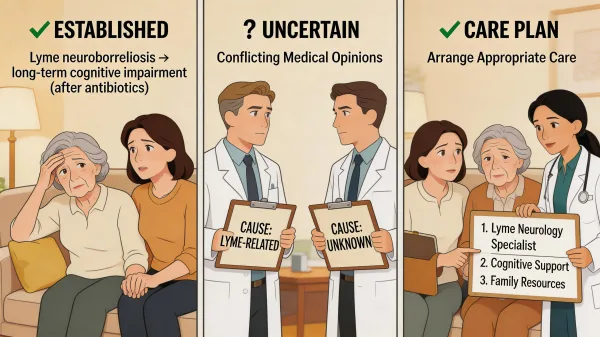
The CDC estimates that roughly 476,000 Americans are diagnosed and treated for Lyme disease each year. Of those, research from Johns Hopkins suggests that 10% to 20% continue to experience symptoms after completing antibiotic treatment, with cognitive difficulties ranking among the most common and disruptive complaints. For families watching a parent struggle with persistent brain fog, memory lapses, and confusion years after a Lyme diagnosis, the situation raises an uncomfortable question: is this still Lyme disease, or is something else going on?
I've spent nearly two decades working in healthcare, and some of the hardest situations I've seen involve patients caught between conflicting medical opinions. When there's no clean answer, families are left trying to piece together a care plan from incomplete information. That's exactly where many families dealing with post-Lyme cognitive symptoms find themselves. This article covers what's medically established about Lyme neuroborreliosis, where the science gets murky, and what practical care options exist when your parent's cognitive symptoms won't go away, regardless of what's causing them. The goal isn't to settle the medical debate. It's to help you make care decisions that improve your parent's daily life.
What Is Chronic Lyme Neuroborreliosis?
Lyme neuroborreliosis is the neurological form of Lyme disease, occurring when the Borrelia burgdorferi bacteria affects the nervous system. According to published research, neurological symptoms develop in roughly 3% to 15% of people with untreated Lyme disease. In its acute form, Lyme neuroborreliosis can cause facial nerve palsy, meningitis, and inflammation of the nerve roots. These symptoms are well-documented and respond well to antibiotic treatment, with about 90% of patients recovering within a year when treated early. The term "chronic" Lyme neuroborreliosis is where definitions get complicated. It can refer to late-stage neuroborreliosis caused by an untreated or undertreated infection, which is a recognized medical condition, but it's also used loosely to describe persistent cognitive symptoms that continue long after antibiotics have been completed, a situation the medical community hasn't fully agreed on how to classify.
How Does Lyme Disease Affect Cognitive Function?
During active infection, Borrelia bacteria can cross the blood-brain barrier and trigger inflammation in the central nervous system. This inflammation can directly impair brain function, affecting memory, concentration, processing speed, and verbal fluency. In rare cases, untreated neuroborreliosis can cause encephalitis, which involves more severe symptoms including confusion, speech difficulties, and coordination problems. A Johns Hopkins study of 124 confirmed PTLDS patients found that 92% reported some degree of cognitive difficulty, but when researchers tested these patients using standardized neuropsychological measures, only 26% showed objective evidence of cognitive decline, primarily in verbal memory and processing speed. That gap between what patients report and what tests measure is part of what makes this condition so frustrating for families and clinicians alike.
The Medical Debate: What's Established and What's Uncertain
If your parent has been diagnosed with or treated for Lyme disease and now has persistent cognitive problems, you've likely already encountered the controversy. One doctor says the infection was cured and the symptoms must be something else, while another insists it's chronic Lyme. Online forums offer everything from reasonable advice to dangerous misinformation. Here's what the evidence actually shows, broken into what's settled and what isn't.
What Medical Science Agrees On
Acute Lyme neuroborreliosis is a real, well-documented condition that responds to antibiotic treatment. A two- to three-week course of doxycycline or intravenous ceftriaxone resolves neurological symptoms in most patients. The American Academy of Neurology, the Infectious Diseases Society of America, and European neurological guidelines all agree on this point. Early treatment produces good outcomes. Late treatment can still stabilize the disease, though 60% to 80% of late-stage patients may have residual neurological symptoms even after successful antibiotic therapy.
There's also consensus that some patients develop persistent symptoms after completing appropriate treatment. The IDSA formally recognizes this as Post-Treatment Lyme Disease Syndrome (PTLDS), defined as fatigue, musculoskeletal pain, and cognitive difficulties that persist for six months or longer after treatment. A rigorous 2022 Johns Hopkins prospective study found that 14% of patients who received early, textbook-quality treatment still developed PTLDS, compared to 4% in a healthy control group.
Where the Disagreement Lives
The central question is why symptoms persist, and there are two broad schools of thought. One holds that the initial infection triggers an ongoing immune or inflammatory response even after the bacteria are eliminated. A 2025 study published in Science Translational Medicine found that remnants of the Borrelia cell wall, called peptidoglycan, can persist in the body for weeks to months after antibiotic treatment, potentially driving continued inflammation. A Johns Hopkins pilot study using specialized brain imaging found evidence of neuroinflammation in PTLDS patients, with distinctive changes in white matter and frontal lobe activity during memory tasks. These findings suggest a biological mechanism for persistent symptoms that doesn't require active, replicating bacteria. If the immune system is responding to leftover bacterial debris rather than a live infection, that would explain why additional antibiotics don't help but the symptoms are still very real. This line of research is gaining traction and has drawn comparisons to long COVID and chronic fatigue syndrome, both of which share overlapping symptom profiles.
The other camp, often associated with "Lyme-literate" practitioners, argues that the bacteria themselves persist despite standard antibiotic courses and that longer or alternative antibiotic regimens are needed. The mainstream medical establishment has pushed back on this position. Multiple randomized controlled trials, including the well-known Klempner study and the European PLEASE trial, found that extended antibiotic treatment produced no benefit beyond placebo for persistent symptoms. The American Academy of Neurology concluded at a Level A recommendation (the highest evidence grade) that prolonged antibiotics have no beneficial effect in post-Lyme syndrome.
In practice, this is where things break down for families. The medical establishment's internal debate about chronic Lyme directly impacts your ability to get care. If a doctor doesn't believe your parent's cognitive symptoms are related to Lyme, they may not refer to the right specialists. If a facility doesn't recognize the condition, they may not accept your parent. And if an insurer disputes the diagnosis, coverage becomes a battle. The diagnostic label matters less than you might think, though. What matters is your parent's functional status right now, today, and what level of support they need to be safe and maintain quality of life.
Having spent years caring for people with complex health situations, including ones where doctors didn't agree on the diagnosis, I learned that the most productive thing a family can do is shift the focus from "what's causing this" to "what does my loved one need right now." That doesn't mean you stop pursuing answers. It means you don't let the pursuit of a perfect diagnosis delay getting help.
Why It Matters for Care Planning
The diagnostic uncertainty creates real, practical problems that go beyond the doctor's office. Families may struggle to get a neuropsychological evaluation covered by insurance if the referring diagnosis is disputed. Care facilities may be unfamiliar with PTLDS and hesitant to admit someone whose cognitive decline doesn't fit a standard dementia profile. Even family members may disagree about whether the symptoms are "real" or whether the parent is exaggerating. Knowing that this debate exists, and that respected institutions like Johns Hopkins are actively researching PTLDS, gives you a foundation for advocating for your parent's care.
Can Lyme Disease Cause Dementia?
True dementia caused directly by Lyme disease is rare but documented. There are isolated case reports in the medical literature of Lyme neuroborreliosis mimicking Alzheimer's disease or other dementias, and some researchers have explored a possible link between Borrelia infection and amyloid deposits associated with Alzheimer's. However, these cases are uncommon and the proposed connections remain unproven. The more common scenario involves cognitive symptoms that look and feel like early dementia but don't follow the same progressive trajectory. Your parent might have trouble finding words, forget recent conversations, or struggle to manage medications, yet a formal neuropsychological evaluation might not show the same pattern of decline seen in Alzheimer's or vascular dementia. This distinction matters because it affects both prognosis and care planning. Lyme-related cognitive symptoms may stabilize or even improve over time, unlike the steady, progressive decline of most dementias. A neurologist experienced with both infectious disease complications and neurodegenerative conditions can help clarify which pattern your parent's symptoms are following, and that clarity shapes everything from treatment expectations to long-term financial planning.
Care Options When Cognitive Symptoms Persist After Lyme Treatment
Regardless of where you land on the medical debate, your parent needs a care plan built around their actual functional abilities, and that starts with a formal neuropsychological evaluation. This involves standardized testing across multiple cognitive domains: memory, attention, processing speed, executive function, and verbal fluency. The results establish a baseline, identify specific deficits, and help distinguish Lyme-related cognitive changes from other conditions like Alzheimer's disease, depression, or normal age-related decline. Request a referral from your parent's neurologist, and make sure the evaluating neuropsychologist is aware of the Lyme history.
Cognitive Rehabilitation
For patients with documented cognitive deficits, cognitive rehabilitation offers a structured approach to improving or compensating for lost function. This can include memory strategies, organizational techniques, attention training, and speech-language therapy for word-finding difficulties. Research on neuroplasticity supports the idea that targeted brain rehabilitation can help rewire neural pathways, and some interdisciplinary clinics now treat post-infectious cognitive symptoms using approaches originally developed for traumatic brain injury and concussion recovery. These programs aren't widely available, but they represent the most evidence-aligned treatment approach for PTLDS-related cognitive symptoms beyond initial antibiotics.
Supportive Care and Symptom Management
Many PTLDS patients benefit from a symptom-management approach that addresses the full picture: sleep disturbances, fatigue, pain, and mood alongside cognitive symptoms. Treating depression and improving sleep quality can have a measurable impact on cognitive function. Exercise, to the extent your parent can tolerate it, has well-documented cognitive benefits. From my years working with patients in the hospital, I've seen how quickly cognitive function can deteriorate when pain and sleep problems go unaddressed, and how much it can improve when those basics are treated. Occupational therapy can help your parent adapt their daily routines to work around cognitive limitations, keeping them independent longer.
When Symptoms Reach Memory Care Level
If your parent's cognitive impairment is severe enough that they can't safely manage daily tasks, forget to take medications, wander, or can't be left alone, memory care may be the appropriate setting regardless of the underlying diagnosis. The threshold isn't about what's on the medical chart, it's about safety and daily function. That said, approaching memory care facilities with a Lyme-related diagnosis can feel like an uphill battle. Many facilities are set up for Alzheimer's and vascular dementia, and staff may not be familiar with PTLDS. During my time doing mobile X-ray work inside care facilities, I saw firsthand that the best ones focused on what each resident needed day to day, not just the diagnosis on the chart. Frame the conversation around your parent's functional needs, not the diagnostic controversy. Describe what they can and can't do, bring the neuropsychological evaluation, and focus on the care requirements rather than the cause.
How Much Does Memory Care Cost for Lyme-Related Cognitive Decline?
Memory care costs the same regardless of the underlying diagnosis. As of 2025, the national median runs between $6,700 and $7,500 per month depending on the source, with wide variation by state and facility. That works out to roughly $80,000 to $90,000 per year. Over a two- to three-year stay, families should plan for $160,000 to $270,000.
Medicare doesn't cover memory care, and Medicaid eligibility requires meeting strict asset and income limits that vary by state. Long-term care insurance may cover memory care if the policy includes cognitive impairment provisions, but pre-existing condition clauses could complicate claims if the Lyme diagnosis predates the policy. The financial shock is real. I watched my own family scramble to understand memory care costs when a loved one's cognitive decline accelerated faster than anyone expected, and nothing about the pricing was intuitive or transparent.
How to Talk to Doctors and Facilities About Lyme-Related Cognitive Symptoms
Expect to do some educating. Many primary care physicians, neurologists, and facility admissions coordinators have limited experience with PTLDS. Bring the Lyme diagnosis records, antibiotic treatment history, neuropsychological evaluation results, and a clear summary of your parent's current functional limitations. If a facility seems skeptical, ask whether they've admitted residents with non-Alzheimer's cognitive impairment before. Most memory care communities serve residents with a range of conditions beyond Alzheimer's, including Lewy body dementia, vascular dementia, and Parkinson's-related cognitive decline. Your parent's Lyme history may be unfamiliar, but their care needs likely aren't.
Avoid leading with the chronic Lyme label if you're getting pushback from a facility's admissions team. Instead, present the functional picture: "My mother has documented cognitive impairment affecting memory, processing speed, and daily function. She needs 24-hour supervision and structured support." The care needs speak for themselves, and most facilities will respond to a well-documented functional assessment even when the underlying diagnosis is unfamiliar to them.
Should Your Family Pursue Additional Lyme Treatment or Focus on Supportive Care?
This is the question most families wrestle with, and there's no single right answer. What the research supports is that extended or repeated courses of antibiotics beyond initial treatment haven't shown benefit for persistent cognitive symptoms in controlled trials. Some families pursue alternative or integrative treatments, and while personal experiences vary, most of these approaches lack rigorous clinical evidence.
The most practical path forward usually involves both tracks running at the same time. Continue working with your parent's infectious disease specialist and neurologist to monitor for treatable conditions while simultaneously building a supportive care plan based on current functional needs. Don't wait for a definitive answer about what's causing the symptoms before putting supports in place. Your parent needs help now, not after the medical community reaches consensus.
Focusing on What You Can Control
The chronic Lyme debate can consume a family's energy in ways that don't always serve the person who's struggling. Conflicting opinions from doctors, heated arguments in online communities, and the frustration of watching your parent decline without a clear explanation are genuinely exhausting. But the question that matters most isn't whether this is "really" chronic Lyme or something else entirely. It's whether your parent is safe, supported, and living with as much quality and dignity as possible.
Start with a neuropsychological evaluation to understand exactly where your parent stands. Build a care team that includes a neurologist, an infectious disease specialist, and whatever therapeutic support addresses your parent's specific deficits. If cognitive symptoms progress to the point where independent living isn't safe, explore memory care with confidence that your parent's needs are valid, regardless of the diagnostic label attached to them. The medical community may still be sorting out the science, but your parent's need for help isn't up for debate. The right care isn't about winning a medical argument. It's about showing up for your parent with the best information you have today, and adjusting as you learn more.