
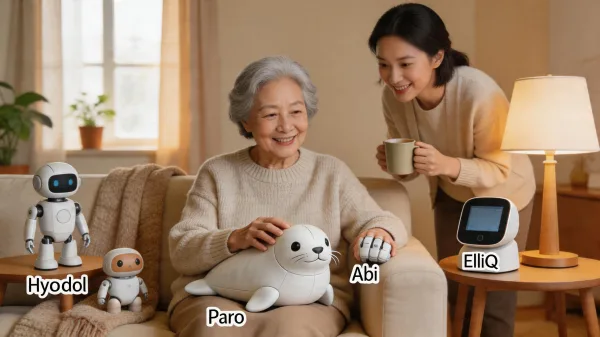
As of April 2026, your 82-year-old mother lives alone in the same house she's been in for forty years. Your father passed two years ago. Most of her friends are gone or in care. She has mild cognitive impairment, no dementia diagnosis yet, and she's increasingly quiet on the phone when you call from three states away. You saw an article about an AI companion robot called ElliQ, and now you're wondering if buying her one would actually help, or if it's a way of paying $30 a month to feel less guilty about not being there.
That question deserves an honest answer, and the honest answer has several parts. AI companion robots for seniors are real products, deployed at scale, with research evidence behind some of them. The benefits are real but partial. The ethical calculus shifts significantly depending on whether the senior has dementia or not. And the question families need to ask themselves first isn't whether the robot works. It's whether they're considering it as a supplement to their own presence or as a substitute for it.
From nearly twenty years in hospitals and from years of caregiving inside families and care facilities, I've learned that the difference between presence and stimulation matters more than it sounds. Both have a place. They aren't the same thing. This article walks through what the research actually shows about these products, what the ethical questions look like in practice, and how to think about whether a companion robot fits your specific family situation.
What AI Companion Robots Exist and What They Cost
Four products dominate the senior companion robot conversation as of April 2026. Each targets a different use case, and the price differences are substantial.
ElliQ, made by Israeli company Intuition Robotics, is the most established consumer-facing option in the United States. It's a small tabletop device with a movable head and a separate touchscreen tablet. ElliQ proactively initiates conversations, remembers what users tell it, suggests activities, prompts medication reminders, and connects family members through video calls. Pricing as of 2026 is a one-time enrollment fee of $249.99 plus a monthly subscription that ranges from about $30 to $59 depending on plan length. Annual cost lands between roughly $610 and $957. ElliQ is designed for cognitively intact seniors who can engage in real conversation. It doesn't have emergency response capabilities and can't call 911.
Paro, the therapeutic robotic seal, is the oldest and most clinically researched product on this list. Developed in Japan, it's been in use since 2003. Paro looks like a baby harp seal, weighs about six pounds, responds to touch and voice, and is FDA-cleared as a Class II medical device for neurological therapy. It costs roughly $6,000, which puts it primarily in care facility budgets rather than family budgets. Paro is used almost exclusively with dementia patients, where the goal is reducing agitation and the need for as-needed psychiatric medication.
Hyodol, a ChatGPT-powered companion doll designed to look like a seven-year-old grandchild, has been deployed to over 12,000 South Korean seniors as of November 2025, primarily through government welfare programs. The doll costs about $879 in Korea, with a U.S. launch planned for 2026 following FDA registration in late 2024. Hyodol includes built-in medication reminders, motion sensors that alert caregivers if no movement is detected for 24 hours, and conversational AI.
Abi, made by Australian startup Andromeda Robotics, is the newest entrant to U.S. care facilities. Abi is a brightly colored, four-foot-tall humanoid that speaks 90 languages and is designed for assisted living group activities and one-on-one engagement. The company raised $17 million in a recent Series A round and announced its U.S. waitlist in March 2026. Pricing for U.S. facilities hasn't been publicly disclosed. Abi is sold to facilities, not families.
What the Research Actually Shows
This is where most of the popular reporting on companion robots breaks down. The research evidence is real, and it's also more limited than the marketing suggests.
The most cited dataset comes from the New York State Office for the Aging's pilot deployment of ElliQ, which placed roughly 900 units with adults aged 60 and older across the state. The state reported a 95% reduction in self-reported loneliness among participants who used ElliQ for at least 30 days, with engagement averaging about 30 interactions per day for roughly 23 minutes of total daily use. Those numbers are striking. They also come with caveats that aren't always reported alongside them. The data is observational, not from a randomized controlled trial. The loneliness measurement tool used was a brief seven-item scale presented by ElliQ itself. Participants self-selected into the program. Researchers studying the deployment have specifically called for randomized trials before drawing strong conclusions about efficacy.
Paro has a deeper clinical literature. A 2017 cluster-randomized controlled trial published in the Journal of the American Medical Directors Association studied 415 dementia residents across 28 long-term care facilities. The trial found Paro was more effective than usual care at improving mood states and reducing agitation, though only modestly more effective than a plush toy with the robotic features disabled. A 2022 randomized trial showed Paro intervention reduced observed pain and led to fewer as-needed medications in long-term care. A 2023 systematic review and meta-analysis pooling 12 studies and 1,461 participants found Paro had a moderate effect on medication use and small effects on anxiety, agitation, and depression. The same review graded the overall quality of evidence as low due to methodological limitations and small sample sizes.
What the research doesn't show is also worth naming. There's no good evidence that companion robots replace human contact in any meaningful way. There's no evidence they improve outcomes that depend on actual relationships, like grief processing or family conflict. Long-term effects past 10 to 15 weeks remain understudied. The benefit appears to be real for some seniors in some situations. It is not a substitute for the things only people can do.
From ten years running an in-home daycare and from five years caring for my first husband through a terminal cancer diagnosis, I learned the distinction between stimulation and real presence. Stimulation is what keeps a tired toddler engaged for the next twenty minutes, or what gives a hospice patient something to focus on besides their pain. It serves a real purpose. Presence is different. Presence is someone in the room who knows you, who's chosen to be there, whose attention isn't programmed. When research shows that companion robots reduce loneliness scores, what it's measuring is closer to stimulation than to presence. That's not nothing. It's also not the same thing as being known and loved by another person, and any family considering one of these products should be clear with themselves about which need they're trying to meet.
The Ethical Question That Differs by Cognitive Status
Whether a companion robot is an easy ethical call or a hard one depends almost entirely on the cognitive status of the senior using it.
For a cognitively intact senior, the decision is theirs to make. They can evaluate the product, understand it's a machine, decide how much they want to engage with it, and turn it off when they don't. ElliQ users in the New York pilot reported finding the robot helpful while remaining fully aware they were talking to software. That's no different from any adult choosing to use a smart speaker, a meditation app, or a video game. The autonomy is intact, and the senior is the appropriate decision-maker.
For a senior with moderate to severe dementia, the calculus shifts. Paro's therapeutic benefit depends in part on the person not fully processing that it's a robot. Residents stroke it, talk to it, sometimes treat it like a baby. The same is true of Hyodol in South Korea, where social workers report seniors steaming sweet potatoes to feed the doll, dressing it in heirloom clothes, and asking to be buried with it. Some have asked to be buried with their Hyodols. That kind of engagement isn't possible if the person fully grasps that the object isn't alive.
This raises a real ethical question. A 2023 study from Oregon Health & Science University surveyed 825 adults and found that 69% were uncomfortable with the idea of someone with dementia being allowed to believe an AI companion was human. The discomfort was strongest among adults who'd had a parent with dementia.
The counterargument is that therapeutic distraction has been part of dementia care for decades. Care staff redirect patients with photos, music, familiar objects, and stuffed animals. None of these techniques require the patient to fully understand reality, and they reduce distress without medication. A robotic seal that lowers agitation enough to avoid an antipsychotic prescription may be ethically preferable to the medication itself. Antipsychotics in dementia patients carry real risks, including increased mortality. From nearly twenty years working with elderly patients in hospital ERs and orthopedic settings, I've seen what heavy sedation looks like in older adults, and the side effects aren't minor.
The honest answer is that this isn't a question with a clean resolution. It's a judgment families have to make, ideally with input from the senior's physician and any care team involved. The questions worth sitting with include: Would your parent have wanted this if they'd been asked when they were able to answer? Is the robot reducing distress that would otherwise require medication? Is it being used as one tool among many, or is it filling a gap where human contact should be? Privacy is also worth weighing. Several of these products record voice data and route it through cloud servers, and the privacy protections vary by manufacturer. Families should read the data policies before bringing one into a parent's home.
When a Companion Robot Might Actually Help Your Family
Setting aside the broader question of whether these products work in general, the more useful question for most families is whether one fits their specific situation. A few patterns emerge from the research and from what care facility staff report.
If your parent is cognitively intact, lives alone, is reasonably comfortable with technology, and has expressed interest in trying something like this, ElliQ is a reasonable supplement. The pilot data suggests it can reduce reported loneliness in this population, and the cost is in the same range as a streaming service bundle. The key word is supplement. ElliQ works best when family members are also calling, visiting, and using the device's video features to stay connected, not when it's filling a vacuum.
If your parent is in memory care and the facility uses Paro as part of their non-pharmacological intervention toolkit, the evidence base for agitation reduction is solid enough to support that use. Paro isn't something families typically buy. It's a facility-level decision, and a good memory care facility should be able to explain how they're using it and what they've observed. If you're touring memory care communities and one mentions Paro or a similar tool, that can be a useful signal that the facility is investing in non-medication approaches to behavior.
If you're considering a companion robot because you've been finding it harder to call or visit as often, and the robot feels like a way to feel less guilty about that, the answer is probably no. From years of mobile X-ray work inside care facilities, I've seen the gap between residents whose families show up and residents whose families don't. The robot doesn't close that gap. It just makes the absence quieter.
What Companion Robots Don't Replace
It's worth being explicit about what these products aren't, because the marketing tends to leave the boundaries fuzzy.
Companion robots don't replace human presence. A weekly visit from an adult child or a friend remains the single most important factor in an isolated senior's wellbeing, and no current technology changes that. They don't replace medical care. The medication reminders are useful, but they don't equal medication management, and none of these products can administer or adjust prescriptions. They don't replace emergency response. ElliQ explicitly cannot call 911. If your parent is at fall risk or has cardiac concerns, a separate medical alert system isn't optional. Years of ER work have shown me how often the difference between a recoverable event and a catastrophic one comes down to how quickly help arrived. Hyodol's motion sensor is useful but isn't equivalent to a monitored response service.
They don't replace physical safety oversight. A robot can't notice that the stove was left on, that someone has stopped bathing, or that there's a developing pressure sore. Companion robots also don't replace the legal, financial, and care-planning conversations every family needs to have, including powers of attorney, advance directives, long-term care planning, and discussions about when aging in place stops being safe. If you're using a robot as a reason to delay those conversations, the technology is working against you, not for you.
The simplest test is this: if you removed the robot from your parent's life, what would still be intact? If the answer is "everything that matters most," the robot is being used as a supplement, which is appropriate. If the answer is "not enough," there's a deeper conversation the family needs to have, and a $250 device with a monthly subscription isn't going to solve it.
Here's the practical version of all of this. If your parent is cognitively intact and lonely, ElliQ is worth a real conversation with her about whether she'd want one. If she's in memory care and her facility uses Paro, the evidence supports that. If you're hoping a robot will let you call less often, no product on the market is going to deliver what you're actually looking for. And before any of these decisions, the basic infrastructure of safety, medical care, and family presence has to be in place.
Companion robots are a real category of senior technology now, with real evidence behind some of them and real ethical complexity that families have to think through. The research is improving. The products will get better. None of that changes the harder underlying question, which is how present we're willing to be in the lives of the people who raised us. The robot is just a tool. What it ends up meaning depends on what it's doing alongside everything else your family is offering.
Take the technology seriously. Take its limits seriously too. And keep showing up.