
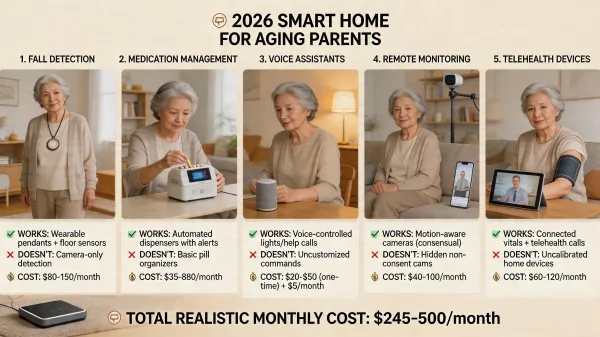
Picture a familiar situation. Your 79-year-old mother lives alone in the house she's lived in for thirty years. She's mobile, mentally sharp, and fiercely independent. But she's had two minor stumbles in the past year, you live three states away, and the worry sits in the back of your mind every time her phone goes to voicemail. You've started looking at smart home technology for an aging parent because you want her to keep her independence and you want some way of knowing she's okay. As of April 2026, the options have gotten genuinely useful, and they've also gotten more complicated to sort through.
Smart home technology that helps an aging parent breaks down into five practical categories: fall detection (wearables, radar, or AI cameras), medication management (automated dispensers and adherence packaging), voice assistants (Echo Show, Google Nest Hub, or senior-specific platforms like ElliQ), remote monitoring (behavioral tracking that alerts family members to changes), and telehealth-connected medical devices (blood pressure cuffs and glucose monitors that share readings with the parent's doctor). Each addresses a different piece of the same problem: keeping a parent safe at home without making the home feel like a hospital.
Doing mobile X-ray work, I went into homes and facilities after falls had already happened. The ones that haunt me are the ones where nobody knew for hours. Today, smart home technology can change that. It can't prevent every fall, but it can change what happens afterward.
Fall Detection: What Actually Works
Falls are the leading cause of injury death in adults 65 and older, and according to the CDC, about one in four older adults falls each year. Fall detection technology splits into three approaches: wearables, radar-based systems, and AI-enabled cameras. Each has tradeoffs that matter more in real homes than the marketing materials suggest.
Wearables include the Apple Watch's automatic fall detection (Series 4 and later) and dedicated medical alert pendants from companies like Medical Guardian, Lively, and Bay Alarm Medical. The response protocols are strong. The Apple Watch detects a hard fall and, if the person doesn't respond within about a minute, calls emergency services and notifies designated contacts. Medical alert pendants typically connect to a 24/7 monitoring center that can dispatch help even when the wearer can't speak. The hard problem isn't the technology. It's adherence. Pendants come off in the shower, get left on the dresser, get forgotten in the morning rush. Watches need charging. The pendant sitting on the dresser is the single biggest threat to any wearable-based fall detection plan.
Radar-based systems take a different approach. Vayyar Care and similar products use millimeter-wave radar to detect falls without the parent wearing anything and without capturing video. The radar tracks motion and posture changes through a small ceiling- or wall-mounted unit. False positives are lower than camera-based systems, the parent doesn't have to remember anything, and there's no privacy footage being recorded. The catch is room coverage. Radar units cover one room each, so a useful setup for a typical home means several units, which raises the upfront cost.
AI-enabled cameras can detect falls with reasonable accuracy, but they involve always-on video in your parent's home. For some families that tradeoff is worth it. For others, especially when the parent is cognitively intact and would object to video monitoring, it isn't.
I've walked into homes after the EMS call and seen what hours on the floor does to an older body. Hip fractures are bad. Pressure injuries from lying immobilized are worse. The cases that stay with me are the ones where the person was found by a neighbor stopping by the next day, not because the technology failed but because there wasn't any. A wearable that gets worn, a radar system that runs in the background, or a camera with detection enabled can all change that outcome. The point isn't picking the perfect product. It's picking one your parent will actually use, or one that doesn't depend on them remembering.
Medication Management Beyond Simple Pill Boxes
Weekly pill organizers work fine for parents managing two or three medications and reliable routines. The technology category exists because plenty of older adults aren't in that situation. The Hero medication dispenser and MedMinder Maya both automate the dispensing schedule, lock the unit between doses, and send alerts to family members when a dose is missed. Hero holds about a 90-day supply across up to ten medications. MedMinder offers similar capacity with cellular connectivity that doesn't depend on home Wi-Fi.
From hospital admissions, I can tell you medication-related events are among the most common preventable reasons older adults end up in the ER. Voice-assistant routines provide a lighter option. An Amazon Echo or Google Nest can deliver scheduled medication reminders without locking anything down, which works for parents who just need a verbal nudge but wouldn't tolerate a dispenser sitting on the counter. The reminder doesn't confirm the medication was actually taken, so this is appropriate for low-stakes regimens, not high-risk ones like blood thinners or insulin.
Adherence packaging from pharmacy services like Amazon Pharmacy's PillPack or Simple Meds shifts the management problem upstream. The pharmacy pre-sorts every dose into a labeled packet (Tuesday morning, Tuesday evening), and the parent just tears off the next packet at the right time. For parents with eight or more medications across multiple times of day, adherence packaging often does more good than any dispenser, because it removes the daily sorting work that's the actual failure point.
The match between tool and situation matters more than the sophistication of the tool. For a parent with two or three medications and intact cognition, a $5 weekly organizer works. For a parent with eight medications and early cognitive changes, a Hero or MedMinder paired with adherence packaging changes outcomes. Pick to the situation, not the marketing.
Voice Assistants and Practical Communication
The Amazon Echo Show and Google Nest Hub have become quietly essential for many families with an aging parent. The screen-plus-voice combination handles video calls without the parent having to learn an app, plays music and audiobooks on request, delivers weather and news, sets timers, and takes medication reminders. Drop-in calling, where authorized family members can connect directly to the device without the parent having to answer, is helpful for daily check-ins or when something seems off.
ElliQ from Intuition Robotics is a senior-specific variant. It's designed for parents living alone who would benefit from a more conversational presence, with proactive engagement features that prompt the user to take a walk, drink water, or call a family member. The FDA has not classified ElliQ as a medical device, but the product is being studied as a tool for reducing social isolation in older adults living alone, which is a real health risk in its own right. From the ER side of things, I've seen what isolation does to older adults' health long before anyone calls it a medical issue.
The setup value is real. A parent who can video call grandchildren by saying their name has a different daily life than a parent who can't. The flip side is that always-on microphones and (with the Echo Show or Nest Hub) cameras are part of the deal. For most families, the privacy tradeoff is acceptable for the connection it enables. For parents with strong privacy preferences, a simpler audio-only Echo Dot delivers most of the benefit without the camera concern.
Smart Home Remote Monitoring Platforms
Behavioral monitoring platforms track patterns rather than incidents. CarePredict's wearable, for instance, learns a parent's normal daily activity (when they get up, how often they go to the kitchen, how much they move during the day) and alerts family members or care providers when patterns shift in ways that often signal a developing problem. Other platforms use motion sensors placed around the home to track activity passively, without requiring the parent to wear anything.
The promise is real. A parent who's drinking less water, sleeping more during the day, or moving less around the house may be developing a urinary tract infection, an early infection elsewhere, or a depression episode that family members wouldn't otherwise catch until it had progressed. After 20 years inside hospitals, I can tell you the cases that get caught late are usually the ones where the trend was visible weeks earlier and nobody saw it. The catch is alert fatigue. Passive monitoring platforms generate a steady stream of notifications, and after enough false positives, family members start ignoring them. By the time a real signal comes through, the response is slower than it would have been with no system at all.
The harder conversation is one product marketing won't have with you: monitoring equals surveillance. The parent whose movement, medication, and behavior are tracked is under surveillance, even when the goal is benevolent. That isn't automatically wrong. Plenty of families decide together that the safety benefit outweighs the privacy cost. The mistake is doing it without naming it. Whenever your parent is cognitively able to participate, have an honest conversation about what's being collected, who can see it, and when alerts will be shared. Skipping that step often leaves the parent feeling watched in their own home, which damages the relationship and the trust the technology was supposed to support.
Telehealth and Connected Medical Devices
FDA-cleared connected medical devices have changed what chronic disease management can look like at home. Bluetooth-enabled blood pressure cuffs, pulse oximeters, glucose monitors, and weight scales can auto-upload readings to a platform shared with the parent's primary care provider or specialist. For parents managing diabetes, hypertension, COPD, or heart failure, the data continuity often matters more than any individual device feature.
The practical impact is steadier care. Instead of a doctor seeing a single in-office reading every three months, the doctor sees a trend line. Medication changes happen earlier, hospitalizations get caught before they happen, and the parent's day-to-day numbers stop being a mystery. Many Medicare Advantage plans now cover at least some connected devices through their aging in place benefits, though coverage varies by plan and changes year to year.
Telehealth visits round out the setup. A parent who can't easily get to a clinic can have video appointments with primary care, mental health, or specialty providers without family members having to coordinate transportation. The barrier is usually the technology setup, not the visit itself. An Echo Show, a tablet, or a laptop with the right app installed and tested in advance turns a friction-heavy process into a routine one. Set it up before the first appointment, not during.
What a Smart Home Setup for an Aging Parent Realistically Costs
Costs scale with how much coverage the family actually wants. As of April 2026, three setup tiers cover most situations.
A minimal safety setup with wearable fall detection and a basic medication reminder runs about $500 upfront and roughly $60 per month ongoing. That covers an Apple Watch or medical alert pendant subscription, a smart pill reminder, and a voice assistant for communication. For families whose parent is otherwise stable, this tier addresses the highest-impact risks without overwhelming the parent or the budget.
A comprehensive remote monitoring setup with wearables, behavioral tracking, voice communication, and family alerts runs $1,500 to $2,000 upfront and $100 to $150 per month. This is the tier most families land at when there's a real concern about cognitive change or a recent fall.
A telehealth-integrated setup adds connected medical devices for chronic condition management, pushing the total to roughly $2,500 upfront and $150 to $200 per month. For parents managing complex chronic conditions, this tier often pays for itself in avoided hospitalizations and ER visits.
Compare any of these to the median assisted living monthly cost, which CareScout pegs at $5,419 in their 2025 Cost of Care Survey, or about $65,000 a year. A complete home technology setup at $200 a month works out to $2,400 a year. Even the most comprehensive home setup, when annualized, runs less than two months of assisted living in most markets, and significantly less in higher-cost regions where assisted living can run $7,000 to $9,000 a month. The financial argument for trying technology first, where appropriate, is strong. The caveat is that assisted living isn't only about cost. When a parent's needs exceed what technology and visiting family can cover, no smart home setup substitutes for in-person care, and dragging out aging in place past the point where it's working can lead to a crisis transition that's harder on everyone. The right question isn't which is cheaper. It's which actually meets the situation.
Putting the Pieces Together
A useful starting point is to match the technology to the actual risk profile, not the wishlist. If your parent's primary risk is falling, prioritize fall detection that doesn't depend on remembering to wear something. If the risk is medication errors, start with adherence packaging before adding a dispenser. If the risk is social isolation, an ElliQ or an Echo Show with regular family video calls does more than any sensor network. Layered systems help, but starting layered usually means nothing gets used well. Add one tool, get the routine working, then add the next. A simple home safety checklist often catches risks technology can't address, like rugs and lighting.
Talking with your parent matters more than picking the right product. Many parents resist monitoring not because they don't want to be safer but because they don't want to feel watched. Bringing them into the decision and giving them control over what's shared changes the dynamic from surveillance to collaboration. Smart home technology for an aging parent works best when the parent considers it theirs, not yours. Independence and safety aren't opposing goals. The right setup, chosen together, can support both.