
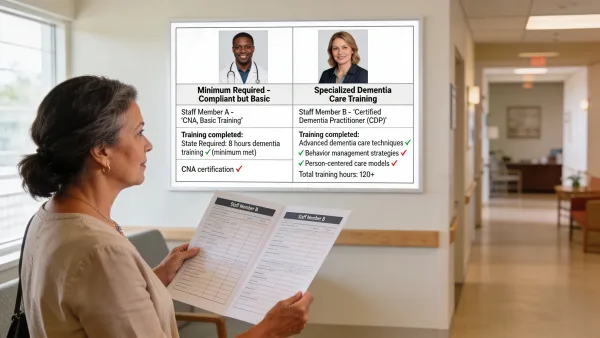
More than 40% of nursing home residents and 70% of assisted living residents live with some form of dementia. Yet research consistently shows that lack of proper dementia knowledge, poor communication skills, and negative attitudes toward dementia affect the quality of care these residents receive. The difference between facilities that merely meet minimum requirements and those that excel often comes down to one factor: how well trained their staff actually are.
Not all memory care training is created equal. Some states require as little as four hours of dementia education for direct care workers. Others mandate specialized certifications for anyone working with memory care residents. Some facilities invest heavily in ongoing education and evidence-based training programs. Others check a box with a one-time orientation video.
Understanding what separates meaningful training from minimum compliance gives you the information you need to evaluate whether a facility's staff can truly meet your loved one's needs. This article breaks down required versus specialized training, the certifications that actually matter, state-by-state requirements, and the specific questions to ask during facility tours.
Where This Gets Confusing: Required Training vs. Specialized Training
Memory care staff training falls into two distinct categories, and facilities don't always make the distinction clear.
Required training refers to the minimum hours mandated by your state's licensing regulations. These requirements vary dramatically. In some states, all staff working with residents with dementia must complete 8-12 hours of dementia-specific training before working independently. In others, only administrators and direct care supervisors need specialized training. Still others have no dementia-specific requirements beyond general caregiver certification.
Required training typically covers basic concepts like stages of dementia, common behavioral symptoms, and safety protocols. It's designed to ensure staff meet a baseline competency level. A facility that only provides required training is doing the legal minimum.
Specialized training goes beyond state mandates. This includes nationally recognized certification programs, evidence-based care approaches like Positive Approach to Care, train-the-trainer programs that create in-house dementia education capacity, and ongoing professional development tied to current research.
Here's what makes this confusing: facilities can truthfully say "all our staff are trained in dementia care" whether they provide eight hours of basic orientation or 40+ hours with nationally recognized certification. Marketing language rarely distinguishes between meeting requirements and exceeding them.
The quality difference is substantial. Staff with specialized training demonstrate better outcomes in managing behavioral symptoms without medication, reducing resident distress and agitation, preventing falls and safety incidents, and maintaining longer employment (which means more consistent care for residents).
When touring facilities, ask explicitly about both categories. Don't accept vague statements about training. Request specifics on hours, certification programs, who receives what level of training, and how often training is updated.
Dementia-Specific Certifications That Matter
Several nationally recognized certification programs indicate a facility has invested in staff education beyond minimum requirements. Understanding what these certifications involve helps you evaluate their value.
Certified Dementia Practitioner (CDP)
The CDP certification from the National Council of Certified Dementia Practitioners represents the most widely recognized dementia care credential in the United States.
To earn CDP certification, staff must complete a one-day Alzheimer's Disease and Dementia Care seminar covering disease processes, communication techniques, person-centered care approaches, and behavioral symptom management. Applicants need at least one year of paid experience in geriatric healthcare and must meet state licensing requirements for their position. The certification costs $180 and requires renewal every two years with continuing education.
The NCCDP recommends at minimum one CDP-certified staff member per shift in memory care settings. Facilities that employ multiple CDPs across all shifts signal a commitment to specialized care. The certification matters because it standardizes knowledge across different roles (nursing, activities, direct care) and requires ongoing professional development rather than one-time training.
Certified trainers (CADDCT designation) can train staff in-house, which allows larger organizations to build internal dementia education capacity. Facilities with in-house certified trainers often provide more consistent, facility-specific training that addresses their unique resident population and care challenges.
Alzheimer's Association essentiALZ
The essentiALZ program from the Alzheimer's Association offers a more accessible entry point for staff certification. This three-hour, self-paced online program covers five core topic areas based on the Association's Dementia Care Practice Recommendations: basics of Alzheimer's and dementia, person-centered care principles, assessment and care planning, activities of daily living support, and communication strategies for behavioral symptoms.
Staff who complete the training and pass the certification exam (90% or higher) receive essentiALZ certification valid for two years. The individual cost is $59.99, with volume discounts for facilities purchasing multiple certifications.
Several established training programs (including those from Relias, OpusVi, and others) have received Alzheimer's Association recognition, meaning their proprietary training aligns with essentiALZ standards. Staff completing these recognized programs can then take the essentiALZ certification exam.
The essentiALZ designation indicates staff have demonstrated knowledge of evidence-based dementia care practices. It's particularly valuable for facilities that want to ensure consistent baseline competency across all direct care workers. However, the relatively short training duration means it works best as a foundation that's supplemented with hands-on coaching and ongoing education.
Alzheimer's Foundation of America Certifications
The AFA offers two certification levels worth noting. The Certified Dementia Care Partner (DCP) follows completion of the Partners in Care training program and passing an associated exam. This certification emphasizes relationship-building and strengths-based approaches to dementia care.
The newer Certified Comprehensive Dementia Care Provider (CDCP) represents advanced learning requiring five professional education courses from different categories (general, clinical, and social/cultural competency) plus a practicum seminar. This two-year certification earns up to 12 social work continuing education credits and signals a significantly higher level of specialized expertise.
Joint Commission Memory Care Certification
While not an individual credential, facilities can pursue Memory Care Certification from The Joint Commission based on the Alzheimer's Association Dementia Care Practice Recommendations. This facility-level certification requires demonstrating structured care delivery, staff competency and training systems, safe physical environments, and family support services.
Facilities with Joint Commission Memory Care Certification appear on both The Joint Commission Quality Check website and the Alzheimer's Association Community Resource Finder. This certification indicates the organization has undergone external validation of their entire dementia care program, not just staff training.
Evaluating Certification Value
When assessing a facility's certifications, consider who holds them. A facility with one CDP-certified activities director has less training depth than one where certified staff work across nursing, activities, and direct care roles. Ask what percentage of direct care staff hold dementia-specific certifications, not just leadership positions.
Also ask how the facility supports recertification. Most dementia certifications require renewal every two years with continuing education. Facilities committed to specialized training will have systems for tracking certification status and providing the ongoing education needed for renewal.
The presence of multiple certification types across different staff levels generally indicates a stronger training culture than relying on a single certification program. It shows the facility values diverse educational approaches and invests in building expertise across roles.
Training Hours vs. Training Quality
State regulations typically specify minimum training hours, but hours alone don't predict care quality. Understanding what makes training effective helps you evaluate whether a facility's approach actually translates to better outcomes for residents.
The Problem with Hour Requirements
Most states with dementia-specific training mandates require between 4 and 16 hours of initial training for direct care workers. Annual continuing education requirements range from 4 to 8 hours. These minimums ensure a baseline, but research shows significant differences in how facilities use those hours.
A facility can meet an 8-hour requirement with a passive video training where staff watch without interaction or assessment. Another might use those same 8 hours for interactive classroom training with role-playing, case studies, and practical skill demonstration. Both satisfy the legal requirement. The educational outcomes differ dramatically.
The Centers for Medicare & Medicaid Services' 2024 minimum staffing standards for long-term care facilities finalized total nurse staffing requirements but didn't mandate specific dementia training hours at the federal level. This leaves considerable variation in state approaches.
Some recent state legislation has moved toward more specific requirements. Colorado's Senate Bill 22-079, effective January 2024, enhanced training standards for assisted living, nursing facilities, and adult day centers. Texas House Bill 1673 now requires dementia training for all staff, even in facilities without designated memory care units. These examples show growing recognition that hour minimums alone don't ensure quality.
What Effective Training Looks Like
Research on dementia care training effectiveness identifies several factors that matter more than total hours:
Interactive learning methods consistently outperform passive approaches. Studies show that staff who practice communication techniques through role-playing and receive feedback on their interactions retain skills better than those who only watch videos or attend lectures. Effective programs combine classroom learning with supervised practical experience.
Theory-driven approaches that teach why certain techniques work produce better outcomes than task checklists. Staff who understand how dementia affects perception, memory, and emotional regulation can adapt their approach to individual situations rather than following rigid scripts.
Relevant and directly applicable content shows better results than generalized information. Training that uses real scenarios from the facility, addresses specific challenging behaviors staff encounter regularly, and provides strategies they can implement immediately leads to actual practice changes.
Person-centered care principles form the foundation of effective dementia training. Programs that emphasize understanding the individual, building relationships, and recognizing behaviors as communication of unmet needs correlate with reduced medication use, fewer behavioral incidents, and improved resident outcomes.
Experienced instructors with dementia care backgrounds teach more effectively than general trainers reading from manuals. The instructor's ability to answer questions, provide context, and share practical examples significantly impacts learning outcomes.
Training Delivery Methods That Work
Train-the-trainer models show promising results. These programs certify internal staff to deliver ongoing dementia education, creating sustainable training capacity. The CADDCT certification from NCCDP and similar programs allow facilities to provide consistent, facility-specific training without relying entirely on external educators.
Fully immersive experiences like Virtual Dementia Tours help staff develop empathy by simulating sensory and cognitive changes associated with dementia. These experiential programs complement knowledge-based training by helping staff understand how the world appears from a resident's perspective.
Regular reinforcement through short, frequent training sessions often works better than annual marathon sessions. Facilities that build dementia education into ongoing staff meetings, conduct quarterly skill refreshers, and provide just-in-time coaching when challenging situations arise maintain competency better than those relying on annual compliance training.
Red Flags in Training Approaches
Watch for facilities that can't articulate their training philosophy beyond meeting requirements, rely exclusively on online self-study with no interactive components, have no system for assessing whether staff actually apply training in daily practice, or use the same generic training for memory care and general assisted living staff.
The most concerning red flag is high staff turnover. When facilities lose 50-100% of their direct care staff annually, even excellent training programs can't maintain consistent care quality. Stability matters as much as training content.
State Requirements: What Your Location Mandates
Memory care regulations vary significantly by state. Understanding your state's specific requirements provides a baseline for evaluating whether facilities meet, exceed, or fall short of legal minimums.
Common State Requirements
Nearly all states with assisted living regulations require some dementia-specific training for staff in facilities that advertise memory care services. The specifics differ widely.
Most states mandate training for direct care workers before they work independently with residents with dementia. Requirements typically range from 4 to 16 hours of initial training. Many states also require administrators and supervisors to complete additional dementia education, often 4-8 hours beyond direct care worker requirements.
Annual continuing education for dementia care typically ranges from 2-8 hours per year. Some states require all staff who interact with residents to complete dementia training, including housekeeping and dietary workers. Others limit requirements to direct care staff and management.
Building design and safety features face regulation in almost all states. Requirements typically cover door locking systems, outdoor access controls, wandering prevention measures, and environmental design elements that reduce confusion.
States with Stricter Standards
Several states have implemented more comprehensive dementia care regulations in recent years.
Arizona requires facilities providing "memory care services" to meet specific care standards and staff training requirements beyond general assisted living regulations. The designation requires documented training programs and disclosure requirements to residents and families.
Colorado's Senate Bill 22-079 enhanced training requirements for assisted living, nursing facilities, and adult day centers starting January 2024. The bill recognizes that specialized training reduces turnover, improves resident outcomes, and addresses the growing dementia care workforce need.
Texas House Bill 1673 represents one of the more progressive approaches, requiring dementia training for all staff in any facility, not just those marketing memory care services. This acknowledges that residents with cognitive impairment exist throughout senior living settings.
Florida requires specific Alzheimer's disease or dementia training for staff in assisted living facilities serving residents with cognitive impairment. The state also mandates pre-admission assessments and ongoing monitoring.
Licensing and Certification Variations
Some states differentiate between general assisted living licenses and memory care designations. Facilities seeking dementia-specific licensure face additional requirements for staffing ratios, training hours, building design, and disclosure to families.
Other states allow facilities to serve residents with dementia under general assisted living licenses but require specific staff training and safety measures when they do. The terminology varies. "Memory care certification," "Alzheimer's designation," and "dementia care endorsement" all appear in different state regulations.
Finding Your State's Requirements
The American Health Care Association and National Center for Assisted Living publish an annual Assisted Living State Regulatory Review detailing requirements by state. This resource provides current information on staffing requirements, mandatory training hours, and dementia-specific regulations.
State health department websites typically maintain licensing regulations and guidance documents. Search for "[your state] assisted living regulations" or "[your state] memory care requirements" to find official sources.
During facility tours, ask staff to explain your state's specific requirements and how they exceed them. Quality facilities should clearly articulate both compliance and areas where they go beyond minimums.
Questions to Ask About Staff Training
Having specific questions prepared helps you cut through marketing language and assess actual training quality. These questions reveal how facilities approach staff development.
About required training: What does your state require for dementia-specific training? How many hours of initial training do direct care staff receive before working independently? What training do other staff (housekeeping, dietary, activities) receive? How do you track and ensure compliance with state requirements?
About certifications: What percentage of your direct care staff hold dementia-specific certifications? Which certification programs do you use? Do you have staff with CDP, essentiALZ, or other recognized credentials? How many certified staff work on each shift? Do you support staff in obtaining and maintaining certifications?
About training quality: Who develops your training curriculum? Who delivers training to staff? Is training interactive or primarily video-based? How do you assess whether staff apply training in their daily work? Can you describe your approach to person-centered dementia care?
About ongoing education: How often do staff receive dementia training beyond initial orientation? What does annual continuing education look like? Do you bring in specialized trainers or handle education in-house? How do you address specific challenges like sundowning, wandering, or aggressive behaviors?
About specialized approaches: Do you use specific evidence-based programs like Positive Approach to Care, Montessori methods, or validation therapy? Have staff completed Virtual Dementia Tours or similar experiential training? Do you have train-the-trainer certified staff who can provide ongoing education?
About staff stability: What's your annual staff turnover rate? What's the average tenure of your current direct care staff? How many staff members on each shift have worked here more than one year?
About practical application: Can you walk me through how staff would handle a resident who becomes agitated during personal care? What's your protocol when a resident refuses medications? How do staff modify communication for residents with advanced dementia?
Beyond Certifications: Other Training Indicators
While certifications provide useful benchmarks, several other factors indicate a facility's commitment to specialized dementia care.
Look for facilities that partner with organizations like the Alzheimer's Association, participate in CMS initiatives like the GUIDE Model for comprehensive dementia care, have earned recognition from external accreditation bodies, or maintain active relationships with local dementia care specialists.
Ask whether the facility conducts regular care conferences where staff discuss individual residents' needs, approaches that work or don't work, and care plan adjustments. This collaborative problem-solving indicates applied learning beyond formal training hours.
Facilities with memory care advisory committees that include families, clinical experts, and staff representatives often maintain higher care standards. These groups review incidents, discuss training needs, and recommend program improvements.
The presence of specialized staff positions like memory care coordinators, dementia care trainers, or behavioral health specialists suggests investment in expertise beyond basic staffing requirements.
What Training Can and Can't Accomplish
Understanding the limits of training helps set realistic expectations. Even excellently trained staff can't stop disease progression, eliminate all challenging behaviors, guarantee your loved one will never experience distress, or provide one-on-one attention at all times.
Well-trained staff should demonstrate patience and empathy when residents repeat questions, recognition that behaviors communicate unmet needs, ability to redirect rather than confront when residents are confused, knowledge of non-pharmacological interventions before medication use, and flexibility to adapt care approaches for individual residents.
Training matters most when combined with adequate staffing ratios, low turnover that maintains consistency, management support for applying person-centered approaches, and facility environments designed to reduce confusion and support independence.
Making Your Decision
Memory care staff training exists on a spectrum from minimum compliance to exceptional expertise. Most facilities fall somewhere in the middle. Your task is determining whether a facility's training level matches your loved one's needs.
For residents with early-stage dementia and few behavioral symptoms, facilities meeting state requirements with some additional specialized training may provide adequate care. For residents with advanced dementia, complex medical needs, or significant behavioral symptoms, facilities with high percentages of certified staff, ongoing specialized training, and evidence-based care programs become essential.
Don't hesitate to ask for specifics. Request information on staff certifications by shift, training schedules and curricula, recent continuing education topics, and the facility's approach to challenging situations your loved one specifically experiences.
The facilities most confident in their training programs will readily provide details, introduce you to trained staff during tours, and explain how their approach differs from minimum requirements. Vague responses or inability to articulate training beyond "all staff are trained" should prompt additional questions or consideration of other facilities.
Quality dementia care depends on many factors, but staff knowledge and skills form its foundation. Taking time to understand training standards, asking specific questions, and evaluating responses against state requirements and national best practices helps ensure you choose a facility where staff have the expertise your loved one deserves.