
What Is Gerstmann-Sträussler-Scheinker Syndrome?
Gerstmann-Sträussler-Scheinker syndrome (GSS) is one of the rarest diseases you'll ever encounter as a family caregiver, affecting roughly 1 to 10 families per 100 million people worldwide. It belongs to a group of conditions called prion diseases, caused by misfolded proteins that gradually destroy brain tissue. Unlike Creutzfeldt-Jakob disease (CJD), which often progresses in months, GSS typically unfolds over 5 to 10 years. That slower pace gives your family something most prion disease families don't get: time to plan.
If your parent has recently been diagnosed with GSS, you're probably processing two things at once. First, the diagnosis itself, a rare and fatal condition with no cure. Second, the genetic reality that GSS is inherited, meaning other family members may carry the same gene mutation. Both of those truths are heavy. But understanding what lies ahead and using this window of time wisely can make an enormous difference in the quality of care your parent receives and the peace of mind your family carries through this process.
When my first husband was diagnosed with terminal cancer, one of the hardest lessons I learned was that once a cure isn't on the table, your entire focus shifts to comfort and dignity. That shift doesn't mean giving up. It means redirecting energy toward what you can still control. For families dealing with GSS, the slower trajectory of this disease gives you the chance to make that shift thoughtfully rather than in crisis mode.
This article covers what GSS looks like as it progresses, when memory care becomes necessary, how to find a facility equipped for both the physical and cognitive challenges of this disease, and how to use the time you have now to plan ahead for your parent and your family.
How GSS Differs From Other Prion Diseases
All prion diseases share a common mechanism: an abnormal form of the prion protein builds up in the brain, causing progressive neurological damage. But the way each prion disease presents and progresses varies considerably. GSS stands apart in several important ways that directly affect how families plan for care.
CJD, the most common human prion disease, typically strikes around age 60 and progresses rapidly, with most patients dying within six months to a year. GSS usually appears earlier, often between ages 35 and 55, and follows a much slower course. The average survival from symptom onset is roughly 5 years, though some patients live closer to 10 years. That difference isn't just a medical detail. It changes everything about how your family prepares.
The other major distinction is the first symptom. CJD often begins with cognitive decline or confusion. GSS usually starts with ataxia, a progressive loss of coordination that shows up as unsteady walking, clumsiness, and difficulty with balance. Many families describe their parent stumbling more often or gripping handrails they never used before. The cognitive changes, memory loss, confusion, and difficulty with decision-making, tend to come later, sometimes years after the balance problems start. I've seen families in the ER whose parent came in after a fall, and no one connected it to anything neurological until much later. That pattern is common with GSS.
The Typical Progression of GSS
GSS doesn't follow a single path. Symptoms and their timing can vary even among members of the same family who carry the identical gene mutation. That said, the general trajectory follows a pattern that helps families anticipate what's coming.
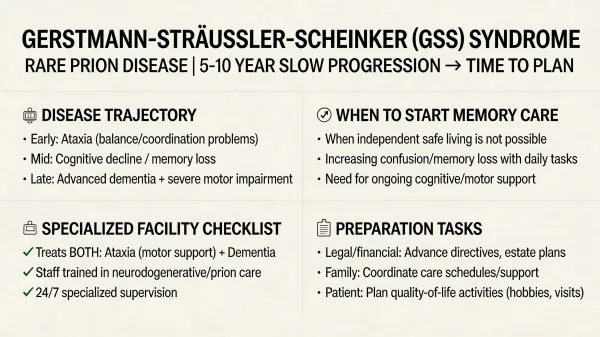
In the early stage, which can last two to four years, ataxia is usually the primary issue. Your parent may walk with a widened gait, have trouble with fine motor tasks like buttoning a shirt, and develop slurred speech (dysarthria). Some individuals also experience changes in eye movement or visual disturbances. Cognitive function may remain relatively intact during this phase, or subtle changes may begin appearing, like difficulty finding words or slight memory lapses that could easily be attributed to normal aging.
The middle stage brings more pronounced cognitive decline alongside worsening physical symptoms. Memory problems become harder to ignore. Your parent may struggle with multistep tasks, get confused about time or place, or show personality changes. The ataxia progresses to the point where a wheelchair may become necessary. Swallowing difficulties (dysphagia) often emerge during this stage, creating new risks around nutrition and aspiration pneumonia.
The late stage involves severe dementia and near-total loss of motor function. Your parent will need full assistance with all daily activities, and communication becomes increasingly limited. This stage is where 24-hour skilled care becomes essential, whether at home with extensive support or in a specialized facility.
When Memory Care Becomes Necessary With GSS
Because GSS starts with physical symptoms, many families initially focus on mobility support rather than cognitive care. That makes sense early on. But the transition point, when memory care should enter the conversation, often comes sooner than families expect.
The trigger isn't a single event. It's usually a pattern. Consider a situation where your parent has had progressive balance problems for three years, initially chalked up to aging, when genetic testing reveals GSS. Now cognitive changes are appearing: forgotten appointments, repeated questions, trouble managing medications. The family knows the trajectory is irreversible but has time to plan. That moment, when physical decline and cognitive decline start overlapping, is when you should begin actively researching memory care options.
Waiting until your parent is in crisis to find a facility is one of the biggest mistakes families make with any form of dementia. With GSS, you have the advantage of a longer runway. Use it.
Planning Ahead With GSS: Using the Slower Timeline to Your Advantage
The question no one thinks to ask when a parent is diagnosed with a prion disease is: "What can we do with the time we have?" With CJD, families are often blindsided by how fast everything moves. Decisions get made in emergency rooms and hospital hallways. With GSS, the 5 to 10 year trajectory creates a window that, if used wisely, can spare your family from making critical choices under pressure.
Start with advance directives while your parent's cognition is still intact. This is the single most valuable thing you can do in the early stages. A healthcare power of attorney, a living will, and a do-not-resuscitate order (if that aligns with your parent's wishes) should all be completed while your parent can fully participate in those decisions. Too many families put this off, and by the time the cognitive decline accelerates, the legal process becomes far more complicated, potentially requiring court-appointed guardianship. I learned this the hard way as a young spousal caregiver. When you're watching someone you love decline, the last thing you want is a legal battle over who gets to make decisions. Get it done early. You'll be grateful you did.
Financial planning deserves the same urgency. Memory care costs nationally average between $7,000 and $8,000 per month as of 2025, according to multiple cost surveys. Over a potential 5 to 10 year disease course, your family could be looking at total care costs ranging from $420,000 to nearly $1 million, depending on when your parent enters a facility and how long they need care. That number shocks most families. Meet with a financial planner or elder law attorney early to explore long-term care insurance (if your parent has it), Medicaid eligibility and spend-down rules in your state, and any VA benefits that might apply. One practical note: Gerstmann-Sträussler-Scheinker disease is listed on Social Security's Compassionate Allowances list, meaning your parent may qualify for expedited SSDI or SSI approval. This won't cover memory care costs, but it can provide some income support that helps during the earlier stages of the disease.
Tour memory care facilities before you need one. Visiting communities while your parent is still relatively stable lets you evaluate options without the emotional pressure of an immediate placement. You can ask better questions, compare multiple facilities, and even bring your parent along to see what feels right. Ask specifically about their experience with residents who have both mobility limitations and cognitive decline, because that dual need is central to GSS care.
The genetic counseling conversation is one that many families avoid, but it's critically important. GSS is caused by a mutation in the PRNP gene on chromosome 20, and it follows an autosomal dominant inheritance pattern. That means each child of an affected parent has a 50% chance of carrying the same mutation. The P102L mutation, the most common variant linked to GSS, is considered nearly fully penetrant, meaning most carriers will eventually develop symptoms. Genetic counseling centers that follow the Huntington disease predictive testing protocol offer a structured, multi-step process for at-risk family members who want to know their status. This isn't a decision to rush, and genetic counselors can help each family member weigh the personal, emotional, and practical implications of testing. Some family members choose to test for planning purposes, while others prefer not to know. Both choices are valid. The important thing is that the conversation happens, ideally with professional guidance from a counselor experienced in hereditary neurological conditions.
Families often discover that the genetic dimension of GSS creates a kind of grief that extends beyond the affected parent. Siblings may process risk differently. Adult grandchildren may have questions about their own future. A good genetic counselor can help your family work through these conversations in a way that respects everyone's pace and boundaries.
Facility Needs for GSS: Ataxia Plus Dementia
Finding the right memory care facility for a parent with GSS means looking for a community that can handle two simultaneous challenges: progressive physical disability and progressive cognitive decline. Most memory care units are designed primarily for ambulatory residents with Alzheimer's or other dementias. A parent with GSS who uses a wheelchair, has difficulty swallowing, and also needs cognitive support requires a different level of care.
Wheelchair accessibility is the starting point, but it goes beyond ramp access and wide doorways. You want a facility where common areas, dining spaces, and activity rooms are genuinely designed for wheelchair users, not just technically compliant. Ask whether they currently have residents in wheelchairs and how programming is adapted for residents who aren't mobile. Some memory care communities treat wheelchair-bound residents as an afterthought rather than including them fully in daily activities.
Fall prevention is especially critical in the earlier stages when your parent is still ambulatory but increasingly unsteady. Look for facilities with handrails throughout hallways and bathrooms, non-slip flooring, adequate lighting including nightlights, low-profile beds, and staff trained to assist with transfers. A community that uses bed alarms and motion sensors can catch falls before they result in serious injury. I've worked in enough clinical settings to know that one bad fall can change the entire trajectory of a patient's decline, and with GSS, the ataxia makes fall risk a constant concern.
Dysphagia monitoring should be a standard part of the care plan. As GSS progresses, swallowing becomes increasingly difficult, raising the risk of aspiration pneumonia, one of the most common causes of death in prion diseases. The facility should have a relationship with a speech-language pathologist who can regularly assess swallowing function and adjust food textures and liquid thickness as needed. Ask how they handle feeding support for residents with swallowing difficulties and whether staff receive specific training on aspiration precautions.
Cognitive support should follow the same evidence-based approaches used for other dementias: structured daily routines, sensory stimulation, music and art therapy, and a calm, low-stimulation environment that reduces confusion. The difference with GSS is that cognitive decline may start later and progress differently than Alzheimer's, so the care plan should be individualized rather than one-size-fits-all. Ask the facility how they develop and adjust care plans for residents with atypical dementia presentations.
A practical approach when evaluating facilities is to ask directly: "Have you cared for residents with prion diseases or rare neurological conditions before?" Most haven't, and that's okay. What matters more is their willingness to learn, their ability to coordinate with your parent's neurologist, and their flexibility in adapting care plans as the disease progresses.
Palliative Care and GSS: Starting Early
Palliative care isn't hospice. This is a distinction worth making clearly, because many families hear "palliative" and assume it means end-of-life care only. Palliative care is an approach focused on improving quality of life through symptom management, emotional support, and care coordination. It can begin at diagnosis and run alongside any other treatments.
For GSS specifically, early palliative care involvement helps manage the ataxia-related symptoms (pain from falls, muscle spasms, fatigue), coordinates swallowing assessments and dietary modifications, provides emotional and psychological support for both the patient and family, and guides ongoing conversations about goals of care as the disease progresses. Research on prion diseases has found that more than a third of patients never receive a palliative care referral, even though nearly all have symptoms that would benefit from supportive care. Don't wait for someone to suggest it. Ask your parent's neurologist for a palliative care referral early.
When my husband was going through cancer treatment, the palliative care team made a bigger difference than almost anyone else on his medical team. They focused on what mattered to him day to day: comfort, dignity, and being heard. That same focus is what your parent with GSS deserves from the start.
The Financial Reality of Long-Term GSS Care
Memory care for GSS is expensive, and the longer disease course means costs accumulate far beyond what most families anticipate. At a national average of roughly $7,000 to $8,000 per month (as of 2025), a parent who enters memory care three years after diagnosis and lives another four to six years in care could face total facility costs between $336,000 and $576,000. That doesn't include medical expenses, neurologist visits, therapies, adaptive equipment, or the costs of genetic counseling for other family members.
Medicare doesn't cover memory care. It will cover some hospital stays, short-term skilled nursing after hospitalization, and hospice care when the time comes. Medicaid may cover memory care in your state, but eligibility requires meeting strict income and asset limits, and the rules vary considerably from state to state. Some families use a strategy called Medicaid spend-down, working with an elder law attorney to restructure assets so the parent qualifies without leaving the healthy spouse or family financially devastated.
Long-term care insurance, if your parent purchased a policy before the diagnosis, can offset some costs. But many people don't carry this coverage. Other options worth exploring include VA Aid and Attendance benefits for veterans or surviving spouses, life insurance policy conversions that redirect the death benefit toward care costs, and reverse mortgages for parents who own their home. Every family's financial picture is different, and the right combination of strategies depends on your parent's specific assets, income, and location.
Supporting Your Family Through a GSS Diagnosis
A GSS diagnosis doesn't just affect the person who has it. The inherited nature of this disease means the entire family is processing layers of grief, fear, and uncertainty at the same time. Your parent is losing function. You and your siblings may be wondering about your own risk. If your parent has grandchildren, they may have questions too.
There's no right way to handle this. Some families are open about everything from the start. Others take it in stages, addressing the immediate caregiving needs first and dealing with the genetic questions later. Both approaches are fine, as long as the genetic conversation eventually happens with professional support.
The CJD Foundation, despite its name, serves families affected by all human prion diseases including GSS. They offer support groups, educational resources, and connections to other families going through similar experiences. The National Prion Disease Pathology Surveillance Center at Case Western Reserve University is another resource, particularly for connecting with specialists who understand the disease.
Caregiver burnout is real, and the slower pace of GSS can actually make it worse in some ways. With a fast-moving illness, the intensity is overwhelming but brief. With GSS, you're looking at years of gradually increasing caregiving demands. Build your support network early. Accept help when it's offered. And don't measure yourself against some impossible standard of what a "good" caregiver looks like.
A Rare Diagnosis, but Not a Hopeless One
GSS is fatal, and no article should pretend otherwise. But fatal doesn't mean nothing can be done. The slower progression of this disease gives your family something rare among prion conditions: a chance to be thoughtful and deliberate about every decision, from advance directives to facility selection to how the genetic conversation unfolds across your family.
Your parent's comfort and dignity through this process depend on the plans you put in place now. Start those conversations while you can still have them together. Tour facilities before you need them. Get the legal and financial documents in order while your parent can participate. These steps won't change the diagnosis, but they'll change how your family experiences it.
You're carrying something heavy right now. But you don't have to carry it alone, and you don't have to figure it all out today. Just start.