
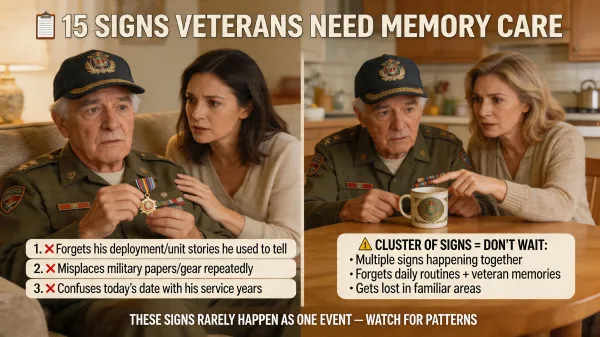
If you're reading this late at night, already pretty sure your aging veteran parent needs more help than you can give, you're probably not wrong. The signs a veteran needs memory care rarely show up as one dramatic event. They show up as a slow pattern over months: missed medications, a scorched pot, a grandchild's name that suddenly doesn't land, a story told three times in an hour. You notice one thing, then another, and then one day the list in your head feels impossible to ignore.
Some of these signs I watched in my own family. Others I see every week in the ER. When several of them are showing up together, it's usually time.
This article walks through 15 signs it's time to move a veteran parent to memory care, grouped by what they tell you. The first group covers safety risks that can't wait, the kind that land an aging parent in the ER if they're not addressed. The second covers cognitive changes that don't have another reasonable explanation. The third covers self-care collapses you've probably been quietly covering for, and the fourth covers behavioral and emotional shifts that feel new. The last group is the one families most often miss: veteran-specific signs that look like the person they always knew, stoic and independent and slow to complain, when in fact the disease is hiding behind a lifetime of those same traits.
The goal isn't to scare you. The goal is to help you trust what you're already seeing and give you a framework for the next conversation with your siblings, your parent's doctor, and eventually a care facility. When the signs cluster, waiting rarely makes the decision easier. It just makes the move harder.
The 15 Signs at a Glance
Here are the 15 signs it's time to move an aging veteran to memory care, in the order we cover them:
- Kitchen accidents and fire risk
- Getting lost in familiar places
- Driving that's no longer safe
- Not recognizing close family members
- Losing track of time, year, or where they are
- Repeating questions within minutes
- Serious medication mistakes
- Weight loss or signs of malnutrition
- Hygiene decline
- Escalating agitation, paranoia, or aggression
- Sundowning and severe sleep disruption
- Withdrawal and unexplained fear
- PTSD symptoms resurfacing or intensifying
- Deepening isolation tied to post-service habits
- Refusing help in ways that go beyond ordinary stubbornness
Safety Risks That Can't Wait
The first cluster of veteran memory care signs are the ones that make this a safety conversation, not a comfort one.
1. Kitchen accidents and fire risk
A pan left on the burner. A microwave run for an hour. Small burns on the counters or dish towels. Kitchen fires and near-misses are one of the clearest signs a veteran parent has moved past what they can safely manage alone. In the ER, I've seen the outcomes of stoves left on overnight, and the families who come in almost always tell me they'd been worried for months.
2. Getting lost in familiar places
Wandering isn't always leaving the house. Sometimes it's driving to the grocery store and not being able to find the way home, or standing in the driveway not knowing which direction the front door is. When a veteran who spent decades in one neighborhood can't orient in it anymore, the ground has shifted under their cognition.
3. Driving that's no longer safe
New dents on the car they can't explain. Missed exits. Calls from neighbors about close calls. Veterans are often the last in a family to give up driving because mobility has always meant independence. You don't need an accident to know it's time. You just need a pattern.
Cognitive Changes That Can't Be Explained Away
Some cognitive changes are normal aging. These aren't.
4. Not recognizing close family members
Forgetting a grandchild's name for a moment happens to everyone. Looking at your own child or grandchild with no recognition, or mistaking them for someone from decades ago, is a different kind of change. In my own family's dementia experience, this was the sign that shifted the conversation from "maybe" to "we have to do something." It lands hard, and it usually means the disease is further along than anyone wanted to admit.
5. Losing track of time, year, or where they are
Not knowing what day it is happens to plenty of retirees. Not knowing what year it is, what season, or whose house they're sitting in signals something else. Veterans with advancing cognitive decline often anchor to the year they were discharged, or to a specific tour, and the present slips away.
6. Repeating questions within minutes
Asking the same question four times in an hour isn't forgetfulness. It's short-term memory that's no longer encoding. This sign is easy to dismiss one-on-one, which is why adult children often don't realize how far it's gone until they spend a full day with their parent.
Self-Care and Daily Living Signs
Everyday tasks a veteran has handled for 60 years start breaking down. These signs are easy to miss from a distance and obvious once you're in the house for a few days.
7. Serious medication mistakes
Missed doses, doubled doses, pills sitting in the weekly organizer untouched. For a veteran on blood pressure, diabetes, heart, or psychiatric medications, mistakes aren't small. I've cared for patients whose ER visit traced directly back to a medication error at home that nobody caught. If your parent can't manage their own pills reliably, that's a memory care signal.
8. Weight loss or signs of malnutrition
Clothes hanging loose. An empty fridge. Cans of soup with no openers and bread that's gone blue. Veterans living alone often lose weight quietly, and the loss accelerates as they forget they haven't eaten.
9. Hygiene decline
Wearing the same clothes for days. Unwashed hair. A smell in the house that wasn't there before. Hygiene decline is often the sign adult children feel most uncomfortable raising, and it's usually the one that tells you daily living is no longer being managed.
Behavioral and Emotional Signs
Behavior changes can feel like personality changes, and in a way they are. These signs often surface before the cognitive ones become obvious.
10. Escalating agitation, paranoia, or aggression
A veteran who was steady for 70 years suddenly accusing family members of stealing, snapping at grandchildren, or becoming combative with a spouse. Paranoia about missing items, aggression toward caregivers, and out-of-character outbursts are classic middle-stage dementia signs. For veterans with a trauma history, they can come on faster and feel more intense.
11. Sundowning and severe sleep disruption
Confusion and agitation that worsen as the day ends. Wandering at 3 a.m. Refusing to sleep in their own bed because it "isn't theirs." Sundowning isn't just exhausting for families. It's usually a sign the cognitive load of daylight has used up the reserves, and the evening hours have no more to give.
12. Withdrawal and unexplained fear
Pulling away from phone calls, refusing visits, canceling appointments, sitting in a dark room with the TV off. Withdrawal in a veteran can look like classic depression, and sometimes it is. Often it's the self-protective instinct of someone who knows something is wrong and doesn't want anyone to see it.
The Veteran-Specific Signs That Shift the Calculus
The last three signs are the ones that matter differently for veterans, and they're the ones families most often misread. Veterans carry a specific combination of service-era exposures, post-service habits, and cultural values around independence that change how dementia presents and how families respond to it. Research from the VA and peer-reviewed studies has consistently found that veterans with PTSD carry close to double the dementia risk compared to veterans without it, and that traumatic brain injuries from service, even mild ones, raise dementia risk decades after the event. The Alzheimer's Association has also highlighted a strong connection between PTSD and frontotemporal dementia, a form of the disease that often shows up first as behavior and personality changes rather than memory loss. What all of this means in practice: the signs below often look like "the way Dad's always been," when they're actually the disease interacting with a lifetime of specific experiences, training, and self-management strategies that have finally stopped working.
13. PTSD symptoms resurfacing or intensifying
Veterans who managed their PTSD successfully for decades can see symptoms return or worsen as dementia progresses. Nightmares that had been quiet for 30 years come back. Startle responses intensify. Hypervigilance shows up as paranoia. Clinicians call this "late-onset stress symptomatology," and it's driven by a combination of cognitive decline loosening long-held coping strategies and the disease uncovering trauma memories the brain had kept contained. Families often interpret this as the veteran "getting meaner" or "becoming paranoid." It's usually the trauma response and the dementia intersecting.
14. Deepening isolation tied to post-service habits
A veteran who has always preferred solitude, kept a tight circle, and resisted "making a fuss" is at particular risk of advanced isolation as dementia progresses. Service-connected conditions like chronic pain, hearing loss, and mobility limitations compound the pull toward staying home. Adult children often miss how isolated a veteran parent has become because the pattern looks like the personality they've always known. The distinction that matters: chosen solitude is different from the inability to reach out. When your veteran parent stops answering the phone entirely, stops attending the one VFW meeting they used to go to, or stops leaving the house for weeks at a time, that's decline wearing the costume of an old habit.
15. Refusing help in ways that go beyond ordinary stubbornness
This is the sign that keeps families stuck the longest. A veteran refusing help from "outsiders" is consistent with values most of them have carried since basic training: take care of your own, don't be a burden, handle it. That refusal is real and worth respecting, up to a point. The problem is that dementia erodes the self-awareness a veteran used to rely on to know when to ask for help, which means the refusal stops being an informed choice and starts being a symptom. When it prevents safe medical care, when it means not accepting home visits, not showing up for scheduled doctor's appointments, not allowing the family to set up basic safety measures like a stove lockout or a medical alert button, or when it turns into active resistance against anyone who tries to help, the refusal has moved from independence into risk. Families often delay action here out of guilt, not uncertainty. Understanding that the refusal is partly the disease speaking can make the decision feel less like betrayal.
I've sat with this exact combination on both sides. In the ER, I've cared for veterans brought in after accidents that could have been prevented if someone had been allowed in the house sooner. In my own family's dementia journey, I watched how fast cognitive decline can accelerate once a person is isolated, underfed, and mismanaging medication. The instinct to honor a veteran's wishes is right. The instinct to wait because they say they're fine is the one that puts families in the ER.
When Multiple Signs Cluster Together
One sign on its own is almost never the trigger. Everyone forgets a name. Everyone leaves a burner on once in a while. Everyone has a bad week of sleep. Individual signs are easy to explain away, and for a long stretch of mild decline, explaining them away isn't wrong.
The picture changes when signs cluster. When your father is forgetting medications, losing weight, starting to get lost on the drive home, and his PTSD symptoms are resurfacing, that's not four separate issues. That's one disease expressing itself in four places. Memory care becomes the answer when the cluster makes clear that staying at home isn't safe and that in-home help isn't enough.
A practical way to think about it: if you're tracking three or more signs from this list, and any one of them involves safety (fire, wandering, medication errors, driving, or serious hygiene breakdown), you're past the point where waiting helps. The decline tends to accelerate once basic routines start failing, because the routines themselves were the scaffolding holding cognition together.
Families often ask about a timeline once they realize the move is coming. A useful rule of thumb from geriatric practice: the 72-hour rule for safety-related decisions. If a sign with a safety dimension has been present for three consecutive days, whether that's wandering, medication errors, or aggression toward a spouse, the next 72 hours are for action, not observation. That doesn't mean moving your parent in 72 hours. It means using those three days to call the doctor, contact the local VA, start touring facilities, and convene siblings. Safety signs don't reverse themselves. They escalate.
Waiting rarely makes the move easier. It usually makes it harder, because the veteran's ability to adapt to a new environment declines right along with everything else.
Common Questions Families Ask
Can a veteran move directly into memory care, or do they need a diagnosis first?
Most memory care communities require a formal dementia diagnosis from a physician, geriatrician, or neurologist before admission. If your veteran parent hasn't been formally evaluated, start there. The VA has neurocognitive evaluation resources, and community clinics can also provide the workup. A diagnosis also opens the door to VA benefits that can help pay for care.
Will the VA pay for memory care?
The VA doesn't typically pay for memory care in an assisted living community, but it does have several benefits that can help offset the cost. Aid and Attendance, the VA Geriatrics and Extended Care program, and community living centers (VA nursing homes) are worth exploring. Eligibility depends on service history, income, and level of care needed. A VA-accredited representative can walk a family through what applies to a specific veteran. Verify current benefits at VA.gov.
What if my veteran parent refuses to go?
This is the most common barrier families face, and it rarely resolves through argument. Several approaches tend to work better than direct confrontation: involving the parent's physician in the recommendation, framing the move as a trial stay rather than a permanent decision, and touring facilities during the cognitive window when reasoning is clearest (usually mornings). Consider a situation where an aging veteran refuses to tour a facility but agrees to visit a friend who lives there. That kind of indirect approach often gets further than a family meeting.
How quickly does memory care need to happen once we see the signs?
It depends on the cluster. If safety signs are present, the timeline is short: weeks, not months. If the signs are primarily cognitive without immediate safety risk, families often have a few months to plan, tour, and transition. The key is to start looking before you need a spot. Memory care facilities with good staff-to-resident ratios often have waiting lists.
Should we tell our veteran parent they have dementia before the move?
This one varies by family, by the stage of decline, and by the veteran's personality. Many families find that gently acknowledging the diagnosis helps, especially when framed around the care they're going to receive rather than what they're losing. Your parent's physician can help you think through the right conversation for your specific situation.
What to Do Next
If the signs above are adding up, the most useful next steps are concrete rather than emotional. Call your parent's physician and describe the cluster of signs you're seeing. Ask for a cognitive evaluation and a referral to a geriatric specialist if one hasn't been made. Contact the local VA or a VA-accredited representative to understand what benefits apply. Start touring memory care facilities in your area while you have time to be selective. Bring siblings into the conversation sooner rather than later, because delay usually deepens family disagreement rather than resolving it.
You don't have to be certain to start. You just have to take the next step.
The families who move earliest are rarely the ones who regret the decision. They're the ones who got their parent into a safer setting before the decline made transitions harder. The ones who wait usually tell us, months later, that they wish they'd trusted what they were seeing sooner. If the signs are showing up together, you're seeing them for a reason. Trust that, and give yourself permission to act on it.