
Vascular Dementia Is More Common Than Most Families Realize
Vascular dementia is the second most common form of dementia after Alzheimer's disease, accounting for roughly 15% to 20% of all dementia cases in the United States and Europe. Yet most families have never heard of it until a doctor mentions it after a stroke, a TIA, or a series of small vascular events that quietly damage the brain over time. Unlike Alzheimer's, which tends to follow a gradual downhill path, vascular dementia often progresses in sudden drops followed by stretches of relative stability. That pattern is what makes it so disorienting for families trying to figure out when their parent actually needs memory care.
Research published by the American Heart Association found that stroke survivors face a nearly threefold increased risk of developing dementia in the first year after a stroke. About 20% of patients hospitalized for stroke develop dementia within that first year, with higher rates among those who experience a second stroke. For families, the window between a vascular event and noticeable cognitive decline can be shockingly short.
I watched this play out with a family member. The cognitive drop after a vascular event wasn't gradual. It came in visible steps, and each one redrew what "normal" looked like overnight.
This article covers how to recognize when memory care for vascular dementia is the right move, what makes vascular dementia care different from Alzheimer's care, and how to evaluate facilities that are equipped to handle the specific challenges this condition brings.
What Is Vascular Dementia?
Vascular dementia results from conditions that reduce or block blood flow to the brain, damaging brain tissue in the process. The most common cause is stroke, but it can also develop from chronic small vessel disease, where tiny blood vessels deep in the brain narrow or leak over time. The brain areas affected determine which cognitive abilities decline, which is why symptoms vary so much from person to person. One individual might lose the ability to plan and organize while retaining memory, while another might struggle with speech or spatial awareness.
There are several patterns of vascular dementia. Multi-infarct dementia involves repeated small strokes that accumulate damage. Strategic single-infarct dementia occurs when one stroke hits a brain region critical for cognition. Subcortical vascular dementia develops from chronic small vessel disease affecting the deep white matter. Each type produces a different symptom profile and a different trajectory of decline, which is one reason vascular dementia can be harder to predict than Alzheimer's.
Vascular dementia can also coexist with Alzheimer's disease, a combination called mixed dementia. Mixed presentations are common in older adults and can complicate both diagnosis and care planning.
The risk factors for vascular dementia overlap heavily with the risk factors for heart disease and stroke: high blood pressure, diabetes, high cholesterol, atrial fibrillation, and smoking history. A parent who has been managing one or more of these conditions for years is carrying cumulative vascular risk, even if they've never had a major stroke. Small vessel disease can cause damage silently over time, with cognitive changes appearing so gradually that they're easy to dismiss as normal aging. By the time a noticeable step-down occurs, the underlying vascular damage may already be extensive.
The Stepwise Decline: Why Timing Feels So Confusing
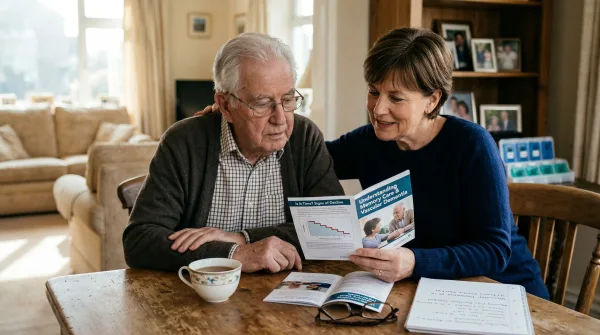
Where this gets confusing is that vascular dementia doesn't follow the gradual slope most people associate with dementia. Alzheimer's disease typically progresses in a slow, relatively predictable curve. Vascular dementia moves in a staircase pattern: a vascular event causes a sudden drop in function, followed by a plateau that can last weeks, months, or sometimes longer. During that plateau, your parent might seem stable. They might even seem like they're improving slightly as the brain adjusts.
That stability tricks families. It creates a false sense that the situation is manageable, maybe even getting better. Then another event hits, and another step down happens. The problem is that each step down takes away more than the last one gave back during the plateau. Over time, the staircase only goes in one direction.
This pattern also makes it hard to know when you've crossed the line from "we can manage this at home" to "this isn't safe anymore." With Alzheimer's, the gradual decline gives families more time to see it coming. With vascular dementia, the transition can happen over a single weekend. That difference changes everything about how families need to plan.
Recognizing the Signs It's Time for Memory Care With Vascular Dementia
The biggest challenge with vascular dementia is that the signs it's time for memory care don't always announce themselves gradually. A parent who was managing reasonably well on Monday might be unable to prepare a meal or remember their medications by Friday, because a new vascular event happened in between. Families who wait for a steady decline to signal that it's time will often find themselves in crisis mode instead.
There are functional losses that consistently signal the tipping point. Medication mismanagement is one of the earliest and most dangerous. Vascular dementia patients are typically on multiple medications, including blood thinners, blood pressure drugs, and sometimes cholesterol-lowering medications, all of which require precise timing and dosing. When a parent starts doubling doses, skipping them, or confusing one medication for another, the consequences aren't just cognitive. They're medical emergencies waiting to happen. A missed blood thinner dose in someone with atrial fibrillation raises stroke risk. A doubled blood pressure medication can cause a dangerous drop. The margin for error is thin.
Beyond medications, watch for sudden changes in the ability to handle basic self-care. Bathing, dressing, and grooming that your parent managed without help during the last stable period but can't manage now suggest a new step down has occurred. The same applies to meal preparation, managing finances, and following multi-step instructions. If your parent could handle their weekly pill organizer a month ago and now can't figure out which day it is, that's not a bad week. That's likely a new baseline.
Safety awareness is another critical marker. Vascular dementia can impair judgment and problem-solving before it significantly affects memory. Your parent might remember your name and their address but leave the stove on, wander outside in inappropriate weather, or fail to recognize when something in the house is a hazard. Executive function deficits, meaning the ability to plan, sequence, and make decisions, often appear earlier in vascular dementia than in Alzheimer's. This is a pattern I've seen in the hospital setting too: patients who can answer orientation questions correctly but can't follow a two-step instruction safely.
When I watched a family member go through this, what struck me most was how fast the ground shifted. One month, they were handling daily routines with minor support. After the next vascular event, they couldn't sequence the steps to get dressed in the morning. The stable period before it had lulled the whole family into thinking we had more time than we did. That experience taught me something I try to pass on to every family in this situation: the time to research memory care is during a stable period, not after the next drop. The stable phases feel like breathing room, and they are, but they're also your planning window. Touring facilities, understanding costs, getting paperwork in order, and having honest conversations with your parent about what might come next are all things that become exponentially harder to do during a crisis. The families who fare best are the ones who treat every stable period as borrowed time and use it accordingly.
Don't wait for a dramatic incident. The accumulation of smaller functional losses across two or three step-downs is itself the signal.
How Vascular Dementia Care Differs From Alzheimer's Care
Not all memory care is the same, and a facility experienced with Alzheimer's disease won't automatically be equipped to handle the specific demands of vascular dementia. The behavioral profiles, medical complexity, and risk monitoring needs are different enough that families should ask specifically about vascular dementia experience before choosing a facility.
The behavioral presentation tends to differ. Alzheimer's patients often experience a gradual erosion of memory first, with personality and behavioral changes developing later. Vascular dementia patients frequently show executive dysfunction, mood instability, and depression earlier in the disease, sometimes before significant memory loss appears. Emotional lability, where a person cries or laughs suddenly and intensely without a clear trigger, is more common with vascular dementia and can be distressing for both the individual and other residents. A good vascular dementia care team recognizes these emotional shifts as neurological symptoms, not behavioral problems, and responds with calm redirection rather than correction.
Medication management is substantially more complex. Vascular dementia patients are almost always on cardiovascular medications: anticoagulants or antiplatelets, antihypertensives, statins, and potentially diabetes medications. These drugs interact with each other and with any cognitive medications the patient may also be taking. The timing, dosing, and monitoring requirements go well beyond what's typical for an Alzheimer's-only population. A facility managing vascular dementia patients needs a medication management system that accounts for drug interactions, tracks blood pressure and blood sugar regularly, and has protocols for when readings fall outside safe ranges.
From my years working in the hospital, I can tell you that medication errors with this population create cascading problems. A missed blood pressure dose doesn't just mean higher readings for a day. In a patient with damaged cerebral blood vessels, it can trigger the next vascular event. The stakes are different.
Stroke risk monitoring is the other major differentiator. Vascular dementia patients live with ongoing stroke risk that Alzheimer's patients generally don't face. Memory care staff need to recognize stroke warning signs: sudden confusion beyond baseline, one-sided weakness, slurred speech, vision changes, or a severe headache with no known cause. Time matters with stroke response. A facility with vascular dementia experience will have staff trained to identify these symptoms quickly and protocols to get the resident to emergency care without delay.
Physical therapy and mobility support also play a larger role. Many vascular dementia patients have residual physical deficits from prior strokes, including gait problems, one-sided weakness, or balance issues. Falls are a serious concern, and the care plan should include regular physical therapy or mobility programs tailored to stroke recovery, not just general senior fitness activities.
How to Choose a Memory Care Facility for Vascular Dementia
Choosing a memory care facility for a parent with vascular dementia means looking beyond the standard checklist. You're evaluating whether the facility can handle a condition that is medically active, not just cognitively progressive. Start by asking how many current residents have vascular dementia or mixed dementia diagnoses. A facility where the majority of residents have Alzheimer's may not have the clinical infrastructure your parent needs.
Look at the staffing model. Vascular dementia requires closer coordination between nursing staff and outside physicians, particularly neurologists and cardiologists. Ask whether the facility has an on-site nurse available around the clock or just during business hours. Ask how they handle after-hours medical changes, who reviews lab work, and how quickly they can get a resident to an emergency room if stroke symptoms appear.
Pay attention to the physical environment too. Because vascular dementia often affects mobility, look for wide hallways, handrails throughout common areas, non-slip flooring, and accessible bathrooms designed for residents with one-sided weakness. A beautiful facility that isn't built for stroke survivors won't serve your parent well.
Ask to see the activity calendar. Cognitive engagement programs should include activities that target executive function, not just memory. Problem-solving exercises, sequencing tasks, and structured social activities are more relevant for vascular dementia than the reminiscence-focused programming designed primarily for Alzheimer's.
Ask how the facility develops and updates individualized care plans. With vascular dementia, the care plan needs to account for both cognitive and cardiovascular needs, and it needs to be revised after every step-down event, not just at scheduled quarterly reviews. Find out who participates in those reassessments. The best facilities include nursing staff, the resident's primary physician, any specialists involved in their cardiovascular care, and family members. A care plan that was written at move-in and hasn't been revisited in six months is a care plan that no longer reflects your parent's reality.
Questions to Ask During a Memory Care Tour
When you tour a facility, bring specific questions that test whether the staff understand vascular dementia's unique demands. General marketing answers won't tell you what you need to know.
Ask: "How does your staff differentiate between a bad day and signs of a new vascular event?" The answer should include specific clinical indicators and a clear escalation protocol. If the answer is vague, that's a red flag. Ask about their medication management process for residents on anticoagulants and multiple cardiovascular drugs. You want to hear about specific systems, such as electronic medication administration records, pharmacist reviews, and monitoring schedules, not just reassurance that "our nurses handle it."
Ask how they handle the emotional lability that comes with vascular dementia. Staff who are trained in vascular dementia will describe de-escalation techniques and understand that sudden crying or laughing isn't a sign of emotional distress in the traditional sense. Ask about fall prevention protocols and what physical therapy or mobility support is available on-site or through partnerships. And ask what happens when a resident's condition steps down suddenly. How do they reassess the care plan? How quickly? Who is involved in that reassessment? The answers to these questions will tell you more than any brochure.
Why Families Should Plan During Stable Periods
The single most important thing a family can do after a vascular dementia diagnosis is start planning immediately, even when things seem fine. Especially when things seem fine. Stable periods are not guarantees. They're windows.
Consider a parent who seems stable for months after a small stroke. They're managing at home with some help. They remember to eat, they take their medications most of the time, and the family checks in regularly. Then one Saturday morning, another small stroke happens. By Sunday evening, that parent can't manage medications, can't bathe without assistance, and can't figure out how to heat a meal. The family has no facility research done, no paperwork ready, no understanding of costs or availability. They're making one of the biggest decisions of their lives from a hospital waiting room with a 72-hour discharge clock ticking.
That scenario plays out constantly. Finding and arranging memory care placement typically takes three to four months when families are prepared. Financial arrangements, including Medicaid applications or VA benefit claims, can take six months or longer. None of this is possible to fast-track in a crisis.
Use stable periods to tour facilities, narrow your list, understand payment options, and get legal and financial documents in order. Have the hard conversations with your parent while they can still participate in decisions about their own care. Get power of attorney and healthcare proxy documents completed if you haven't already, because a sudden step-down can remove your parent's ability to sign legal documents. Talk to a financial advisor who specializes in elder care about how to structure assets for potential Medicaid eligibility down the road. That planning doesn't mean you're giving up on the stable period lasting. It means you're ready if it doesn't.
Memory Care Costs for Vascular Dementia
Memory care for vascular dementia costs roughly what it costs for any form of dementia, with the potential for higher expenses due to the added medical complexity. As of 2025, the national median cost for memory care ranges from approximately $7,000 to $8,000 per month, depending on the source and how costs are measured. That works out to $84,000 to $96,000 per year. The average memory care stay is two to three years, putting the total cost in the range of $168,000 to $288,000.
Those numbers represent base rates. Vascular dementia patients may incur additional costs for more frequent nursing assessments, physical therapy, specialized monitoring equipment, or higher-acuity care levels as the disease progresses. Some facilities use tiered pricing that increases as care needs rise, so the monthly cost your parent pays at move-in may not be the monthly cost a year later.
Medicare does not cover room and board in memory care facilities, which surprises many families who assume their parent's insurance will help. Medicaid may cover some costs in states that offer home and community-based services waivers, but eligibility requirements are strict, asset limits are low, and waitlists in many states run months or even years long. Starting a Medicaid application early, even before your parent needs placement, can save critical time later. Veterans and surviving spouses may qualify for VA Aid and Attendance benefits, which can provide up to $2,300 per month for eligible veterans (as of 2025), though the application process itself can take several months. Long-term care insurance policies vary widely in what they cover, so review the policy details carefully before assuming it will handle the full monthly cost. Personal savings, home equity through a reverse mortgage or home sale, and life insurance conversions are other options families piece together. The financial shock is real. I experienced it with my own family, and the numbers hit harder than anyone expects. Start the financial planning conversation early.
Making the Decision With Confidence
Choosing memory care for a parent with vascular dementia is one of the hardest calls a family can make, partly because the disease doesn't give you a clean signal that it's time. The staircase pattern creates a cycle of crisis and calm that makes every stable period feel like evidence that things are under control. They might be, for now. But planning as though the next step-down is coming isn't pessimism. It's the most protective thing you can do for your parent.
Focus on what you can control. Learn the signs that matter. Ask the right questions when you tour facilities. Understand the costs before you're forced to make a decision under pressure. And know that choosing professional care for someone you love isn't giving up on them. It's making sure they have the medical monitoring, the safety infrastructure, and the daily support that vascular dementia demands as it progresses.
You're doing the research right now, and that tells me you're already ahead of where most families are when this decision arrives. Trust that preparation. It matters more than you think.