
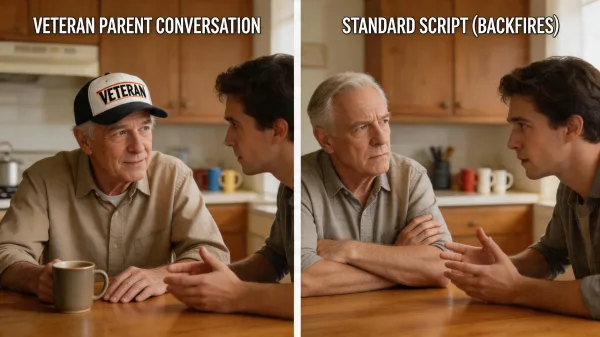
Her father is 79, a Korean War veteran, and living alone in the house where he raised his kids. His daughter has been watching the signs accumulate over the last year. Weight loss, an empty fridge with expired milk, mail piling up on the kitchen counter. A conversation last month where he couldn't remember the name of his oldest grandchild for a beat longer than he should have. She's brought up senior living twice. Both times, he shut the conversation down before it really started. Not with anger, but with finality. The kind of "we're not discussing this" that ends things.
She's not looking for a script. She's looking for a different way in.
If this is where you are, if you've tried to bring it up once or twice and walked away wondering what you did wrong, you're in the right place. Talking to a veteran parent about senior living has its own weight. The approaches that work with other aging parents often don't land the same way with a military parent, and sometimes they backfire. Independence means something specific when it was earned through service. Institutions feel different when you've been inside them.
I'll be straight with you about what I know. I've sat across from a family member during our own family's dementia decline, trying to have a conversation they didn't want to have. I know what that silence feels like. The veteran version of this carries an additional weight I haven't claimed personal expertise on, so I researched to understand it. What follows is honest guidance rooted in both places: the general hard truth of talking to a proud parent about care, and the specific dynamics that shape these conversations for military families.
How Veteran Parent Conversations Differ From Typical Senior Living Talks
Veterans bring a different starting point to conversations about care. Standard senior living talking points often don't apply, not because your parent is being difficult but because the values they're drawing on were shaped in a different world than the one the standard scripts were written for. Here's how these conversations tend to differ:
- Independence has a heavier meaning. It wasn't a default. It was earned through service.
- Institutional distrust runs deeper. Many veterans carry experiences with the VA, military bureaucracy, or chain-of-command decisions that make them skeptical of systems.
- Safety doesn't motivate the way it does with civilian parents. Safety was something they gave up when they signed up.
- Accepting care can feel like failing a personal code. The same code that told them to look out for their unit now tells them not to be a burden on their family.
- Peer veterans carry more weight than family members. A conversation with another vet at the VFW can move something your best attempts can't.
- The timeline runs slower, with more pauses, more restarts, and fewer decisive moments.
These patterns don't mean your parent won't ever agree to senior living. They mean the path there looks different. Knowing that ahead of time changes how you approach the first conversation, the fifth one, and the one that finally turns the corner.
What Makes These Conversations Different for Veteran Parents
Independence That Was Earned, Not Assumed
For many veterans, independence isn't a default position. It's something they earned through service, often through years of being subject to someone else's orders, and they don't give it up easily. The paradox of military life is that you spend years under strict command and then you spend the rest of your life protecting the independence you fought to return to. Civilian parents may value independence as a personal preference. A veteran parent often values it as something purchased with years of their life. That difference lands hard in a conversation about moving into a care facility.
When you suggest senior living, what your veteran parent may be hearing isn't "this is a good next step." They may be hearing "give up the thing you fought for." That's not dramatic. It's an accurate read of how many veterans experience the suggestion.
Distrust of Large Systems
Many veterans have been on the wrong end of institutional decisions. They remember VA claims that took years to process, or bureaucratic errors that cost friends medical care, or military decisions that didn't protect the people they were supposed to protect. That history doesn't go away because you've found an assisted living facility with good reviews. For some veterans, any residential facility starts from a position of mistrust, and you have to earn your way past that before they'll consider it seriously. That isn't stubbornness. It's pattern recognition, learned the hard way.
"I've Survived Worse"
The third dynamic is harder to describe, but if you've talked to a veteran parent, you've felt it. Many of these men and women have already survived hard things. Combat. Captivity. Losing the people they served with. Coming home to a country that wasn't always grateful. From my own hospital work, I've seen how pain and risk register differently for patients who served. What other patients would rate a 7 out of 10, a combat veteran often calls a 3. Their bar for "serious" isn't set where yours is. "Eating poorly" doesn't sound dangerous to someone who has eaten rations in a foxhole. "Falling risk" doesn't sound dangerous to someone who has been shot at. That doesn't make the signs you're seeing any less real. It does mean you won't persuade them by pointing to risks that don't feel like risks to them.
Why Safety and Convenience Framings Fall Flat
This is why the standard adult-child script often fails. You lead with "I'm worried about your safety," and your parent hears a concern they've long ago made peace with. You lead with "it would be so much easier," and your parent hears a value they don't share. The framings that work on civilian parents assume a starting point of "life should be comfortable." Many veteran parents are starting from "life should be honorable." That shifts the whole conversation.
Scripts That Tend to Backfire
If you've been reaching for the standard talking points, you're not doing anything wrong. These are the scripts we've all heard from well-meaning relatives, doctors, and care coordinators. They're calibrated for a civilian audience. Here are the ones that tend to land badly with veteran parents:
- "It's safer there." Your parent's threshold for danger isn't your threshold. This framing often reads as patronizing.
- "You'll make friends." Many veteran parents had friends they can't replace. That conversation is tender in ways a civilian might not recognize.
- "It'll be so much easier." Ease isn't a motivator for someone whose values are built around service and duty.
- "The staff will take care of you." Being taken care of by strangers is not something many veteran parents want to hear.
- "It's for your own good." This phrase has a military echo many veterans remember. It rarely means what the person saying it thinks it means.
What works better isn't the opposite of these. It's language that respects the value system those phrases clash with. The next section walks through that approach and why it tends to land when the standard scripts do not.
What I've Learned the Hard Way
The rest of this article is about tactics. This section isn't. It's what I learned the hard way when our own family was on the other side of these conversations, and it's the thing I wish someone had told me before I tried.
When our own family faced dementia, I learned a few things about these conversations that no one warned me about. The first is that the conversation where your parent finally agrees isn't usually the big one. It's the quiet one that happens weeks later, after the yelling and the silences and the apologies. The second is that pushing for a decisive moment almost always pushes things backward. Every time I tried to force clarity, the person I loved dug in harder, not because they disagreed but because they needed to feel like they were still in charge of their own life. The third is that the version of your parent who refuses today isn't necessarily the version who'll refuse tomorrow. Cognitive decline brings bad days and better days, and something that fails on a hard day can land on a clearer one. The fourth is that your goal isn't to win the conversation. It's to stay in the relationship long enough to have the next one.
What Usually Works Better With Veteran Parents
Framings That Fit Their Values
Instead of leading with safety, lead with purpose. A veteran parent is more likely to hear "a place where you'd have your own space, access to veteran peers, and your own schedule" than "a place where someone will help you bathe." Instead of framing senior living as rest, frame it as a next assignment. Many veterans spent their working years around mission and structure, and they respond to that language decades later. Community Living Centers, State Veterans Homes, and Aid and Attendance benefits all carry military framing that civilian assisted living doesn't. From my facility visits during mobile X-ray work, I've seen how much difference a place with other veterans around the common areas makes. When the place on the table is VA-affiliated, or when the cost is offset by benefits they earned, the conversation shifts. The financial piece matters too: many veterans feel better accepting something they earned than something their children are paying for.
Respect the Decision Process
Veterans don't usually respond to being managed. If your parent feels like the family is handling him instead of talking with him, the conversation ends before it starts. Ask questions instead of issuing conclusions. Present options as options. Leave the decision with him, even if that means waiting longer than you'd like. "I've been looking into some things and I'd value your thoughts on what I found" lands differently than "we've decided it's time."
Bring In Another Voice
Another veteran can say things you can't. A VSO (Veterans Service Officer), the parent's physician, or a fellow veteran at the local VFW often carries more credibility on this topic than an adult child does. This isn't about undermining your voice. It's about recognizing that some conversations are easier to receive from a peer. Veterans often trust other veterans with things they don't share with family, and care decisions are no exception.
Pace the Conversation Over Time
The goal of the first conversation isn't agreement. It's keeping the topic open. Aim for small steps: a brochure mentioned in passing, a casual visit to a State Veterans Home as information-gathering rather than a pitch, a lunch with a friend who made the move. Most veteran parents don't say yes on the first conversation or the fifth. They come around slowly, usually after enough small exposures that the idea stops feeling like an ambush. Patience isn't a tactic here. It's the whole strategy.
When Independence Crosses Into Denial
One of the hardest parts of this is knowing when to respect your parent's wishes and when the situation has moved past what respect alone can protect. There's no clean line, but there are signals. Missed medications with medical consequences. Unpaid bills leading to utilities being cut off. Weight loss that crosses into malnutrition. Driving incidents. Fall injuries that didn't get treated. When any of these show up, the framing changes. Autonomy is still the goal, but autonomy has to be weighed against the cost of waiting. I'd encourage families to document these specifics in writing, with dates, and share them with your parent's physician. A physician who has objective facts can raise concerns in a way that carries clinical weight, and that often moves a conversation that's been stuck for months. This isn't about pathologizing your parent. It's about giving the people who can help a clear picture. Families who wait for a crisis often find themselves making decisions at 2 AM in an emergency room, and those decisions are rarely the best ones anyone will make.
If You're Still Not Getting Through
Some conversations stay stuck. If you've tried the framings, brought in a VSO or a peer veteran, given it time, and you're still hitting a wall, a few options remain. The first is to keep the relationship over the outcome. A parent who shuts down care conversations today may reopen them in six months, and the only way to be there when that happens is to have stayed in close contact through the resistance. In my years around families facing hard decisions, the ones who kept showing up were usually the ones who eventually got through.
The second option is to consult a geriatric care manager who has experience with veteran populations. They know the resources, the cultural dynamics, and the scripts that don't come naturally to family members. The third, in cases where cognitive decline has advanced, is to involve a physician and a trusted attorney to discuss capacity. That's a last-resort conversation, but it exists for a reason. Your parent's safety and dignity both depend on someone making the next call when they can't anymore. You haven't failed if you reach that point. You've done the hard work of loving someone through a stage they didn't want to accept.
What to Carry With You
This conversation is one of the hardest you'll ever have. It's harder with a veteran parent because the values they're defending were earned through experiences you likely haven't shared. That doesn't mean the conversation can't happen, and it doesn't mean the outcome is out of reach. The adult children who find their way through are the ones who stop trying to win the conversation and start trying to stay in relationship through it. They trade one decisive moment for twenty smaller ones. They bring in the right voices at the right times. They let go of the timeline they wanted, and they pay attention to the one their parent needs.
Your father or mother served. They came home. They built a life that let them stay in charge of themselves for a long time, and that's not a small thing to give up. Honor that by approaching the conversation the way they'd want to be approached: directly, respectfully, and with patience. You won't get it perfect, and you'll probably leave a few conversations feeling frustrated or sad. That's part of this. Keep showing up even when it doesn't feel like it's working. That's what they'll remember.