
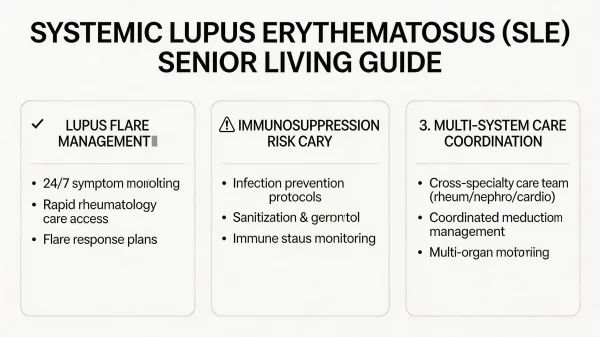
Systemic lupus erythematosus, commonly called lupus or SLE, is an autoimmune disease that can damage the kidneys, joints, heart, lungs, brain, and skin, sometimes all in the same person and sometimes all at the same time. For families watching a parent manage lupus that has already caused organ damage, the question of senior living isn't just about finding a place with friendly staff and nice meals. It's about finding a community that can handle a disease most of their caregivers have never seen before.
That's where this gets confusing. Lupus doesn't behave like most chronic conditions. Your parent might have three good weeks and then a flare that puts them in bed for days, affecting a completely different organ system than the last one did. The care staff who learned your parent's routine during a stable stretch can be caught off guard when a flare changes everything about what your parent needs. I spent years as a caregiver for someone whose condition hit different body systems at different times, and the hardest part wasn't any single symptom. It was the unpredictability. You can't prepare for what you can't predict, and lupus thrives on that uncertainty.
This article walks through what makes lupus different from other conditions in a senior living context, what kind of care your parent actually needs, and how to evaluate whether a community can handle the full scope of SLE. You won't find generic checklists here. You'll find the specific questions, red flags, and considerations that matter when organ damage is already part of the picture.
Multi-System Disease: Why Lupus Can't Be Managed Like a Single Condition
Most chronic conditions that bring a senior into assisted living follow a somewhat predictable path. Diabetes requires blood sugar monitoring and dietary management. COPD requires respiratory support and oxygen management. Lupus doesn't work that way. SLE can affect the kidneys, joints, skin, heart, lungs, and central nervous system, and it can shift between these targets with little warning. A parent who was dealing primarily with joint inflammation last month might develop kidney complications this month and skin flares next month. According to the Lupus Foundation of America, about half of people with SLE will experience inflammation affecting a major organ at some point during the course of their disease.
The kidneys are one of the most common and most dangerous targets. Lupus nephritis, which is kidney inflammation caused by SLE, develops in a significant number of lupus patients and requires careful, ongoing monitoring. According to the American College of Rheumatology's 2024 guidelines, people with lupus nephritis need their proteinuria levels checked at least every three months if they haven't achieved complete kidney response, and every three to six months if they're in remission. They also need regular blood tests for serum creatinine, complement levels, and anti-dsDNA antibodies. That's a level of lab monitoring that most assisted living communities aren't set up to coordinate on their own, and if someone misses those labs or the results don't get flagged, kidney damage can progress toward kidney failure before anyone realizes the decline has accelerated. I've worked in hospitals long enough to see what happens when monitoring falls through the cracks with complex patients. Small delays in catching changes can turn into big problems fast.
Joint involvement adds another layer. Lupus-related arthritis can cause significant pain and reduced mobility, which affects a resident's ability to participate in daily activities, exercise, and even basic self-care. Unlike osteoarthritis, which tends to follow a gradual progression, lupus joint symptoms can flare suddenly and then improve, making it hard for care staff to calibrate the right level of physical assistance from one week to the next.
Then there's the medication balancing act. Most people with organ-damaging lupus take immunosuppressant medications like mycophenolate, azathioprine, or corticosteroids, often in combination. These drugs are necessary to prevent the immune system from attacking the body's own tissues, but they come with a serious trade-off: they suppress the protective immune response too. Research published in Rheumatology found that infection is the leading cause of hospitalization and one of the top causes of death in SLE patients, with nearly half of mortality in elderly lupus patients traced to infections, particularly lung infections. For an older adult living in a community setting where respiratory illnesses can spread among residents, this isn't a theoretical risk. It's a daily concern that requires infection control awareness from every staff member who interacts with your parent.
The heart and brain can also be targets. Lupus can cause pericarditis (inflammation around the heart), increase cardiovascular disease risk, and in some cases, affect cognitive function through neuropsychiatric lupus. Late-onset SLE in particular is associated with significantly more cardiovascular and musculoskeletal damage compared to younger-onset cases. A community caring for a lupus resident needs to understand that the person in room 214 might need completely different care during a flare than during remission, and that those transitions can happen with very little advance notice.
When I was caregiving for my husband through his cancer, I learned something about multi-system disease that I don't think you can fully grasp until you live through it. His condition didn't just stay in one lane. One week we were managing pain, the next we were dealing with nutrition because the feeding tube wasn't working right, and the week after that we were handling an infection because his immune system was compromised from treatment. I had to learn to pivot constantly, to adjust what I was doing based on what his body decided to throw at us that day. That experience shaped how I think about lupus care in communities. The staff who will care for your parent need that same ability to pivot, to read the signals that something has shifted and respond accordingly rather than waiting for a doctor to tell them what changed.
Systemic Lupus Senior Living: Comparing Care Options
Not every senior living setting can handle the complexity of lupus with organ damage. The right fit depends on which organs are affected, how stable your parent's disease is, and how much medical coordination they need day to day.
Consider a situation where your parent has lupus with kidney damage requiring careful fluid and dietary management, joint inflammation that limits their mobility on bad days, and takes immunosuppressant medications that put them at increased infection risk. The family is trying to find a single community that can manage all three of these dimensions at once. That's not a hypothetical edge case. It's what many lupus families are actually dealing with, and it requires a care team that can think across multiple systems simultaneously rather than treating each issue in isolation.
Assisted living communities work best for parents whose lupus is relatively well-controlled between flares, who can manage most daily activities with moderate help, and whose medication regimen is stable. These communities typically provide help with bathing, dressing, meals, and medication reminders. They don't usually have nursing staff on-site around the clock, which matters if your parent's condition can change quickly during a flare.
For parents with active lupus nephritis, significant cardiac involvement, or frequent severe flares, a community with higher-level nursing support may be necessary. Some assisted living communities offer enhanced care or have licensed nurses on staff during all shifts, but you'll need to ask specifically about this during tours. Nursing homes provide 24-hour skilled nursing care and are better suited for parents whose lupus has caused severe functional decline, but the cost difference is substantial, and many families find that an assisted living community with strong medical coordination can bridge the gap if they choose carefully.
What to Look for in a Community That Can Handle Lupus
The difference between a community that can manage lupus and one that can't often comes down to how well they coordinate with outside specialists. Your parent will likely need ongoing relationships with a rheumatologist, nephrologist (if kidneys are involved), and possibly a cardiologist or dermatologist. The community needs a system for getting your parent to those appointments, communicating changes in condition to those specialists, and acting on new orders promptly.
Look for communities that have experience with residents on immunosuppressant medications. This isn't a niche concern. Many communities serve residents taking these drugs for various autoimmune conditions or post-transplant care. Ask about their infection control protocols, how they handle residents who are immunocompromised, and whether they have a process for isolating a resident or limiting exposure when respiratory illness circulates through the community. During my time doing mobile X-ray work in care facilities, I saw how quickly illness could move through a building. For someone on immunosuppressants, that kind of exposure isn't just uncomfortable. It can be dangerous.
Dietary management is another area that matters more than families initially realize. If your parent has lupus nephritis, they may need a renal-friendly diet that restricts sodium, potassium, and phosphorus. Some lupus patients also take corticosteroids that raise blood sugar, meaning the kitchen staff needs to accommodate a diet that manages both kidney health and blood sugar control. Ask the community's dietitian (if they have one) whether they can create individualized meal plans and how they handle residents with overlapping dietary restrictions. A community that offers only standard menu options with limited flexibility may not be the right fit.
The Medication Management Challenge
Lupus medications require precise timing and careful monitoring for side effects. Corticosteroids like prednisone, which many lupus patients take during flares, carry significant risks with long-term use, including bone thinning, weight gain, high blood pressure, and increased infection risk. Immunosuppressants like mycophenolate need regular blood work to check for drops in white blood cell counts that could signal dangerous immune suppression. Hydroxychloroquine, which most lupus patients take as a baseline medication, requires regular eye exams to watch for retinal toxicity.
A good community won't just hand your parent their pills on schedule. They'll track when labs are due, flag missed specialist appointments, and recognize when side effects of medication look different from lupus symptoms. That distinction matters more than it sounds. Fatigue from a lupus flare looks identical to fatigue from anemia caused by immunosuppressant medication, but the response to each is completely different.
Sun sensitivity is another factor that care staff need to understand. Many lupus patients experience flares triggered by UV exposure, and some medications increase photosensitivity further. A community that schedules outdoor activities during peak sun hours without offering alternatives for photosensitive residents hasn't thought through what lupus management actually requires. Ask whether the community can accommodate a resident who needs to avoid prolonged sun exposure, and whether outdoor spaces include shaded areas where your parent can still enjoy fresh air without risk.
Questions to Ask During Community Tours
When you're evaluating a community for a parent with lupus, the standard tour questions won't be enough. You'll need to go deeper. Start with these:
Ask whether they currently have or have had residents with autoimmune conditions that require immunosuppression. Ask how they coordinate lab work and specialist appointments for residents with complex medical needs. Find out who reviews lab results and how quickly changes are communicated to the resident's physicians. Ask about their protocol when a resident on immunosuppressants is exposed to a contagious illness. Ask how they adjust care plans when a resident's condition fluctuates, and how quickly those adjustments happen. Find out whether they have licensed nursing staff on-site during evenings and weekends, not just business hours.
The answers to these questions will tell you more about a community's ability to care for your parent than any brochure or website ever could. If the staff seem unfamiliar with autoimmune conditions or can't describe their process for managing residents whose needs change frequently, that's a red flag worth paying attention to.
Cost Considerations for Complex Lupus Care
Caring for a parent with organ-damaging lupus in senior living will likely cost more than the base rate you see advertised. As of 2025, the national median cost for assisted living is approximately $6,200 per month, or about $74,400 per year, according to CareScout's 2025 Cost of Care Survey. But that's the baseline. For a resident who needs medication management for multiple drugs, help coordinating specialist visits, and a higher level of monitoring during flares, expect additional charges that can push monthly costs to $7,500 or more depending on the community and location.
Communities that use tiered pricing will reassess your parent's care level periodically. During stable periods, your parent might qualify for a lower tier. During flares, they may temporarily move to a higher (and more expensive) one. Ask specifically how the community handles these fluctuations. Some lock in a care level for months at a time, which can mean you're paying for a higher tier long after a flare has resolved. I remember the financial shock when our family first started looking at care costs for a loved one with complex needs. The base price was just the starting point, and every extra service added up faster than we expected. Annual costs easily exceeded $90,000 when you factored in everything.
Medicare doesn't cover assisted living costs. Medicaid coverage for assisted living varies significantly by state, and qualification requires meeting both income and asset limits. Long-term care insurance, if your parent purchased a policy years ago, may cover some or all of the daily cost, but review the policy carefully for exclusions related to pre-existing conditions. Some families also explore Veterans benefits if the parent served in the military, as the Aid and Attendance pension can provide additional monthly income to help offset care costs. A financial planner who specializes in elder care can help you map out which funding sources apply to your parent's situation.
When Home Care Might Be the Better Choice
Senior living isn't always the right answer for every lupus patient. If your parent's organ damage is primarily managed through regular specialist visits and their daily functional needs are moderate, a combination of home care aides and strong specialist coordination might work well. Home care gives your parent more control over their environment, which matters when infection risk is a constant concern. There's no communal dining room where a tablemate's cold could turn into your parent's hospitalization.
Home care also provides more flexibility around flares. During good stretches, your parent might only need a few hours of help per day. During a flare, you can increase those hours without going through a formal care level reassessment process. The national median cost for a home health aide is roughly $34 per hour (as of 2025), so 20 hours per week comes to about $2,720 per month. That's less than the base rate at most assisted living communities, though costs climb quickly if your parent needs full-time support.
The trade-off is that home care puts more coordination responsibility on the family. Someone needs to make sure labs get done, medications are taken correctly, flare symptoms are caught early, and specialist appointments happen on schedule. If that person is you, be honest with yourself about whether you can sustain that level of involvement long-term. I've been the person managing all the moving pieces for a loved one with a complex condition, and the mental load alone can wear you down even when you have help. That's not a failure. It's a realistic assessment of what complex disease management demands.
Making the Decision That Fits Your Family
Choosing senior living for a parent with lupus and organ damage means accepting that no community will be a perfect fit on day one. Lupus requires ongoing education, flexibility, and a willingness from the care team to adjust their approach as your parent's disease shifts. The best community for your parent isn't necessarily the most expensive one or the one with the nicest lobby. It's the one where the staff ask good questions about your parent's condition, where they have a clear process for handling medical variability, and where they treat your parent as a whole person rather than a checklist of symptoms.
Start your search early, before a crisis forces a rushed decision. Tour at least three to four communities, and bring a written list of the specific questions from this article. Talk to the nursing director, not just the marketing team. Ask if you can speak with families of residents who have complex medical conditions. Pay attention to how the community responds when you describe your parent's lupus in detail. A community that listens carefully and asks follow-up questions is already showing you something about how they'll approach your parent's care.
Your parent's lupus is complicated, but finding the right care doesn't have to be impossible. With the right questions and realistic expectations, you can find a community that's equipped to support them through the stable stretches and the hard ones. You're already doing the most important thing by looking into this now.