
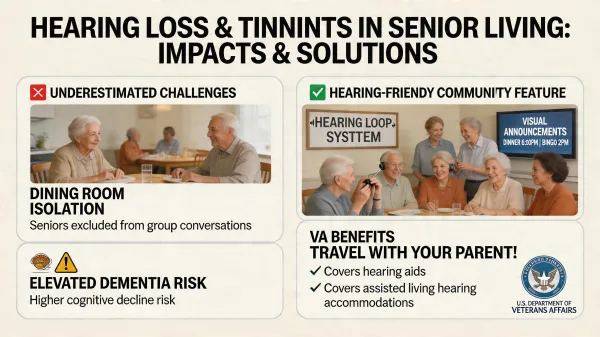
If Dad can barely hear the TV at home, what's going to happen when he's in a dining room with 50 other people? That's the question most families don't ask until they're already touring communities, and by then the emotional momentum is pushing everyone toward a decision that hasn't accounted for hearing at all.
Service-connected hearing loss and tinnitus are the two most common disabilities among American veterans, by a wide margin. More than 3.2 million veterans currently receive disability compensation for tinnitus alone, and well over a million more receive compensation for hearing loss. These aren't rare conditions. If your parent served, the odds are high that he lives with some degree of noise-induced hearing damage, whether he talks about it or not.
Every clinical setting I've worked in, the veteran patients have some level of service-connected hearing loss. It gets called minor, and it isn't. That framing, the idea that hearing loss is an annoyance rather than a medical issue, is exactly what leads families to underweight it when they're evaluating senior living.
This guide walks through what veteran hearing loss and senior living look like together: why communal environments make hearing loss harder, what the research now says about hearing loss and dementia risk, what a hearing-friendly community actually looks like on the ground, and how VA benefits can follow your parent into assisted living. The goal isn't to scare you. The goal is to help you evaluate the next step with a clear picture of what hearing loss really costs once your parent moves.
Service-Connected Hearing Loss in Aging Veterans
Service-connected hearing loss usually traces back to the same sources: artillery, aircraft, heavy machinery, and vehicle engines. Hearing protection was inconsistent for decades, and noise-induced damage to the inner ear is permanent. Most veterans with service-connected hearing loss have sensorineural hearing loss, which hearing aids can help but cannot reverse.
Tinnitus, the ringing or buzzing in the ears that about 15% of American adults experience, shows up in veterans at far higher rates. It often travels alongside hearing loss. The two conditions reinforce each other. The ringing makes it harder to pick speech out of background noise, and the hearing loss makes the ringing feel louder because there's less ambient sound to mask it.
Aging adds a second layer. Presbycusis, the age-related hearing loss most adults develop over 60, stacks on top of existing noise-induced damage. By the time a veteran is considering senior living, his hearing may be significantly worse than the VA rating reflects. Ratings get set once and rarely updated.
The Hidden Cost of Hearing Loss in Communal Living
Here's what most people miss about hearing loss in senior living: it's often the thing that quietly kills a veteran's quality of life, and it's the easiest thing for families to underweight when they're touring. A facility that looks cheerful and active on a Tuesday afternoon tour can feel like a wall of noise to someone who can't separate one voice from another.
The dining room is where this hits first. Senior living dining rooms are acoustically difficult by design: hard floors, high ceilings, 40 to 80 people eating at once, clattering dishes, overlapping conversations. For a resident with moderate-severe hearing loss, the room isn't a place to socialize. It's a place to get through. Many veterans with hearing loss start eating alone in their apartments within a few months of moving in, not because they're depressed but because the dining room is exhausting. Cognitive load compounds that exhaustion. Listening with impaired hearing is work. The brain runs overtime to fill in gaps, guess at words, and piece together meaning. After a full day of that in a noisy environment, a veteran with hearing loss is mentally spent in a way his family doesn't see. Fatigue, irritability, and withdrawal all get read as personality changes or early dementia when they may be straight hearing fatigue.
Then there's the research. The 2024 Lancet Commission on dementia identified hearing loss as the single largest modifiable risk factor for dementia from midlife, estimated to account for about 7% of global dementia cases. Every 10-decibel decrease in hearing ability is associated with a 4 to 24% higher risk of dementia, depending on the study. The ACHIEVE trial, the first large randomized controlled trial on this question, found that in older adults at elevated dementia risk, hearing aids reduced cognitive decline by roughly 48% over three years. Treating hearing loss is now understood as brain health work, not just quality-of-life work.
I've watched a family member's dementia accelerate in ways that the family, including me, wasn't prepared for. Hearing loss was part of that picture long before the diagnosis, and nobody pushed hard enough on the hearing piece early on. It's one of the clearest lessons I've taken from that experience into my clinical work. When I see an older patient in the ER who can't hear well, I think about what the last year has probably looked like at home, and how much the hearing loss may have quietly shaped everything else.
Safety is the fourth layer. A resident who can't hear a smoke alarm clearly, a staff announcement, a nurse call response, or a person approaching from behind is at real risk in a communal environment. The risk compounds at night, when hearing aids come out and ambient cues disappear.
Tinnitus and the Assisted Living Environment
Tinnitus behaves differently in a communal setting than it does at home. At home, your parent controls the sound environment. He knows which chair in the living room has the best acoustics, when the refrigerator hum kicks in, and how loud to run the TV to cover the ringing. In assisted living, all of that goes away. When I see older veterans in the ER, chronic tinnitus comes up in the history more often than most non-clinical people would guess, and the ones who manage it well have usually built their home environment around it over years.
Noisy hallways and thin walls can make nighttime tinnitus worse, because the sleep environment isn't consistent. Many veterans with chronic tinnitus rely on sound machines, fans, or the TV as masking noise to fall asleep. A new apartment with different ambient sound patterns can disrupt sleep for weeks or months, and sleep deprivation worsens tinnitus, which worsens sleep. That feedback loop is brutal.
The VA's approach to tinnitus has shifted toward cognitive behavioral strategies, sound therapy, and hearing aids with built-in tinnitus masking features. If your parent hasn't been seen by a VA audiologist in the past few years, a fresh evaluation before a move is worth the appointment.
What a Hearing-Friendly Community Looks Like
When you're touring, the building won't label itself hearing-friendly. You have to look for specific features. Here's what to evaluate:
- Visual alert systems. Fire alarms, nurse call buttons, and doorbells should have flashing light components, not just audio. Ask whether every resident apartment has them or only "accessible" units.
- Hearing loop (telecoil) technology in common areas. A hearing loop sends audio directly into hearing aids equipped with a telecoil. Dining rooms, activity rooms, chapels, and theaters that are looped are dramatically easier for hearing-aid users. Ask the community whether any common spaces are looped. If they don't know the term, that's an answer.
- Acoustic treatment in the dining room. Look for sound-dampening ceiling tiles, carpeted or rubberized flooring, fabric seating, and smaller dining clusters rather than one giant hall. Ask what the dining room sounds like at peak times. A community that offers smaller dining pods of 6 to 10 people is worth a closer look.
- Staff training on communicating with hearing-impaired residents. Facing the resident, getting attention before speaking, slowing down without over-enunciating, and rephrasing rather than repeating. Ask specifically how new staff are trained on this and whether it's refreshed. Generic answers usually mean it isn't.
- On-site or visiting audiology access. A resident who has to leave the building for every hearing aid adjustment often stops going. Ask whether audiologists visit the community, whether there's a preferred provider the community coordinates with, and how routine issues like wax guards and battery replacement are handled.
- Quiet zones and small-group programming. Group activities of 6 to 12 people are manageable for most hearing-aid users. A 40-person bingo hall with a single microphone is not. Look for a calendar that includes smaller groups, book clubs, and one-on-one activities.
- Captioned TV in common areas. Most communities have TVs running all day with no captions on. A small detail, but it tells you whether the culture takes hearing loss seriously.
Walk the hallways during a meal. Sit in the dining room for 10 minutes. If you can't carry on a normal conversation with your parent in that environment, a resident with hearing loss can't either. I've done enough mobile X-ray work inside care facilities to know that the marketing tour and the actual sound of a building on a random Wednesday can be two different things. Try to see the building when it's busy.
VA Hearing Benefits That Move With Your Parent
VA hearing aid benefits follow the veteran, not the building. If your parent is enrolled in VA healthcare and has any service-connected disability rating, he qualifies for hearing aids at no cost. Veterans who are service-connected for hearing loss, tinnitus, or ear disease at any percentage qualify automatically, including at a 0% rating. That 0% rating is still a qualifying rating for care.
The VA covers the devices, fittings, batteries, repairs, wax guards, accessories, and follow-up appointments. Batteries are ordered by mail every six months through the Denver Acquisition and Logistics Center. If your parent has VA-issued hearing aids that haven't been serviced in years, a pre-move audiology appointment is worth scheduling. The devices have likely drifted from the settings he actually needs now.
If your parent hasn't filed a claim for service-connected hearing loss or tinnitus, it's worth looking into. Establishing service connection later in life is harder than it was in the post-discharge window, but it can still be done with a medical nexus opinion and a clear in-service noise exposure history.
Questions to Ask When Touring a Community
Standard community tours won't surface hearing-related information unless you ask directly. Bring a short list and expect the marketing director to get some of the answers wrong. That's useful data too.
Ask how many current residents use hearing aids and whether the community tracks that. Ask whether any common spaces have a hearing loop. Ask what happens if a resident can't hear the fire alarm. Ask whether staff receive training specifically on communicating with hearing-impaired residents, and who does that training. Ask whether an audiologist visits the community, and how often. Ask whether there are smaller dining rooms or quieter meal times available. Ask whether the community has helped coordinate VA audiology appointments for other veterans.
If the answers are vague, that's the answer. Communities that actually serve hearing-impaired residents well can describe what they do.
Common Questions Families Ask
Does Medicare cover hearing aids for my parent if VA benefits aren't an option? Traditional Medicare doesn't cover hearing aids or routine hearing exams. Some Medicare Advantage plans include partial hearing aid benefits. Medicaid coverage varies significantly by state.
Will assisted living staff help my parent put in and care for his hearing aids? Most communities will assist with basic hearing aid insertion and battery changes if it's added to the care plan, but the level of competence varies widely. Ask specifically during the care assessment.
What if my parent refuses to wear his hearing aids? This is common and frustrating. Comfort issues, feedback problems, and settings that haven't been updated often explain the resistance. A current VA audiology evaluation frequently solves what looks like stubbornness.
Is memory care a better fit if hearing loss is severe? Not usually. Memory care is designed for cognitive impairment, not sensory impairment. A veteran with severe hearing loss and intact cognition typically does better in assisted living with the right hearing-friendly features than in a more restrictive memory care environment.
How do I know if hearing loss is contributing to what looks like cognitive decline? Start with a current audiology evaluation. If hearing has degraded significantly since the last test, correcting it should be the first move before any dementia workup.
Framing the Decision
Hearing loss doesn't make senior living the wrong choice for your parent. It makes the specific community you choose matter more than most families realize. A well-designed community with trained staff and good acoustics can actually improve a hearing-impaired veteran's social engagement, because home can be isolating in ways families don't see. A poorly-designed community will accelerate the isolation your parent is already experiencing.
The decision isn't whether to move. It's whether the building you're considering is set up for the hearing he actually has, not the hearing he had ten years ago. Walk the dining room at lunchtime. Ask about loops and alerts and staff training. Get a current VA audiology evaluation on the calendar before the move. Take the hearing piece as seriously as the mobility piece or the medication piece, because over time it shapes quality of life more than most families expect.
You're not overthinking any of this. These are the right questions to be asking, and your parent needs you to be asking them right now.