
Your mother is sitting on the living room floor with her granddaughter, trying to pick up a tiny plastic toy horse from the carpet. Her fingers won't close around it. She tries again, pressing harder, adjusting her grip, but the skin across her knuckles is tight and shiny, and the joints barely bend. She laughs it off, but you can see the frustration behind the smile. That small moment tells you more about where things are heading than any doctor's visit has so far.
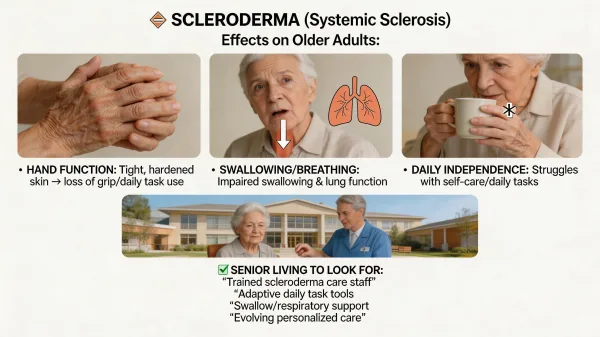
Scleroderma, also called systemic sclerosis, is an autoimmune disease that causes the body to overproduce collagen, hardening the skin and connective tissue over time. For older adults living with this condition, the changes go far beyond appearance. The same fibrotic process that tightens the skin on the hands and face can also damage the esophagus, lungs, blood vessels, and digestive tract. What starts as stiff fingers or difficulty opening jars can progress to serious challenges with eating, breathing, and getting through basic daily tasks without help.
For families watching a parent's body gradually stiffen and tighten, the question isn't just about the diagnosis. It's about what daily life looks like now, what it will look like in six months, and when the right time comes to consider a care environment that can keep up with the disease. Having spent years caring for people with very different physical limitations, I know that understanding how a condition changes someone's daily routine is the first step toward finding the right kind of support. This article breaks down the specific ways scleroderma affects independence in older adults and what to look for in a scleroderma senior living community that can meet those needs.
What Families Should Know About Scleroderma
Systemic sclerosis affects roughly 70,000 to 100,000 people in the United States, according to the Scleroderma Research Program and the National Scleroderma Foundation. It occurs about four to five times more often in women than men, and onset is most common between ages 40 and 60. The disease is classified into two main types: limited cutaneous, which primarily affects the skin on the hands, face, and lower arms, and diffuse cutaneous, which spreads more widely and tends to involve internal organs earlier and more aggressively.
Both types can cause Raynaud's phenomenon, a vascular condition present in 80% to 90% of scleroderma patients where blood vessels in the fingers and toes overreact to cold or stress, turning white, blue, and then red. In scleroderma, Raynaud's can lead to painful digital ulcers and tissue damage that further limits hand use. For families, the visible skin changes often come first, but the internal progression is what ultimately drives the need for more structured daily support. Systemic sclerosis also carries the highest mortality rate of any systemic autoimmune disease, with interstitial lung disease as the leading contributor to disease-related death.
When the Body Hardens: How Scleroderma Transforms Daily Function
The hallmark of scleroderma is fibrosis, the gradual replacement of healthy tissue with dense, inflexible collagen. In the hands, this process thickens the skin and subcutaneous tissue, tightens the tendons and palmar structures, and creates contractures that pull the fingers into a curled, claw-like position. Research published in the Scandinavian Journal of Rheumatology found that scleroderma patients experienced grip force reduced to 46% to 65% of normal values, with dexterity dropping to 68% to 80% compared to healthy individuals. Finger flexion and extension were the most severely impaired aspects of hand mobility. Over time, the metacarpophalangeal joints lose extension while the smaller finger joints curl inward, producing what clinicians describe as a claw-type deformity that makes nearly all fine motor tasks difficult or impossible without assistance.
What that looks like in daily life is a parent who can't button a shirt, grip a fork firmly enough to eat without dropping food, turn a doorknob, or open a medication bottle. Picking up coins, holding a pen, using a phone, or pulling up a zipper all become tasks that require help or adaptive tools. The skin across the fingers becomes so tight and shiny that the joints lose their normal range of motion, and the stiffness tends to worsen over time rather than stabilize. I've cared for people whose physical limitations changed the way they did almost everything, and the hardest part for them was always the loss of tasks they used to do without thinking. A parent with scleroderma goes through that same experience as their hands slowly stop cooperating with what their brain is telling them to do.
Facial involvement adds another dimension to the daily challenges that families may not anticipate until they see it happening. The skin around the mouth can tighten enough to reduce the oral opening, making it harder to eat, brush teeth, or even smile naturally. Some patients also develop dry mouth due to salivary gland involvement, which compounds the difficulty of chewing and swallowing. These changes affect both function and self-image in ways families don't always anticipate, and they often make dental care harder to maintain at the exact time oral health matters most.
Raynaud's phenomenon complicates scleroderma hand function further because cold temperatures or even mild drafts can trigger vasospastic episodes where blood flow to the fingers drops sharply, causing numbness, pain, and color changes that last minutes to hours. For seniors in care environments, this means climate control matters enormously. Air conditioning set too low, cold handrails, or a drafty dining room can trigger attacks that make already-limited hands completely unusable. Managing Raynaud's in scleroderma daily living involves keeping the whole body warm (not just the hands), avoiding sudden temperature changes, wearing layers and gloves even indoors when needed, and keeping chemical hand warmers readily accessible.
The esophagus is the most commonly affected part of the GI tract, with gastrointestinal involvement present in roughly 90% of systemic sclerosis patients. The same fibrotic process that hardens the skin replaces the smooth muscle of the esophagus with scar tissue, weakening the ability to move food downward and reducing the strength of the valve between the esophagus and stomach. About half of patients develop significant acid reflux or difficulty swallowing. Food may feel stuck in the throat, meals take longer, and the risk of aspiration increases, particularly when lying down too soon after eating. Gastroparesis, where the stomach empties too slowly, can cause nausea, bloating, early fullness, and poor nutrition that leads to gradual weight loss the family may not notice until it becomes significant.
Lung involvement is the complication that families need to take most seriously. Interstitial lung disease affects approximately 40% of people with systemic sclerosis and is the leading cause of disease-related death. Scarring in the lung tissue reduces the ability to exchange oxygen, causing progressive shortness of breath that starts with exertion and eventually affects rest. A parent who used to walk the hallway comfortably may need supplemental oxygen or frequent rest breaks within a year or two of pulmonary symptoms appearing. Pulmonary arterial hypertension, where the blood vessels in the lungs stiffen and narrow, is another serious complication. Standard finger oximetry can actually be unreliable in scleroderma patients because Raynaud's affects peripheral circulation, so care teams may need to use earlobe or forehead probes for accurate readings.
Adaptive equipment for scleroderma goes well beyond built-up utensil handles and jar openers, though those help considerably. Lever-style door handles, electric can openers, button hooks, zipper pulls, rocker knives, weighted utensils, and heated gloves all support hand function. Raised toilet seats, grab bars, and walk-in showers reduce the fall risk that comes with stiff joints and poor grip strength. For scleroderma swallowing difficulties, modified food textures and upright positioning during and after meals are practical adjustments any good care environment should accommodate.
What Families Often Underestimate About Scleroderma
Most families notice the skin changes first because they're visible and striking. The hands look different and the face seems tighter. But what catches families off guard is that the same hardening process is happening inside the body where no one can see it. The lungs are slowly scarring, the esophagus is losing its ability to push food down, and blood vessels are narrowing in ways that don't produce obvious symptoms until the damage is well advanced.
This matters for senior living decisions because the external symptoms don't always match the internal reality. A parent may look relatively mobile but be struggling significantly with eating, breathing, or digestion. Families who focus only on what they can see risk choosing a care level that doesn't address the complications developing beneath the surface. A thorough assessment from the community should include questions about scleroderma swallowing difficulties, breathing capacity, and GI symptoms, not just mobility and hand function. I've seen families caught off guard when a condition progressed faster internally than anyone expected, and with scleroderma, that pattern is common enough that it should shape how you evaluate care options from the very start.
Scleroderma and Senior Living: Choosing the Right Care Environment
Not every scleroderma assisted living community is equipped to support the specific needs of a resident with systemic sclerosis. The combination of hand limitations, swallowing difficulty, lung involvement, and temperature sensitivity means the care team needs to understand the condition well enough to anticipate problems, not just respond to them after something goes wrong.
From my years working inside hospitals, I saw how often care teams defaulted to standard protocols that didn't account for unusual or uncommon conditions. Scleroderma requires that kind of individualized, condition-specific attention.
Look for communities where staff can assist with fine motor tasks like dressing, grooming, and meal preparation without rushing the resident or taking over entirely. The goal is to preserve as much independence as possible while filling the gaps the disease creates. Communities with on-site or closely coordinated occupational therapy are especially valuable because OT professionals can recommend specific adaptive tools and hand exercises that help maintain remaining function for as long as possible. Temperature-controlled environments with consistent heating and minimal cold drafts are practical priorities that matter far more for systemic sclerosis care than for most other conditions residents might have.
Care Environment Adaptations That Preserve Dignity
The right adaptations aren't just about physical function. They're about helping your parent feel like themselves even as the disease changes what their body can do. A care environment that understands scleroderma will offer modified dining options, including softer textures, smaller portions, and upright seating, without making the resident feel singled out. They'll provide adaptive utensils as a standard option at meals, not something that has to be specially requested each time.
Having spent much of my life caring for people whose abilities didn't match what others expected, I learned early on that the way you provide help matters as much as the help itself. When you grow up in caregiving and then spend years working with patients in clinical settings, you see the difference between care that respects someone's autonomy and care that quietly takes it away. The best scleroderma care setups are the ones where the adaptation is built into the routine, not added as an afterthought. When a resident doesn't have to ask for help opening every container, turning every knob, or cutting every piece of food, their dignity stays intact even as the disease progresses. That kind of environment doesn't just accommodate a condition. It sees the person living with it.
The Cost of Systemic Sclerosis Care in Senior Living
As of 2025, the national median cost for assisted living is approximately $6,200 per month, or $74,400 per year, according to the CareScout Cost of Care Survey. For a resident with scleroderma who needs higher-level personal care assistance with dressing, eating, grooming, and medication management, additional charges can push monthly costs well above that baseline. Communities that use tiered pricing may place a scleroderma resident at a higher care level from the start because of the number of daily living activities affected.
That adds up fast. If your parent also needs occupational therapy, pulmonary monitoring, or specialized dietary accommodations, those costs layer on top of the base rate. Some families find that the total monthly bill runs $8,000 to $10,000 or more depending on location and care intensity, which translates to $96,000 to $120,000 per year. I remember the financial shock when our family first looked at long-term care costs for a loved one's progressive condition, and nothing prepares you for seeing those numbers on paper. Starting the financial conversation early matters more than most families realize.
Planning for systemic sclerosis elderly care means budgeting not just for where your parent is today but for where the disease is likely to take them over the next one to three years. Long-term care insurance, Medicaid waiver programs (which vary significantly by state), and VA Aid and Attendance benefits for qualifying veterans are all worth investigating before the financial pressure becomes urgent.
Questions to Ask When Evaluating Senior Living Communities
Families evaluating communities for a parent with scleroderma should go beyond the standard tour questions. Ask how the community handles residents who need help with fine motor tasks throughout the day, not just at scheduled care times. Ask whether the dining program can accommodate modified food textures and extended meal times for residents who eat slowly due to scleroderma swallowing issues or hand limitations. Ask about climate control in individual rooms and common areas, and whether staff understand Raynaud's phenomenon and know how to respond when an episode happens.
Find out if the community has experience with autoimmune conditions or chronic progressive diseases that affect multiple body systems simultaneously. Ask about their relationship with rheumatology and pulmonology specialists, and whether they coordinate directly with those providers or leave scheduling and follow-through to the family. Most importantly, ask what happens as care needs increase over time. Does the community offer higher levels of care on-site, or would your parent need to relocate to a different facility? Scleroderma doesn't stay static, and a care plan that works today may need significant adjustments within a year or two as the disease continues to progress.
Supporting Your Parent Through a Changing Body
Watching scleroderma change your parent's hands, face, and ability to do everyday things is one of the more difficult experiences a family can go through. The disease is relentless in a quiet way, taking a little more function each month without the kind of dramatic episodes that signal it's time to act. That gradual pace makes it easy to wait too long before getting the right level of help in place.
Pay attention to the small losses: the jar they stopped trying to open, the meals they're picking at instead of finishing, the shortness of breath on the walk from the parking lot to the front door. Those small changes carry real information about where your parent is in the disease process and how quickly things are shifting. When the time comes to explore senior living options, look for a community that sees your parent as a whole person with a life that matters, not just a list of limitations to manage. The right environment won't just keep them safe. It will help them hold onto the parts of their daily life that still feel like theirs. You're already taking the right step by learning about this now.