
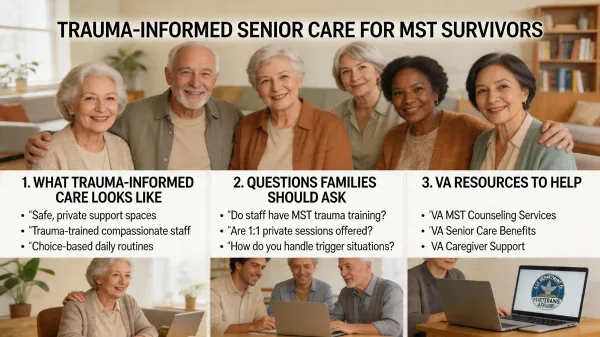
This article discusses military sexual trauma (MST) and its long-term effects on survivors as they age into senior care settings. It's written for informational and decision-support purposes, not as medical or mental health advice. Survivors experiencing distress can reach the Veterans Crisis Line at 988, then press 1, available 24/7. Free MST-related care is available through the VA regardless of discharge status, era of service, or whether the experience was ever reported.
The community looked right on paper. Bright, clean, a warm admissions director, a dining room that didn't smell like a nursing home. Then, halfway through the tour, the daughter noticed something the brochure hadn't mentioned: the assisted living community used a communal bathing room for residents who needed help. Two stations, a privacy curtain, and a bath aide assigned by the day's schedule. For most families, this is a logistical detail. For this family, it was the thing that made her walk back to the car and sit with her 74-year-old mother in silence.
Her mother is a Navy veteran who survived military sexual trauma in the 1980s. She didn't report it. She didn't talk about it for thirty years. When she finally did, it was quietly, to her daughter, over a kitchen table. Now she's starting to need help with bathing and dressing, and the family is trying to figure out how to find a community that won't reopen something she's spent most of her adult life managing.
This is the part of senior living planning that most brochures don't cover. MST survivors, of all genders, carry experiences that don't disappear with age. Communal bathing, male staff in intimate care roles, shared bedrooms in rehab, night checks by unfamiliar aides, locked memory care units; any of these can reactivate symptoms survivors have worked hard to manage. This guide is written for families like that one, trying to find care that supports an aging survivor rather than compounding what they've already lived through.
Why MST Matters in Senior Living Decisions
Military sexual trauma is the VA's term for sexual assault or threatening sexual harassment experienced during military service. About 1 in 3 women veterans and 1 in 50 men veterans in VA care report experiencing MST, according to the VA's National Center for PTSD. Because men vastly outnumber women in the military, nearly 40% of veterans who disclose MST to the VA are men, even though the percentage is higher among women.
Many of today's aging veterans served in eras when reporting was harder or actively discouraged. A 74-year-old woman who served in the 1970s or 80s lived through a culture that frequently blamed or dismissed survivors. A male survivor from that same era faced even steeper stigma and was less likely to ever seek care. The result is a generation of older adults who have often lived with the effects of MST privately for decades. Some built coping strategies that worked in their own homes. Those strategies can collapse in a care environment they don't control. I've taken care of patients in their seventies and eighties who I could tell were carrying something they'd never told anyone, and in a hospital setting there's rarely time or privacy to ask.
How MST Symptoms Can Resurface in Senior Living
Research from the National Center for PTSD shows that older adults may experience a re-emergence or worsening of trauma symptoms as they age, and the reasons are layered. Loss of autonomy, unfamiliar medical settings, and increasing dependence on others for personal care can all function as triggers. Retirement, the death of a spouse, and social isolation remove the routines and relationships that survivors often used to keep symptoms at bay. Cognitive decline adds another layer. As short-term memory fades, long-term memories, including traumatic ones, can become more vivid and less filtered, and the usual cognitive tools survivors used to redirect intrusive thoughts stop working as reliably. A 2020 review found that up to 10% of veterans in VA Community Living Centers have both PTSD and dementia diagnoses, and a full third of older veterans in those settings have a PTSD diagnosis of some kind. Those numbers aren't theoretical. They're the real prevalence of unresolved trauma in the long-term care population.
What this can look like in a care setting: sudden refusal of showers, panic during medical exams, resistance to certain staff members, nightmares, withdrawal, or unexplained agitation during personal care routines. Staff who don't understand the history often label these behaviors as "combative" or "non-compliant." They're usually trauma responses. I've watched elderly patients in the ER get labeled difficult for pulling away from a stranger's hands, when what they were actually doing was protecting themselves from something no one in the room knew about. The staff meant no harm. They just weren't trained to see it.
What Trauma-Informed Senior Living Actually Means
"Trauma-informed" has become a marketing phrase in senior care, used freely by communities that haven't actually changed their practices. Genuine trauma-informed care is an organizational approach, not a logo on the website. It draws from the Substance Abuse and Mental Health Services Administration (SAMHSA) framework, which outlines six principles: safety, trustworthiness and transparency, peer support, collaboration, empowerment and choice, and cultural and gender humility. In a senior living setting, those principles translate into specific, observable practices.
Staff training is the first and clearest marker. A trauma-informed community trains every employee who has resident contact, not just the nurses. That includes the bath aides, the dining room staff, the housekeepers, and the night shift. Training covers what trauma is, how it presents in older adults, why a resident might flinch during personal care, and how to respond without escalating. One-time onboarding isn't enough. Strong programs include annual refreshers and scenario-based practice. When you tour a community, you can ask directly: who trains your staff on trauma-informed care, how often, and what does the curriculum cover?
Privacy and bathing protocols are where trauma-informed practice becomes most concrete. Genuinely trauma-informed communities offer private bathing rooms, not communal setups with curtains. They give residents real choice over the gender of the aide providing intimate care. They let residents set the pace, with no rushing through a shower schedule. Staff knock before entering rooms and wait for a response. They announce what they're about to do before they do it. They ask permission before touching, even for routine care like helping with buttons or shoes.
Same-gender care preferences are honored as a policy, not a favor. For many MST survivors, having a male aide in the bathroom, the bedroom, or during a toileting task can trigger severe distress, even decades later. Some male survivors have the opposite preference. A trauma-informed community builds staffing flexibility into its schedule so a resident's preference can actually be met, including on weekends, on overnight shifts, and when the usual aide is out. They also avoid tokenism. Promising a female aide, then assigning one who can only cover partial shifts, isn't honoring the request.
Environmental design matters more than most families realize. Predictable routines reduce hypervigilance. Clear signage helps residents orient themselves without asking staff. Locked memory care units can feel like confinement to a trauma survivor, so good communities think carefully about how to balance safety with autonomy. Noise levels, lighting, and the layout of shared spaces all affect how safe a resident feels day to day.
I've spent nearly twenty years working inside hospitals, and I've seen how quickly a clinical setting can retraumatize someone who isn't expecting it: a curtain pulled too abruptly, a gown handed over without explanation, a male tech entering a room without warning. Senior living isn't a hospital, but the same dynamics apply to daily care. I did extensive research on trauma-informed senior living for this article, because survivors deserve care that doesn't compound what they've already lived through, and because most families have no idea what questions to even ask. The good communities exist. They're not the default, and they usually don't advertise themselves loudly. Finding them takes deliberate effort.
Special Considerations for Rehab and Hospital Stays
Short-term rehab after a hospitalization is often where survivors encounter the most distress. Shared rooms, rotating staff, and unfamiliar routines combine in a way that can destabilize someone who'd been managing fine at home. Families frequently don't realize rehab is coming until discharge planning begins, which leaves little time to research.
When possible, request a private room during admission. Medicare may not cover the upgrade, but the out-of-pocket cost is often worth it for a survivor. Ask the rehab facility whether same-gender care is available for bathing and toileting. Find out if the admissions paperwork includes a section on trauma history, and if not, ask to add it as a note in the chart. A short written statement from the family, shared with the care team, can prevent retraumatization during shift changes when staff turnover makes verbal handoffs unreliable. I've worked enough shift changes in hospitals to know how much gets lost between outgoing and incoming staff, even when everyone is doing their best.
Questions to Ask, Warning Signs to Notice
The admissions tour is where families get the clearest signal of whether a community takes trauma-informed care seriously. Most admissions directors are trained to sound reassuring. Specific questions cut through that quickly. Here's what to ask:
- How is your staff trained on trauma-informed care? A strong answer names a curriculum, a trainer, and a frequency. A weak answer is "we take it very seriously."
- Can a resident request same-gender aides for all personal care, and is that honored on every shift? Listen for whether the scheduler builds around preferences or treats them as exceptions.
- What does bathing look like here? Private rooms or communal setup? Ask to see the actual bathing area.
- How do you handle a resident who refuses a shower or personal care? A trauma-informed community describes de-escalation, not persuasion tactics or documentation of non-compliance.
- Do you have residents who are veterans, and does your team have experience with MST or PTSD? Familiarity matters. So does the willingness to say no.
- Can I see your policy on same-gender care preferences in writing? Written policy is stronger than verbal reassurance.
- What happens at night? Who does room checks, and how? Night staff is often where trauma-informed practice falls apart.
Warning signs during a tour are often subtle. Watch how staff interact with residents in hallways. Do they knock before entering rooms on the tour? Do they announce themselves, or do they walk in and start talking? Watch the body language of residents who see staff approach. A resident who flinches, goes still, or looks away is telling you something the brochure won't. I've learned to trust those small signals over any written policy, because they tell you how the place actually runs when no one is selling you anything.
Listen to how the admissions coordinator describes difficult situations. If they talk about "managing" residents, "redirecting" behavior, or "compliance," that's a clinical-control mindset, not a trauma-informed one. If they describe getting to know residents, building trust, and adjusting care plans based on what a resident needs, that's closer to what you're looking for.
Also pay attention to staffing ratios and turnover. Trauma-informed care depends on relationships, and relationships depend on continuity. A community where the same aides have worked for years is far more likely to deliver consistent, survivor-sensitive care than one with constant turnover. Ask directly: what's your staff retention rate, and how many of your aides have been here more than a year?
Once your parent has moved in, advocacy doesn't end. Build a direct relationship with the Director of Nursing and the care coordinator. Put specific preferences in writing and request they be added to the care plan. If something goes wrong, document it the same day. Patterns matter more than single incidents, and written records give you standing if you need to escalate.
VA Resources Many Families Don't Know About
Every VA medical center has a designated MST Coordinator whose job is to connect survivors with services. Free MST-related mental health and medical care is available through the VA regardless of discharge status, era of service, or whether the experience was ever officially reported. A service-connected disability rating isn't required. This care is available even for veterans who don't qualify for other VA benefits.
Vet Centers, which operate separately from VA medical facilities, offer free and confidential MST counseling at more than 300 locations nationwide. They often have nontraditional hours that work better for older veterans. The VA also offers the Beyond MST mobile app, a free self-help tool created specifically for MST survivors, with no account required and no information shared with the VA.
For families considering VA options for long-term care, VA Community Living Centers (CLCs) are VA-operated nursing homes with integrated mental health clinicians and some trauma-informed protocols in place. State Veterans Homes are another option, though their approach to trauma-informed care varies widely. A VA social worker can help evaluate which options fit your family's situation.
Where This Gets Hard
Here's the reality most families figure out the hard way: most senior living communities aren't trauma-informed in any meaningful way. Staff training on trauma is often a single onboarding video. Same-gender care is treated as a scheduling inconvenience rather than a care need. Communal bathing is normalized, and privacy is framed as a luxury. Good communities exist, but they're not the industry standard, and they rarely market themselves as trauma-informed because the term has been watered down.
That means families and survivors often have to advocate hard for reasonable accommodations, and sometimes advocate repeatedly with new staff, new shifts, and new situations. That's exhausting. It can also feel like the survivor is being difficult, when what they're actually doing is protecting themselves. Families who name the reality out loud, rather than pretending a community is better than it is, tend to end up with better outcomes. Hard conversations with admissions directors early are easier than emergency conversations after a crisis.
After the Move: Ongoing Advocacy
Settling in is the period families most often underestimate. The first 30 to 60 days determine whether trust gets built or eroded. Visit often during this window, at different times of day, so you see how the community operates on a Tuesday afternoon and a Saturday night, not just during tours. Get to know the aides by name. Attend the first care plan meeting and bring specific requests in writing. If a shift change brings new staff who haven't been briefed, speak up the same day, not the next week.
Ask for a single point of contact on the care team, someone who can flag changes and know the resident's history. That continuity, more than any policy document, is what makes ongoing care feel safe. If the community uses an electronic health record, request that trauma history and care preferences appear in the alerts section so they're visible at every shift handoff, not buried in an intake note no one reads.
Build a relationship with at least one person on the night shift too. Overnight hours are when most trauma-related disruptions happen, and overnight staff often don't attend care plan meetings. A quick introduction and a shared written summary of preferences can prevent a hard situation from turning into a crisis.
A Final Word for Families and Survivors
Finding senior living that supports an aging MST survivor is harder than it should be. The industry has a long way to go before trauma-informed care is the default rather than the exception. In the meantime, informed families can do a lot. Asking the right questions, watching for the right warning signs, and building relationships with the care team after move-in all make real differences in a survivor's daily experience.
If you're a survivor reading this yourself, or the adult child of one, know that your concerns aren't overblown. They're clinically grounded, and they deserve to shape the care decisions you make. The VA has resources. Good communities exist. And the work you're doing to find the right fit, even when it feels overwhelming, is the kind of advocacy that changes how someone experiences the last chapters of their life. That matters more than any brochure can tell you.