
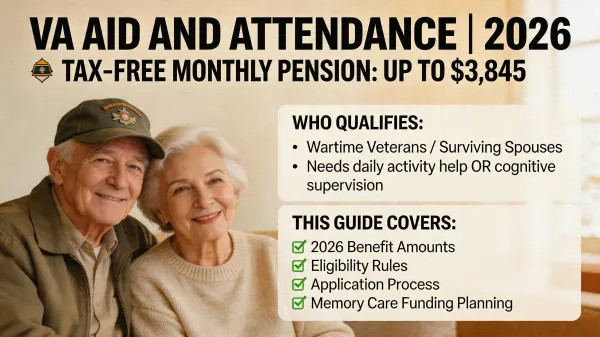
How much is Aid and Attendance actually worth in 2026, and does your parent qualify? Those two questions drive thousands of families to this benefit every month, and the honest answer is that most of them leave money on the table because nobody explains the rules clearly. A qualifying married veteran can receive up to $2,874 per month in tax-free pension income. A single veteran can receive up to $2,424. A surviving spouse can receive up to $1,558. When two veterans are married to each other and both qualify, the ceiling climbs to $3,845 per month. For a family writing $8,500 checks to a memory care community every month, those numbers make a real dent.
VA Aid and Attendance isn't a household name the way Medicare is, and the VA doesn't exactly run commercials about it. I've researched this benefit extensively for this cluster and over years of helping family members and friends try to figure out what they qualified for. What I've seen, repeatedly, is families leave A&A money on the table because nobody told them how to qualify. This article is the one I wish someone had handed me.
This guide walks through the 2026 benefit amounts, the three qualification tests the VA uses, how A&A interacts with memory care bills and Medicaid, how to apply without sabotaging your own claim, and the honest picture of when to use a Veterans Service Organization versus a paid attorney. The figures here reflect the cost-of-living adjustment that took effect December 1, 2025 and runs through November 30, 2026.
What Is VA Aid and Attendance in 2026?
VA Aid and Attendance is a tax-free monthly pension paid to qualifying wartime veterans and surviving spouses who need help with daily activities or supervision due to cognitive impairment. It is an add-on to the basic VA Pension, not a separate program. For 2026, maximum monthly amounts range from $1,558 for a surviving spouse to $3,845 for two married veterans who both qualify.
A&A is needs-based. It isn't tied to service-connected disability, and your parent doesn't need a combat record to qualify. What matters is wartime service, income and assets below the VA's limits, and a documented medical need for assistance. The money arrives by direct deposit, can be used for any purpose the family chooses, and doesn't need to be paid back. That last detail matters. A&A is a pension benefit, not a loan, and it doesn't create a claim against the estate the way Medicaid estate recovery can. It can also be used flexibly: to pay a family caregiver, fund adult day programs, cover in-home help, or offset the monthly bill at an assisted living or memory care community. The VA doesn't dictate where the money goes once it lands in the account.
2026 Aid and Attendance Benefit Amounts and Eligibility Rules
The VA sets a ceiling called the Maximum Annual Pension Rate (MAPR) for each household category. Your actual benefit equals the MAPR minus your countable income, divided by twelve. Someone with zero countable income receives the full MAPR. Someone with income equal to the MAPR receives nothing. The 2.8% cost-of-living adjustment that took effect December 1, 2025 lifted every category by a few hundred dollars per year compared to 2025.
2026 MAPR Amounts
For a veteran with no dependents who qualifies for A&A, the 2026 MAPR is $29,093 per year, which works out to $2,424 per month. A veteran with a dependent spouse or child receives $34,488 per year, or $2,874 per month. Two veterans married to each other who both qualify for A&A reach the top tier at $46,143 per year, or $3,845 per month. A surviving spouse with no dependents receives up to $18,697 per year ($1,558 per month), and a surviving spouse with one dependent child receives up to $22,304 per year ($1,858 per month). These amounts are verified from the VA.gov pension rate tables for the benefit year running December 1, 2025 through November 30, 2026.
The Three Qualification Tests
Every A&A claim has to clear three hurdles: service, medical, and financial. Missing any one of them ends the claim.
Service requirement. The veteran must have served at least 90 days of active duty, with at least one day during a VA-recognized wartime period (WWII, Korea, Vietnam, Gulf War), and received a discharge other than dishonorable. Veterans who entered service after September 7, 1980 generally need at least 24 months of active duty or the full period they were ordered to serve. Surviving spouses must have been married to the veteran for at least one year before death, or any length of time if they had a child together.
Medical requirement. The veteran or surviving spouse must need assistance with daily activities (bathing, dressing, feeding, toileting), be bedridden, live in a nursing home due to disability, or have severely limited eyesight. For families dealing with dementia, the cognitive supervision standard is the usual path. A person who can't be left alone safely, who needs reminders to eat or take medication, or who has wandered outside unsupervised typically meets this bar once documented properly.
Financial requirement. For 2026, the net worth limit is $163,699. Net worth combines countable assets and annual income. The primary residence (plus up to two acres) and one vehicle are excluded. Income counts before Medicare deductions, including Social Security, pensions, retirement distributions, and investment earnings. The VA then allows unreimbursed medical expenses (UMEs) above 5% of MAPR to reduce countable income, which is why many middle-income families still qualify once memory care costs are factored in.
The Three-Year Look-Back
Since October 18, 2018, the VA reviews asset transfers made in the 36 months before the claim filing date. Transfers made for less than fair market value during that window can trigger a penalty period of up to five years, during which no benefits are paid. The penalty period rate in 2026 is $2,874. This is where families get into trouble when well-meaning relatives suggest "just gift the money to the kids." That gift can shut off A&A for years.
Watching a family member's dementia accelerate taught me how fast this decision window closes. One month the family is researching options, the next month the diagnosis is confirmed and the care bills are real, and somewhere in between the financial picture has to be sorted out without making decisions that disqualify the veteran from a benefit they've earned. Families in this situation often discover the look-back rule only after they've already moved money, and by then the options have narrowed. If your parent is a wartime veteran and dementia is in the picture, the time to understand these rules is before assets move, not after.
Required Documentation
At minimum, the VA needs the veteran's DD-214 or equivalent discharge paperwork, proof of wartime service dates, a marriage certificate (and death certificate for a surviving spouse claim), financial documentation covering income and assets, and VA Form 21-2680 completed and signed by a licensed medical doctor. A nurse practitioner or physician's assistant signature on the 21-2680 will often trigger a denial or a request for a corrected form. Residents of licensed memory care or assisted living communities should also include VA Form 21-0779, which documents that the facility provides custodial care.
How Aid and Attendance Interacts With Memory Care Costs
Memory care in 2026 commonly runs $7,000 to $10,000 per month in most metro areas. A&A helps, but it's rarely the whole answer. Understanding how the math actually works changes how families plan.
The A&A Plus Private Pay Math
Take a realistic example. Your father is a Vietnam-era veteran with a dependent spouse. His MAPR is $34,488. His Social Security and pension total $40,000 per year in gross income, which on paper puts him over the MAPR limit. But his memory care community charges $8,500 per month ($102,000 per year), and the VA lets him deduct unreimbursed medical expenses above 5% of the MAPR ($1,724) from his countable income. After that deduction, his countable income for VA purposes drops to effectively zero, which means his A&A pension equals the full MAPR: $34,488 per year, or $2,874 per month. That benefit, combined with his Social Security and pension, covers roughly $6,200 of the $8,500 monthly bill. The family still has to find $2,300 per month from savings or other sources, but the gap is far smaller than it looked on day one, and the earned benefit keeps private savings intact longer. That extra runway often buys families the time they need to plan for Medicaid down the line instead of scrambling when the savings run out.
The Interaction With Medicaid
A&A and Medicaid are separate programs with different rules, and they don't always play well together. Medicaid has stricter asset limits, a longer five-year look-back in most states, and estate recovery after death. A&A has more generous asset rules, a shorter three-year look-back, and no estate recovery. For a family paying privately for memory care, A&A is usually the easier win first.
The trouble comes later. When assets eventually spend down to Medicaid levels, the VA pension can count as income for Medicaid purposes in some states, potentially complicating eligibility. In a nursing home setting, a single Medicaid beneficiary's VA pension is typically reduced to $90 per month. Families often move through a predictable sequence: private pay first, then A&A to extend private pay, then Medicaid once assets are exhausted. The specifics vary by state, and this is one of the areas where professional planning pays for itself.
How Families Typically Sequence VA Benefits With Other Resources
A workable sequence for most families looks like this. First, start with private pay from Social Security, pensions, and liquid savings. Next, apply for A&A as soon as memory care placement creates a qualifying medical need. Then use A&A to stretch private pay for one to three additional years, and plan for Medicaid if assets are projected to run out. The earlier A&A enters the picture, the longer private savings last. Waiting until assets are nearly depleted means missing years of benefits the veteran had already earned.
One detail trips up families repeatedly: the VA pays A&A retroactively to the date the claim was filed, not the date of approval. Submitting a clean application quickly, even an imperfect one, preserves the earliest possible effective date. Benefits typically take three to nine months to process.
What the VA Won't Tell You About the Application Process
The VA won't tell you that most denials aren't about eligibility. They're about paperwork. I've looked at more denial letters than I care to count, and the pattern is consistent: a missing form, a wrong form, a physician statement too vague to prove medical need, or a financial disclosure that didn't properly account for unreimbursed medical expenses.
The VA also won't steer you toward free help, even though it exists. A VA-accredited Veterans Service Organization representative can prepare and submit the claim at no cost. They're funded by their organization, not by the veteran. They can't charge fees, period. Despite that, families regularly pay thousands of dollars to non-accredited "benefits consultants" who do the same work a VSO would do for free, sometimes using predatory financial products that trigger the look-back penalty. If anyone asks you to buy an annuity or trust product to qualify for A&A, walk away and call a VSO.
VSO, Attorney, or Claims Agent: Who Should Help
Only three categories of representatives are legally allowed to assist with VA claims: VA-accredited VSO representatives, VA-accredited attorneys, and VA-accredited claims agents. Everyone else is operating outside the law, even if their marketing looks polished.
VSO representatives are free. They handle the majority of initial claims and are the right starting point for most families. Major organizations include the American Legion, VFW, DAV, and county veterans service offices. Appointments can take a few weeks in some areas, but the price is right.
VA-accredited attorneys and claims agents can't charge for initial claims by law. They're most valuable after an initial denial, when appeals and higher-level reviews get complicated. Their fees are capped at 20% of past-due benefits in most cases and can only be collected after a favorable decision on appeal.
Start with a VSO. Escalate to an attorney or claims agent only if the initial claim is denied and the denial letter points to legal issues a VSO can't resolve. In practice, most A&A claims never need paid help, and families who start with a VSO typically save thousands of dollars they would have spent on unaccredited "consultants" selling products of dubious value.
Common Denial Reasons and How to Avoid Them
Most A&A denials trace back to a small number of patterns. Understanding them upfront prevents the most painful kind of loss, which is losing a claim you actually qualified for.
Physician statement problems. VA Form 21-2680 has to be completed by a medical doctor, not a nurse practitioner or PA. The narrative answers need to describe functional limitations in specific terms: what the patient can't do, how often, and with what severity. "Needs help with bathing" won't carry the claim. "Requires physical assistance with bathing four to seven times per week due to balance deficits and short-term memory loss" will.
Missing UME documentation. If you don't document unreimbursed medical expenses, the VA uses your gross income, and many claims fail the income test. Memory care monthly statements, prescription receipts, home care invoices, and insurance premium documentation should all go in the initial packet.
Incomplete service records. If the DD-214 is lost, order a replacement from the National Archives before filing, not after. Requests during the claim stall the entire review.
Asset transfers within the look-back. Disclose them truthfully and be prepared to explain. Concealing transfers that surface later can trigger fraud findings and permanent disqualification.
How to Apply for Aid and Attendance
The cleanest path starts with gathering documents before touching any forms. Pull together the DD-214, marriage and death certificates as applicable, recent bank statements, Social Security and pension award letters, and current memory care invoices showing the monthly cost and services provided. Then schedule a physical exam with the veteran's primary care physician specifically to complete VA Form 21-2680. Ask the physician in advance to document functional limitations in specific, behavior-based language rather than generic terms. From my hospital experience, the difference between a claim that sails through and one that stalls is almost always how specifically the medical evidence describes what the patient actually can't do on a daily basis.
Once the packet is assembled, contact a local VSO. They'll review everything, complete VA Form 21P-527EZ (the pension application) or VA Form 21P-534EZ (for surviving spouses), attach the 21-2680, and submit as a Fully Developed Claim. The Fully Developed Claim process generally moves faster than standard filings because the evidence is already in hand. Expect three to nine months for a decision, with payment retroactive to the claim filing date.
If memory care placement has already happened, also include VA Form 21-0779 (Nursing Home Status Request), which the facility completes to confirm the level of care provided. Residents of licensed memory care communities generally satisfy the medical need test, but this form makes the connection explicit and reduces the chance the VA sends the file back for additional development.
Common Questions Families Ask About A&A
Can my parent qualify if they live in memory care?
Yes. Residence in a licensed memory care community typically satisfies the medical need requirement because the VA accepts that these residents need help with daily activities. A physician statement on VA Form 21-2680 is still required to confirm the specific functional limitations.
Does my parent qualify if they're already receiving VA disability compensation?
A veteran can't receive the A&A pension and VA disability compensation at the same time. If disability compensation is higher, that's what they keep. If the A&A pension would be higher, they can elect the pension. A veteran rated at 30% or higher disability may qualify for Special Monthly Compensation based on aid and attendance, which is a different program with different rules.
How long does approval take in 2026?
Typical processing runs three to nine months from a complete application. Fully Developed Claims with clean documentation move faster. The VA had roughly 900,000 pending pension claims in the system as of early 2026, so delays aren't unusual. Benefits are paid retroactively to the filing date.
Can my parent still qualify with a home worth $500,000?
The primary residence (including up to two acres of land) doesn't count toward the $163,699 net worth limit. Neither does one vehicle. Many homeowners qualify for A&A even when the house is valuable, as long as liquid assets and countable income stay within limits after medical expense deductions.
What happens to A&A when my parent moves from memory care to a nursing home?
A&A continues to apply in a nursing home setting, but once Medicaid begins paying for nursing home care, the VA pension is typically reduced to $90 per month (for a single veteran with no dependents). Families often see this as a trade: a smaller A&A check in exchange for Medicaid covering the much larger nursing home bill. Timing and coordination matter, and this is a common point where an elder law attorney becomes useful.
Is the A&A benefit taxable?
No. A&A pension payments are tax-free at the federal level, and most states also treat them as nontaxable. Families don't need to report A&A as income on tax returns, though the total benefit may still appear on certain financial disclosures for other programs. This is part of what makes A&A such a valuable tool for stretching a memory care budget: every dollar received goes further than a dollar of taxable pension or retirement income.
The Bottom Line on Aid and Attendance in 2026
If your parent is a wartime veteran or surviving spouse who needs help with daily activities or cognitive supervision, A&A can provide up to $3,845 per month in tax-free income toward memory care. The benefit is real, the application process is manageable if you use a VSO, and the money is retroactive to your filing date, so submitting sooner matters more than submitting perfectly. The rules favor families who understand them and punish families who don't, especially around the three-year look-back.
Start with the three qualification tests. Confirm wartime service. Document medical need with a physician's statement that describes functional limitations specifically. Pull the financial picture together with unreimbursed medical expenses included. Then walk it all into a VSO office and let a trained representative submit it. You don't need to pay anyone to help with an initial claim, and you shouldn't.
Your parent earned this benefit. Don't leave it on the table.