
The call came around 4 p.m. A daughter on the East Coast heard her mother's voice on the phone and knew something was wrong. Her mom, usually sharp and independent at 72, sounded confused about the day of the week, kept asking the same question twice, and couldn't remember whether she'd eaten lunch. By the time the family got to the ER two hours later, she couldn't recognize her own grandchildren. Everyone in the waiting room was thinking stroke, and the family was bracing for the worst.
It wasn't a stroke. It was hepatic encephalopathy, a buildup of ammonia her failing liver couldn't clear, triggered by two missed doses of lactulose and a urinary tract infection no one had caught. Within 18 hours of treatment, she was back to her baseline, asking about the dog and complaining about hospital food. The family left with a question that should have been answered months earlier: if this had happened in her assisted living community instead of at home, would anyone have known what they were looking at?
This is the gap that makes liver cirrhosis senior living decisions so different from other care planning. Decompensated liver disease produces emergencies that look like other conditions, and the difference between catching them and missing them comes down to whether the people around your parent have been trained to recognize what they're seeing. The stakes aren't hypothetical. Unrecognized hepatic encephalopathy can progress from mild confusion to coma within hours, and a misjudged medication dose or an unmonitored dietary slip can trigger hospitalization within days. This article covers what daily care for cirrhosis actually requires, how hepatic encephalopathy presents, what medications and dietary rules must be followed without exception, and what to ask any care community before you trust them with a parent who has advanced liver disease.
What Makes Liver Cirrhosis Different From Other Senior Living Conditions?
Decompensated liver disease care sits in a narrow category of conditions where a treatable emergency can look exactly like a normal day. Unlike diabetes or heart failure, where symptoms tend to match the underlying problem, cirrhosis sends mixed signals: confusion that looks like cognitive decline but comes from toxins in the bloodstream, leg swelling that mimics heart trouble but comes from portal hypertension, and a mild infection that can cascade into a life-threatening event within 24 hours. Caregivers who don't understand these patterns may watch a dangerous change unfold while assuming it's just a rough day.
Decompensation is defined by specific events: ascites (fluid buildup in the abdomen), variceal bleeding, jaundice, or hepatic encephalopathy. Once one of these appears, median survival without transplant drops substantially, and daily management becomes non-negotiable. The MELD score (Model for End-Stage Liver Disease), calculated from bilirubin, creatinine, and INR values, helps the hepatology team estimate short-term risk and transplant priority, and the newer MELD 3.0 incorporates sodium and other factors for improved accuracy. A parent with a MELD score above 15 typically needs coordinated medical oversight that goes beyond standard assisted living. After nearly two decades in hospital radiology, I've watched plenty of families arrive certain they're dealing with one thing and leave understanding it's something else entirely, and liver disease is one of the conditions most likely to produce that whiplash.
Hepatic Encephalopathy: The Confusion That Isn't Dementia
Hepatic encephalopathy (HE) is brain dysfunction caused by the liver's inability to clear toxins, primarily ammonia, from the bloodstream. When ammonia crosses into the brain, it causes swelling of astrocytes and disrupts neurotransmitter function, producing confusion, disorientation, slurred speech, personality changes, sleep-wake cycle reversal, and in severe cases, coma. Overt HE affects 30 to 40 percent of people with cirrhosis at some point in their disease course, and a milder form called minimal HE may affect up to 80 percent. Minimal HE often goes undiagnosed because it presents as subtle changes in attention and processing speed that families attribute to aging.
The reason HE matters so much in a senior living setting is that it's reversible. Dementia isn't. A resident who becomes confused from HE can often return to full cognitive baseline within hours or days once ammonia is brought back down, while a resident with Alzheimer's or vascular dementia follows a different trajectory. If care staff assume every episode of confusion is "just her baseline" or "a bad day," they'll miss a treatable emergency that, left untreated, can progress to coma and death.
How Lactulose Works and Why Doses Can't Be Missed
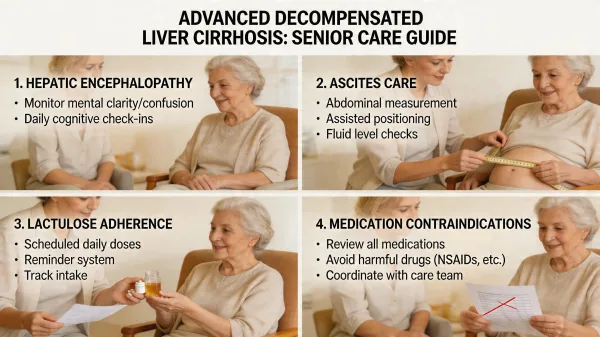
Lactulose is the first-line treatment. It's a non-absorbable synthetic sugar that travels intact to the colon, where bacteria break it down into lactic acid and other organic acids. Those acids lower the pH of the colon, which traps ammonia as ammonium ion (a charged form that can't cross back into the bloodstream) and pulls it out with stool. The target is two to three soft bowel movements per day. Too few, and ammonia builds up; too many, and the patient gets dehydrated, which itself can trigger HE. Dosing precision matters in both directions, and a community that records "given as prescribed" without tracking bowel movement counts doesn't fully understand the regimen.
Typical dosing runs 15 to 30 mL of syrup two to four times daily, titrated by the hepatologist based on bowel movement response. Rifaximin, a non-absorbed antibiotic, is often added as a second agent because it reduces HE recurrence by altering gut bacteria that produce ammonia. Missing doses for even a day or two can tip a stable resident into a confusional episode, and the medication itself tastes sweet and syrupy, which some residents resist. I've seen residents quietly stop taking it because of the taste or texture, and that's often the detail that lands a stable patient back in the hospital. When that kind of adherence slip goes unnoticed, the next stop is often an ER.
Protein Isn't the Enemy Families Were Told It Was
Older guidance told families to restrict protein in cirrhosis patients because protein breakdown produces ammonia. Current consensus from both the American Association for the Study of Liver Diseases and European liver society guidance has reversed that recommendation. Protein restriction in cirrhosis patients worsens malnutrition and accelerates muscle loss, which actually makes HE more likely because skeletal muscle helps process ammonia when the liver can't. The current recommendation is 1.2 to 1.5 grams of protein per kilogram of body weight daily, with vegetable or dairy protein often better tolerated than red meat. Families who've been told "no meat" by a well-meaning relative need to be gently corrected.
In my years working in the ER and on the hospital floor, I've seen this pattern often enough to recognize it in the triage bay. A family brings in a parent who became confused over the course of an afternoon, convinced it's a stroke, and within an hour of hanging a lactulose order the patient starts coming back. It's one of the few scenarios in medicine where you can almost watch the clock turn backward. The staff who identify it quickly save days of hospitalization and real suffering, while the staff who don't tend to treat it like a baseline state and wait for it to resolve on its own. It doesn't resolve on its own.
What this means for senior living evaluation: any community caring for a parent with cirrhosis must train staff to recognize the onset of HE and escalate immediately rather than attributing new confusion to aging or a rough night of sleep. The question isn't whether a nurse is on site. The real question is whether the aides and med techs who spend the most time with your parent know the difference between cognitive decline and a treatable toxin buildup, and whether they know to ask "has the lactulose been given" and "has there been a bowel movement today" before they file the change under normal.
Daily Management Non-Negotiables for Liver Cirrhosis
Daily management for decompensated liver cirrhosis involves a short list of tasks that can't slip without consequence. Getting any one of them wrong doesn't just produce discomfort. It can trigger hospitalization within days, and repeated admissions drive down both quality of life and long-term survival.
Sodium Restriction
Dietary sodium is capped at 2,000 mg per day. This is the primary intervention for controlling ascites and works alongside diuretic therapy. It isn't the same as "low salt." It requires reading labels on every processed food, checking sauces, broths, and deli meats, and understanding that a single restaurant meal often contains a full day's allowance. Senior living communities vary widely in how strictly their kitchens can honor cardiac or renal diets, and cirrhosis diets are typically stricter than either.
Daily Weight Monitoring
A daily weight, taken at the same time each morning in the same clothing, is how diuretic response and ascites accumulation get tracked over time. The target is roughly 0.5 kg per day of weight loss for patients without peripheral edema and up to 1 kg per day for those with it. Rapid gain means retained fluid and likely needs diuretic adjustment. Rapid loss means dehydration risk and possible acute kidney injury or encephalopathy. A missed weight is a missed data point, and several in a row often precede a hospital admission.
Lactulose and Medication Adherence
Lactulose must be given on schedule, with bowel movement counts recorded daily. Rifaximin, spironolactone, furosemide, and sometimes a fluoroquinolone or trimethoprim-sulfamethoxazole for SBP prophylaxis round out a typical regimen. The community must be able to track stool frequency and consistency, not just confirm that a pill was swallowed. This is a level of documentation most senior living settings don't default to, so it should be spelled out in the care agreement.
Paracentesis and SBP Prophylaxis
Patients with refractory ascites often need large-volume paracentesis every two weeks to remove accumulated fluid, typically 5 to 10 liters at a time, with albumin replacement to prevent post-paracentesis circulatory dysfunction. This is a scheduled outpatient procedure done at a hepatology clinic or hospital outpatient center. The community needs to coordinate transportation, recovery monitoring, and incision care. Spontaneous bacterial peritonitis (SBP) occurs in roughly 25 percent of patients with ascites, and for those with low ascitic fluid protein plus advanced liver or kidney dysfunction, daily antibiotic prophylaxis is standard.
Medication Contraindications
This is where the wrong medication can cause a crisis. Sedatives, benzodiazepines, and opioids can precipitate HE. NSAIDs (ibuprofen, naproxen) can trigger kidney failure in cirrhosis patients by reducing renal blood flow. ACE inhibitors and ARBs should generally be avoided because of the risk of hypotension and hepatorenal syndrome. Thiazide diuretics are contraindicated due to electrolyte disturbances that provoke HE. Proton pump inhibitors require caution because they're associated with higher HE and SBP risk. Any community giving your parent a new medication, even over the counter, needs a cirrhosis-aware review first.
What Level of Care Fits Decompensated Liver Disease?
Most decompensated cirrhosis patients who need supportive care do well in assisted living with enhanced medical oversight, provided the community can handle complex medication schedules, specialized diets, and timely recognition of HE onset. The key word is "enhanced." A standard assisted living with minimal nursing presence often can't deliver the level of tracking this population needs, particularly around bowel movement counts, daily weights, and medication review for contraindications.
Memory care is rarely the right fit unless true dementia coexists with cirrhosis, because memory care staff train for cognitive decline management rather than reversible toxic encephalopathy. A memory care community may reasonably conclude that a resident's new confusion is progression of dementia, when in fact it's an acute HE episode that needs a lactulose adjustment and a hepatology call. During my mobile X-ray work, I walked into plenty of long-term care settings where the gap between the marketing brochure and the daily reality was hard to unsee, and that experience still shapes how I evaluate any community handling medically complex residents.
Skilled nursing may be required for patients needing frequent paracentesis, IV albumin infusions, wound care for ascitic leaks, or advanced fall recovery after decompensation. For patients actively on the transplant list with rising MELD scores, a higher acuity setting closer to a transplant center often becomes necessary. The care setting should scale with the MELD score, not remain static as liver function declines.
What Questions Should Families Ask a Care Community?
The question no one thinks to ask: can your staff distinguish hepatic encephalopathy from baseline confusion? If the community treats every cognitive change as the resident's new normal, they'll miss a treatable emergency. Press specifically on this point and listen for whether the answer involves a specific protocol or a vague reassurance.
Additional questions worth asking:
- How is the 2-gram sodium diet enforced at meals, snacks, and family visits?
- Who records daily weights and bowel movement counts, and how are changes escalated to the nurse or hepatology team?
- What's your protocol if a resident becomes suddenly confused, and how quickly does a nurse assess?
- How do you coordinate scheduled paracentesis appointments, including transportation and post-procedure monitoring?
- Which staff members review new medications for cirrhosis-specific contraindications, and does a pharmacist participate?
- Have you cared for cirrhosis residents before, and are you willing to call the hepatologist directly rather than routing every concern through a primary care physician?
- If a resident starts showing early HE signs on a weekend or overnight, who makes the call about escalating care?
A community that hesitates on these questions, or answers in generalities about "individualized care plans," probably isn't the right setting for a parent with advanced liver disease. The right answers are specific, confident, and detailed. Listen for protocols with names, roles with titles, and response times measured in minutes or hours rather than "whenever we notice." If the community can't tell you who specifically makes the call when a resident's mental status changes overnight, that's a gap you'll feel later.
How Do Medication Mistakes Worsen Cirrhosis?
The most common medication-related hospitalizations in cirrhosis patients involve three recurring patterns. First, an over-the-counter sleep aid containing diphenhydramine (found in many "PM" formulations of common pain relievers) gets given for insomnia, triggering confusion that looks like HE and is actually medication-induced delirium on top of existing liver vulnerability. Second, ibuprofen or naproxen gets given for joint pain because they're considered safer than opioids, but in cirrhosis they trigger acute kidney injury that worsens ascites and raises MELD score within days. Third, a new antibiotic interacts with existing diuretics, causing electrolyte shifts that precipitate HE.
None of these scenarios are unusual in clinical experience. All of them are preventable with a pharmacy review and a single designated point of contact who understands cirrhosis-specific contraindications. I've seen a well-meaning family member hand over an over-the-counter sleep aid from their own purse at a bedside visit, and the confusion that followed looked exactly like another HE episode, which cost a real ER trip to sort out. Many assisted living communities don't have this role clearly assigned, which leaves room for a well-meaning aide or visiting family member to reach for something from the cabinet that shouldn't be given. Ask who fills the med-review role before you sign a care agreement, and ask whether a pharmacist reviews the medication list at admission and at every change. If the answer is that the primary care provider handles it, ask how often that provider consults with the hepatology team.
What About Cost and Insurance Coverage?
As of 2025, assisted living with enhanced medical oversight runs roughly $5,500 to $8,500 per month in most U.S. markets, with memory care averaging $6,500 to $9,500 monthly and skilled nursing substantially higher, often exceeding $10,000 per month for semi-private rooms. Over a year, that translates to $66,000 to $120,000 for assisted living alone, and costs vary significantly by region, with coastal markets and major metros running higher. These figures don't include medication copays, specialist visits, or out-of-pocket costs for paracentesis when outpatient.
Most of this is private pay. Medicare doesn't cover long-term custodial care, though it does cover hospital stays, paracentesis procedures performed in hospital outpatient settings, and short-term skilled nursing after a qualifying hospitalization of three or more days. Medicaid coverage for long-term care varies by state and requires financial eligibility, typically involving spend-down of most assets. Some states operate HCBS (Home and Community-Based Services) waivers that can help cover assisted living costs for Medicaid-eligible residents, but availability and waiting lists vary widely.
Families often discover that the monthly rate they were quoted doesn't include extras like medication management, specialized diet accommodation, incontinence care, or transportation to frequent hepatology appointments. Build these add-ons into the budget conversation early, and get the community to itemize in writing before you sign. For cirrhosis patients specifically, the realistic monthly total often lands 15 to 25 percent higher than the advertised base rate once medication oversight, diet accommodation, and specialist transport are factored in. Knowing this upfront prevents the unpleasant surprise of a revised invoice three months into the stay.
When Should Hospice Replace Senior Living?
For patients with MELD scores above 21, refractory ascites requiring weekly paracentesis, recurrent SBP episodes, or hepatic encephalopathy that no longer responds reliably to treatment, the conversation often shifts toward hospice or palliative care. Median survival drops substantially at these thresholds, and repeated hospitalizations begin to take more than they give. Hospice doesn't mean giving up. It means shifting the care plan toward comfort, dignity, and family presence rather than another round of procedures that won't extend meaningful time with the people who matter.
Patients who aren't transplant candidates, whether due to age, comorbidities, active substance use, or personal choice, often benefit from palliative care integration much earlier in the disease course, even while still receiving disease-directed treatment. Palliative care isn't synonymous with hospice. It can run alongside active management and focuses on symptom control, goals-of-care conversations, and family support. A hepatologist who knows your parent can help you read the signs that the balance has shifted, and many families find the hardest part isn't choosing hospice but accepting that it's time.
Putting It Together
Liver cirrhosis senior living decisions require a level of medical precision that most families don't encounter with other conditions. The right community isn't the one with the prettiest dining room or the longest activity calendar. It's the one where the aides know what lactulose is, the kitchen takes the 2-gram sodium cap seriously, bowel movements and daily weights get documented without a reminder, and a sudden change in a resident's mental state prompts a phone call rather than a shrug. Ask hard questions. Expect specific answers. Your parent's next stable year depends on it.
If you're early in this process, take it one decision at a time. Talk with the hepatology team before you tour communities so you understand your parent's specific care needs, including current MELD score, paracentesis schedule, and medication regimen. Bring those needs to every tour and watch how the community responds. The right answer feels calm and detailed. The wrong answer feels vague, reassuring in a generic way, or reliant on phrases like "we customize everything." You're not asking for too much. You're asking for exactly what decompensated liver disease requires, and a community that understands the condition won't be surprised by any of your questions.