
What If Your Parent's Alzheimer's Diagnosis Isn't Actually Alzheimer's?
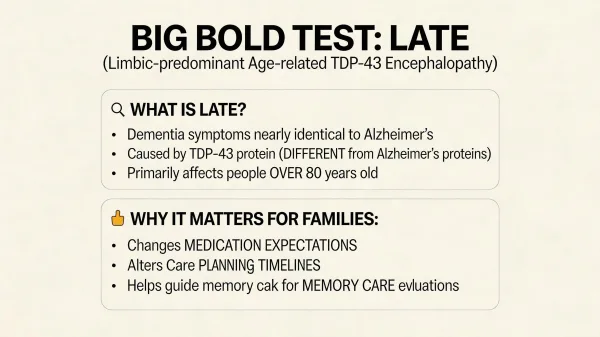
LATE, or Limbic-predominant Age-related TDP-43 Encephalopathy, is a recently identified form of dementia caused by abnormal deposits of a protein called TDP-43 in brain regions responsible for memory. It produces symptoms very similar to Alzheimer's disease but has a different underlying cause, typically affects adults over 80, and may progress at a different rate.
That definition matters more than it might seem. For families who have been told their parent has Alzheimer's, it raises a question no one thinks to ask: what if the diagnosis isn't quite right?
LATE wasn't formally defined until 2019, when an international group of researchers gave it a name and a framework. Before that, many people with LATE were almost certainly diagnosed with Alzheimer's, because the symptoms overlap so closely that even clinicians couldn't tell the difference during a standard evaluation. The two conditions affect some of the same brain areas, cause the same kind of memory loss, and look nearly identical on cognitive tests.
But LATE involves a completely different protein than Alzheimer's. That difference changes what medications might help, how quickly your parent's condition may change, and what kind of care planning makes sense. When my own family was going through a dementia diagnosis with a loved one, I remember how frustrating it was that the progression didn't match what we'd been told to expect. Nobody mentioned that the diagnosis itself might be incomplete. That experience taught me that families need to push for specifics, not just accept a general label and hope for the best.
This article covers what LATE is, how it differs from Alzheimer's, how common it may be, and what it means practically for memory care decisions.
What Is LATE Encephalopathy?
LATE is a type of brain disease that causes problems with memory and thinking, similar to Alzheimer's. The difference is what's happening inside the brain. Alzheimer's disease involves a buildup of two proteins: amyloid plaques and tau tangles. LATE, on the other hand, is driven by abnormal clumps of a protein called TDP-43, which normally helps regulate how genes are expressed in brain cells. When TDP-43 misfolds and accumulates in areas like the hippocampus and amygdala (the brain's memory and emotion centers), it damages those cells and leads to cognitive decline.
LATE tends to show up later in life than Alzheimer's, most often in people over 80. It also appears to progress more slowly when it occurs on its own, without Alzheimer's pathology present alongside it. Researchers have identified a three-stage system for LATE based on where TDP-43 deposits are found in the brain: beginning in the amygdala, then spreading to the hippocampus, and eventually reaching the frontal cortex.
The name itself is a useful summary. "Limbic-predominant" tells you where the damage starts. "Age-related" tells you who it typically affects. "TDP-43 Encephalopathy" tells you what's going wrong.
How LATE Differs From Alzheimer's Disease
On the surface, LATE and Alzheimer's look remarkably alike. Both cause gradual memory loss. Both can lead to difficulty finding words, confusion, and trouble with daily tasks. Both eventually require increasing levels of care. But beneath that surface, the two conditions are driven by entirely different biological problems, and those differences matter for families making care decisions.
The most fundamental difference is the protein involved. Alzheimer's is defined by the accumulation of beta-amyloid plaques and tau tangles in the brain. These proteins are the targets of both the older generation of Alzheimer's medications (cholinesterase inhibitors like donepezil and memantine) and the newer anti-amyloid therapies recently approved by the FDA, including lecanemab and donanemab. LATE doesn't involve amyloid or tau in the same way. It's driven by TDP-43, a protein that plays no role in Alzheimer's pathology. This means the medications designed for Alzheimer's are targeting a problem that doesn't exist in a person with pure LATE. Your parent may be taking donepezil for years with limited benefit, and one reason could be that the underlying condition isn't responding to that drug's mechanism. I've seen families in the hospital system go through round after round of medication adjustments for a parent's dementia, and it doesn't occur to anyone to question whether the root diagnosis is right.
The age profile is another important distinction. Alzheimer's most commonly presents in people in their 60s and 70s, though it can appear earlier or later. LATE overwhelmingly affects people over 80, with the highest rates found in people 85 and older. If your parent was diagnosed with Alzheimer's in their mid-80s and the progression seems unusually slow, or if Alzheimer's medications haven't helped the way the doctor predicted, LATE is worth asking about.
Consider a situation where your parent, in their mid-80s, was diagnosed with Alzheimer's two years ago. Their doctor prescribed a standard cholinesterase inhibitor, but you haven't seen the expected stabilization. Their decline continues, but at a pace that doesn't match the typical Alzheimer's trajectory you've read about. A geriatrician suggests the underlying cause might be LATE, a condition you've never heard of. Suddenly, the medication plan, the progression timeline, and the care approach all need a second look.
This matters even more now that anti-amyloid drugs are available. These new therapies only work by clearing amyloid plaques from the brain. If your parent's dementia is caused by TDP-43 rather than amyloid, those treatments won't help and would carry risks with no potential benefit. Accurate diagnosis isn't just academic. It has direct consequences for treatment decisions and cost.
The progression pattern also differs. Research suggests that LATE on its own tends to progress more slowly than Alzheimer's. But here's the complication: more than half of people with LATE also have some degree of Alzheimer's pathology present. When both conditions exist together, the cognitive decline tends to be faster and more severe than either condition alone. That mixed picture is one reason why LATE has been so hard to identify as its own condition.
How Common Is LATE in Older Adults?
More common than most families realize. According to autopsy studies reviewed by the National Institute on Aging, researchers who examined brains from more than 6,000 deceased individuals (average age at death: 88) found TDP-43 deposits consistent with LATE in roughly 40% of them. Among those, about 25% had experienced noticeable cognitive decline during their lifetime that was linked to those deposits. The Sanders-Brown Center on Aging at the University of Kentucky reports that LATE is present in the brains of approximately one-third of people over 85.
That makes LATE one of the most common contributors to dementia in the oldest adults. Harvard Health has described it as the third most common cause of dementia overall, after Alzheimer's and vascular dementia. Yet most families, and many clinicians, have never heard the term.
The numbers also show that LATE rarely occurs in isolation. Just over half of people with LATE pathology also had Alzheimer's-related proteins in their brains, which suggests that mixed dementia is far more common in the oldest age groups than a single clean diagnosis.
Can LATE Be Diagnosed in a Living Person?
This is where things get difficult. As of early 2026, LATE can only be confirmed with certainty through a brain autopsy after death. There is no blood test, no brain scan, and no cognitive assessment that can definitively identify LATE in a living person. That's a hard reality for families who want answers.
But the picture is changing. In January 2025, researchers published the first clinical criteria for diagnosing LATE during life. These criteria use a combination of progressive memory loss, MRI evidence of significant hippocampal shrinkage, and amyloid biomarker testing to classify someone as "probable LATE" (if amyloid tests come back negative) or "possible LATE" (if amyloid is present but the brain shrinkage exceeds what Alzheimer's alone would explain).
This is still an emerging framework. It hasn't been widely adopted in clinical practice yet. But it gives families and physicians a starting point for asking better questions. If your parent has been diagnosed with Alzheimer's but tests negative for amyloid on a PET scan or spinal fluid test, LATE may be the more likely explanation.
What LATE Means for Memory Care Planning
Understanding that your parent might have LATE rather than Alzheimer's doesn't change the fact that they'll likely need memory care at some point. What it changes is how you plan for that care, what you should expect from medications, and how you evaluate the facilities you're considering.
Medication management is the most immediate practical concern. The standard Alzheimer's medications, cholinesterase inhibitors and memantine, work by supporting chemical signaling pathways that Alzheimer's disease specifically disrupts. If TDP-43 is the real problem, those drugs may have little or no benefit. Families sometimes spend months assuming a medication isn't working yet when, in reality, it was never going to work because the underlying condition is different. Talk to your parent's doctor about whether amyloid testing makes sense, especially if current medications aren't producing the expected results. Memory care costs are significant, with national averages running $5,400 to $8,000 per month as of 2025 depending on location and care level. That's $65,000 to $96,000 per year. You don't want to layer unnecessary medication costs on top of that without understanding what's driving the decline.
Progression expectations are the second area that shifts. If your parent has LATE without co-occurring Alzheimer's, the decline may be slower and more gradual than what Alzheimer's care plans typically assume. That could mean a longer period where your parent can live semi-independently or in a lower level of care before needing full memory care. On the other hand, if both LATE and Alzheimer's are present, the decline may be more rapid. Either way, the planning timeline looks different than a standard Alzheimer's projection.
When I watched a family member's cognitive decline accelerate far faster than anyone predicted, I realized how much care planning depends on understanding what's actually happening in the brain. The financial plan, the care level, the timeline for transitions: all of it changes when the diagnosis shifts. Having a name for the condition doesn't fix anything by itself, but it gives you something to plan around instead of guessing.
Families should also know that LATE research is still young. There are no LATE-specific treatments approved today. But clinical trials are underway, and the fact that researchers now have clinical criteria for identifying likely LATE patients during life means that treatment research can move forward in a way it couldn't before.
Should You Ask About LATE When Evaluating Memory Care Facilities?
Yes. Not because you should expect every facility to have a LATE specialist on staff, but because the question itself reveals how a facility thinks about dementia care. A memory care community that treats all dementia as interchangeable Alzheimer's is operating with an outdated understanding. One that acknowledges different dementia types, adjusts care plans accordingly, and stays current on research is a better fit for a parent whose condition may not follow the Alzheimer's playbook.
Ask whether the facility's medical team is aware of LATE and TDP-43 pathology. Ask how they handle residents whose dementia doesn't respond to standard Alzheimer's medications. Ask whether care plans are adjusted when a resident's progression doesn't match expectations. These aren't gotcha questions. They're practical ways to gauge whether a facility is paying attention to the whole picture or just running a standard protocol.
From doing mobile X-ray work in care facilities earlier in my career, I saw firsthand how big the gap can be between what a facility says it does and what actually happens on the unit. Asking specific, informed questions is one of the best tools families have for closing that gap.
What Can Families Do Right Now?
Start with what you can control. If your parent is over 80 and has been diagnosed with Alzheimer's or another form of dementia, ask their doctor specifically about whether the diagnosis has been differentiated from other possible causes, including LATE. Mention it by name. Many primary care physicians are still unfamiliar with the condition, so don't be surprised if you need to push for a referral to a neurologist or geriatrician with expertise in dementia subtypes.
If your parent's Alzheimer's medications don't seem to be helping, bring that up directly. Ask whether amyloid biomarker testing (through a PET scan or cerebrospinal fluid analysis) could help clarify the picture. Not every patient will be a candidate for these tests, and insurance coverage varies. But the conversation itself can shift how the care team approaches your parent's treatment.
Keep detailed notes on your parent's symptoms and how they change over time. Track what improves, what stays the same, and what gets worse. Those observations are valuable data when a doctor is trying to determine what's driving the decline. The more specific you are, the better equipped the care team is to make informed adjustments.
Looking Ahead
LATE is one of those conditions that most families will never hear about unless they go looking for it. The research is still evolving, diagnostic tools are still catching up, and there's no treatment yet that targets TDP-43 directly. But the fact that it now has a name, a clinical framework, and growing attention from the research community is real progress.
For families in the middle of a dementia journey, the practical takeaway is this: don't accept a vague diagnosis without asking questions. The specific type of dementia your parent has affects everything from medication choices to care costs to how quickly things may change. The more you know about what's happening, the better you can plan, advocate, and make decisions that fit your family's actual situation.
You're already doing the hard part by researching and asking questions. That effort matters more than most people realize.