
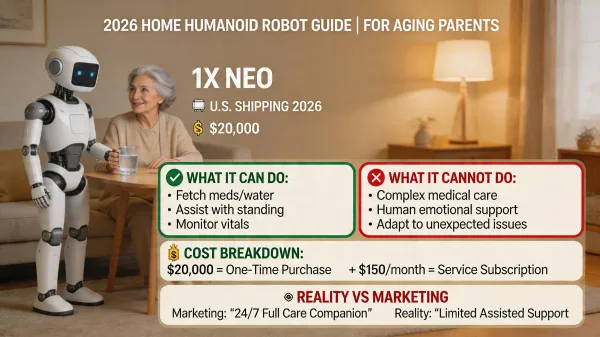
As of April 2026, you can place a $200 deposit on a humanoid robot for your home. The robot is called NEO. It's made by 1X Technologies. The headline number is $20,000 outright, or $499 a month on subscription. For a family staring down memory care at roughly $7,000 a month, the math looks tempting. A robot for the price of three months of facility care.
The math is real. The conclusion most articles draw from it isn't.
Picture a fairly common situation. Your mother is 76. Mobile, cognitively intact but increasingly forgetful, isolated since your father died last year. She's had one minor fall. She doesn't want to move into assisted living, and you don't want to push her there a moment before you have to. Could a $20,000 humanoid robot extend her independence by another two or three years?
That's the question this article tries to answer with the limits of the technology in mind. The answer is: maybe, for a narrow profile, with significant caveats most marketing won't tell you. For most families weighing this against assisted living or memory care, the technology in 2026 isn't a substitute for the work of caring for an aging parent. It's an interesting supplement that doesn't yet do the things that actually drive families to facility placement.
The rest of this piece walks through what's actually shipping, what the work of aging in place really looks like, what the cost math looks like once you do it carefully, and what a family might reasonably do given all of that.
Can a Home Robot Replace Assisted Living in 2026?
No, not as a direct replacement. A humanoid home robot in 2026 can't bathe a parent, respond reliably to a fall, administer medication with clinical judgment, or provide the overnight presence that drives most facility placements. For a narrow profile, cognitively intact, mobile, isolated, and struggling only with light household tasks, a robot might extend independence at the margin. For most families considering memory care, it can't.
Robot Capabilities vs. Tasks That Trigger Facility Placement
The honest comparison isn't "robot vs. facility cost." It's "what triggers a family to move a parent" against "what a robot can actually do today."
| Task that typically triggers facility placement | Can a 2026 home robot do this? |
|---|---|
| Bathing assistance | No |
| Toileting and incontinence care | No |
| Reliable fall response | No, not safely |
| Medication administration with clinical judgment | No (reminders only) |
| Dressing someone with limited mobility | No |
| Overnight presence and 2 a.m. response | Limited; battery and supervision constraints |
| Reassurance during sundowning | No, not at clinical level |
| Meal adherence for swallowing or diet issues | No clinical oversight |
| Fetching dropped items | Yes, slowly |
| Medication and appointment reminders | Yes |
| Light tidying, simple object manipulation | Yes, often with remote operator help |
| Voice conversation, daytime companionship | Yes |
| Monitoring for unusual activity patterns | Yes, with privacy tradeoffs |
That table is the article. Everything else is context for how to read it.
What Robots Actually Ship to American Homes in 2026
The first thing to understand about humanoid home robots in 2026 is the gap between announcement and availability. Several companies have demos. One company has a product. The rest is roadmap.
1X Technologies NEO
NEO is the one humanoid robot you can actually pre-order for your home as of April 2026. 1X Technologies opened orders in October 2025 at $20,000 for Early Access purchase or $499 per month on subscription, with a $200 refundable deposit and first U.S. deliveries beginning in 2026. The robot stands about 5 feet 6 inches, weighs 66 pounds, runs roughly 4 hours on a charge, and is built around a soft body and tendon-driven actuators designed to be safer in human environments than industrial humanoids.
NEO can perform a small set of tasks autonomously: opening doors, fetching items, turning lights off, simple voice interaction. For anything more complex, it relies on what 1X calls "Expert Mode," where a human teleoperator at 1X takes control and pilots the robot through the task. Independent reviewers describe roughly 60 to 70 percent autonomy at launch, with the rest handled by remote operators. A widely circulated Wall Street Journal test by Joanna Stern at home found that nearly every real-world task NEO performed was teleoperated, not autonomous, and that loading a dishwasher took about five minutes.
That's not a knock on 1X. The company has been refreshingly upfront about teleoperation. It's a knock on how the consumer launch tends to get described in headlines.
In December 2025, 1X announced a strategic partnership with private equity firm EQT to deploy up to 10,000 NEO units across EQT's portfolio companies between 2026 and 2030, in industrial software, logistics, warehousing, manufacturing, and healthcare settings. Worth noting: that's the home robot pivoting toward commercial deployment, where structured tasks are easier than the chaos of a real home.
Tesla Optimus, Figure 03, Boston Dynamics Atlas
Tesla's Optimus isn't available to consumers. Elon Musk's stated target as of his Davos remarks in January 2026 is end of 2027 for consumer sales, with first external commercial customers expected late 2026 at the earliest. Tesla's own Q1 2026 update describes Optimus as still in research and development. There are no pre-orders, no waitlist, and no announced retail channel.
Figure AI's Figure 03 launched in October 2025 and is targeting roughly $20,000 for consumers, but isn't yet available for purchase. Figure is currently deploying units to industrial partners like BMW. CEO Brett Adcock has said consumer release requires the robot to "do most things in your home, autonomously, all day," which is honest framing about where the technology actually is.
Boston Dynamics' Atlas remains an enterprise platform, with pricing estimates around $140,000 to $150,000 and pilot deployments at Hyundai facilities. It's not a consumer product.
Care-focused Robots: Fourier GR-3, Andromeda's Abi
Two robots worth noting because they're aimed specifically at older adults, both targeting facilities rather than family homes. Fourier's GR-3, unveiled at CES 2026, is a Chinese-made care-focused humanoid priced above $27,500 and aimed at hospitals, rehab centers, and eldercare institutions, not the consumer market. Andromeda Robotics' Abi, a child-sized companion robot from a $17 million Series A round led by Forerunner Ventures, started U.S. rollout to assisted living facilities in early 2026 after deployments across 22 Australian aged care homes. Abi is built for emotional companionship and group activities, not physical tasks. It's not sold as a consumer product.
Unitree's G1 sells around $16,000 but is a developer platform, not a household helper.
Bottom line: in 2026, NEO is the only general-purpose humanoid you can put a deposit on for use at home. Everything else is research, enterprise, or roadmap.
What the Work of Aging in Place Actually Requires
This is where the headline numbers fall apart. The cost comparison between a robot and a facility only matters if the robot can replace what the facility provides. The honest answer is that most of what a memory care or assisted living facility actually does isn't on the list of things a 2026 humanoid robot can do.
The tasks that drive families to move a parent into a facility cluster around a small number of categories. Bathing assistance ranks at or near the top in nearly every assessment. Incontinence care, particularly when nighttime accidents become regular, exhausts at-home caregivers faster than almost anything else. Reliable fall response matters because seniors who fall and can't get up within an hour face dramatically worse outcomes. After nearly 20 years working ER and Orthopedics, I can tell you what an unwitnessed fall does to a fragile hip and the family timeline that follows it. A robot that drops or fails to catch a parent is creating new risk rather than reducing it. Medication administration with clinical judgment, knowing when to call the doctor versus when a missed dose is fine, isn't a reminder problem. It's a nursing problem.
Then there's the work that doesn't show up in marketing materials. The 2 a.m. call. The patient dressing of someone whose arthritis has frozen their shoulders. The reassurance during sundowning, when a parent with dementia becomes agitated as the light fades and needs a calm human presence to settle. Meal adherence for someone with swallowing issues or a heart-failure diet. Picking up on the subtle cues that something is off, that today is a worse day than yesterday, that a urinary tract infection is brewing because Mom is suddenly more confused than she was last week.
Doing mobile X-ray work inside rest homes and nursing facilities, I watched what the actual work looks like, room by room. The slow, patient dressing of someone whose shoulders had frozen with arthritis. The calm voice during sundowning, when a resident I'd been chatting with the day before suddenly didn't know who I was. The way good aides notice a resident's gait has changed before the resident does, or pick up that today's confusion isn't the usual kind because there's a UTI brewing. The gap between what the marketing brochures said about those facilities and what was happening inside the rooms wasn't always small. None of what I saw the best aides doing is the kind of task you ask a robot to perform in 2026. It's the kind of task that shows you why human caregiving is so hard to replace, and why families are paying $7,000 a month for memory care in the first place. They aren't paying for laundry to get folded. They're paying for someone trained to read a person whose brain is changing.
What can a 2026 humanoid robot plausibly do? Fetch dropped items. Remind a parent to take a pill at the right time. Carry groceries from the car. Turn lights on and off. Hold a voice conversation that helps with isolation during the day. Monitor for unusual patterns, like a parent not getting out of bed at her usual time. Open doors. Help with light tidying, sometimes with a remote operator's help.
That's a useful list. It's not a substitute for assisted living. It's a possible supplement for someone who doesn't yet need assisted living. The distinction matters more than it sounds.
The most honest framing I've seen is this: a humanoid robot in 2026 can help an independent senior stay independent a little longer, by reducing friction on light tasks and providing some daytime presence. It can't help a senior who has crossed the line into needing personal care. And the move from "independent" to "needs personal care" is often sudden, particularly with dementia, where weeks can rearrange the entire situation.
The Cost Math, Done Carefully
The cost comparison most articles run goes something like this: NEO costs $20,000. Memory care costs about $7,000 a month, or roughly $84,000 a year. Therefore, NEO pays for itself in less than four months. Therefore, buy NEO.
That math is misleading because it compares the wrong things. Here's the version that actually helps a family decide.
The CareScout 2025 Cost of Care Survey puts the national median for assisted living at $6,200 per month, or $74,400 a year, with memory care typically running 20 to 30 percent higher, putting national medians around $7,000 to $7,500 per month for memory care. Your local numbers may be very different. New York, New Jersey, Connecticut, and California memory care can start above $8,500 per month and climb past $12,000 in metro areas.
The right way to think about a robot's value is delay, not replacement. If a robot can extend a parent's independence by 6 months for a family that would have otherwise moved her to memory care at $7,000 a month, that's roughly $42,000 of delayed cost. Eighteen months of delay is closer to $126,000. That math can justify a $20,000 robot on its face, even with high ongoing costs, if the delay is real.
But "if the delay is real" is doing a lot of work in that sentence. It's only real if the robot is actually preventing the move, rather than coexisting alongside a move that was going to happen anyway. For a parent whose move is being driven by bathing assistance needs, fall risk after dark, or medication management problems, a robot doesn't change the timing. The move still has to happen. Having walked through these numbers with my own family during a dementia journey, I can tell you the sticker shock is real, and the speed of decline is what catches most families off guard.
The ongoing costs people don't budget for include the subscription itself ($499 per month is $5,988 a year, more than nine times what most home internet plans cost), maintenance and repair on a 66-pound robot moving through a home, increased homeowner's insurance premiums, home modifications that may be needed (better lighting, stable charging location, removal of certain rugs and obstacles), some level of caregiver oversight and training time, and potential liability coverage for a device that could conceivably injure your parent or a visitor. These add up to thousands of dollars per year on top of the purchase or subscription.
The honest cost framework is: a robot is worth considering if you have a parent who's clearly within the band where a robot's actual capabilities reduce real burden, and if you can afford the carrying costs without strain, and if you have a plan for what happens when the robot can't keep up anymore.
The Liability and Privacy Questions Nobody Has Answered
The technology is moving faster than the rules around it. As of April 2026, several questions that matter to families considering this don't have clear answers anywhere.
What happens if the robot drops a parent during a transfer? There's no clear regulatory answer, no standard insurance product, and no meaningful body of case law. The companies selling these robots are aware of the risk, which is part of why 1X has explicitly stated NEO won't handle sharp or hot objects in early deployment, and homes with children aren't part of the first phase.
What happens if the robot fails to respond to a fall, a stroke, or a medical emergency? Right now, it's "call 911 yourself," which is what your parent would do without a robot. The robot isn't a medical alert system, and it isn't being marketed as one, but families may assume it functions as one.
What about teleoperators? With NEO specifically, when the AI can't handle a task, a remote 1X employee takes control through cameras and microphones inside your parent's home. The company has built in privacy features, including no-go zones and the ability to blur faces, but the underlying reality is that a stranger has visual and audio access to your parent's living space. For a parent with dementia who can't reliably consent in the moment, this raises questions that nobody has fully answered yet.
And data. The video and audio that home robots collect is used to train future AI models. The privacy policies governing this are evolving in real time, and the regulatory framework, in the U.S. especially, hasn't caught up. Families considering a humanoid robot in 2026 are early adopters in a privacy and liability sense, not just a technology sense. That's worth saying out loud.
What a Family Might Reasonably Do Now
This isn't a recommendation to buy a humanoid robot, and it isn't a recommendation against. It's a framework for thinking about whether the technology fits a specific situation in 2026.
For a parent who's cognitively intact, mobile, struggling primarily with isolation and light household tasks, and who would benefit from daytime companionship and reduced friction on chores, a humanoid robot is worth tracking. Not necessarily buying today. Tracking. The technology is improving fast, the privacy frameworks are catching up slowly, and the value proposition will look very different a year from now than it does today.
For a parent who needs help with bathing, toileting, fall response, or medication administration, the answer in 2026 is no. A robot doesn't address those needs. Trying to make it do so introduces risk without solving the underlying problem.
For any family considering this seriously, the steps that matter aren't about the robot itself. They're about getting clear on what your parent actually needs versus what the robot actually does. Run an honest assessment of activities of daily living. Talk to your parent's primary care doctor about what changes are likely in the next 12 to 24 months. Read the privacy policy carefully, including what happens to video and audio data. Talk with an elder law attorney about liability if something goes wrong. And keep your assisted living and memory care research current, because the move from "independent" to "needs help" is rarely as gradual as people expect.
One more thought. Don't buy a robot to delay a conversation you need to have anyway. The conversation about what your parent wants as her needs change, who has medical and financial power of attorney, and what the family's plan is when independence ends. Technology can buy time at the margins. It can't buy you out of those conversations. Our starter guide on planning for an aging parent's care walks through how to begin those conversations.
What This Looks Like a Year From Now
Humanoid robots for the home are real in 2026 in a way they weren't in 2025. NEO is shipping. Figure 03 is approaching consumer launch. Tesla Optimus is targeting late 2027. The technology will be noticeably better by mid-2027. The privacy and liability frameworks may also catch up by then, or they may not. Both possibilities are worth planning for.
If you're researching this for an aging parent right now, the most useful thing is to understand the current reality clearly. The cost math is real, but the capability gap is also real, and any honest comparison between a robot and a facility has to account for both. A robot won't replace the trained human attention that a memory care community provides, and it won't change the trajectory of dementia. What it might do, for the right profile, is make a few extra months of independence at home a little more sustainable for a family already stretched thin.
For most families, the robot question won't be the most important question they face in the next year. The questions about memory care versus assisted living, about how to pay for either, and about what your parent actually wants matter more. The robot, if it has a place at all, is a tool inside a much larger plan. Our breakdown of memory care costs can help you put the robot's price tag in context.
If you've been wondering whether the headlines about $20,000 robots mean you can keep your mom home for another few years, the honest answer is "probably not the way you're hoping, but maybe at the edges, and only if the rest of your plan is already solid." That's a less satisfying answer than the headlines, but it's the one that actually helps you make a good decision.