
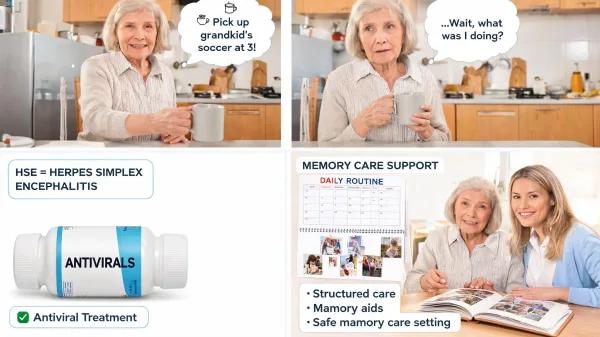
Surviving herpes simplex encephalitis is a victory. Most families don't realize that until weeks or months later, when the relief of a parent making it home from the hospital quietly gives way to a harder realization: the person who came back isn't quite the person who went in. There may be memory gaps, confused conversations, or a parent who can't manage daily life the way they did before. That gap between surviving the illness and recovering from it is where herpes encephalitis memory care becomes part of the family's vocabulary, often without warning.
Herpes simplex encephalitis (HSE) is the most common sporadic viral encephalitis in the United States, and it's a medical emergency where mortality reaches roughly 70 percent without antiviral treatment. With prompt acyclovir treatment, most patients survive, but a large share are left with lasting cognitive damage, particularly in memory. After nearly 20 years working in emergency departments, I've seen how quickly families pivot from focusing on whether their loved one will live to wondering what life will look like once they do.
This article covers what families face after the hospital stay ends. We'll look at why HSE so reliably damages memory, what the static nature of that damage means for care planning, how it differs from progressive dementias like Alzheimer's, and when memory care becomes the right setting. The decisions ahead are different from what most families expect, and understanding the difference makes the next steps clearer.
What Is Herpes Encephalitis?
Herpes simplex encephalitis is a serious brain infection caused by the herpes simplex virus, almost always HSV-1 in adults, that inflames brain tissue and most often targets the temporal and frontal lobes. Without prompt antiviral treatment, mortality reaches around 70 percent, and even with treatment, about 30 percent of patients die or are left severely disabled while many of the rest carry lasting cognitive deficits.
The virus that causes HSE is the same one that causes common cold sores, and most adults already carry HSV-1 without any problems. In a small subset of people, the virus reaches the brain through nerve pathways and triggers an aggressive inflammatory response that damages neurons in regions critical for memory, language, and emotional regulation.
HSE isn't contagious the way a cold is, and family members don't typically catch encephalitis from a relative who has it. The illness reflects how the virus behaves inside one person's body, not a transmissible threat to those around them.
Why HSE Damages Memory So Heavily
The reason memory loss is so common after HSE comes down to where the virus goes. HSV-1 has a strong preference for the medial temporal lobes, the area of the brain that includes the hippocampus and surrounding structures responsible for forming new memories. When inflammation hits these regions hard, the cells that encode and consolidate memory are damaged, sometimes permanently.
This is why anterograde memory loss, the inability to form new memories after the illness, is the most common long-term deficit in HSE survivors. Studies have found that around two-thirds of acyclovir-treated survivors have lasting memory impairment. Some can hold a conversation that seems normal in the moment but won't remember it an hour later, while others have trouble recognizing places they've known for years.
Personality and behavioral changes are also frequent because the same regions handle emotional regulation. Some survivors become more impulsive, more anxious, or harder to redirect, and families often describe their loved one as familiar but different.
Why Speed Matters in Herpes Encephalitis Care
HSE outcomes depend heavily on how quickly antiviral treatment begins. Research consistently shows that patients who start IV acyclovir within five days of symptom onset have significantly better cognitive outcomes than those treated later. Every hour of delay allows more inflammation, more damage, and a higher likelihood of permanent deficits.
The challenge is that early HSE symptoms look like other things. Fever, headache, confusion, sometimes a seizure. In a busy ER, distinguishing viral encephalitis from a urinary tract infection causing delirium in an older patient, or from a stroke, takes time the brain doesn't have. From years working ER and orthopedics, I've watched the patients who do best with HSE tend to be the ones whose families pushed for answers quickly and whose providers started acyclovir before waiting for confirmation. If you're sitting with a parent who has fever and sudden confusion, ask whether viral encephalitis has been ruled out and whether acyclovir has been started.
Once HSE is suspected, treatment usually doesn't wait for testing to confirm and acyclovir is started empirically. Even if testing later rules out HSV, the cost of unnecessary antivirals is far lower than the cost of HSE going untreated.
Life After Herpes Encephalitis: When Memory Care Becomes Necessary
The acute hospital phase ends and a different chapter begins. Many HSE survivors leave the hospital able to walk, talk, and eat normally, which gives families false confidence about how recovery will go. Within weeks, the picture changes. Short-term memory problems that seemed minor in the hospital become impossible to live with at home, where a parent might call asking the same question repeatedly, forget medications, miss appointments, or leave the stove on.
Unlike progressive dementia, HSE damage is typically static, meaning it doesn't worsen over time the way Alzheimer's does. Whatever cognitive level a survivor reaches in the months after acute recovery is roughly where they will stay. Some improvement during the first 6 to 12 months is common as inflammation fully resolves and the brain compensates around damaged regions, after which gains tend to plateau. The damage doesn't grow, but it also doesn't repair itself the way a healing bone does.
This static nature shapes care planning in ways that surprise families. Memory care for an HSE survivor isn't about preparing for further decline. It's about building a stable environment around a fixed level of impairment, where the right facility supports compensatory strategies, memory aids, predictable routines, and environmental cues, while protecting the person from the daily-life consequences of memory failure: missed medications, wandering, kitchen accidents, financial mistakes.
I've spent nearly two decades watching families move through this transition in hospitals. The acute care side of medicine saves the life. The discharge papers say the patient is medically stable, the infection has cleared, and the imaging shows what it's going to show. Then the family takes them home and finds out, slowly, that medical stability isn't the same as functional independence. Most families I've sat with through this didn't know that the brain can be damaged in a way that doesn't show up on a routine follow-up appointment but turns daily life into a series of small, exhausting failures. They expected recovery to mean returning to who their parent was. Instead, they're meeting a slightly different version of that person and learning what it takes to support them. The grief that comes with that realization is real, even when the person they love survived.
Memory care typically becomes the right setting when daily safety risks outpace what family caregivers or in-home help can manage. That threshold varies by family, but the trigger is usually unmistakable when it arrives, often after a fall, a kitchen fire, a wandering incident, or a missed medication that lands a parent back in the hospital.
Static Damage vs Progressive Dementia: Why the Difference Matters
The question no one thinks to ask after HSE is whether the cognitive damage is static or progressive. Families default to comparing it to dementia because the symptoms look similar, but the trajectory is different in ways that change everything about care.
Progressive dementias like Alzheimer's get worse over time, so care planning has to anticipate decline: more supervision next year than this year, more support for activities of daily living as the disease advances, eventually full assistance with everything. Memory care facilities for dementia patients are designed for that downward trajectory, with staffing models, activity programs, and environmental safeguards that all assume the resident will need more help over time, not less.
HSE damage doesn't behave that way: once the inflammation resolves and the brain finishes its initial healing, the impairment level holds steady. A survivor who can manage with cues and routines today will likely still benefit from those same supports five years from now. That stability changes the conversation, since the right care environment is one that adapts to a fixed deficit rather than preparing for accelerating loss.
Choosing a Memory Care Community for Herpes Encephalitis Survivors
Most memory care communities are built around progressive dementia care, which means HSE survivors don't always fit the standard profile. Some facilities understand acquired brain injury and adjust accordingly, while others run a one-size-fits-all program that may not match your parent's needs.
When evaluating a community, ask whether staff have experience with non-progressive cognitive impairment from stroke, traumatic brain injury, or encephalitis. Ask how they handle compensatory strategies like memory notebooks, environmental labels, and structured routines. Ask whether residents are pushed toward activities matched to their pre-illness identity rather than generic dementia programming.
From mobile X-ray work in care facilities over the years, I've seen the gap between what marketing materials promise and what daily life inside a building actually looks like. Visit at off hours, watch how staff interact with residents who aren't on display, and pay attention to whether the place feels alive or just functional. A facility that treats every memory care resident as a person with a unique history, rather than a diagnosis, will serve an HSE survivor far better than one running on autopilot.
Common Questions Families Ask After HSE Recovery
Will my parent get better with time? Some improvement is common during the first 6 to 12 months as inflammation resolves. After that, gains tend to plateau, though compensatory strategies and rehabilitation can keep improving function even when the underlying damage doesn't change.
Is HSE a form of dementia? Some families search for "viral encephalitis dementia" because the memory problems feel like dementia, but HSE causes static brain damage rather than progressive neurodegeneration. The cognitive picture can resemble dementia, but the trajectory is different.
Can the herpes virus reactivate and cause more damage? Recurrence of HSE is rare but possible, and some patients are kept on long-term oral acyclovir or valacyclovir for suppression. This is a decision to make with your parent's neurologist or infectious disease specialist.
Does Medicare cover memory care? Medicare doesn't cover long-term memory care room and board, though it does cover some skilled nursing rehabilitation after a qualifying hospital stay. Long-term memory care is usually paid out of pocket, through long-term care insurance, or through Medicaid for those who qualify.
What about cognitive rehabilitation? Outpatient cognitive rehabilitation can help HSE survivors learn compensatory strategies and improve daily functioning, especially in the first year after recovery. Ask your parent's neurologist about referrals to a brain injury rehabilitation program rather than a generic memory clinic.
The Path Ahead After Herpes Encephalitis
Herpes encephalitis memory care looks different from dementia care because the underlying condition is different. Your parent survived a serious illness, and the damage left behind is real, often life-altering, but typically stable. That stability is the foundation everything else builds on.
Families who do well after HSE are the ones who let go of the expectation of full recovery and focus instead on what their parent can still do, what supports they need, and what environment will let them live with as much dignity and routine as possible. That shift takes time, and the grief of losing pieces of who someone was is real even when they're still here.
Take the time you need to evaluate options carefully, visit facilities, ask hard questions, and trust your read on whether a community sees your parent as a person or a diagnosis. The decisions ahead are weighty, but they aren't urgent in the way the original hospitalization was. You have time to choose well.