
When Your Parent Stops Showing Up
Fecal incontinence is one of the most common conditions in older adults, and it is also the one families are least likely to talk about. If your parent has started withdrawing from meals, avoiding social activities, or making excuses to stay in their room, bowel problems may be the reason they won't say out loud. This isn't a personal failure or an inevitable part of aging. It's a medical condition, and in many cases, a treatable one.
Consider a parent who used to enjoy dinner in the community dining room every evening but has quietly stopped going. They've been washing sheets and clothes at odd hours, pulling away from friends, and snapping when asked what's wrong. Months later, their adult child discovers the truth: their parent has been managing fecal incontinence alone, too ashamed to tell anyone. That shame kept them from getting help that could have improved their situation weeks or months earlier.
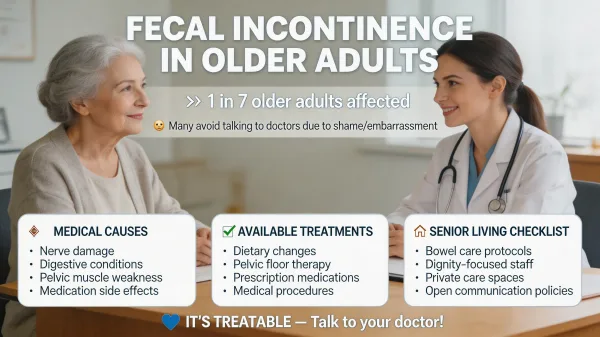
What most people don't realize until they're in it is that fecal incontinence affects roughly 1 in 7 older adults, with rates climbing sharply for those over 80 and in long-term care settings. It's far more common than families think, and it's often manageable or even reversible once someone actually addresses it. The longer it goes unspoken, the worse the physical consequences become, the deeper the social isolation grows, and the harder it becomes for your parent to accept help. This article covers the causes, the treatments, and how to find a senior living community where bowel care is handled with the dignity your parent deserves.
Breaking the Silence: Why Fecal Incontinence Requires Proactive Conversation
Fecal incontinence, the involuntary loss of solid or liquid stool, affects a significant portion of the older adult population. Research published in peer-reviewed geriatric journals consistently shows that fewer than one in four people with the condition ever mention it to their doctor. Many older adults believe bowel problems are just something you live with after a certain age, or they're too embarrassed to bring it up during a medical appointment. Some worry that admitting to the problem will lead directly to a nursing home. That fear of consequences keeps them silent, and silence lets the condition get worse.
The physical causes of fecal incontinence in older adults fall into several overlapping categories. Weakening of the anal sphincter muscles over time reduces the body's ability to hold stool, particularly during physical exertion or sudden urges. Nerve damage from diabetes, stroke, or spinal conditions can disrupt the signals between the brain and the bowel, making it harder for your parent to sense when they need to get to the bathroom. Chronic constipation, which is extremely common in older adults, can paradoxically cause incontinence when hardened stool blocks the rectum and liquid stool leaks around the blockage. Medications are another significant contributor that families often overlook. Opioids, certain blood pressure medications, antidepressants, cholinesterase inhibitors used for dementia treatment, and even common supplements like magnesium can alter stool consistency enough to trigger episodes. The interaction between multiple medications, known as polypharmacy, is particularly problematic in older adults who may be taking eight or ten prescriptions simultaneously.
Here's what matters most for families: many of these causes are treatable. A medication review alone can sometimes resolve the problem entirely. Treating underlying constipation with appropriate fiber supplementation and adequate fluid intake has been shown to reduce incontinence episodes significantly, with some studies suggesting fiber supplementation can reduce episodes by as much as 50%. Dietary changes that eliminate known triggers like caffeine, artificial sweeteners, and high-fructose foods can make a real difference within weeks. Pelvic floor physical therapy, which strengthens the muscles involved in bowel control, is recommended as a first-line treatment and remains effective even in patients over 80. For some patients, biofeedback training helps restore awareness of rectal sensation and improves coordination of the muscles used to hold stool. In more persistent cases, medical interventions like sacral nerve stimulation have shown promising results. I've seen families assume the worst about a condition that actually had medical solutions once the right provider got involved.
But none of these options become available until someone starts the conversation, and that's the barrier that matters most. If your parent is hiding the problem, the first step isn't finding a community or researching treatments. The first step is creating a space where your parent can admit what's happening without feeling judged.
Approach the topic gently, in private, at a calm moment. Mention how common the condition is among people their age. Make it clear that you're not looking for reasons to take away their independence, but looking for ways to protect it. Start with their doctor.
What Fecal Incontinence Looks Like in Daily Life
Your parent probably won't tell you they're dealing with bowel incontinence. What you'll notice instead are the behavioral changes that circle around the condition without naming it. They may stop attending group activities, decline invitations from friends, or avoid leaving their apartment entirely. Unexplained laundry, especially bedding washed at unusual hours, is one of the most common signs. You might notice odor in their living space, stained clothing they've tried to hide, or a sudden increase in air freshener use. Some parents become irritable or unusually defensive when asked about their daily routines, because every question feels like it could expose the secret they're working so hard to keep.
Weight loss sometimes follows because your parent has started skipping meals to reduce bowel activity, which is a strategy that doesn't actually work and creates new health problems. Depression and anxiety often accompany the condition, and research shows the relationship runs both directions: depression increases the risk of fecal incontinence, and fecal incontinence deepens depression. Watch for skin irritation around the hips or complaints about soreness when sitting, which can signal that prolonged stool contact is already causing dermatitis. The earlier you recognize these patterns, the sooner your parent can get help from their physician. Don't wait for them to bring it up.
How Senior Living Communities Manage Bowel Incontinence
A good senior living community doesn't treat fecal incontinence as something to simply "manage with products." It treats it as a clinical issue that deserves a structured, individualized care plan. This typically starts with a thorough assessment of the resident's bowel patterns, dietary intake, fluid consumption, complete medication list, and mobility level. From that assessment, the care team builds a bowel management program tailored to the resident's specific causes and daily rhythms.
These programs often include scheduled toileting at times that match the resident's natural bowel patterns, usually after meals when the gastrocolic reflex is strongest. Dietary adjustments focus on optimizing stool consistency through the right balance of fiber and hydration, and the care team tracks fluid intake to prevent the dehydration that makes constipation worse. Physical activity appropriate to the resident's ability level is also part of the plan, since movement stimulates healthy bowel function. The goal of a well-designed program isn't just containment of episodes. It's actively reducing or eliminating them by working with the body's own rhythms rather than simply reacting after the fact. Communities with strong bowel management programs also maintain relationships with gastroenterologists and pelvic floor therapists for residents whose symptoms don't respond to conservative measures alone. I've watched families be surprised to learn that a structured program reduced their parent's episodes from daily to weekly, or even less. That kind of improvement changes everything about how a person experiences their day. The structure matters.
Protecting Skin Health: Why Bowel Care Goes Beyond Cleanup
One of the most serious secondary risks of fecal incontinence is skin damage, and it develops faster than most families expect. Stool contains digestive enzymes and bacteria that can begin breaking down skin tissue within minutes of contact. In older adults, whose skin is already thinner, less elastic, and slower to heal, this creates a condition called incontinence-associated dermatitis: painful redness, rash, blistering, open sores, and increased risk of secondary fungal or bacterial infection. Research shows that incontinence-associated dermatitis affects roughly 45% of patients with any form of incontinence, and fecal incontinence carries a higher skin damage risk than urinary incontinence alone because of the enzymes and bacteria present in stool. Left unaddressed, this skin breakdown can progress to pressure injuries that become extremely difficult to heal in elderly patients, sometimes requiring months of wound care.
Structured skin care protocols are what separate adequate communities from excellent ones. The right approach includes gentle pH-balanced cleansing rather than harsh soap (alkaline soaps actually make skin more vulnerable to bacterial overgrowth), application of barrier creams containing dimethicone or zinc oxide to protect intact skin, use of high-absorbency incontinence products that wick moisture away from the body, and prompt changing after every episode regardless of the time of day. Ask any community you're evaluating to walk you through their specific skin care protocol for residents with bowel incontinence. If they can't describe one in detail, that tells you something important about their level of preparedness.
Evaluating Communities: Staff Attitude Toward Bowel Care Is What Matters Most
You can compare amenities, floor plans, and price sheets all day long. But for a parent with fecal incontinence, the single most important factor in choosing a senior living community is how the direct care staff handles intimate care moments. Dignity isn't a word that belongs only on a brochure. It's what happens in the room when your parent needs help with something deeply personal and no family member is there to watch.
I spent a decade running an in-home daycare, caring for other people's most vulnerable family members. What I learned during those years is that dignity comes entirely from how the care is delivered. It's the tone of voice, the unhurried pace, the closed door, the absence of sighing or visible frustration. It's the caregiver who handles an accident as if it's the most routine thing in the world, because in a care setting, it genuinely is. When I later did mobile X-ray work inside care facilities, I could tell within minutes which buildings had staff who understood this and which ones didn't. The difference showed in the residents' faces. The ones who were treated gently still made eye contact, still participated, still seemed like themselves. The ones who weren't had withdrawn into a kind of quiet resignation that was hard to see.
When touring communities, pay close attention to the aides and nursing assistants rather than focusing solely on the marketing director's presentation. Ask how they train staff specifically for incontinence care and whether that training is ongoing or limited to initial orientation. Ask what happens when a resident has an accident in a common area, because the response to that situation will reveal the culture of the building more than any planned tour ever could. Ask about overnight staffing ratios, because bowel episodes don't follow a convenient schedule.
Questions to Ask When Touring a Senior Living Community
Talking about bowel care during a tour feels uncomfortable, but it's exactly the conversation that will reveal whether a community can meet your parent's needs. Ask these types of questions directly and pay attention to how the staff responds. Hesitation, vagueness, or visible discomfort from the staff is itself useful information about how comfortable the team is with this aspect of care.
Ask how they develop individualized bowel management plans for residents with incontinence and how often those plans are reassessed. Ask what their protocol is for perineal skin care and which specific products they use for cleansing and barrier protection. Ask about the staff-to-resident ratio during overnight hours, since nighttime is when many accidents occur and slow response times create skin damage risk. Ask whether they coordinate with outside specialists like gastroenterologists or pelvic floor physical therapists when conservative approaches aren't working. Ask what training their certified nursing assistants receive around preserving dignity during intimate care, and how often that training is refreshed. The specificity and confidence of their answers will tell you far more than any glossy marketing materials.
Understanding What Higher-Acuity Bowel Care Costs
Senior living communities typically charge a base rate that covers housing, meals, and a standard level of personal care assistance. As of the 2025 CareScout Cost of Care Survey, the national median for assisted living is $6,200 per month, or $74,400 annually. But residents who need help with incontinence care almost always fall into a higher "level of care" tier, which adds to the monthly bill. These surcharges typically range from $500 to $1,500 per month depending on the frequency and complexity of the care needed, and fecal incontinence usually lands toward the higher end of that range because it requires more staff time per episode than urinary incontinence.
That means a parent with fecal incontinence might realistically pay $6,700 to $7,700 per month, or $80,400 to $92,400 annually, before factoring in the cost of incontinence supplies. Some communities include supplies like briefs, wipes, and barrier creams in their monthly fee, while others bill for them separately. Those supply costs alone can run $200 to $400 per month. That adds up fast. From our own family's experience with unexpected care costs, I can tell you that the number on the initial quote is rarely the number you actually pay. Get the full breakdown in writing before signing any agreement, and ask specifically what triggers a move to the next pricing tier.
When Home Care Is No Longer Enough
Many families try to manage fecal incontinence at home first, and that approach can work for a period with the right home care support and medical guidance. But there are clear signals that home management has reached its limits, and recognizing them early protects both your parent and the family members providing care. If your parent is developing skin breakdown that isn't healing despite proper care, if they're falling while rushing to the bathroom at night, if they've stopped eating or drinking adequately to avoid triggering episodes, or if the caregiving demands are pushing family members toward burnout, those are strong indicators that a more structured environment would serve your parent better.
Moving to a structured care setting doesn't mean giving up on your parent or admitting defeat. It means giving them access to a team that can coordinate bowel management, medical treatment, skin protection, and emotional support around the clock, in ways that are extremely difficult to replicate with in-home care alone.
Having been a caregiver myself through years of hands-on daily care, I know that guilt often delays this decision longer than it should. Your parent's comfort, skin health, social engagement, and overall quality of life deserve to be weighed clearly against the limitations of what any single person can provide at home.
Finding Compassionate Care for What Families Discuss Least
Fecal incontinence is a medical condition, not a character flaw. Your parent didn't choose this, and they almost certainly feel worse about it than you can imagine. The best thing you can do right now is educate yourself on the causes and treatments, start the conversation with patience and kindness, involve their physician early, and evaluate senior living options based on how they handle the condition that families talk about least and residents fear the most.
The right senior living community won't just keep your parent clean. It will help them feel like themselves again, able to share meals with others, participate in activities, and live without the constant fear of an accident defining their day. Your parent is worth the uncomfortable conversations it takes to find that kind of care.