
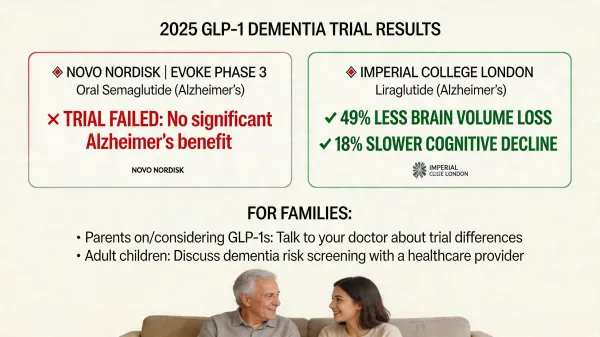
As of April 2026, families have a real reason to be confused about Ozempic and dementia. In the span of about a week in late 2025, two big trials landed with completely different headlines. Novo Nordisk's Phase 3 EVOKE study of oral semaglutide for early Alzheimer's failed. A few days later, Imperial College London published a Phase 2 trial in Nature Medicine showing that liraglutide, a drug from the same class, cut brain shrinkage in Alzheimer's patients by nearly 50% and slowed cognitive decline by 18%. Add in a string of population studies from 2025 showing GLP-1 users have meaningfully lower dementia rates, and you get a picture that doesn't fit a clean headline either way.
The honest answer to "can Ozempic prevent dementia" is that the research is mixed. Large trials of semaglutide as an Alzheimer's treatment failed in late 2025. Other studies, including a different drug in the same class and population data on people taking GLP-1s for diabetes or weight loss, show signals of brain protection. The distinction between treatment and prevention matters here, and it's the part most coverage is glossing over.
In hospitals for nearly two decades, I've watched how families process medical news. A drug headline flashes across the screen, and within a week the phone calls start. The questions are always practical: should I ask about this for Mom, or should I be taking it myself? With GLP-1s and dementia, the honest answer is more complicated than either the pro-Ozempic enthusiasts or the recent-failure skeptics are telling you. This piece walks through what the evidence actually shows and what a family can do with it right now. If you're at the earlier end of this and trying to figure out whether your parent's symptoms even point to dementia in the first place, that's a separate question covered in early signs of dementia in aging parents.
What the EVOKE Trial Actually Found
EVOKE and EVOKE+ were the largest trials ever run on a GLP-1 drug for Alzheimer's disease. Novo Nordisk enrolled 3,808 adults aged 55 to 85 with mild cognitive impairment or mild dementia due to Alzheimer's, all confirmed by amyloid testing. Half got daily oral semaglutide (the same drug sold as Ozempic by injection and Rybelsus by pill), and half got placebo on top of whatever standard care they were already receiving. The trials ran across nearly 40 countries for 104 weeks, with a planned 52-week extension after that.
The primary endpoint was the Clinical Dementia Rating Sum of Boxes, or CDR-SB. It's a standard score from 0 to 18 that measures how much someone's memory, judgment, problem-solving, and daily function have declined. Investigators pulled this score from interviews with both the patient and a care partner. A treatment that works should produce a smaller increase in CDR-SB than placebo over two years.
On November 24, 2025, Novo Nordisk announced that semaglutide didn't beat placebo on CDR-SB in either trial. The same was true for the secondary endpoints, including the activities-of-daily-living scale and the Mini-Mental State Examination. A pooled analysis didn't show any delay in progression from mild cognitive impairment to mild Alzheimer's either. The company decided to discontinue the one-year extension based on these results.
One wrinkle did show up in the biomarker data: patients on semaglutide had a roughly 10% reduction in cerebrospinal fluid p-tau181 at week 78 compared to placebo. P-tau181 is a marker of Alzheimer's pathology, and seeing it drop while clinical scores didn't move is unusual. When Novo Nordisk presented the full data at the AD/PD 2026 conference in March, experts agreed the biomarker change was real but too small to translate into anything patients would feel.
Scientific American framed the result as a setback for the field, and that's accurate as far as it goes. The Alzheimer's Drug Discovery Foundation, which had funded earlier groundwork on this hypothesis, called it disappointing but not the end of the line. Their argument is that targeting metabolic and inflammatory pathways, the way GLP-1s do, still belongs in the toolbox for combination therapy. The trial didn't kill the concept. It just showed that this specific drug, given to people who already had symptomatic Alzheimer's, didn't slow the disease. From years doing mobile X-ray work inside care facilities, I can tell you that residents already on Ozempic for diabetes weren't suddenly going to lose access because of EVOKE, and they shouldn't.
The Liraglutide and Population Study Evidence on Dementia Risk
The week after EVOKE failed, a different result landed in Nature Medicine. Professor Paul Edison's team at Imperial College London published the ELAD trial: 204 patients with mild to moderate Alzheimer's randomized to daily liraglutide injections or placebo for one year. Liraglutide is an older, weaker GLP-1 drug, sold as Victoza for diabetes and Saxenda for weight management. It's the same drug class as semaglutide but a different molecule, and that distinction may matter more than the headlines treated it.
The headline finding was striking: patients on liraglutide had nearly 50% less volume loss across several brain regions, including the frontal, temporal, and parietal lobes and total grey matter, measured by MRI at 52 weeks. They also had 18% slower decline in cognitive function compared to placebo. The trial didn't hit its original primary endpoint, which was a change in cerebral glucose metabolism on PET scans, and that limitation is worth holding in mind. But the secondary outcomes on brain volume and cognition were statistically significant in a relatively small study, which is uncommon.
Edison's team thinks liraglutide may work the way statins work for the heart, by acting on multiple pathways at once: reducing inflammation, improving insulin signaling in the brain, lowering the toxicity of amyloid and tau, and supporting how nerve cells communicate. Whether that holds up in a larger Phase 3 trial is the next question.
Layered on top of these two trials is a substantial body of population data, mostly from 2024 and 2025, all pointing the same direction. A meta-analysis published in JAMA Neurology in April 2025, pooling 26 trials and more than 160,000 patients with type 2 diabetes, found GLP-1 users had a 45% lower risk of Alzheimer's and other dementias compared to other glucose-lowering drugs. A separate JAMA Neurology study from the University of Florida, using Medicare claims data, found GLP-1s associated with 33% lower risk of Alzheimer's and related dementias in older adults with diabetes. A 2025 cohort study in JAMA Network Open found that semaglutide and tirzepatide users with both type 2 diabetes and obesity had lower rates of dementia, stroke, and all-cause mortality than people on other diabetes drugs.
The gap between EVOKE and these other studies makes sense once you look at the patient populations, which weren't the same to begin with. EVOKE enrolled people who already had symptomatic Alzheimer's confirmed by amyloid testing, while the population studies looked at people taking GLP-1s for diabetes or obesity, often years before any cognitive symptoms appeared. The endpoints were different too: EVOKE measured slowing of established disease, and the population studies measured whether dementia ever showed up at all. Those are different questions, and getting different answers from them isn't actually a contradiction. It's a clue.
What This Means If Your Parent Is on Ozempic
Here's where the practical sorting happens. The right answer depends entirely on which situation you're in.
Scenario one: your parent is already on a GLP-1 for diabetes or weight management. The signal from the population data is strong enough that there's no reason to come off the drug for cognitive reasons. If anything, the evidence leans the other way. The drug isn't failing them on the brain front, it just isn't a treatment for established Alzheimer's. If your parent has been tolerating semaglutide or tirzepatide well and getting metabolic benefit, stay the course. Talk to the prescribing physician about the recent research if you want, but don't push for a change based on the EVOKE headlines alone.
Scenario two: your parent has early cognitive concerns but no diabetes or significant weight issue. Don't go to the doctor and ask for off-label Ozempic to slow the memory loss. The treatment trial failed. Off-label use of a GLP-1 specifically for Alzheimer's, in someone who doesn't have a metabolic indication for the drug, isn't supported by the evidence. The population signal is about prevention in metabolically affected populations, not treatment of established disease in healthy-weight, non-diabetic seniors. Save the conversation with your parent's doctor for what's actually on the table: a proper cognitive workup, ruling out reversible causes, and discussing the FDA-approved options if Alzheimer's is confirmed. Understanding how fast dementia typically progresses often matters more for the immediate decisions than any single drug headline.
Scenario three: you have a family history of Alzheimer's and you're wondering about prevention for yourself. The evidence here is observational and still inconclusive for healthy people. The population studies are mostly in people with diabetes or obesity, so the data doesn't transfer cleanly to a healthy-weight person without metabolic disease. If you have legitimate metabolic indications, that's a different conversation. If you don't, the best dementia-prevention evidence still points to the unglamorous basics: blood pressure control, sleep, hearing care, exercise, social engagement, and treating any metabolic issues you do have. The full picture on lifestyle and risk is covered in evidence-based dementia prevention strategies.
I've watched this in my own family. We didn't see the dementia coming, and once it started, the speed of the decline caught all of us off guard. There was a window in those early months where I think we all wished we could grab any new headline and turn it into a plan, where having something to do felt urgent in a way that the actual evidence didn't really support. What I've learned, both from that experience and from years of watching families process medical news in the hospital, is that the desire to do something is almost always stronger than what the research can back up at the moment a story breaks. The right move with this kind of mid-stage research is usually patience, not action. If your parent is already on one of these drugs, the picture looks reasonable. If they aren't, this isn't yet the moment to start. The next round of trial data will tell us a lot more than another cycle of headlines.
Why Treatment Failed but Prevention May Still Work
The leading theory among researchers, including Edison's group at Imperial and commentators at the Alzheimer's Drug Discovery Foundation, is that GLP-1 drugs may work upstream of where Alzheimer's becomes clinically obvious. From the inside of the hospital system, this matches a pattern I've seen play out in other diseases: drugs that move the needle in early or pre-symptomatic stages often don't help once the cascade is fully underway. Alzheimer's isn't one process. It's amyloid accumulation, tau tangles, chronic neuroinflammation, vascular damage, and brain insulin resistance, all running in parallel for years before symptoms show up. By the time someone has a confirmed diagnosis, the cascade has been running for a decade or more.
GLP-1 drugs affect insulin sensitivity, vascular health, and inflammation, which are exactly the kinds of factors that probably matter most before symptomatic disease starts. Once neurons are already dying and amyloid plaques are established, dialing down inflammation may not be enough to change the trajectory. That's the timing hypothesis, and EVOKE is consistent with it. So is the Imperial liraglutide trial, which enrolled mild-to-moderate Alzheimer's patients but still showed brain volume effects, suggesting the drug may slow some processes even after symptoms begin.
Commenting on the contrast between the trials, researcher Ivan Koychev made the point that a negative trial in symptomatic disease doesn't erase the prevention signal in earlier-stage populations. It points researchers toward designing prevention trials in people who haven't developed cognitive symptoms yet, ideally identified by biomarkers or risk factors. That kind of trial is harder to run, takes longer, and costs more, but it's also where the GLP-1 story might actually pay off if it pays off at all.
What's Coming Next in GLP-1 Dementia Research
The pipeline didn't stop with EVOKE, and several trials are still running or about to start. A Phase 2 study of Rybelsus combined with candesartan, vitamin D, and oral hygiene measures is set to begin in early 2026, looking at whether multimodal approaches do better than single-drug strategies. Tirzepatide, the dual GLP-1 and GIP agonist sold as Mounjaro and Zepbound, hasn't been tested in a randomized Alzheimer's trial yet. Early observational data from a 2026 cohort study suggests it may carry a similar or stronger protective signal than semaglutide, but that needs prospective confirmation before it means much clinically.
Edison's team has signaled interest in a Phase 3 liraglutide trial, which would be the natural next step after the Imperial Phase 2b results. The infrastructure to run that kind of trial is already in place. Other GLP-1 molecules and next-generation incretin combinations are also in earlier-stage development.
The realistic timeline for clearer answers is two to four years. If a prevention-focused trial in pre-symptomatic populations launches in 2026 or 2027, results would come in around 2030. Until then, families have what they have: a treatment trial that failed, a preserved-brain-volume signal in a different drug from the same class, and a population-level pattern that keeps showing up across different datasets. Inconclusive isn't satisfying, but it's where the science actually is.
The Honest Bottom Line
The 2025 to 2026 GLP-1 and dementia story doesn't have a clean ending yet. The EVOKE failure was real and it changes what these drugs are likely to be used for in established Alzheimer's. The Imperial liraglutide result was real too, and the population data keeps replicating. Both things can be true at the same time, and both probably are.
For families right now, the practical action is small: if your parent is on a GLP-1 for legitimate metabolic reasons, the evidence supports staying the course. If they aren't, this isn't the moment to push for off-label use. If you're thinking about your own long-term brain health, the basics still matter more than any single drug class. Watch this space over the next two to four years. The next round of trials is where the picture should sharpen, and either prevention will hold up or it won't. For now, what families have is a more nuanced story than the headlines suggest, which is usually how research actually goes.